Robot brains that learn like you – quietly meet the company rewiring robotics
Physical intelligence is not yet a household name. But if the current trend continues, there’s a good chance people will talk about it the same way they talk about OpenAI, Nvidia, or the original iPhone moment a few years later.
That sounds dramatic. Maybe it is. Robotics has a long history of over-promise and hand-holding. Anyone who has followed this industry for more than five minutes has seen this cycle: shiny demos, huge funding rounds, impossible claims, silence. Then layoffs.
But what’s happening now feels different. Not resolved. Not guaranteed. Just… different.
And honestly, the weirdest part isn’t the billion dollar valuation or the celebrity investors. It’s the air fryer.
Table of Contents
The Day a Robot “Figured Out” The Air Fryer
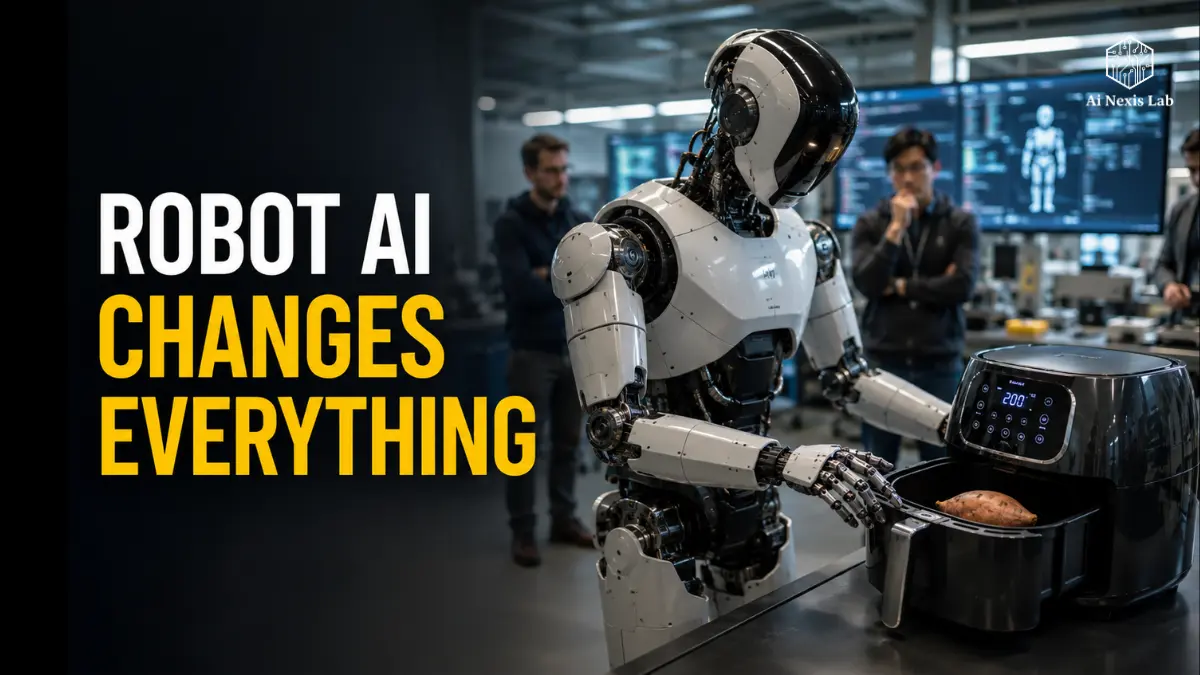
Physical intelligence researchers showed a robot that interacted with an air fryer it had never seen before. No detailed training. There’s no carefully scripted environment. There is no step-by-step guide hidden behind the scenes.
The robot opened the fryer, put the sweet potato inside, and tried to cook it.
Not entirely. That’s important. People continue to misunderstand this demo as evidence of human-level intelligence. It’s not. The robot wasn’t making dinner like your aunt who prepares meals on Sundays. It was fumbling through the task with partial comprehension.
What’s important, though, is how little data it needed.
The researchers reportedly found only two vaguely related clips in the training data: one of a robot closing an air fryer, the other of a robot putting something inside. That’s absurdly scarce information for a machine to generalize from.
A few years ago, robotics systems would break down completely outside of strictly controlled scenarios. Different lighting? Failure. Slightly different device shape? Failure. Someone bumping into a table? Failure again.
This robot is improved.
That’s the change that people are paying attention to.
What Physical Intelligence Is Really Building
At its core, physical intelligence is trying to build a universal AI “brain” for robots.
It’s not a robot company in the traditional sense. They don’t focus on creating humanoid bodies like Figure AI or making highly specialized hardware like Boston Dynamics.
Their focus is on software. Specifically, a basic model for physical tasks.
The idea is easy to explain and incredibly difficult to implement:
A model that can control many types of robots across many types of tasks.
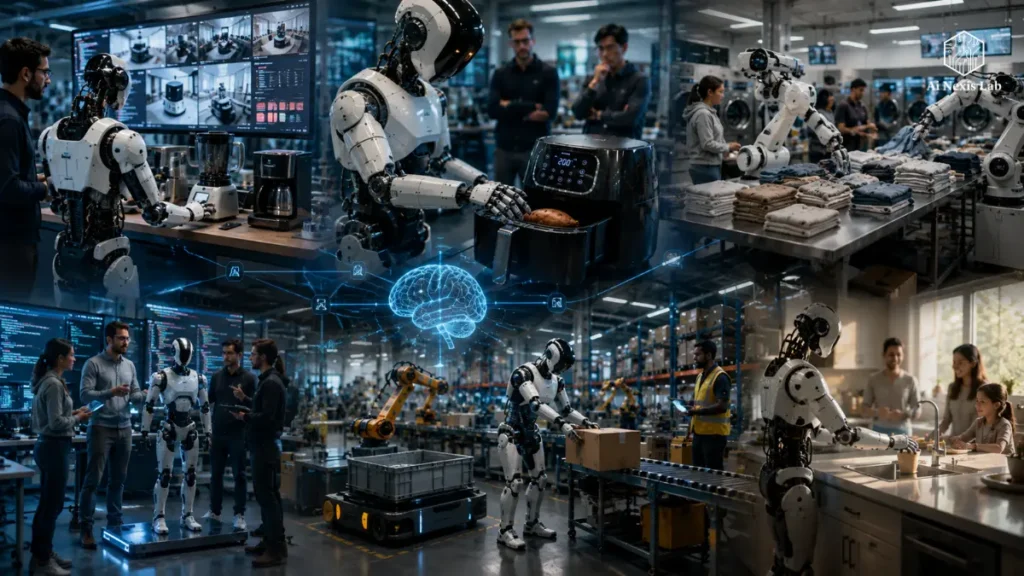
Laundry folding. Box assembly. Kitchen work. Warehouse handling. Maybe eventually elder care or household chores.
That’s the ambition.
The comparison everyone makes is to the smartphone. Developers don’t create a new operating system every time they create an app. They build on top of iOS or Android.
Physical intelligence wants robotics to work the same way.
And if that sounds unrealistic, fair enough. Many smart people in robotics thought that general-purpose robot intelligence was still a long way off.
Then π0.7 appeared.
Why π0.7 Has Researchers So Excited
The company’s new model, π0.7, demonstrated something robotics researchers have been pursuing for decades: constructive generalization.
Ugly academic phrase. Important concept.
Basically, it means that a robot can combine knowledge from separate experiences to solve a new problem that it has never explicitly trained on before.
Humans do this all the time without even noticing.
You may have never used a specific coffee machine in an Airbnb, but you can usually find one. Your brain reconnects past experiences with buttons, handles, heat, cups, and basic logic.
Robots historically haven’t been good at this.
They memorized patterns rather than understanding relationships.
π0.7 seems to be moving towards something more flexible.
One experiment involved training laundry-folding behavior on one robot platform and transferring it to a completely different robot setup without collecting fresh folding demonstrations.
That’s a big deal in robotics because data collection is so expensive. Each new task typically requires hours or months of retraining. If foundation models dramatically reduce that need, the economics of robotics change overnight.
Not slowly. Overnight.
The Important Point No One Should Ignore
This is where people start to get hooked.
These robots are still nowhere near fully autonomous household helpers.
You can’t say “clean my kitchen,” and expect the robot to easily handle everything from greasy pans to random clutter to your dog’s wandering around the room.
The demos are real, but they’re narrow slices of capability. Very impressive slices, yes. Still slices.
And the company itself openly admits that robotics benchmarks are weak.
Unlike language AI, where you can compare models in standardized tests, robotics lacks a universally reliable measurement system. Companies often compare new models to their own previous models.
That makes it easy to hype.
A polished demo doesn’t automatically equal widespread credibility.
People need to separate “significant success” from “consumer-ready product.” Those are different things.
The Technology Underneath
You don’t need a computer science degree to understand the basic architecture.
Physical intelligence uses something called the vision-language-action model.
Robot:
- Sees through a camera
- Interprets language instructions
- Outputs physical movements
That combination is important because older robotic systems were rigid and rule-based. They behaved more like industrial automation scripts than adaptive intelligence.
Pi’s systems are designed to operate more fluidly.
One key technique they use is called flow matching, which helps produce smooth continuous movements instead of robotic stop-start jerks. According to the company, their systems can operate at action frequencies of around 50Hz, making the motion significantly more natural.
The second major upgrade is something called multi-scale embedded memory, or MEM.
This could actually be more important than a flashy demo.
Early robot AI systems basically had terrible memory. They struggled with long tasks because each moment was considered almost independently.
MEM gives robots short-term and long-term memory structures so they can handle multi-step processes lasting more than several minutes.
It may seem boring until you realize that almost every useful household task relies on memory.
Folding laundry.
Cooking.
Cleaning.
Inventory handling.
Packing orders.
Without memory, robots quickly hit the wall.
Real-World Deployments Are More Important Than Viral Videos
Most robotics companies can produce a slick demo video.
Deployment is important in chaotic situations with real business pressures.
That’s why the partnership with Weave Robotics is important.
They are deploying pie-powered laundry-folding systems in real laundromats around the San Francisco Bay Area. Not pristine labs. Real business environments with constant variability.
According to the report results:
- Improved fold quality
- Reduced human intervention
- Improved throughput
It is more meaningful than social media clips.
The company has also demonstrated:
- Chocolate packaging assembly
- Long-term espresso preparation
- Continuous operation for hours without interruption
Again, not perfect. But stable enough to be commercially significant.
This is the key difference.
A robot doesn’t have to perform better than humans to be economically useful. It just needs to be “good enough” at scale.
Many people underestimate that threshold.
Why Are Investors Pouring Big Money Into This
The funding figures are astonishing for such a young company.
The November 2025 round is said to value Physical Intelligence at around $5.6 billion with backing from major investors including:
- Jeff Bezos
- CapitalG
- Sequoia Capital
- Lux Capital
- Thrive Capital
That list of investors is important because these companies typically avoid pure science projects unless they believe commercialization is feasible in the realistic horizon.
And the founding team is unusually stacked.
Carol Hausman came from DeepMind and Stanford.
Sergey Levin is one of the most influential names in robot learning research.
Chelsea Finn is widely respected for her work in meta-learning and adaptation.
This is not random startup energy. These are researchers who worked for years on specific obstacles that are now starting to open up.
The Competitive Landscape Is Brutal
Physical intelligence is not alone.
Tesla is developing the Tesla Optimus.
Figure AI is heavily funded.
Google DeepMind continues its internal robotics work.
1X Technologies is pushing home assistant robots.
And honestly, there’s a real argument that hardware companies could ultimately own a greater share of the value chain than software providers.
Many AI people underestimate this part.
Robotics is not pure software. Physical reality is brutal. Sensors fail. Motors wear out. Hardware costs matter. Safety matters. Battery limits matter.
A brilliant basic model running on incredible hardware still creates incredible robots.
The physical world punishes weakness more severely than the digital world.
So… Are We Really That Close To General-Purpose Robots?
Closer than people thought in 2022.
More than hype accounts claim in 2026.
That’s probably the most honest answer.
The path is real. Progress is measurable. Successes are meaningful.
But scaling:
- Impressive demos
to - Reliable mass-market deployment
…Historically, robotics companies spend money and impact reality.
Household robotics remains particularly brutally difficult because homes are chaotic. Humans constantly improvise around messes, lighting changes, pets, strange shapes of objects, children, spilled liquids, social interactions, and randomness.
Warehouses are easy.
Factories are easy.
Laundromats are easy.
Homes are the ultimate boss.
Still, it is becoming difficult to completely reject this idea.
A few years ago, many experts believed that general robot intelligence was decades away. Now you have systems demonstrating early forms of transferable logic and long-horizon working memory in real-world deployment.
That changes the conversation.
What This Means For Ordinary People
The short-term impact is probably labor growth, not mass unemployment.
Industries with labor shortages – logistics, elderly care, manufacturing support, repetitive service work – are likely the first major adoption targets.
But long-term? Yes, some jobs are clearly exposed.
Any role built around repetitive physical manipulation in a structured environment is ultimately vulnerable.
Not tomorrow.
Not next year.
But eventually.
The protected categories include:
- Unpredictable human interaction
- Emotional intelligence
- Decision-making
- Strategy
- Creativity
- Complex decision-making under uncertainty
Ironically, physical labor turned out to be more difficult for AI than many white-collar cognitive tasks. That surprised many people.
Moravec’s paradox continues to prove true: humans underestimate how sophisticated everyday physical intelligence really is.
Folding laundry seems easy until you ask a robot to do it reliably across thousands of fabric types and messy situations.
Then it becomes one of the hardest engineering problems on Earth.
Final Thoughts
Material intelligence can fail. That possibility is real.
Companies can hit scaling walls. Hardware bottlenecks can slow deployment. Competitors can build better systems. The economy could collapse before consumer adoption arrives.
The history of robotics is full of “revolutionary” companies that never made it past the last mile.
But it would be a mistake to dismiss this one entirely.
The air fryer demo is important.
The laundry deployment is important.
Memory systems are important.
Generalization capabilities are important.
For the first time in a long time, robots are starting to look less like rigid industrial tools and more like adaptive systems.
They don’t think like humans. People throw that phrase around so casually.
But adapt? Learn? Transfer skills between contexts?
Yes. Increasingly, they can.
And once that curve starts to rise, progress seems slow before it suddenly stops.
Frequently Asked Questions
Is physical intelligence creating humanoid robots?
No. Physical intelligence focuses primarily on the robot hardware rather than the intelligence layer. Their goal is to create software that can work across multiple robot types, rather than designing one specific robot body.
This distinction is important because they are betting that long-term value lies in the “brain,” not the physical shell. Whether that holds true is still an open question. In robotics, hardware problems can completely dominate software advantages.
What makes π0.7 different from older robotics systems?
Older robots relied largely on narrow task training. You trained them for one thing, and they struggled outside of that environment.
π0.7 demonstrated early forms of constructive generalization – combining knowledge from different experiences to solve fundamentally unfamiliar tasks. That’s why the air fryer example received so much attention. The robot wasn’t following a memorized script line by line.
However, people should avoid equating this to “human logic.” The systems are still fragile compared to actual human adaptability.
Are home robots coming soon?
What “soon” means depends.
Basic commercial deployments are already taking place in controlled environments. Fully capable household helpers who can reliably clean, cook, organize, and adapt to chaotic homes? Perhaps even further away than social media hype.
A realistic timeline for meaningful early customer adoption is probably closer to 5-10 years than 2-3. And even then, the cost will be significant. Most households aren’t spending luxury car money on a laundry-folding robot.
Can this technology replace workers?
In some areas, eventually yes.
Repetitive physical labor in a structured environment is the most obvious risk category. Warehousing, packaging, sorting, repetitive manufacturing tasks – those areas become increasingly exposed over time.
But deployment will be gradual as businesses care more about reliability and economics than futuristic demos. A robot that works 80% of the time but often requires expensive supervision is not yet worth it.
Why are investors so obsessed with robotics AI right now?
Because if foundation-model-style scaling works like language AI in robotics, the economic benefits are huge.
Manual labor is a multi-trillion dollar global market. If general-purpose robot intelligence becomes practical, it could impact manufacturing, healthcare, logistics, retail, food service, elderly care, and domestic life all at once.
That’s why investors are willing to bet big early on. They’re not funding the gadgets. They’re trying to fund the infrastructure layer for physical automation itself.