Your bank account is being targeted by AI right now – here’s what you really need to do
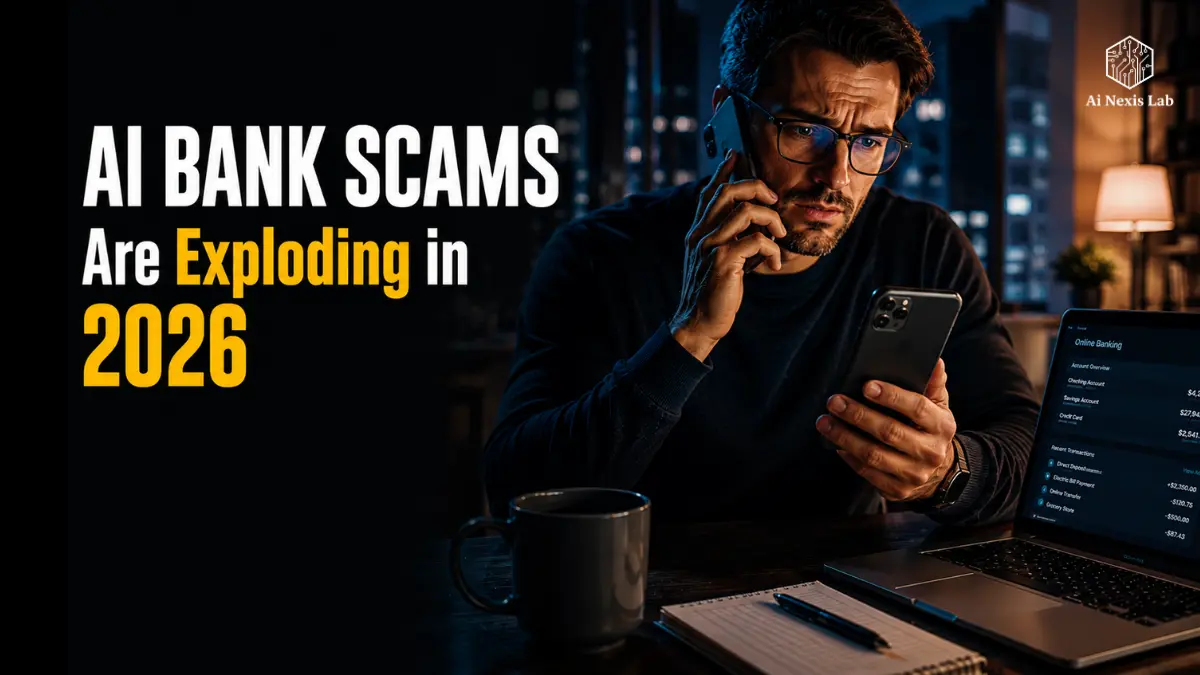
AI bank scams are exploding in 2026. Discover 8 proven ways to stop phishing, voice cloning, and fraud before criminals steal your money.
The scary thing about modern bank scams isn’t that criminals have gotten smarter. It’s that the tools have gotten much better and much faster.
Five years ago, most phishing attempts seemed sloppy. Weird grammar. The usual “Dear Customer” intro. Clear scam energy. A reasonably vigilant person could have spotted them in seconds.
That version of phishing still exists. But it’s not the dangerous part anymore.
What’s dangerous is what happens when cheap AI tools are combined with leaked personal data, cloned voices, fake banking portals, and psychological manipulation designed to affect people exactly when they’re distracted, stressed, or tired. Which, honestly, most of us are most of the time.
And no – this is not paranoia. The statistics are now ugly.
According to the FBI’s Internet Crime Complaint Center, Americans lost more than $12 billion to cybercrime in 2025, with phishing and financial fraud topping the list. AI didn’t detect scams. It made them better and seemed terrifyingly believable.
Table of Contents
Introduction: Phone Calls That Feel Real Because They Are Real Enough
A friend of mine almost had a stroke last year.
In the middle of the workday. Busy. Half-aware. He gets a call that looks like it’s from his bank. The person on the line knows his full name, the last four digits of his card, a recent Amazon purchase, even the city where he opened the account years ago.
That’s what makes people nervous. Not the tech itself. The context.
The caller seemed calm. Professional. Not pushy at first. They said there was suspicious activity and they needed to verify the transfer before freezing the account.
Then came the one-time code request.
Now that’s the catch. Modern scams usually don’t “hack” you in the movie sense. They manipulate you into authorizing your own settlement.
And honestly? Many smart people get caught up in this because the scams are designed by people who understand human behavior better than most marketers.
The old advice – “just be careful online” – is now borderline useless.
You need systems. Habits. Friction.
Because AI has removed most of the obvious warning signs that people used to rely on.
Section 1: How AI Completely Changed The Phishing Economy
Before AI, phishing was basically spam economics.
Send 10 million junk emails. Hope 0.01% click through.
Now? Attackers can run precision-targeted scams for almost no cost.
That changes everything.
Personal on a Ridiculous Scale
Modern scammers don’t start from scratch anymore.
They scrape:
- Leaked databases
- Public records
- Data broker sites
- Old breaches from years ago
Your information is probably already floating around online in some form. Most people grossly underestimate this.
An attacker can feed that data into AI tools and generate messages tailored specifically for you in seconds.
Not “Dear Customer.”
More like:
“We noticed unusual activity connected to your Chase Sapphire account ending in 4821 after a transaction near Phoenix.”
That level of specificity immediately lowers defenses.
AI Is Strangely Good at Emotional Manipulation
This part is ignored.
AI models trained on large amounts of human conversation understand tone frighteningly well. They know how urgency works. They know how authority works. They know that fear stifles decision-making.
That’s why scam messages now seem emotionally calibrated rather than robotic.
And honestly, under stress, humans are predictable.
A message says:
“Your account may be frozen in 10 minutes”
Because your brain prioritizes loss avoidance over logical reasoning.
That’s behavioral psychology, not hacking.
Voice Cloning Is No Longer Experimental
This is the part that worries people the most.
By 2026, consumer-grade voice cloning tools are so cheap that random scammers can use them. Some only need a few seconds of audio.
This means that:
- TikTok videos
- YouTube uploads
- Voicemail greetings
- Instagram stories
can all become training materials.
Cases involving cloned family voices, fake officials, and fraudulent financial approvals have already surfaced. And it’s getting worse.
The uncomfortable truth? Humans instinctively trust voices. We are ready for it.
Section 2: The 5 Biggest AI-Powered Threats Currently Affecting Bank Customers
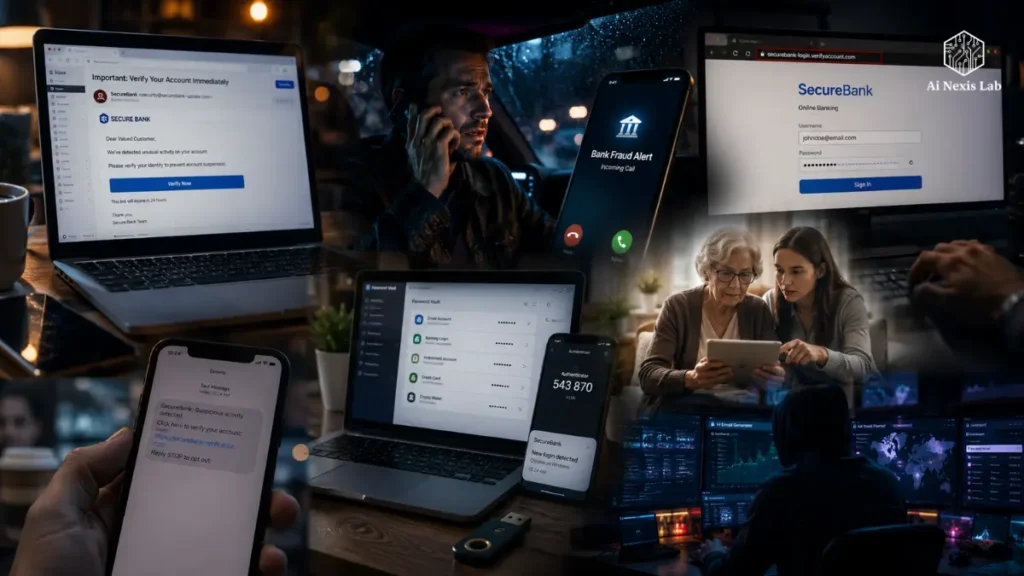
2.1 Spear Phishing Emails
These are no longer the ridiculously bad scam emails of 2012.
Some are almost indistinguishable from legitimate bank communications.
Same branding.
Same tone.
Same formatting.
Sometimes even fake support ticket numbers.
The goal is usually simple:
Bring you to a fake login page.
And those pages are now ridiculously convincing.
What really works:
Never log in to your bank via an email link.
“Most of the time.” Not “unless it looks legitimate.”
Just don’t.
Type the bank URL manually or use a saved bookmark.
It may seem small, but this habit alone kills a large portion of attacks.
2.2 Voice Phishing (Vishing)
Phone scams are growing faster than people realize.
Attackers create urgency because urgency turns off suspicion.
“Your account is under attack.”
We have detected fraud.”
We need to confirm identity immediately.”
The pressure is intentional.
A real bank will usually not pressure you to take immediate action over the phone. Fraudsters certainly will.
Best response:
Hang up.
Call the official number on your debit card.
Not the number they gave you.
Not the number in the text.
Not a callback extension.
Just your own verified number.
2.3 SMS Smile
Texts work because people trust phones more than emails.
Bad assumption.
Some scam texts now misrepresent legitimate-looking sender IDs to look like real banking alerts.
And when you’re busy, distracted, or tired, you’re more likely to click without thinking.
Good habit:
Never check banking alerts through text links.
Open the official banking app directly instead.
Small behavioral change. Big security improvement.
2.4 Deepfake Identity Fraud
This still seems futuristic to most people, but it’s already happening.
Some financial services use selfie verification or video KYC systems. Attackers are experimenting with AI-generated identity matching to bypass them.
It is not yet widespread enough to cause mass panic. But it would be naive to pretend that it’s “years away.”
Fraudulent technology generally spreads faster than regulation.
2.5 AI Customer Support Imitation
Fake banking websites now use AI chatbots that seem surprisingly human.
People think:
“Well, if there’s live support, the site must be real.”
Not anymore.
The whole purpose of a chatbot is to extract:
- Passwords
- SSNs
- Security answers
- Verification codes
And because the interaction feels like a conversation, people overshare.
Section 3: Why Smart People Still Get Caught in This Stuff
Security articles like to suggest victims are careless.
This is lazy analysis.
The reality is more disturbing:
The human brain can be exploited under pressure.
Authority Bias
Banks represent institutional trust.
When something looks and sounds like your bank, your brain naturally reduces suspicion.
It’s normal human behavior.
Urgency Hijacks Rational Thinking
When people think money is disappearing right now, logic goes haywire.
Your brain switches to reaction mode.
That’s why scammers constantly create artificial deadlines.
“Act immediately.”
“Verify now.”
“Suspicious transfer detected.”
The goal is speed. Because speed prevents verification.
Familiarity Creates a False Sense of Security
People trust things that seem recognizable.
Same logo.
Same tone.
Same color palette.
Same account formatting.
Same AI excels at mimicry.
That’s what makes this dangerous.
Section 4: Your Real Defensive Playbook
A lot of cybersecurity advice sounds good in theory and is never put into practice.
So here are the things that really matter.
Step 1: Upgrade Your MFA
SMS-based two-factor authentication is better than nothing.
But it is no longer strong security.
Authenticator apps are more secure.
Hardware keys are better.
If your bank supports app-based MFA, use it.
Step 2: Freeze Your Credit
This is largely underused.
A credit freeze in the US is free and dramatically reduces the risk of identity fraud.
Most people avoid it because they think it’s complicated. It’s not.
A freeze creates friction for attackers. Friction is important.
Step 3: Use a Password Manager
The fact that people still use passwords consistently despite years of breaches proves why they are dangerous.
If your email password and bank password overlap even slightly, you’re gambling.
Password managers solve this in a clear way.
Not perfectly. Nothing is perfect. But a lot better than human memory.
Step 4: Turn On Transaction Alerts
Every transaction.
Every login.
Every device access notification.
Yes, it’s a little annoying.
Guess what’s more annoying? Finding out about fraud three weeks later.
Step 5: Use a Dedicated Financial Email
This is one of the smartest low-effort moves.
Create an email that is only used for:
- Banking
- Taxes
- Investments
- Financial accounts
Never use it for newsletters or random shopping sites.
It dramatically reduces exposure.
Step 6: Audit Connected Apps
People forget how many apps have banking access.
Budgeting apps.
Payment services.
Subscription tools.
Every integration expands the attack surface.
If you haven’t used an app in six months, disconnect it.
Section 5: Real-Time Scam Detection Habits
This is more important than memorizing scam examples because scam formats are constantly changing.
Habits scale better than specific alerts.
Pause Rule
When something feels urgent, deliberately pause.
Seriously. Even 30 seconds helps.
Scammers rely on emotional momentum.
Disrupting that momentum is powerful.
The Rule of Source Separation
Never trust contact information in a suspicious message.
That’s the whole trap.
Always verify independently.
Callback Protocol
This should basically become muscle memory.
If “your bank” calls:
- Hang up
- Call back using the number on your card
- Verify independently
Easy. Effective.
Section 6: What To Do If You’ve Already Been Cheated On
First: Stop spiraling.
Panic is a waste of time.
Immediately:
- Call your bank
- Freeze affected accounts/cards
- Change passwords
- Cancel sessions/devices
- Document everything
Then:
- Check your credit reports
- File reports with the FTC
- Monitor new account activity
The faster you act, the better your chances.
And yes, timing is very important here.
FTC Fraud Reporting Portal
Section 7: People Most at Risk Aren’t Who You Think
Everyone assumes that older people are the primary target.
They are vulnerable, yes.
But scammers are increasingly targeting:
- Stressed professionals
- College students
- Immigrants
- Fatigued parents
- People under financial pressure
Basically anyone who is cognitively overloaded.
It’s easier to manipulate a tired brain than to fool it.
That distinction is important.
Section 8: What’s Coming Next
This is where things get messy.
In a few years, we will likely see:
- Real-time deepfake bank calls
- Hyper-personalized scam timing
- AI-generated synthetic identities
- Automated fraud networks operating 24/7
The average person will no longer be able to reliably distinguish fake from real based on instinct alone.
That sounds dramatic. But honestly, we’re already halfway there.
Which means habits become everything.
Not intuition.
Not “gut feeling.”
Not trust.
Systems.
Insider Tips Most Banks Don’t Emphasize Enough
Your bank will never need your one-time code
If someone verbally asks for it, it’s a scam.
Full stop.
Warm transfer scams are on the rise
A scammer pretends to transfer money to your bank.
But you never really leave the scam call ecosystem.
People get caught up in this because the transition feels official.
There is a limit to fraud reimbursement
Many banks reimburse unauthorized transactions.
But if you technically “allow” something to be under manipulation, recovery becomes more ambiguous.
Read your bank’s fraud policy before disaster strikes.
Nobody reads this stuff until it’s too late.
Common Mistakes People Make After Learning About Scams
“I’m too young to be a target”
Wrong.
Automation means attackers can target almost anyone cheaply.
“My bank will hold it”
Sometimes.
Not always.
Especially if you authorized the transaction.
Online Oversharing
People vastly underestimate how much personal details fuel phishing quality.
Birthdays.
Pets.
Jobs.
Travel plans.
Family names.
All useful.
Reusing security questions
Security questions are often terrible security.
A determined attacker can find a shocking amount through public information.
Randomized answers stored in a password manager are safer.
Frequently Asked Questions: What People Are Searching for About AI Bank Scams in 2026
Can AI-generated scams really bypass spam filters?
Yes. More often than people realize.
Traditional spam detection relies heavily on pattern recognition, bad grammar, suspicious domains, and known scam signatures. AI-generated phishing campaigns constantly change wording, formatting, and structure, making them difficult to consistently detect. Security companies are fighting back with their own AI-based detection tools, but this has basically become an arms race now.
Also, people tend to overestimate how much security email providers offer. Spam filters reduce noise. They don’t guarantee safety. Some very convincing phishing emails still arrive straight to inboxes every day.
Is app-based MFA really more secure than text-message codes?
Generally, yes.
SMS-based codes can be circumvented by SIM-swapping attacks, where criminals convince a mobile carrier to transfer your number to another device. Once they have control of your number, they receive your verification texts.
Authenticator apps reduce that risk because the code remains tied to your physical device instead of your phone number. Hardware security keys are stronger, although admittedly less convenient for average users.
Convenience and security almost always trade off against each other a bit. That’s just the reality.
What should I do if a scammer already knows my banking information?
Don’t think you’ve failed, but don’t ignore it either.
Partial account numbers, addresses, birthdays, and old passwords are already circulating in breached databases on the internet. What matters is whether attackers can gather enough information to successfully impersonate you.
Immediately:
1) Change password
2) Enable strong MFA
3) Monitor accounts closely
4) Freeze credit if necessary
5) Contact your bank if anything seems amiss
A mistake people make is waiting for obvious fraud before reacting.
Are banking apps more secure than browsers?
Generally, yes – although not magically immune.
Official banking apps reduce some phishing risks because users aren’t manually typing URLs or clicking on random email links. The apps also have strong built-in security controls and device verification.
However, fake banking apps also exist. Only download apps directly from official app stores, and carefully double-check the publisher’s information before installing anything.
Blind trust is still dangerous.
Can scammers clone my voice from social media videos?
Maybe yes.
Modern AI voice models can create convincing voice replicas from surprisingly small audio samples. Public videos, podcasts, interviews, and voicemail greetings can also provide useful content.
That doesn’t mean everyone with a TikTok account will be financially ruined tomorrow. But that means voice authentication systems are becoming less reliable over time.
This is why banks and security teams are moving towards layered verification methods rather than relying heavily on voice recognition alone.