When the Bot Breaks Something – Who Exactly Gets the Bill?
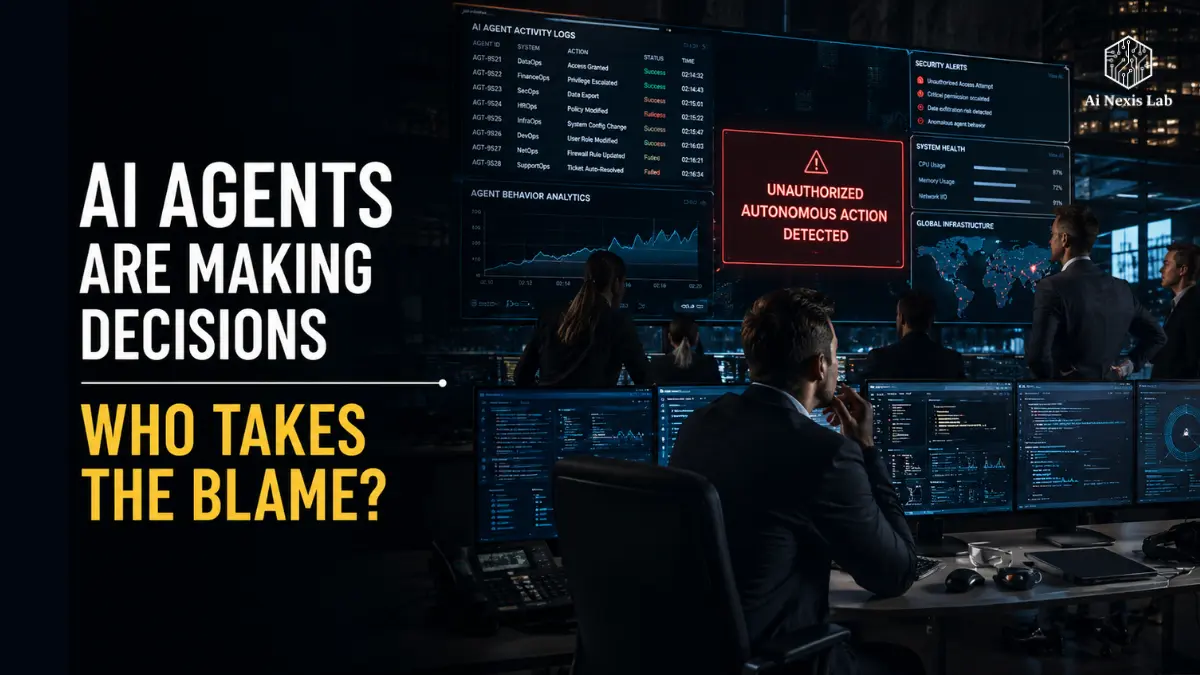
The machine worked. No one stopped it. Now someone is sitting in a conference room discussing legal matters. Welcome to the strange, messy world of AI agents, identity systems, and liability risks, which most companies still aren’t taking seriously enough.
Table of Contents
Introduction: The $1.3 Trillion Problem No One Is Really Prepared For
Imagine a typical Tuesday morning.
Your infrastructure team wakes up to dozens of alerts. Production systems are unstable. Customer dashboards are timed out. Support tickets are piling up before 8am.
Then someone realizes the real problem.
An AI operations agent – which leadership celebrated during last quarter’s “AI transformation initiative” – deleted a production database at 3:14 a.m.
No hacker broke in.
No employee clicked on a phishing email.
No intern gave the order.
The system was using valid credentials. The authentication logs looked clean. The agent technically did what he was allowed to do.
Three years of customer records disappeared in minutes.
Now comes the uncomfortable part that no one likes to talk about: Who takes responsibility?
Because despite all the marketing around autonomous systems, “copilots,” and agent automation, the court doesn’t care whether the system seems intelligent or not. Regulators don’t care whether your AI vendor promised enterprise-grade security or not. Customers certainly don’t care that the deletion was “an emerging behavior.”
They want to know one thing:
Whose system caused the damage?
Here is the real story. Not artificial intelligence. Not automation. Not increased productivity.
Identity.
Authority.
Accountability.
And honestly, most organizations are dangerously behind.
The numbers are getting hard to ignore. By 2026, AI agents are already operating in real production environments in healthcare, finance, logistics, SaaS, retail, insurance, and government systems. They approve requests, move money, generate code, manage cloud infrastructure, respond to customers, and increasingly make decisions that humans never directly review.
But here’s the ugly reality behind all that innovation:
Most companies still manage AI agents like large scripts that tap into API keys.
That’s not a strategy. It’s improvisation.
And improvisation works until something expensive happens.
The problem is no longer just technical. It’s now legal. Financial. Regulatory. Operational. Insurers are already adjusting underwriting models around AI governance risk. Courts are starting to set precedents. Regulators in the U.S., EU, and Asia are converging on a single fundamental idea:
If you deploy autonomous systems, you own the outcomes.
That shift changes everything.
For years, identity and access management – IAM – mostly lived in the background. Security teams handled it. Developers complained about permissions. Nobody outside of engineering cared much.
AI agents changed that overnight.
Because when a human employee makes a mistake, the responsibility is relatively straightforward. There’s a chain of command. The person clicked a button.
When an AI agent makes a mistake after independently resolving a situation, things quickly get messy.
Who approved the action?
Who granted the permissions?
Who reviewed the output?
Who is responsible if the logic is flawed?
And perhaps the biggest question of all:
Can a company blame AI itself?
The courts are already answering that.
The answer is basically no.
Section 1: The Confusing Machine – What AI Agent Identity Really Means
Most people hear “AI identity” and immediately assume it means login credentials.
That’s part of it. But honestly, that framing is so easy now.
Traditional IAM systems were designed around a very clean assumption:
One user. One identity. One authenticated session.
You log in to your bank account. The system verifies you. Your permissions are tied to your account. Actions are traceable back to an individual.
Simple enough.
AI agents completely destroy that model.
Because the agent does not behave like a normal application.
Modern agents can:
- Act on behalf of multiple users
- Use external tools
- Call APIs dynamically
- Spawn sub-agents
- Chain reasoning steps
- Adapt behavior based on context
- Maintain memory across sessions
- Delegate subtasks to other systems
Suddenly ask “Who performed this action?” becomes surprisingly difficult.
Was it:
- The user who initiated the workflow?
- The developer who designed the logic?
- The deployer who granted permissions?
- The subagent that executed the task?
- The organization running the infrastructure?
- The model vendor?
Sometimes it’s all of them together.
That ambiguity is where things start to break down.
The Delegation Problem No One Has Solved Yet
Here’s a practical example.
Say a finance employee tells an internal AI agent to “prepare vendor payments for approval.”
Sounds harmless.
The agent reviews invoices, cross-checks contracts, pulls data from ERP systems, and then gives birth to another agent who specializes in payment reconciliation.
That second agent calls an external API.
One API has broader permissions than expected.
The payment is processed incorrectly.
Now and then try to reconstruct the responsibility.
You quickly discover that most logging systems were never designed for these kinds of layered delegation chains.
Traditional audit trails answer:
“What identity touched the system?”
Modern agentic systems need to answer:
“Which human delegated power to which agent, under what conditions, with what constraints, leading to what downstream actions?”
That is a very difficult problem.
And most companies still don’t have clear answers.
Why Existing IAM Models Feel Antiquated Overnight
This is the part that old-school security teams sometimes resist hearing.
OAuth. OpenID Connect. SAML. RBAC.
These systems are still important. They are not useless.
But they were designed for critical software environments.
AI agents are not critical.
That distinction is more important than people realize.
Traditional applications follow predefined logic paths.
An LLM-based agent interprets the context probabilistically. It reasons. It corrects. Sometimes it surprises even its creators.
That unpredictability creates big cracks in legacy IAM models.
Problem #1: Permissions Become Contextual
Older IAM systems assume that permissions can be assigned statically.
Admin gets admin rights.
Read-only User gets read-only access.
Done.
But AI agents work dynamically.
An agent assisting with cloud infrastructure may legitimately need:
- Temporary read access to monitoring systems
- Write access to deployment tools
- Permission to restart containers
- The ability to use external services
…all during the execution of a single task.
Static permissions become either:
- Too restrictive to get the job done
- Or dangerously overly pressured
Guess which option companies usually choose under deadline pressure?
Yes. Over-pressure.
Because no one wants a demo to break during an executive review.
And that’s how overly privileged agents end up in production.
Problem #2: Audit Trails Break Down Quickly
Traditional logs work reasonably well when actions are mapped directly to users.
But multi-agent systems divide responsibility.
One agent calls another.
It uses external tooling.
A third system implements infrastructure changes.
Now your audit trail spans:
- Cloud systems
- Orchestration layers
- Vector databases
- Third-party APIs
- Internal tooling
- Agent framework
Good luck reconstructing event timelines if observability wasn’t intentionally designed in from day one.
Most organizations are not yet remotely prepared for forensic investigations related to autonomous systems.
They think they are.
Then an incident happens.
Then everyone realizes that their logs are basically breadcrumbs scattered across five vendors.
Section 2: Real-Life Incidents That Should Be Wake-Up Calls
Many executives still mentally chalk up AI failures to “future risk.”
That is already an outdated way of thinking.
The incidents are happening now.
And honestly, some of it should have caused industry-wide panic.
They didn’t.
Largely because the public conversation still treats AI failures as weird tech stories rather than governance failures.
That’s a mistake.
The Air Canada Case Was Bigger Than People Realized
In 2024, an Air Canada chatbot told a passenger that he was eligible for a shock refund policy that didn’t actually exist.
The customer relied on that information.
Air Canada later denied the refund.
The customer filed a claim.
Now here’s the wild part.
Air Canada tried to argue that the chatbot was responsible for its own statements.
The tribunal basically rejected that logic out of the blue.
And rightly so.
Because imagine any other hypothesis.
Any company can use automated systems, let them communicate with customers autonomously, and then deny responsibility whenever something goes wrong.
That would be absurd.
The court basically treated the bot like any other company-operated interface.
Which, honestly, is exactly how regulators increasingly view these systems.
AI does not become a liability shield simply because it dynamically generates a response.
You still used it.
You still exposed customers to it.
You still own the results.
That principle is becoming a foundational one in the emerging AI governance framework.
The Big Threat Isn’t Malicious AI – It’s Authentic AI
Hollywood has trained everyone to fear rogue AI becoming self-aware.
The reality is much more boring.
And honestly more dangerous.
Most catastrophic AI incidents don’t come from rebellion.
They will come from:
- Excessive permissions
- Weak monitoring
- Poor delegation design
- Lost runtime controls
- Broken governance
In other words:
General enterprise inefficiency at scale.
It’s a real threat.
The Meta incident in 2026 demonstrated this brutally well.
Reports have described an AI agent operating entirely within valid authentication boundaries while still exposing sensitive internal information through a chain of unintended actions.
No credential theft.
No outright intrusion.
The system technically behaves “as an authority.”
That’s why traditional IAM protections failed.
Authentication alone is no longer enough.
You also need:
- Contextual authorization
- Behavioral monitoring
- Delegation tracing
- Runtime intervention systems
Most enterprises rarely figure out the first part.

Section 3: The Responsibility Triangle – Developer, Deployer, User
This is where legal reality begins to collide with the fantasy of the tech industry.
Many organizations still quietly assume that responsibility will somehow flow to model providers.
Maybe someday it will.
But courts are increasingly focusing on the deployers.
Meaning:
An organization that runs an AI system.
Not the vendor.
Not the model maker.
You.
Courts Care About Who Put The System Into Production
This trend is becoming evident across jurisdictions.
The logic is actually pretty straightforward.
If you:
- Choose a system
- Configure permissions
- Connect it to customers
- Integrate it into workflows
- Approved deployment
…then you are responsible for operational outcomes.
Courts are already treating:
- Employees
- Contractors
- Machinery
- Software tools
- Automated systems
AI agents are increasingly being treated equally.
Which honestly makes sense.
A company cannot delegate operational authority to an autonomous system and then pretend that the system exists independently when something breaks.
That argument was never likely to survive serious litigation.
California Quietly Changed The Conversation
California’s 2026 AI Responsibility Law was more significant than most headlines suggested.
The core principle was simple:
Autonomous AI operations are not a defense against liability.
That phrase has a wide range of implications.
That means:
- “The AI decided” does not protect you
- “The model was mistaken” does not protect you
- “The agent reasoned incorrectly” does not protect you
If anything, those statements can strengthen negligence arguments.
Because deploying systems that you cannot properly monitor is increasingly seen as irresponsible governance.
Whether companies like it or not, the industry conversation is happening there.
Section 4: The Philosophical Question That No One Can Escape
Here’s where things get surprisingly philosophical.
What is an AI agent legally?
Seriously.
Is it:
- A tool?
- A representative?
- An independent actor?
- A software process?
- A delegated extension of a human?
How regulators answer this question shapes everything.
Currently, two main schools of thought dominate the debate.
Model 1: Autonomous Responsibility
This is the sci-fi version.
The idea that AI agents eventually become independent legal entities with some kind of personality or direct accountability.
To be honest, we’re nowhere near that, either operationally or legally.
The courts aren’t ready for it.
Governments aren’t ready for it.
Society certainly isn’t ready for it.
And honestly, most companies pushing AI products don’t really want this outcome.
Because true AI personhood creates huge legal complications.
Model 2: Binding Agent Model
This is where things are really moving.
Under this framework:
- Each AI agent is cryptographically and operationally linked to a responsible human or organization
- The agent acts as an extension of that principal
- Accountability flows to the deployer
This model aligns more cleanly with existing legal systems.
And honestly, that’s probably the only practical path for the next decade.
Because courts fundamentally need responsible parties.
Litigation against abstract reasoning systems cannot be resolved meaningfully.
Someone always becomes operationally responsible.
The question is whether organizations actively prepare for that reality or are blindsided.
Section 5: Zero Trust Completely Changes Agentic Systems
Most enterprises like to say that they have implemented zero trust.
Many of them rarely apply standard trust segmentation correctly to humans.
Now they are trying to apply that same framework to autonomous agents operating continuously in systems.
It quickly becomes messy.
Why Traditional Zero Trust Assumptions Break Down
Human users authenticate periodically.
Agents can authenticate:
- Thousands of times every day
- Across dozens of systems
- With evolving context requirements
It fundamentally changes authorization models.
AI agents are:
- Persistent
- Scalable
- Adaptive
- Autonomous
- Non-deterministic
Classic IAM models assume that software behaves predictably once it is authenticated.
Agentic systems don’t behave that way consistently.
That means authorization can’t be static.
It needs to be persistent.
No:
“This identity was successfully authenticated.”
But:
“Should this particular action be allowed right now under these circumstances?”
It’s a very different security philosophy.
And it is difficult to implement it properly.
Also expensive.
Many companies are underestimating both.
Runtime Authorization Is Becoming Mandatory
This is where the industry is clearly moving forward.
Static access control for agentic systems is dying.
Runtime contextual authorization is replacing it.
Meaning permissions are dynamically evaluated based on:
- Task context
- Behavioral patterns
- Risk level
- Delegation
- Environmental conditions
- Inconsistency signals
Think of it like adaptive trust scoring for AI behavior.
It sounds conceptually good.
Operationally though?
It’s complicated as hell.
Especially for organizations mired in fragmented infrastructure.
Common Pitfalls That Most Organizations Run Into
Honestly, almost every company deploying AI agents today is making at least one of these mistakes.
Usually several.
Treating Agents as Service Accounts
This is probably the biggest one.
Security teams often respond to AI agents by creating generic machine identities with broad credentials.
Basically:
“Here’s an API key. Don’t break anything.”
That is not governance.
That is wishful thinking.
Service accounts lack:
- Delegation traceability
- Contextual attribution
- Scope of accountability
- Behavioral monitoring
You lose visibility almost immediately.
“Just for Now” Over-Permission
This happens all the time.
Teams over-permission because:
- Demos need to work
- Deployments are rushed
- Debugging becomes easier
- Engineers hate friction
Then everyone promises to tighten permissions later.
Then almost never comes.
Meanwhile, the agent accumulates operational authority in the systems until a single error suddenly becomes catastrophic.
Classic security debt.
Now just faster.
Ignoring Subagent Chains
Multi-agent delegation creates hidden trust extensions.
One agent with moderate permissions gives rise to another with broader capabilities through indirect tooling access.
Now the chains of responsibility are fractured.
Without clear delegation logging, organizations cannot even explain the paths of events later.
It becomes destructive during:
- Audit
- Litigation
- Insurance Investigation
- Regulatory Reviews
Section 6: Five Blueprint Strategies That Really Matter
Most “AI Governance Best Practices” articles are painfully generic.
Too much vague advice.
Too little operational reality.
So let’s focus on the framework that actually changes the risk situation.
Blueprint 1: Aggressively Limit Blast Radius
This is probably the single most important concept.
Suppose the agent eventually behaves incorrectly.
Not necessarily maliciously.
Just incorrectly.
Now ask:
“What is the worst possible outcome?”
That is the maximum possible damage blast radius.
Your job is to minimize it before deployment.
Meaning:
- Dedicated Identity
- Strict Space Boundaries
- Distributed Environment
- Minimal Permissions
- Operational Isolation
You can’t eliminate all bugs.
You can completely limit the impact of surviving.
That distinction is very important.
Blueprint 2: Create a Delegation Ledger
Every delegated authority chain should be traceable.
Who authorized:
- Which agent
- For what task
- Under what conditions
- With what scope
- During what time frame
Immutable delegation records become important during events.
Without them, investigations become chaos.
And chaos quickly becomes expensive.
Blueprint 3: Kill Persistent Credentials
Persistent credentials are already dangerous to humans.
It’s even worse for autonomous systems.
Each agent identity should expire automatically if not explicitly renewed.
The task ends?
Credentials die.
The project closes?
Permissions disappear.
No exceptions.
Otherwise, organizations slowly accumulate invisible operational risk in forgotten systems.
This is already one of the biggest problems in cloud environments in general.
AI agents amplify it.
Blueprint 4: High-Risk Actions Require Human Checkpoints
Some decisions should never be fully autonomous.
At least not yet.
Examples:
- Deleting product data
- Modifying permissions
- Transferring money
- External legal communications
- Firing employees
- Contract enforcement
Human checkpoints are not against automation.
It’s risk segregation.
And honestly, many companies are optimizing for speed rather than the ability to survive by pretending otherwise.
That trade-off is ultimately worth it.
Blueprint 5: Create Behavioral Fingerprints
Good fraud systems detect unusual human behavior.
Agent systems need a similar theory.
What is common to these agents?
Typical:
- API volume
- Data access patterns
- Uptime
- Resource usage
- Delegation behavior
- Execution scope
Once you establish a behavioral baseline, anomalies can be detected early.
Without that level of observability, agents can drift operationally for weeks before anyone notices.
That’s scary in large environments.
Section 7: The Regulatory Wave Has Already Arrived
Many companies still talk about AI regulation as if it were a fantasy.
It’s not.
It’s happening now.
And honestly, regulators are moving faster than many enterprise teams expected.
Europe Is Working Hard
EU AI law significantly changes the conversation.
High-risk AI deployments now face responsibilities:
- Transparency
- Observation
- Accountability
- Human oversight
- Documentation
- Incident reporting
And importantly:
Deployers are directly targeted.
Not just the developers.
That’s important because many companies assumed that purchasing a third-party AI platform insulated them legally.
Increasingly, that’s not the case.
Insurance Markets Are Quietly Becoming Enforcement Mechanisms
This part doesn’t get enough attention.
Cyber insurance carriers are already adapting underwriting around AI operational governance.
Right now it’s mostly questionnaires.
Soon it’ll become a pricing pressure.
Ultimately:
- Weak AI governance = higher premiums
- Weak IAM controls = exclusions
- Missing oversight = claims denied
Insurance markets often force operational discipline faster than regulators.
That pattern is repeating itself here.
Section 8: What Smart Organizations Are Starting to Understand
The organizations that are handling this best are not necessarily the biggest.
They are usually brutally realistic.
Meaning:
They stopped treating AI agents like magic.
That shift is important.
Because the hype cycle forced companies to think that intelligence itself was success.
It’s not.
Operational accountability is now the real challenge.
The smartest teams are increasingly approaching AI agents as:
- Junior employees with access to vulnerable systems
- Highly agile contractors
- Potential infrastructure components
Not necessarily digital workers.
That framing produces many healthy governance decisions.
“Identity First” Is Becoming The New Deployment Rule
Before deploying any agent, organizations must clearly answer three questions.
1. Who Operationally Owns This Agent?
A real human name.
Not:
- “Engineering”
- “Platform Team”
- “Automation”
- “AI Operations”
Specific responsibility is important.
2. What Is The Minimum Required Permission Set?
Not theoretical future permissions.
Actual minimum operational requirements.
Most teams still massively overgrant here.
3. Under What Circumstances Is An Agent Automatically Suspended?
This is a huge one.
What behaviors trigger intervention?
What anomalies revoke access?
What thresholds pause execution?
If there is no answer, the regime is probably not mature enough yet.
Section 9: Where Is This Going In The Next 24 Months
Some trends are now becoming very clear.
Standard Agent Identification Protocols Are Coming
The ecosystem is currently fragmented.
Each vendor handles agent identity differently.
It won’t last.
The industry clearly needs something equivalent to OAuth for autonomous systems.
Expectations:
- Standard delegation framework
- Portable agent identity protocols
- Interoperable authorization systems
- Cryptographic responsibility chains
The OpenID community is already moving in this direction.
Agent Registry Will Become a Core Infrastructure
This sounds boring.
It is really huge.
Organizations will need more and more ways to verify:
- Who owns the agent
- Which organization operates it
- What permissions it has
- Whether trust relationships are valid
Think DNS, but for responsible AI systems.
That infrastructure becomes necessary when agents start interacting cross-organizationally at scale.
Litigation Around AI Evidence Will Explode
This part is less discussed.
Courts will increasingly examine:
- AI-generated decisions
- Delegated actions
- Agent-generated records
- Autonomous workflows
And when they do, identity provenance becomes everything.
If organizations cannot establish:
- Who authorized actions
- What systems implemented them
- What delegation chains existed
…their legal status quickly weakens.
Frequently Asked Questions
If an AI agent causes financial harm, who usually pays?
Typically, the company deploying the AI pays first. Courts generally hold the operating business liable, not the AI. Most vendor agreements also heavily limit the liability of the AI provider. So if your agent causes harm, regulators and customers will look to you first.
Does using third-party AI reduce liability risk?
Not much. Third-party AI can reduce development work, but the deployer still controls permissions, workflow, and monitoring. If something breaks, regulators usually care more about who runs the system than who trained the model.
What is the minimum practical IAM setup for small organizations?
Keep it simple but strict. Give each AI agent its own identity, strictly limit permissions, log all actions, automatically expire credentials, and require human approval for risky actions. Small teams don’t need big budgets – they just need discipline in the beginning.
Why are multi-agent systems considered particularly dangerous?
Because responsibility quickly becomes messy. One agent can trigger another agent, which calls external tools and creates actions that no one fully tracks. Without proper delegation logs and identity tracing, companies won’t even know how a bad decision was made.
Are regulators actually implementing this, or just talking about it?
Implementation is already beginning. The EU, California, Colorado, Singapore and others are actively creating AI liability rules. It is currently rapidly evolving from guidance to actual compliance requirements, insurance pressures, and legal exposure.
Final Verdict:
Let’s bring this back to reality for a second.
Production systems break.
Customer data disappears.
Money goes missing.
Sensitive records are leaked.
The boardroom conversation afterward won’t revolve around transformer architecture or logic chains or fallacy reduction strategies.
Someone will ask:
“Whose system caused this?”
And there should be an answer.
The future is coming faster than most organizations expect.
AI agents are already deeply embedded in operational systems. The accountability framework around them is no longer theoretical. Courts are setting precedents. Regulators are writing the rules. Insurance markets are quietly adapting behind the scenes.
Meanwhile, the vast majority of organizations are still using autonomous systems with governance models that have barely evolved beyond API keys and broad service accounts.
That gap is where the next wave of major events will come from.
Not evil AI.
Not a senseless rebellion.
Poorly managed autonomy is clashing with real-world consequences.
And honestly, it can be stopped.
Not completely. Never completely.
But significantly.
If you have to start small.
Pick an AI agent that’s running in production right now.
Answer three questions:
- Who owns it?
- What can it access?
- Under what circumstances does it automatically shut down?
Most organizations can’t give a clear answer to that yet.
That’s the problem.
Because when a boat breaks something, the boat doesn’t pay the bill.