Claude Sonnet 4.6 vs. GPT-5.5: I spent 30 days using both – here’s what really matters
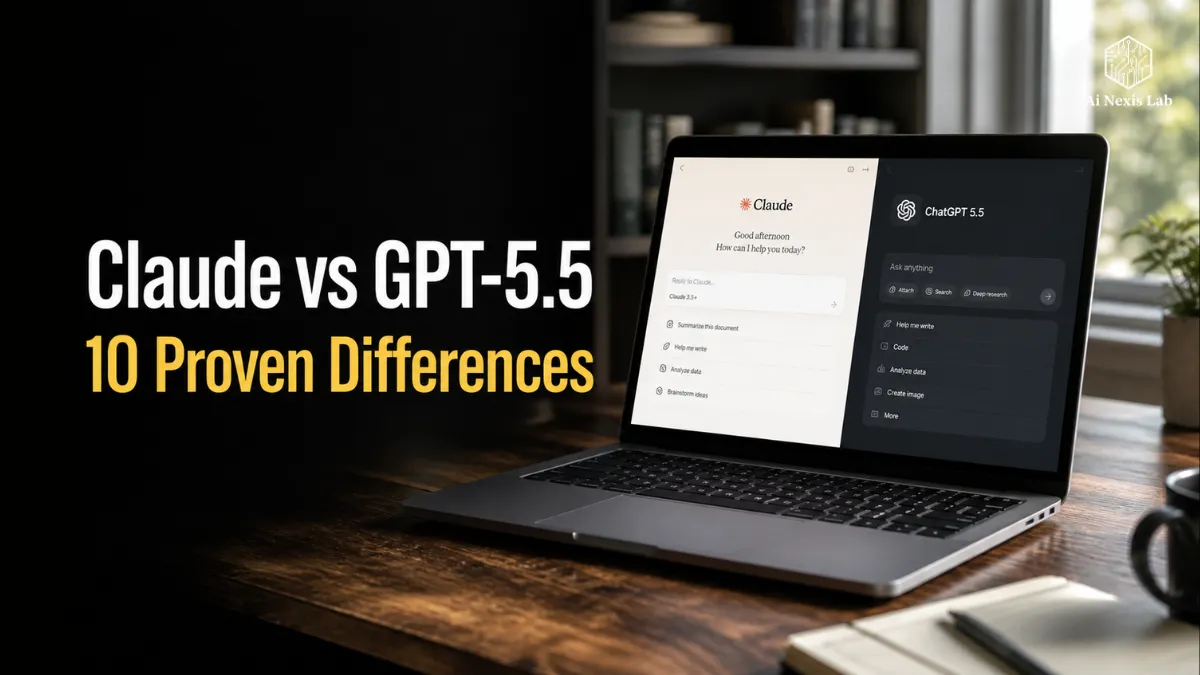
Claude vs GPT-5.5 compared with 10 proven differences in writing, coding, and cost. Find which AI actually performs better in real-world tasks.
Table of Contents
Introduction: Stop Picking Sides Before You Know What You’re Doing
I’ll start with an uncomfortable truth: Most people arguing about “which AI is better” don’t actually use either in a way that justifies having an opinion.
I was one of them.
For months, I was leaning heavily towards the claude. It felt more… human. Not in the fake marketing sense, but in how it handles ambiguity. It didn’t just answer – it interpreted. It’s more important than people admit.
Then GPT-5.5 dropped in April 2026, and suddenly everyone I knew who sent real work – not just tweets – started switching or at least experimenting. That caught my attention.
So instead of forming another half-baked opinion, I ran both models through real tasks for 30 days. No artificial cues. No cherry-picked output. Only the kind of work that really pays the bills: writing, coding, summarizing messy situations, and creating workflows.
Here’s a conclusion that most people won’t like:
There is no universal winner. And if you’re trying to find one, you’re already asking the wrong question.
What matters is how each model behaves under pressure – your pressure. Deadlines, unclear inputs, incomplete specs, disorganized thinking. That’s where the differences appear.
And yes, cost matters, too. The claude is significantly cheaper. GPT-5.5 spends almost twice as much on output tokens. It’s not theoretical – if you’re doing anything at scale it quickly becomes real money.
But cost alone doesn’t determine anything. Performance without context is just noise.
So let’s break it down properly.
Scoreboard at a Glance
A quick snapshot before going deeper:
- Creative Writing: Claude wins
- Coding (logic, refactoring): Claude slightly ahead
- Boilerplate + Documentation: GPT-5.5
- Agentic Workflow: GPT-5.5, no competition
- Cost Efficiency: Claude
- Reference Handling: Depends on the use case
This is the surface. Now let’s get to the part that people usually skip – the why.
Section 1: Creative Writing Showdown – Where the Claude Really Feels Different
Let’s first kill the old idea: AI no longer “writes like a robot”. That argument ended two years ago.
Both models can write well. The difference is how they think about writing.
What GPT-5.5 Does Well
GPT-5.5 writes like a competent professional.
- Structured
- Logical
- Clean Transitions
- Clear Objective
If you’ve ever read a solid but slightly forgettable business article – that’s the atmosphere. It gets the job done.
Where It Falls Short
It rarely surprises you. It organizes ideas well, but it doesn’t naturally elevate them.
It answers the question. It doesn’t explore it.
What Claude Does Differently
Claude doesn’t just write – he frames.
It tends to:
- Start with a moment, not a concept
- Anchor ideas in human situations
- Externalize instead of making a list of points
It sounds subtle, but it changes everything. One seems like information. Another seems like perspective.
Real Difference In Practice
When I asked both to write tech article introductions:
- GPT gave me a polished explanation of AI adoption trends
- Claude put me in a late-night work scenario where AI saved hours
Same topic. Completely different experience.
And here’s the part people miss:
The Claude is not “more creative”. It is better to understand the intent beyond the prompt.
If you write for a living, that’s a big deal.
Think Honestly
If your work involves:
- Storytelling
- Marketing
- Persuasion
- Content strategy
Then yes, the Claude is better. Not a little – significantly.
But don’t make it too romantic. Claude is still around. It can get very abstract. You still have to run it.
Section 2: Coding – Where The Distance Gets Weird
This is where people oversimplify things in a bad way.
Both models are strong. Really strong. They solve most real-world problems you throw at them.
But their working styles are completely different.
Claude: The Thinking Partner
The Claude shines when:
- Requirements are unclear
- Problems are messy
- Specs are incomplete
It doesn’t panic when you say:
“Make this system more reliable.”
It interprets. It elaborates. It assumes intelligently.
That’s rare.
GPT-5.5: Execution Machine
GPT-5.5 is more intense when:
- Requirements are clear
- Tasks are structured
- Output needs to be specific
It is fast:
- Generating boilerplate
- Writing documentation
- Producing clean, readable code quickly
Where GPT-5.5 Pulls Ahead
If you need:
- Automation on tools
- System-level interactions
- UI-based execution
GPT-5.5 is built for that. The Claude isn’t.
The Harsh Reality
Most developers don’t need a “best model”.
They need:
- Clarity when it comes to stopping
- Speed when it comes to building
- Reliability when it comes to shipping
The Claude helps you think.
GPT-5.5 helps you implement it.
If you are only using one, you are limiting yourself.

Section 3: Context Windows – Bigger Is Not Always Better
Everyone loves to talk about “1 million tokens” because it automatically solves everything.
It’s not.
Claude
- 200K Standard
- 1M (Beta)
GPT-5.5
- 1M API
- ~400K In a specific coding environment
What Really Matters
is not size. Usability.
Dumping large context into the model:
- Increases cost
- Reduces focus
- Often produces bad output
What Works Well
Breaking your input into pieces:
- Feature-specific
- Task-specific
- Only relevant
This may seem obvious, but most people don’t do it.
And then they complain that the model “missed something”.
No – it drowned in your input.
Section 4: Cost Reality Check – This Is Too Often Ignored
Let’s not pretend that cost doesn’t matter.
It does.
Cost Difference
That’s almost double.
Why Is This Important
On a small scale: irrelevant
In real life: painful
Examples:
- 10 million tokens/month → $150 vs $300
- 100 million tokens → $1,500 vs $3,000
That’s not sound. That’s budget.
The Hard Truth
If you’re running a production system, ignoring cost is just bad decision-making.
But – and this is important –
It’s even worse to choose a cheap model that performs poorly for your main task.
Don’t optimize for the wrong variables.
Section 5: Agentic Capabilities – The Real Divide
This is where things stop being theoretical.
GPT-5.5
Built for:
- Perform tasks
- Execute
- Interact with systems
It can:
- Navigate software
- Automate workflows
- Act like a semi-autonomous agent
Claude
Built for:
- Reason
- Plan
- Think through complexity
It’s slower, but more deliberate.
The Easiest Way To Understand It Is
- GPT = action
- Claude = idea
Neither is “better”. They are optimized differently.
Where People Mess Up
They try to use:
Then blame the model.
Wrong tool, wrong job.
Section 6: Hallucination and Accuracy – Still a Problem
Let’s not pretend this is solved.
It’s not.
GPT-5.5
- Improved factual accuracy
- Better with structured data
- Still sometimes wrong with confidence
Claude
- More cautious
- More likely to accept uncertainty
- Still makes things
Real Issue
Confident.
Both models can sound very convincing even when they are wrong.
It is dangerous.
Practical Rule
If it is:
- Financial
- Legal
- Scientific
Check it. Every time.
No exceptions.
Section 7: Real World Individuals – Who Should Use What
Let’s cut to the chase.
1. Solo Creator / Freelancer
Use the Claude.
You need:
- Thoughts
- Voice
- Story
GPT adds little value here unless you are doing structured output.
2. Developer / Small Team
Use both.
If you’re choosing one, you’re leaving performance on the table.
3. Enterprise / Product Teams
Now it gets serious.
The decision depends on:
- Scale
- Workflow
- Infrastructure
There are no shortcuts here. You need real testing.
Section 8: Mind Mapping Moves – What Really Improves Output
This is more important than model selection.
1. Scene-First Writing
Don’t say:
“Write an article about X”
Say:
“Start with a real-world moment…”
Quick fix.
2. Two-Pass Coding
- Pass 1 → Logic (Claude)
- Pass 2 → Execution (GPT)
Cleaner results. Fewer errors.
3. Chunked Context
Stop dumping everything.
Feed only what is necessary.
4. Verification Loop
Before Implementation:
Ask the Model:
- What Does It Understand
- What Does It Plan
Catch Errors Early.
5. Confidence Filtering
Tell the Model:
“Flag anything you’re not sure about.”
You will avoid a lot of silent nonsense.
Section 9: Benchmark Reality – Why Most Comparisons Are Misleading
Benchmarks are useful – but limited.
What They Tell You
Both models:
- Solve ~80% of real coding tasks
- Do the same overall
What They Don’t Tell You
- How the models behave under random inputs
- How they interpret ambiguous instructions
- How they fail
That’s where the real differences appear.
And benchmarks don’t measure that well.
Section 10: Future Direction – What’s Coming Next
This section is important if you’re thinking long-term.
GPT Direction
- More autonomy
- Deeper system integration
- Robust agent workflow
Claude Direction
- Better logic
- Higher reliability
- Secure output
Different bets.
Both valid.
Final Verdict: Stop Looking For a Winner
After 30 days, here’s where I landed:
- Claude is my default
- GPT is my expert
That’s it.
The Claude helps me think better.
GPT helps me do more.
If you’re trying to crown a single winner, you’re missing the point.
The real skill isn’t in choosing a model anymore.
It’s about knowing when to use which.
Frequently Asked Questions
Is one model clearly better overall?
No. And anyone who says yes is oversimplifying.
The Claude is better for creative and logic-heavy tasks. GPT-5.5 is better for implementation, automation, and structured output. The “best” model depends entirely on your workflow. If your task changes, your answer changes.
Does the price difference really matter?
At low usage, no. You wouldn’t know it.
At scale, it is very important. If you are running high-volume operations, the cost of GPT-5.5 can almost double. That adds up quickly. But choosing a cheaper model that underperforms can indirectly cost you more – through time, errors, or missed output quality.
Which should writers or content creators use?
Claude. Quite clear.
It handles tone, flow, and narrative better. GPT can still write well, but it feels structured rather than expressive. If your work relies on voice or persuasion, the claude gives you a stronger base draft.
Can you actually use both?
Yes – and you probably should.
Serious users in 2026 are not loyal to one model. They are rooting for tasks. Thinking is moving to the claude. Implementation is moving to GPT. This hybrid approach consistently produces better results than sticking to one model.
Which is more secure for accurate information?
Neither is completely reliable.
GPT-5.5 is structurally stronger in real-world tasks. The claude is better at signaling uncertainty. But both can be misleading. If accuracy is important, verification is not optional – it is required.
If you’re serious about this, don’t take my word for it.
Pick one task you do every day. Learn it from both models today.
You will learn more in 20 minutes than in any comparable article – including this one.