Should every AI-generated content have a warning label?
Delving Deep into Trust, Technology, and the Reality No One Wants to Accept in 2026
Discover 7 powerful truths about AI-generated content warning labels, legal risks, SEO trust, and why advertising is more important in 2026.
Table of Contents
The Internet’s Reality Problem Isn’t Coming – It’s Already Here
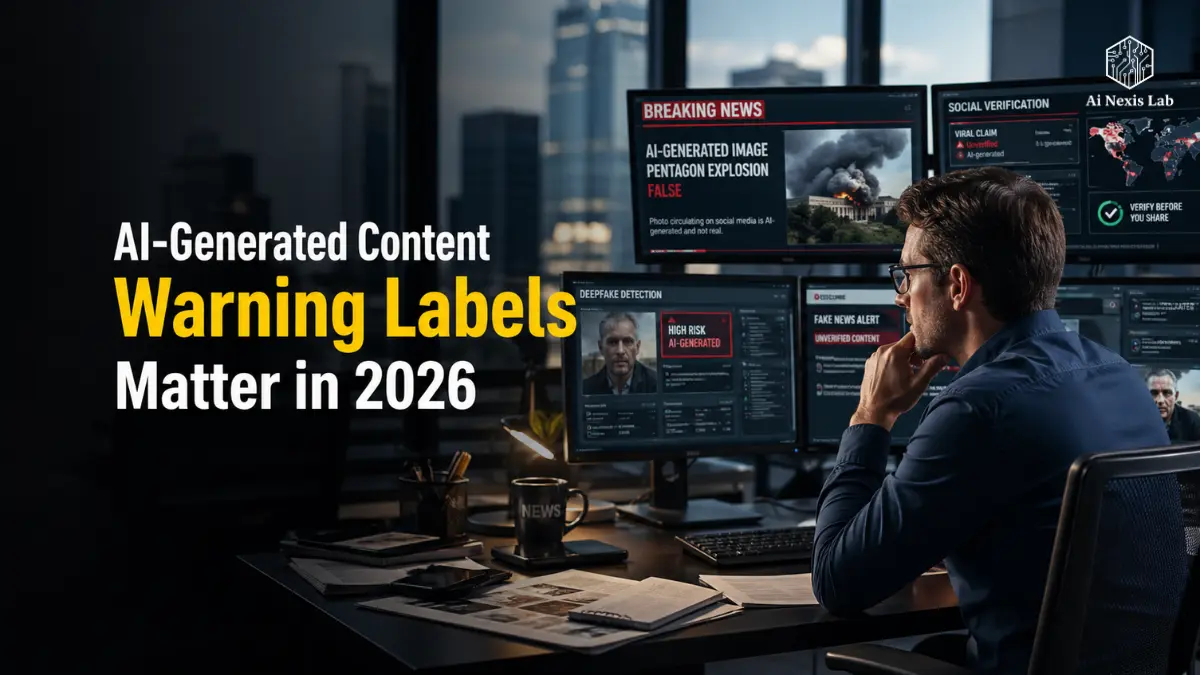
In May 2023, a Single Image Rocked Financial Markets.
It showed the Pentagon on fire. Smoke rising. Emergency response in motion. It seemed so real that journalists reacted, social media exploded, and – most importantly – stocks plummeted. Then, just as quickly, it fell apart: the image was fake. AI-generated. Completely fake.
No labels. No disclaimers. No friction.
That moment wasn’t just a weird internet glitch – it was a preview of what happens when artificial media moves faster than our ability to verify reality.
Now fast forward to 2026. The volume of AI-generated content – text, images, audio, video – is simply not high. It’s overwhelming. And most of it still comes without any indication that tells you whether a human made it or not.
That’s the core question that’s currently driving one of the most chaotic debates in tech:
Should every piece of AI-generated content have a clear, permanent label?
It may seem obvious at first, but it’s not.
What “AI Content Labeling” Really Means (and Why Most People Get It Wrong)
Before arguing about whether labeling should exist, you need to understand something fundamental:
Not all labels are created equal. Not even close.
Visible Watermarks
This is the simplest version. A tag stamped directly on the material – such as stock photos that say “Getty Images.”
For AI, it can say: “AI-generated”.
Reality Check:
- Easy to see
- Easy to remove
- Mostly cosmetic
Cut it out or fade it, and it’s gone. So while it may seem like transparency, it is weak protection.
Invisible Watermarks
are embedded in the file itself – hidden within pixels or audio frequencies.
You can’t see them, but the software can detect them.
Example: Google’s SynthID system.
Reality Check:
- Survives light edits
- Breaks under heavy manipulation
- It’s useless if someone takes a screenshot or re-uploads
In other words: better than nothing, but not reliable.
Creator Disclosure Labels
This is an authenticity system.
Like the caption:
“This video was created using AI.”
Platforms like Instagram, TikTok, and YouTube now require this in many cases.
Reality Check:
- Relies entirely on honesty
- Bad actors ignore it
- Implementation is inconsistent
If you’re relying on lies to self-report, you’ve already lost.
Metadata & Provenance (The Only Serious Approach)
This is where things get more robust.
Instead of tagging content, you track its entire history:
- Who created it
- What tools were used
- What edits were made
C2PA (Content Authenticity Initiative) is building this.
Reality Check:
- Harder to fake
- More useful for verification
- Needs global adoption
That last point is the problem. It only works if everyone participates – which they don’t.
Why Is This Discussion Suddenly Urgent?
Let’s cut to the chase. This is no longer theoretical.
These numbers are ugly.
- Deepfake incidents increased by 257% in 2024 alone
- Outpacing previous years in early 2025
- Fraud, scams, and identity theft are exploding
And the damage is not insignificant.
Real Damage, Not Imaginary Risk
- In Spain, AI-generated explicit images target 11-year-old girls
- Political deepfakes now routinely influence elections
- AI voice scams are hitting older victims with increasing success
No labels. No warnings. No defenses.
This is the reason why governments are struggling.

The Laws Are Coming Fast (And They’re Messy)
Regulation is no longer even theoretical.
Europe (Aggressive Approach)
EU AI law now requires disclosure for actual AI-generated content.
Fines can reach 6% of global revenue.
It’s not symbolic – it’s existential.
United States (Fragmented Approach)
- Federal law focuses primarily on intimate deepfakes
- 46 states have their own regulations
- No unified national framework
Translation: confusion and loopholes.
Other Countries
- China: Mandatory labeling rules (2025)
- France: Fines for unlabeled AI images
- Australia: Criminal penalties for certain deepfakes
This is not compiled. It’s a patchwork.
And patchwork doesn’t scale.
The Case For Labeling (and Why It’s Not Crazy)
Let’s give the pro-labeling argument its full weight.
Because it’s not paranoia – it’s pattern recognition.
1. Trust Is Infrastructure
Every system – media, markets, democracy – relies on one fundamental assumption:
What you are seeing is at least somewhat real.
AI breaks that.
Without labels, you lose:
- Trust in the news
- Trust in the visuals
- Credibility of evidence
Once trust is broken, everything that builds on it follows.
2. Consent Is More Important Than Your Thoughts
When you consume content, you are making an implicit agreement:
- This is a human perspective
- This is a real voice
- This is an authentic expression
AI-generated content without ads removes that choice.
You are being influenced without knowing the source.
It’s not just misleading – it’s manipulative.
3. Traceability Is Essential For Accountability
When something harmful spreads, you need to answer one question:
Where did it come from?
Right now, the answer is often: nowhere.
Labeling – especially embedded at creation time – creates a trail.
Without it, enforcement is a joke.
The Case Against Labeling (and Where It Differs)
Now let’s be honest.
“Label everything” sounds clean. It’s not.
1. Watermarks Are Fragile
Most labeling systems fail under basic pressure.
- Crop the image → label gone
- Screenshot it → watermark gone
- Edit it → metadata gone
If a teenager with Photoshop can beat the system, it’s not the system.
2. False Confidence Is Dangerous
Here’s a subtle but serious problem:
If people start believing that “AI stuff is labeled,” they’ll assume:
No label = real
That’s worse than doubt.
It creates blind faith in unlabeled counterfeits.
3. The Creative Gray Zone Is a Mess
This is where things get uncomfortable.
Answer honestly:
- If a writer uses AI for a draft → is that AI content?
- If a designer uses AI for concepts → does that count?
- If a musician uses AI for ideas → is it artificial?
There is no clean line.
And forcing someone creates legal and creative chaos.
4. Global Enforcement Is a Fantasy
Content crosses borders instantly.
Laws don’t.
So:
- One country requires a label
- Another country does not
- A third country cannot enforce
The result?
Bad actors operate where the rules are weakest.
Everyone else faces consequences.
What Big Tech Is Really Doing (Not What They Claim)
Let’s ignore the PR statements and look at the reality.
Current Approaches
- Google → Invisible watermarking (partial success)
- Microsoft → C2PA integration (early stage)
- Platforms → User advertising requirements
Common Problem: None of these are perfect.
None.
The Only Practical Way Forward: Layered Transparency
If you’re expecting a single solution, you’re thinking wrong.
The only approach that works is to stack multiple systems.
What That Looks Like
- Visible labels (for humans)
- Metadata (for machines)
- Platform ads (for scale)
Each layer compensates for the weaknesses of the others.
Nothing short of security theater.
The Privacy Problem Nobody Wants to Talk About
This is the part that most people ignore:
Tracking AI content can easily become tracking people.
If every generated image is linked to an identity:
- Journalists lose anonymity
- Whistleblowers get exposed
- Governments gain surveillance tools
Then you’ve now traded the risk of misinformation for the privacy risk.
Not a net win.
What This Means for You (Whether You Like It or Not)
If you create content – even if it’s just by accident – you’re in this.
And here’s the plain truth:
If you’re using AI and not disclosing it, you’re already behind.
Not ethically. Strategically.
Because:
- Platforms are adding auto-labeling
- Detection (imperfect but improving) is spreading
- Audiences are becoming more sensitive
There is no risk of getting caught using AI.
The risk is getting caught hiding it.
The Smarter Approach (That Most People Still Ignore)
If you are serious about long-term reliability:
- Be clear about AI usage
- Separate AI-generated vs. AI-assisted
- Create clear internal policy
- Assume that scrutiny will increase
Because it will.
The Detection Arms Race (Spoiler: We’re Losing)
Let’s kill a common assumption:
“We’ll just detect AI stuff instead of labeling it.”
No, you can’t.
Detection tools:
- Generate false positives
- Missed advanced outputs
- Can be easily bypassed
And improve faster than AI detection.
Always has. Always will.
So relying on discovery is like chasing smoke.
Frequently Asked Questions
Does AI-generated content currently require a legal label?
Depends on where you work.
Europe enforces it broadly.
America is fragmented.
Other countries vary widely.
If your audience is global, assume the strictest rules apply. Playing the jurisdiction game is short-term thinking.
Can AI watermarks really be removed?
Yes. Most. Some have to work hard, some don’t.
Nothing currently available is tamper-proof.
Anyone who tells you otherwise is either giving you false information or selling something.
Will labeling hurt creators?
In the short term, maybe a little. In the long term, no.
What really damages credibility is that hiding the use of AI exposes it.
Transparency is not a disadvantage – it is insurance.
What is better: watermarking or provenance?
Origin. Not even close. Watermarks are fragile tags. Origin is a complete history.
The problem is adoption – not capacity.
Should AI-written text be considered AI images?
Not at all. The text has always been collaborative – edited, ghostwritten, refined.
Images seem more “real”, so they have a higher risk of fraud.
That’s why the rules treat them differently.
Final Verdict
Here’s the honest answer:
Yes, AI content should be labeled.
But if you think labeling alone solves the problem, you’re not paying attention.
- It is necessary → because the harm is real and growing
- It is incomplete → because the technological limitations are real
- It is urgent → because the window for action is closing
The real issue is not about labeling.
It is whether we can maintain any shared understanding of reality.
Because once it’s broken, labels won’t fix it.
They’ll just document the fall.