Your code now reviews itself – but only if you set it up correctly
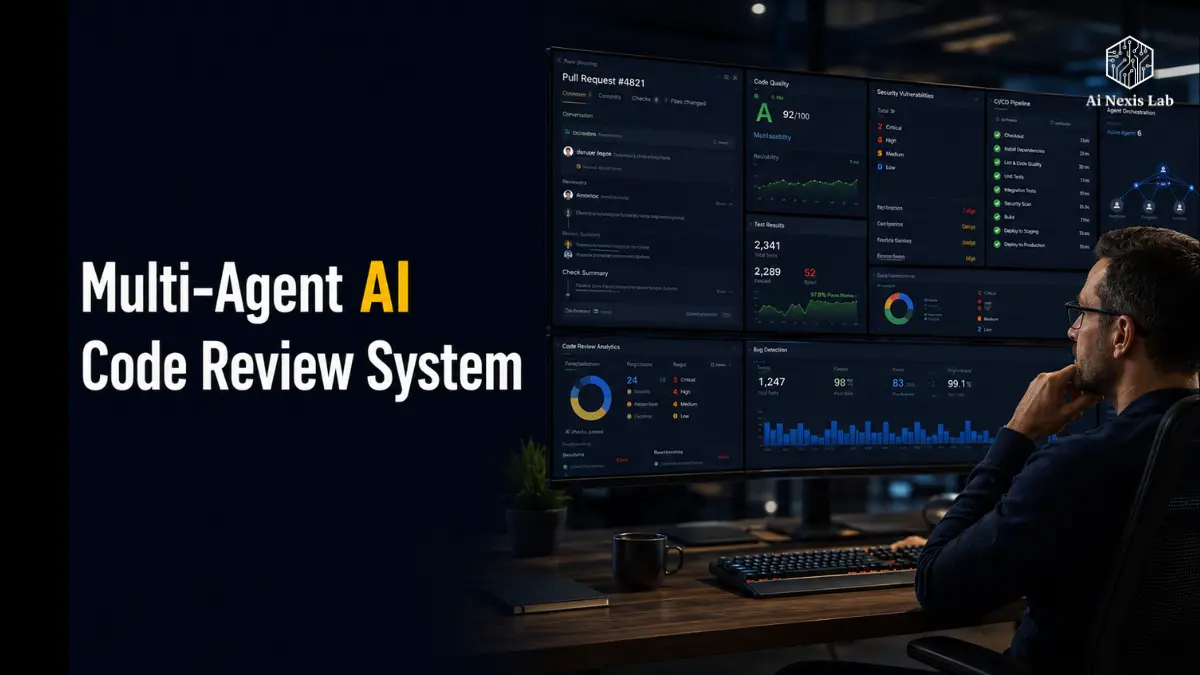
Learn 4 powerful multi-agent AI code review frameworks that automate testing, security scans, bug detection, and PR workflows for faster releases.
The shift that most teams still aren’t talking about
A few years ago, AI in software development mostly meant autocomplete. You typed a few words, and the assistant suggested a function, an SQL query, or maybe an entire class. It was useful. Sometimes surprisingly useful.
But things are not going that way now.
A big change is happening behind the scenes. Instead of just helping developers write code faster, modern AI systems are starting to participate in the entire software delivery process. They are reviewing pull requests, generating tests, identifying security issues, analyzing failures, and in some cases proposing improvements even before a human reviewer sees the code.
It is a fundamentally different model.
Imagine a backend team managing a large application with dozens of services and hundreds of weekly commits. Traditional code reviews quickly become a bottleneck. Reviewers get busy. Tests are abandoned. Small bugs survive longer than they do.
Now imagine a system where multiple specialized agents automatically monitor each pull request. One focuses on logic. Another checks security. A third handles testing. A fourth tries to fix things when something breaks.
The result is not complete automation. That is a false expectation.
The result is a reduction in the amount of routine work required, allowing humans to spend more time on architecture, design decisions, and business problems.
That’s where the real value lies.
Table of Contents
Why “Vibe Coding” Hits a Wall
AI-generated code is great for prototypes.
It’s also great for personal projects, quick experiments, and situations where speed is more important than long-term maintenance.
The problem is that most production systems are not simple.
When someone asks an AI assistant to add rate limits, implement authentication, or create a new API endpoint, the generated code may be technically correct. But software quality is not determined by a single file.
It is determined by how dozens or hundreds of files interact.
AI does not automatically check whether new logic conflicts with existing business rules. It is not known whether the mobile application relies on undocumented behavior. It does not test performance effects unless explicitly instructed to.
That’s where basic AI-assisted coding starts to break down.
Multi-agent systems solve this by distributing responsibility.
Instead of having one assistant do everything, you create experts.
One reviews the code quality.
One runs the tests.
One checks security.
One investigates failures.
The system starts to behave less like an auto-complete engine and more like a software team with defined responsibilities.
Sentinel Stack: Specific Review Levels
Level 1: Style and Convention
This level handles tedious but necessary work.
Linting rules, formatting, naming conventions, import organization, and code consistency.
No advanced logic is required.
The goal is simple: stop obvious issues before they reach the deep review stage.
Level 2: Logic Review
This is where the real analysis begins.
The logic agent examines business rules, edge cases, architecture patterns, and implementation decisions.
For example:
- Does a new API endpoint introduce inconsistent behavior?
- Was error handling forgotten?
- Does the implementation violate existing architectural standards?
These are not formatting issues. They are logic issues.
Level 3: Security Review
Security reviews are often done in a hurry because teams are under delivery pressure.
That’s why automated review helps.
A dedicated security agent can monitor authentication flows, permission checks, secret management, dependency vulnerabilities, and common attack vectors on each pull request.
Humans still make the final decisions.
But the system never tires and never skips a review because it’s Friday afternoon.
Level 4: Performance Analysis
Performance problems rarely appear immediately.
They accumulate.
An extra database query here. A blocking operation there.
Over time, those small inefficiencies become production problems.
A dedicated performance reviewer helps catch these patterns before they reach customers.
The biggest lesson here is specialization.
Most teams fail because they ask an AI agent to “review everything.”
It is usually too broad to be effective.
Zero-Handoff Protocol
One of the most interesting ideas in autonomous development is no code generation.
It is self-improvement.
The concept is straightforward:
- The agent identifies the problem.
- The agent estimates confidence.
- The agent applies the fix.
- The agent runs tests.
- If the tests pass, the work continues.
- If the tests repeatedly fail, move on to humans.
Easy in theory.
Harder in practice.
The challenge is scoring confidence.
Some fixes are low-risk.
Missing imports.
Syntax errors.
Explicit null checks.
Those can often be fixed automatically.
Other changes affect business logic, payment workflows, compliance requirements, or customer data.
They almost always have to involve human review.
The smartest systems are not the ones that automate everything.
It’s the one that knows when to stop and ask for help.
Mesh Delegation Method
A common mistake is to run every agent against every pull request.
It sounds perfect.
It’s really inefficient.
A one-line CSS change does not require a database migration reviewer.
Terraform update does not require frontend accessibility analysis.
Instead, modern systems operate in a route dynamic manner.
The orchestrator examines the changed files and decides which experts should participate.
If changes are made to the database migration, schema reviewers are activated.
If the authentication files change, security agents are involved.
If frontend components are touched, UI-focused reviewers join the workflow.
This selective routing signal dramatically reduces review time while improving quality.
The goal is not maximum activity.
The goal is related activity.
Red Loop Technique
Test failures contain valuable information.
Most developers skim error logs to look for clues.
AI systems can parse them systematically.
The Red Loop follows four phases:
Run
Run tests against the revised code.
Parse
Extract structured information from failures.
What failed?
Where?
What was expected?
What happened instead?
Improve
Generate targeted corrections based on available evidence.
Retest
Run failed tests again.
If successful, verify the comprehensive test suite.
Iterate a limited number of times.
Hard limits are important.
An agent that repeatedly fails usually lacks the context that only humans possess.
Infinite automation loops don’t create productivity.
They create costly confusion.
Tools That Really Matter
The tooling landscape changes rapidly, but three categories remain particularly useful.
Claude Code
Strong repository awareness, long-reference logic, and terminal integration make it valuable for logic analysis and autonomous review workflows.
Its biggest advantage is understanding relationships across multiple files instead of focusing on individual snippets.
Cline
Especially useful in developer environments.
It can navigate files, run commands, make codebase changes, and perform practical development tasks directly in the workflow.
LangGraph
This becomes important when multiple agents need shared memory, conditional routing, and integrated decision making.
Many teams jump into orchestration too early.
That is usually a mistake.
Build a simple workflow first.
Add orchestration only when complexity demands it.
Automated Pull Request Creation
A surprisingly overlooked detail is how agents communicate findings.
While the analysis is excellent, a poorly written pull request creates friction.
Good automated PR should answer three questions:
- What changed?
- Why did it change?
- How was the change validated?
Developers shouldn’t need to do detective work.
The context should already be there.
Many teams also label agent-generated pull requests separately. This may seem small, but it significantly simplifies reporting, filtering, and long-term evaluation.
Data is critical.
If you don’t keep track of what your agents are catching, you can’t improve them.
Common Pitfalls
Too Much Autonomy Too Soon
The fastest way to lose trust in automation is to immediately give it too many permissions.
Start with observations.
Then recommendations.
Then limited improvements.
Then carefully expand authority.
Trust must be earned.
Treat Agent Output as Fact
Agents are sometimes wrong.
Every production team eventually discovers this.
Treat findings as hints, not truths.
Verification remains important.
Context Limitations
Large repositories create challenges.
Large pull requests cannot always fit into a single logic session.
Chunking, routing, and summarization become necessary engineering problems.
Missing Observability
If you can’t explain why the agent made a decision, you can’t really control the system.
Logging, monitoring, and traceability are not optional.
They are fundamental.
What Will Software Development Look Like in 18 Months?
The biggest change may not be smart models.
It will be simple infrastructure.
Today, building a mature multi-agent review pipeline can take weeks.
By the end of this decade, much of that setup will become configuration rather than engineering.
Competitive advantage will not come from using autonomous review systems alone.
Everyone will eventually have access to the same capabilities.
The benefit will come from understanding how they work, where they fail, and how to customize them for unique business needs.
This is the difference between using a tool and mastering a system.
And that’s where experienced engineers will continue to create value.
The Final Verdict
The conversation around AI and software development often boils down to a single question:
“Will AI replace developers?”
That is the wrong question.
A more useful question is:
“What parts of software development should humans stop doing manually?”
Multi-agent review systems provide one possible answer.
They don’t remove developers.
They reduce repetitive review work, accelerate testing, surface security issues sooner, and shorten feedback loops.
The teams seeing the most benefit aren’t replacing engineers.
They are building systems that allow engineers to spend less time finding preventable errors and more time solving meaningful problems.
The future is not autonomous software development.
It is highly supervised automation combined with strong human decision-making.
And for most engineering teams, that’s probably the best possible outcome.
Frequently Asked Questions
What is the biggest benefit of a multi-agent code review pipeline?
The biggest advantage is consistency. Human reviewers get distracted, overloaded, or unavailable. Agents review each pull request using the same rules every time. It doesn’t guarantee perfection, but it dramatically reduces missed issues and shortens the review cycle throughout the development process.
Can small development teams benefit from autonomous code review?
Yes, and probably more than in larger enterprises. Small teams typically have fewer dedicated reviewers and tighter deadlines. Even a simple setup that automates linting, testing, and basic security checks can eliminate hours of repetitive work each week without requiring a large infrastructure investment.
How accurate are AI-powered code review agents in production?
They can be very effective in identifying patterns, security concerns, test failures, and code quality issues. However, they should not be considered as final authorities. The best product deployments combine automated analysis with human approval, especially when business-critical logic or customer-facing behavior is involved.
Do multi-agent pipelines increase development costs?
Initially, yes. This includes infrastructure, API, and engineering costs. However, many teams find that the reduction in reviews, faster bug detection, and fewer product builds offset the cost over time. The key is to carefully monitor usage and avoid unnecessary agent activity.
What should developers build first?
Start with a simple style and linting agent. It is easy to implement, easy to validate, and immediately useful. Once that workflow is stable, then add logic review, security scanning, and automated testing layers sequentially, rather than trying to build a fully autonomous system from day one.
Is autonomous code review replacing senior engineers?
No. If anything, it increases the value of senior engineering skills. Organizations still need experienced people to define architecture, establish review standards, design workflows, evaluate trade-offs, and decide when to trust automation or not. The role shifts towards system design and oversight rather than repetitive inspection work.