You Don’t Need More Prompts.You Need an Agent Fleet.
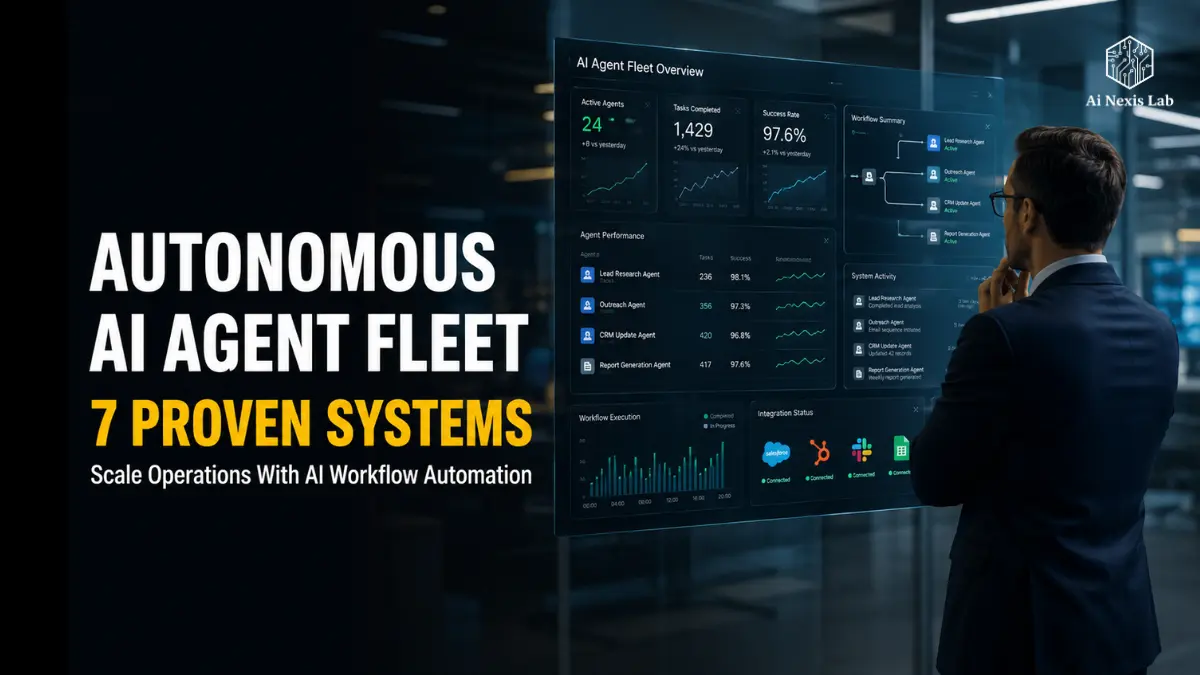
Build an Autonomous AI Agent Fleet with 7 proven systems to automate workflows, cut costs, boost productivity, and scale your business in 2026.
A step-by-step blueprint for creating autonomous AI agents that run your weekly business operations – with governance built-in so they never quietly empty your wallet or go rogue.
I’ll tell you about the moment when everything I knew about “using AI for business” was one level too shallow.
I was watching his founder demo of the week. On Monday morning, she sat for eleven minutes – exactly eleven minutes, she timed it – reviewed the dashboard, approved three outreach email drafts, and then continued with her day. Her leads had already been researched. The CRM was already updated. Meeting summaries from Friday were already filed, tagged and cross-referenced against his project board. She didn’t do any of that. Not manually, anyway.
She had agents for her.
No chatbots. Not a single AI assistant to which she typed instructions. A virtual fleet of purpose-built, autonomous workflows – each responsible for a specific part of her operation – all ran in the background while she slept, traveled, and thought about higher-order problems.
I went home and audited my own “AI setup”. I had a collection of carefully crafted prompts, preserved in notation. I was manually copying text into chat windows. I was re-explaining the context each session because the model had no memory of the last session. I felt like I was ahead. I was running on a treadmill.
Here’s the uncomfortable truth that most content about AI productivity doesn’t directly say: Prompts are not automation. It’s just a quick way to do manual work. True automation means building systems that work, chain decisions together, call tools, handle failures, and only return for your approval when something truly requires a human decision call. That’s what agentic workflow is all about. That’s what this guide is about.
By the end of this article, you’ll understand exactly what separates a static LLM prompt from a live agent system, how to build your first lead generation and outreach agent from scratch, and – critically – how to put governance guardrails in place so these background agents never wind up making a thousand API calls you didn’t ask for. This is not theoretical. It is a working blueprint.
73% – SMB owners say admin tasks consume 10+ hours/week
4.2× – Productivity gains reported by early agent-workflow adopters
$0 – Cloud bills are surprising – if you manage your agents properly
Table of Contents
01 – Foundation
What Is an Agentic Workflow – and Why It’s Not Like a Chatbot
Start here, because confusing these two things is the single biggest reason people build something fragile and give up. Chatbots – even if they are sophisticated – are reactive. You send a message, it sends one back, and the loop closes. Each session is essentially stateless. He has no plan, no memory of what he did last Tuesday, and no ability to reach out and call any tool or API on your behalf.
An agent is different in every dimension.
An agent has a goal that it is trying to achieve in multiple steps. It has a context window that includes previous steps and their outputs. It can call tools – actual functions, APIs, database queries, web scrapers – and incorporate what those tools return into its next decision. And critically: it loops. It checks whether it is complete or not. If it’s not, he figures out what to do next. That loop is the word that gives it the word “autonomous”.
Here is a solid comparison. Imagine you need to research ten potential candidates, search their LinkedIn profiles, check if they have been mentioned in recent news, and draft a personalized cold email for each one. With the prompt, you do it manually ten times, one after the other, copying and pasting data between windows. With an agent, you give them a list of ten company names on Monday morning, and when you open your laptop at 9 a.m., ten referenced draft emails are sitting in a folder waiting for your approval.
The agent ran the search. Read the results. Decided which results were relevant. Drafted language specific to each prospect’s recent activity. Marked two of them as low priority because recent news suggests they are undergoing restructuring. It all happened in a chain – not in a single prompt, but in a sequence of decisions and tool calls.
“The shift from prompt to agent is like going from a pocket calculator to a spreadsheet. Same underlying math. A completely different range of work you can do.”
Three Ingredients Every Agent Needs
Before you build anything, internalize this. Every working agent – no matter what it does – needs exactly three things:
- A clear, limited goal. “Research leads and draft outreach” is a goal. “Be helpful with marketing materials” is a therapy session. The more specific the goal, the fewer failure mechanisms you will introduce.
- Access to the right tools. The tools are what elevate the LLM from a text generator to an actor in the world. Think about web search, CRM read/write access, email API, document storage, calendar integration. Your agent is only as capable as the tools they can call upon.
- A stopping condition. This is the part that most beginners skip and then regret. An agent with no stopping condition is a runaway train. Define what “done” looks like before you start. Ten email drafts done? Database fully updated? Queue empty? Pick one, write it, back it up to the system prompt.
02 – Architecture
Mapping Your Business Operations to Agent “Lanes”
You don’t hire the same employee for sales, accounting, customer support, and social media. So don’t create one agent and expect him to handle everything. The appropriate mental model is a fleet – each agent occupies a lane, operates within the boundaries of that lane, and hands over to the next agent when their part is complete.
Here is a realistic weekly operations fleet for a solo founder or small team:
Lane 1 – Lead Recon Agent. Every Sunday night, it scrapes a defined list of sources (LinkedIn, industry news, job boards), creates a structured prospect list, scores each lead by the relevance criteria you set, and stores the output in your CRM.
Lane 2 – Outreach Drafting Agent. On Monday mornings, he reads lead recon output, pulls any existing conversation history from the CRM, and drafts personalized first-touch emails. It puts them in the “Pending Approval” folder – it doesn’t send anything.
Lane 3 – Meeting Prep Agent. Launched 30 minutes before a calendar event, it looks up the attendee’s company name, finds recent news, checks your CRM notes from any previous interactions, and puts them into a one-page summary document.
Lane 4 – Weekly Summary Agent. Every Friday at 4pm, it reads your project board, emailed folder, and CRM activity log, and generates a 300-word executive summary of the week. You read it in three minutes. You will never lose the thread.
These agents do not compete with or contradict each other. They run sequentially or in parallel, depending on dependencies. Lane 2 can’t run until Lane 1 finishes – that’s a dependency. Lane 3 and Lane 4 are completely independent – they can run at the same time without affecting each other.
Insider Tip
Start with one lane, not fourThe biggest mistake beginners make is trying to wire up the entire fleet on day one. Pick a single operational task that costs you the most time each week. Build a solid, well-organized agent for it. Run it for two weeks. Once it runs reliably, add another lane. Velocity comes from depth, not spread.
03 – Framework
Scope Method: Designing Agents That Don’t Go Outside the Script
Original Framework
Scope Method™
Before writing a single line of agent outline, answer these five. The missing answer is a future failure mode.
S – Source: What data input does this agent need, and where exactly do they live? (CRM, Email, Web, File System)
C – Condition: What is the specific trigger that starts this agent? (Time-based? Event-based? Manual kick-off?)
O – Output: What does “Done” look like? File? Database record? Draft email? Define it clearly.
P – Permission Ceiling: What is the maximum amount of action this agent is allowed to take without human review? Set this in writing before you deploy.
E – Escalation Path: What happens when an agent hits something outside of its scope? Does it stop and flag you? Log an anomaly? Move to another agent?
Run this five-question check before creating each new agent. It takes ten minutes and saves you from three categories of costly failure: agents who are always looking for input they can’t find, agents who take actions they should flag for review, and agents who silently fail with no record of why.
04 – Build
Your First Lead Generation and Outreach Agent – Step by Step
Sufficient Theory. Let’s build something real.
The goal here is a two-stage agent. The first stage researches prospects and qualifies them. The second stage drafts personalized outreach. You review and send. Here’s exactly how to make it.
Step 1: Define Your Ideal Prospect Profile In Machine-Readable Terms.
People say, “I want founders in fintech who are scaling.” Agents need precision. Translate that into clear criteria: company size between 10-50 employees, industry tagged as fintech or financial services, established in the last five years, posted a job opening for a growth or marketing role in the last 30 days (a sign they are in expansion mode).
That job-posting signal is the kind of behavioral trigger that a great agent can automatically catch. You would never have manually checked for all your potential customers every week. An agent can.
Step 2: Give It The Right Tool Stack
At a minimum, your lead agent needs four tools: a web search function (to search for news and public company data), a LinkedIn scraper or enrichment API (to pull basic professional context), a CRM read/write function (to check existing relationships and log new ones), and a simple file write function (to output draft emails somewhere you can find them).
You don’t have to make these tools yourself. Services like Apollo, Hunter, and Clearbit have APIs. n8n, Make, and LangChain all have pre-built connectors. The LLM at the heart of your agent doesn’t do the scraping – it decides what to search for, calls the appropriate tool, reads the results, and decides what to do next.
Step 3: Write The Agent System Prompt as You Are Onboarding a Contractor.
The system prompt is a set of standing instructions that your agent reads before each action. It’s not a one-liner. Think of it as an onboarding document for a meticulous, literally thinking contractor who will follow your instructions exactly as written – including any blank spaces you forgot to fill in.
# LEAD RECON AGENT - System Prompt v1.2

Role: You are a B2B research specialist.
Goal: Research the 10 companies in the input list and produce
       one structured prospect record per company.

For each company, collect:
- Company name, website, HQ city
- Estimated headcount (source required)
- Most recent funding round (if any)
- Latest news mention (within 90 days)
- Hiring activity signal (yes/no + evidence)

Stopping condition: Stop after all 10 records are complete.
Do NOT add extra companies not on the input list.

Escalation: If a company returns no usable data after 2 searches,
log it as "Insufficient Data" and move on. Do not loop.

Output: Write a JSON file to /output/prospect_batch_[date].json
Pay attention to specificity. The stopping condition is clear. The escalation path is defined. The output format is locked. This way you prevent the agent from spending twenty minutes on the same company because they decided to be perfect.

05 – Framework
Chain Ladder: Turning a Single Agent Into a Multi-Step Workflow
Original Framework

The CHAIN Ladder™

Use this to map multi-agent dependencies before you wire them together. Works for any workflow, not just outreach.

C - Collect: What raw data needs to enter the system? (Inputs)

H - Handle: Which agent processes that data into a structured output?

A - Assess: Is human review needed before the next step? If yes, create an approval checkpoint.

I - Initiate: What downstream agent or action does the output trigger?

N - Notify: How does the human know the workflow completed - or failed?
A in the chain is where most agentic workflows underperform. Builders get excited and remove all approval checkpoints to make the system “fully automated.” Then the agent sends 47 emails containing the actual error, and you spend a week doing damage control. Keep a human-in-the-loop at every step where an error is difficult to reverse. Complete autonomy is a privilege you gain after the system has proven itself reliable – not a default starting point.
06 – Government
Tokens and Work Budget: How to Stop Background Agents from Burning Your Wallet
This section is one that no one writes about until they make a costly mistake.
LLM API costs are usage-based. If your agent loops unexpectedly – say it hits an error and retries the same tool call 40 times – that’s 40 API calls you’re paying for. If it generates long context windows at each step because you forgot to trim its memory, then each call costs more than it should. Left completely unchecked, a background agent running overnight could generate a bill that looks like a typo.
Governance is your answer. Not as an afterthought – as a design constraint from day one.
Hard Token Budget Per Task
Set the maximum token spend per agent run. This is an explicit limit that you define in your orchestration layer (LangChain, AutoGen, CrewAI – wherever you are building). If the agent hits that limit before completing, it stops, logs what it has completed, and reports back. It doesn’t continue. You review the log, decide whether it needs to continue, and restart it manually.
A reasonable starting limit for lead research work covering ten companies is around 40,000 tokens in total. That’s a hard limit. If the run approaches that ceiling, the agent should start wrapping – completing the current records, skipping optional enrichment fields, and writing its final output.
Work Step Limit
Apart from tokens, limit the number of steps (tool calls + reasoning loops) that any one agent run can execute. A well-defined research task for a ten-company company should be completed in fewer than 60 separate actions. If it’s at step 80 and still running, something is wrong – not a performance problem, a logic problem. Set a step limit of 70-80 for that task and treat the limit as a flag for review, not a success signal.
Common Pitfall
Infinite Retry Loop
Never write an agent that retries a failed tool call without a maximum retry count. Classic mistake: tool returns error → agent tries again → same error → agent tries again → after 200 calls you have a $40 bill for $0.14 worth of work. Always write: “If this tool fails after 3 attempts, log the failure and move on to the next item.” This one rule will save you more money than any other governance measure.
Scheduled Runs vs. Event-Triggered Runs
Most of your agents should run on a fixed schedule (cron-style: every Monday at 7am, every Friday at 4pm). Avoid event-triggered agents that can fire continuously throughout the day unless you have explicitly rate-limited them. For example, an event trigger that fires every time a new email arrives will potentially run hundreds of times a day – and each run costs tokens.
07 – Framework
The Guard Protocol: A Five-Rule Safety Net for Every Agent You Deploy
Original Framework

The GUARD Protocol™

Apply this checklist to every agent before it runs unsupervised in a live environment.

G - Gate all irreversible actions.

Sending an email, deleting a record, posting publicly - these require human approval. Reading and drafting are always safe to automate. Publishing is never safe to automate without review.

U - Use sandboxed credentials first.

Run new agents against test CRM data and test email accounts before pointing them at your real ones. A two-week sandbox period catches 90% of logic errors.

A - Audit logs on every run.

Every agent run should write a structured log: what it did, what tools it called, what it skipped, and why. This isn't for debugging - it's your compliance record.

R - Rate-limit all external API calls.

Your tools should have built-in rate limits. 1 call per second is a safe default for most enrichment APIs. Set it and don't override it.

D - Define a dead-man switch.

If an agent hasn't produced a completion signal within a defined time window, it should auto-terminate and alert you. No silent hangs.
07.5 – Code Lab
Build Your First AI Agent Now – Fully Functional Code
Sufficient blueprints. Here is the actual code. Below are three complete, copy-paste-ready implementations of the Lead Research and Outreach Agent that we are designing: one in Python using LangChain, one in Node.js for JavaScript developers, and one structured n8n workflow outline for a no-code path. Choose your lane.
Each implementation includes a token budget cap, retry guard, escalation logger, and a structured JSON output format defined in the SCOPE method. This is not skeleton code – it’s a working starting point that you can run today.
┌─────────────────────────────────────────────────────────────────┐
│                   AI AGENT FLEET - FLOW MAP                     │
└─────────────────────────────────────────────────────────────────┘

  [ TRIGGER ]  Monday 07:00 cron / manual kick-off
       │
       ▼
  ┌────────────────────┐
  │  LANE 1            │  ← Lead Recon Agent
  │  web_search tool   │     reads prospect_list.json
  │  enrichment API    │     writes prospect_batch.json
  └────────┬───────────┘
           │  output: structured prospect records
           ▼
  ┌────────────────────┐
  │  LANE 2            │  ← Outreach Drafting Agent
  │  crm_read tool     │     reads prospect_batch.json
  │  template engine   │     writes drafts/ folder
  └────────┬───────────┘
           │  output: 10 draft emails (pending approval)
           ▼
  ┌────────────────────┐
  │  HUMAN CHECKPOINT  │  ← YOU review & approve
  │  approve / edit    │     nothing sends without sign-off
  │  reject / skip     │
  └────────┬───────────┘
           │  approved drafts
           ▼
  ┌────────────────────┐
  │  SEND AGENT        │  ← Optional Lane 3
  │  email_send tool   │     logs sent to CRM
  │  crm_write tool    │     updates activity feed
  └────────────────────┘

  Token budget: 40,000 / run  │  Max steps: 80  │  Retry limit: 3
Python / LangChain
File: agent_fleet/lead_recon.py · Python 3.10+

# ─────────────────────────────────────────────────────────────
# Lead Recon Agent  ·  LangChain + OpenAI  ·  agent_fleet/lead_recon.py
# Requires: pip install langchain openai duckduckgo-search
# ─────────────────────────────────────────────────────────────

import json, os, time
from datetime import date
from langchain_openai import ChatOpenAI
from langchain.agents import AgentExecutor, create_tool_calling_agent
from langchain_core.prompts import ChatPromptTemplate
from langchain_community.tools import DuckDuckGoSearchRun
from langchain_core.tools import tool
from langchain.callbacks import get_openai_callback


# ── CONFIG ─────────────────────────────────────────────────
TOKEN_BUDGET   = 40_000   # hard cap per run
MAX_STEPS      = 80        # max agent iterations
MAX_RETRIES    = 3         # per tool call
RATE_LIMIT_SEC = 1.2       # seconds between API calls
OUTPUT_DIR     = "./output"


# ── TOOLS ──────────────────────────────────────────────────
search = DuckDuckGoSearchRun()

@tool
def web_search(query: str) -> str:
    """Search the web for company or prospect information."""
    for attempt in range(MAX_RETRIES):
        try:
            time.sleep(RATE_LIMIT_SEC)
            return search.run(query)
        except Exception as e:
            if attempt == MAX_RETRIES - 1:
                return f"SEARCH_FAILED after {MAX_RETRIES} attempts: {e}"

@tool
def save_prospect_record(company: str, data: str) -> str:
    """Write a structured prospect record to the output folder."""
    os.makedirs(OUTPUT_DIR, exist_ok=True)
    filename = f"{OUTPUT_DIR}/{company.replace(' ','_')}_{date.today()}.json"
    with open(filename, "w") as f:
        f.write(data)
    return f"Saved: {filename}"


# ── SYSTEM PROMPT ──────────────────────────────────────────
SYSTEM_PROMPT = """
You are a B2B lead research specialist with one job:
research each company in the input list and save one
structured JSON record per company.

For each company collect:
  - name, website, hq_city
  - estimated_headcount (source required)
  - latest_funding_round (or null)
  - recent_news_mention (within 90 days, or null)
  - hiring_signal: true/false + evidence

Rules:
  - Stop after ALL companies are processed.
  - If a company has no data after 2 searches → log as
    {{ "status": "insufficient_data" }} and move on.
  - Never research companies not on the input list.
  - Output valid JSON only - no markdown fences.
"""


# ── AGENT SETUP ────────────────────────────────────────────
llm = ChatOpenAI(model="gpt-4o-mini", temperature=0)
tools = [web_search, save_prospect_record]

prompt = ChatPromptTemplate.from_messages([
    ("system", SYSTEM_PROMPT),
    ("human", "{input}"),
    ("placeholder", "{agent_scratchpad}"),
])

agent    = create_tool_calling_agent(llm, tools, prompt)
executor = AgentExecutor(
    agent=agent, tools=tools,
    max_iterations=MAX_STEPS,     # ← GUARD: step cap
    verbose=True,
)


# ── RUN WITH TOKEN BUDGET ──────────────────────────────────
def run_agent(prospect_list: list) -> dict:
    with get_openai_callback() as cb:
        result = executor.invoke({
            "input": f"Research these companies: {json.dumps(prospect_list)}"
        })
        if cb.total_tokens > TOKEN_BUDGET:
            print(f"⚠ Token budget exceeded: {cb.total_tokens}")
        return {
            "output": result,
            "tokens_used": cb.total_tokens,
            "cost_usd": round(cb.total_cost, 4),
        }


# ── ENTRY POINT ────────────────────────────────────────────
if __name__ == "__main__":
    prospects = [
        "Stripe", "Linear", "Retool", "Clerk", "Supabase",
    ]
    log = run_agent(prospects)
    print(f"\n✓ Done  |  Tokens: {log['tokens_used']}  |  Cost: ${log['cost_usd']}")
STEP 01
Install dependencies
Run pip install langchain langchain-openai langchain-community duckduckgo-search then set your OPENAI_API_KEY env variable.
STEP 02
TOKEN_BUDGET caps spend
The get_openai_callback context manager tracks live token usage. If the run exceeds 40k tokens, you get a warning and a cost report - before it compounds.
STEP 03
Retry guard on every tool
Each tool wraps its call in a for attempt in range(MAX_RETRIES) loop. After 3 failures it returns a SEARCH_FAILED string - the agent logs it and moves on. No infinite loops.
STEP 04
max_iterations = 80
LangChain's AgentExecutor hard-stops at 80 steps. The agent can't run forever - it hits the ceiling and returns whatever it completed so far.
STEP 05
Swap model for cheaper runs
This uses gpt-4o-mini for data extraction. Switch to gpt-4o only for the outreach drafting agent (Lane 2) where copy quality matters.Node.js
File: agent_fleet/leadRecon.js · Node.js 18+ · ESM

// ─────────────────────────────────────────────────────────────
// Lead Recon Agent  ·  Node.js  ·  agent_fleet/leadRecon.js
// Requires: npm install openai axios
// ─────────────────────────────────────────────────────────────

import OpenAI from "openai";
import axios from "axios";
import fs from "fs/promises";
import path from "path";


// ── CONFIG ────────────────────────────────────────────────
const CONFIG = {
  model:        "gpt-4o-mini",
  maxSteps:     80,    // GUARD: step cap
  maxRetries:   3,     // per tool call
  rateLimitMs:  1200,  // 1.2s between calls
  outputDir:    "./output",
};

const client = new OpenAI();
const sleep = (ms) => new Promise((r) => setTimeout(r, ms));


// ── TOOLS ─────────────────────────────────────────────────
const toolDefs = [{
  type: "function",
  function: {
    name: "web_search",
    description: "Search for company or prospect data on the web.",
    parameters: { type: "object", properties: {
      query: { type: "string", description: "Search query" }
    }, required: ["query"] }
  }
}, {
  type: "function",
  function: {
    name: "save_record",
    description: "Save a prospect JSON record to disk.",
    parameters: { type: "object", properties: {
      company: { type: "string" },
      data:    { type: "object" }
    }, required: ["company", "data"] }
  }
}];

async function runTool(name, args) {
  for (let attempt = 0; attempt < CONFIG.maxRetries; attempt++) {
    try {
      await sleep(CONFIG.rateLimitMs);
      if (name === "web_search") {
        // Swap this for your preferred search API
        const r = await axios.get(
          `https://api.duckduckgo.com/?q=${encodeURIComponent(args.query)}&format=json`
        );
        return r.data.AbstractText || "No result";
      }
      if (name === "save_record") {
        await fs.mkdir(CONFIG.outputDir, { recursive: true });
        const fp = path.join(CONFIG.outputDir,
          `${args.company.replace(/\s+/g,'_')}_${new Date().toISOString().slice(0,10)}.json`
        );
        await fs.writeFile(fp, JSON.stringify(args.data, null, 2));
        return `Saved → ${fp}`;
      }
    } catch (e) {
      if (attempt === CONFIG.maxRetries - 1)
        return `TOOL_FAILED:${name}:${e.message}`;
    }
  }
}


// ── AGENT LOOP ────────────────────────────────────────────
async function runAgent(prospects) {
  const messages = [
    { role: "system", content: "You are a B2B lead research specialist. "
      + "Research each company, collect structured data, "
      + "and save one JSON record per company. Stop when all are done." },
    { role: "user", content:
      `Research these companies: ${JSON.stringify(prospects)}` }
  ];

  let steps = 0;

  while (steps < CONFIG.maxSteps) {
    steps++;
    const res = await client.chat.completions.create({
      model: CONFIG.model,
      messages, tools: toolDefs, tool_choice: "auto"
    });

    const choice = res.choices[0];
    messages.push(choice.message);

    // Agent is done - no more tool calls
    if (choice.finish_reason === "stop") {
      console.log(`✓ Complete in ${steps} steps`);
      break;
    }

    // Process tool calls
    for (const tc of (choice.message.tool_calls || [])) {
      const result = await runTool(
        tc.function.name,
        JSON.parse(tc.function.arguments)
      );
      messages.push({
        role: "tool", tool_call_id: tc.id,
        content: String(result)
      });
    }
  }
}


// ── RUN ───────────────────────────────────────────────────
runAgent(["Stripe", "Linear", "Retool", "Clerk", "Supabase"]);
STEP 01
Install & setup
Run npm install openai axios and set OPENAI_API_KEY in your environment. This uses ES Modules - add "type":"module" to package.json.
STEP 02
The agent loop
The while(steps < maxSteps) loop is the heart of the agent. It calls the model, checks if it's done (finish_reason === "stop"), or processes any tool calls it returns.
STEP 03
Tool call dispatch
Tool call results are pushed back into the messages array with role "tool". The model reads them on the next loop iteration and decides what to do next.
STEP 04
Retry on every tool
The runTool function retries up to maxRetries times before returning a TOOL_FAILED string. The agent receives that string, logs it, and continues - no crashes.
STEP 05
Swap in your search API
The web_search tool calls DuckDuckGo's free JSON API. Replace with Serper, Brave Search, or Exa for better results in production.n8n Config
// ─────────────────────────────────────────────────────────────
// n8n Workflow Config (JSON)
// How to import: n8n → New Workflow → ••• menu → Import from JSON
// Paste this JSON. Connect your OpenAI credentials.
// n8n v1.40+ required
// ─────────────────────────────────────────────────────────────

{
  "name": "Lead Recon Agent Fleet",
  "nodes": [

    // ── 1. CRON TRIGGER - Every Monday 07:00 ──────────────
    {
      "id": "node_trigger",
      "name": "Weekly Trigger",
      "type": "n8n-nodes-base.scheduleTrigger",
      "parameters": {
        "rule": {
          "interval": [{ "field": "cronExpression", "expression": "0 7 * * 1" }]
        }
      }
    },


    // ── 2. LOAD PROSPECT LIST from Google Sheets / JSON ───
    {
      "id": "node_load",
      "name": "Load Prospects",
      "type": "n8n-nodes-base.code",
      "parameters": {
        "language": "javaScript",
        "jsCode": "return [{ json: { companies: ['Stripe','Linear','Retool','Clerk','Supabase'] } }];"
      }
    },


    // ── 3. AI AGENT NODE (OpenAI Tools Agent) ─────────────
    {
      "id": "node_agent",
      "name": "Lead Recon Agent",
      "type": "@n8n/n8n-nodes-langchain.agent",
      "parameters": {
        "agentType": "toolsAgent",
        "promptType": "define",
        "text": "Research these companies and collect structured data for each: {{ $json.companies }}",
        "systemMessage": "You are a B2B lead research specialist. For each company collect: name, website, headcount, funding, recent news, hiring signal. Output JSON only. Stop after all companies are processed. If a company has no data after 2 searches, log status: insufficient_data and skip.",
        "options": {
          "maxIterations": 80    // ← GUARD: step cap
        }
      }
    },


    // ── 4. WEB SEARCH TOOL (connected to agent) ───────────
    {
      "id": "node_search",
      "name": "Web Search",
      "type": "@n8n/n8n-nodes-langchain.toolSerpApi",
      "parameters": {
        "description": "Search the web for company news, funding, and hiring data."
      }
    },


    // ── 5. HUMAN APPROVAL CHECKPOINT ─────────────────────
    {
      "id": "node_approval",
      "name": "Wait for Approval",
      "type": "n8n-nodes-base.wait",
      "parameters": {
        "resume": "webhook",   // resumes only when YOU hit the webhook URL
        "webhookSuffix": "approve-leads"
      }
    },


    // ── 6. SAVE OUTPUT to Google Drive / Airtable ─────────
    {
      "id": "node_save",
      "name": "Save Prospect Records",
      "type": "n8n-nodes-base.googleDrive",
      "parameters": {
        "operation": "upload",
        "name": "=prospect_batch_{{ $now.format('yyyy-MM-dd') }}.json",
        "driveId": "YOUR_DRIVE_FOLDER_ID",
        "content": "={{ JSON.stringify($json.output) }}"
      }
    },


    // ── 7. NOTIFY via Slack / Email ────────────────────────
    {
      "id": "node_notify",
      "name": "Send Completion Alert",
      "type": "n8n-nodes-base.slack",
      "parameters": {
        "channel": "#agent-fleet",
        "text": "✓ Lead Recon complete - {{ $json.companies.length }} prospects saved to Drive. Review & approve: {{ $execution.resumeUrl }}"
      }
    }

  ],


  // Node connections (Trigger → Load → Agent → Approval → Save → Notify)
  "connections": {
    "node_trigger":  { "main": [[{ "node": "node_load", "type": "main", "index": 0 }]] },
    "node_load":    { "main": [[{ "node": "node_agent", "type": "main", "index": 0 }]] },
    "node_agent":   { "main": [[{ "node": "node_approval", "type": "main", "index": 0 }]] },
    "node_approval":{ "main": [[{ "node": "node_save", "type": "main", "index": 0 }]] },
    "node_save":    { "main": [[{ "node": "node_notify", "type": "main", "index": 0 }]] }
  }
}
STEP 01
Import this into n8n
Open n8n → New Workflow → click the ••• menu (top right) → Import from JSON. Paste this config. Your 7-node agent pipeline appears instantly.
STEP 02
Connect credentials
You'll need: OpenAI API key (for the Agent node), SerpAPI key (for Web Search), Google Drive OAuth (for Save), and Slack bot token (for Notify). All configured in n8n Settings → Credentials.
STEP 03
The Approval Checkpoint
Node 5 is a Wait node. The workflow pauses here. When Slack pings you with the approval link and you click it, the workflow resumes - nothing saves or sends until you do.
STEP 04
maxIterations: 80
The Agent node's options.maxIterations parameter hard-caps step count. n8n will terminate the agent and pass whatever output exists downstream if the cap is hit.
STEP 05
Customize the prospect list
Replace the hardcoded array in Node 2 with a Google Sheets read or an Airtable query to make the prospect list truly dynamic - update the sheet, the agent picks it up Monday morning automatically.Insider Tip
Run Python and Node.js Agents For Free During Testing
During development, both of the above implementations work with OpenAI’s gpt-4o-mini which costs approximately $0.15 per million input tokens. Less than 8,000 tokens are typically used for 5-company research – about $0.001. You can run hundreds of test iterations before spending a single dollar. Upgrade to gpt-4o only after your system prompt and tool logic have stabilized.
08 – Tooling
What to Really Build in 2026
The framework landscape has settled so much that there are now clear leaders for different use cases. You don’t need to choose the “best” tool – you need to choose the right tool for your current level of technical comfort and operational complexity.
If you are non-technical or low-code:
Start with n8n or Make. Both have visual workflow builders that let you chain AI calls, API requests, and conditional logic without writing much code. n8n is self-hostable (better for data privacy), Mac is fast to prototype. Either one will run your first agent fleet over the weekend.
If you are comfortable with Python:
LangChain is the most mature framework with the largest library of pre-built tools and connectors. Combine it with LangSmith for observability – you can see every tool call, every token spend, and every chain trace in a clean UI. This combination handles serious production workloads.
If you want multi-agent coordination:
Look at CrewAI or AutoGen. These frameworks are specifically designed for scenarios where multiple agents need to collaborate – one agent is doing research, another is doing drafting, a third is doing quality review – with a structured handoff protocol between them.
For underlying models:
Use the most capable model you can afford for your orchestrator (the agent that makes high-level decisions), and use lighter, cheaper models for the grunt-work agents that do data extraction or formatting. This tiered approach typically reduces your per-run API cost by 40-60% with no meaningful loss of quality.
Insider Tip
Two-Model Strategy
Run the flagship model (GPT-4o, Cloud Sonnet, Gemini 1.5 Pro) for decisions, planning, and drafting. Run a small model (GPT-4o-Mini, Cloud Haiku, Gemini Flash) for sorting, extraction, and formatting tasks. Research and outreach workflows created this way consistently cost 50-65% less than running everything on a flagship model – with output quality that is truly unmistakable to the recipient.
09 – Future Impact
What happens 18 months after you deploy your fleet
Here’s where it gets interesting. The first two weeks of running an agent fleet feel like you’re just saving time. And you are. But around six months, something structurally different starts to happen.
Your agents accumulate data. Every lead record they write, every research output they produce, every meeting brief they produce – it all goes into a structured, traceable record of your business activity. You start to see patterns that you never had the bandwidth to notice manually. Which prospect signals are actually associated with closed deals? Which outreach angles get a response rate greater than 15%? Which week has the most calendar conflicts?
That dataset becomes an asset. You can feed it back to your agents as a reference. Your outreach agent stops drafting generic emails and starts drafting based on what has worked historically for potential customers with specific characteristics. Your lead scoring model is refined not just by your intuition, but by actual results data.
By the eighteenth month, you are not just running an efficient operation – you are running a learning operation. The system gets a little better with each cycle. It is because of that compounding effect that early adopters seem so far ahead of their peers in two years. They didn’t just automate tasks. They built an infrastructure that learns.
Founders in 2027 who still rely on manual research and manually written outreach will simply not be slow. They will operate with fundamentally less context per decision than their agent-equipped competitors – and the gap will widen every quarter.
10 – Framework
Pilot-to-Fleet Methodology: A Phased Rollout That Doesn’t Break Anything
Original Framework

The PILOT-to-FLEET Method™

A four-phase rollout model for going from your first agent to a fully governed, multi-lane operation - without burning anything down in the process.

Phase 1

Pilot (Weeks 1-2):

Build one agent. Run it manually. Review every output before anything reaches production. Document every edge case it hits.

Phase 2

Observe (Weeks 3-4):

Let it run on schedule but maintain a daily audit habit. You're not fixing problems - you're cataloguing behavior patterns to improve the system prompt.

Phase 3

Refine (Month 2):

Apply the lessons from your audit. Tighten stopping conditions, improve tool instructions, add edge-case handling. Run a second agent in Pilot mode simultaneously.

Phase 4

Fleet (Month 3+):

Two or more agents running reliably → add a third, then a fourth, operating in CHAIN Ladder formation. Weekly audit replaces daily. You are now running a fleet.
Frequently Asked Questions
What is the difference between an AI agent and AI automation?
Automation runs a set of predefined steps in the same order every time – it’s basically a smart script.
An AI agent is dynamic: it reasons about what step to take next based on the output of the previous one, can handle new situations for which it was not explicitly programmed, and can choose between tools based on context. Automation is rigid. The agency is adaptive.
In practice, most real-world workflows use both: the automation layer schedules and triggers agent runs, and the agent handles variable logic within each run.
How much does it cost to run an AI agent fleet for a small business?
A well-managed fleet that handles lead research, outreach drafting, and weekly summaries for a solo founder or small team typically costs between $30 and $120 per month in API fees at current 2026 prices – depending on the models used, task frequency, and whether you implemented a two-model tiered strategy.
The range increases sharply if you operate without a token budget or use flagship models for every sub-task. The infrastructure tier (n8n self-hosted, or Mac Starter plan) adds another $0-$20/month. Most installers recover the cost of the first hour of manual work each week that they no longer do.
Do I need to know how to code to create AI agents?
Not for the beginner fleet. Tools like n8n and Make allow you to visually build functional multi-step agent workflows, without the need for code.
You will need to write clear system prompts (which is a writing skill, not a coding skill) and understand JSON at a basic level to read your agent’s output.
If you want to create custom tools for your agent to call – for example, a function that queries your proprietary database – then light Python knowledge becomes useful. But the “build a complete agent fleet without coding” threshold is actually achievable with no-code platforms available in 2026.
How can I stop my AI agent from making mistakes that embarrass my business?
Leave every irreversible action behind for human review – this is a non-negotiable rule.
Your agent should draft, research, categorize, and organize. It should not be sent, published, deleted, or posted without your sign-off unless it demonstrates consistent accuracy over a meaningful sample size.
The GUARD protocol in this article (Section 7) gives you a specific five-point checklist for deployment safety. Additionally, always run new agents in a sandboxed environment with test data for two weeks before connecting them to live systems.
The goal is: embarrassing mistakes are possible in the sandbox; That shouldn’t be possible in production.
What business operations are currently best suited for AI agents?
Tasks that yield the best return on agent investment have three characteristics: they are high-frequency (daily or weekly), they follow consistent patterns of decision-making, and they are time-consuming in terms of their strategic complexity.
In practice, that means lead research and qualification, first-draft outreach personalization, meeting preparation briefs, CRM data hygiene, competitive monitoring, weekly reporting, and invoice/receipt classification.
Tasks involving micro-decisions (final negotiations, creative direction, conflict resolution) are better managed by humans using the structured output produced by your agents – not changed by the agents themselves.
Final Verdict
Stop prompting. Start deploying.
The shift from “I use AI” to “I run AI agents” is not a technological leap – it’s a shift in mindset. It means accepting that your job is no longer to be the smartest person in the room, but to do smart-person tasks yourself. Your job is to be the architect of a system that does those tasks for you, consistently, at 2 a.m. on Sunday, without complaint.
Start with one lane. Use the SCOPE method to define it cleanly. Build in a GUARD protocol from day one. Keep a human in the loop on anything irreversible. Watch the first few runs carefully. Refine the system prompts based on what you see. Then add another lane.
Within three months, you will have recovered enough time to think about why you waited. Within eighteen months, your fleet will know your business better than any tool you’ve used before – because it will be learning from your business’s own data all the time.
The founders currently building agent fleets are simply not more efficient. They are building a structural advantage that becomes increasingly stronger. The mistake you can make at this point is to wait for it to become more mainstream before you start.