LangGraph vs CrewAI (2026): The Real Decision That Will Make or Break Your AI System
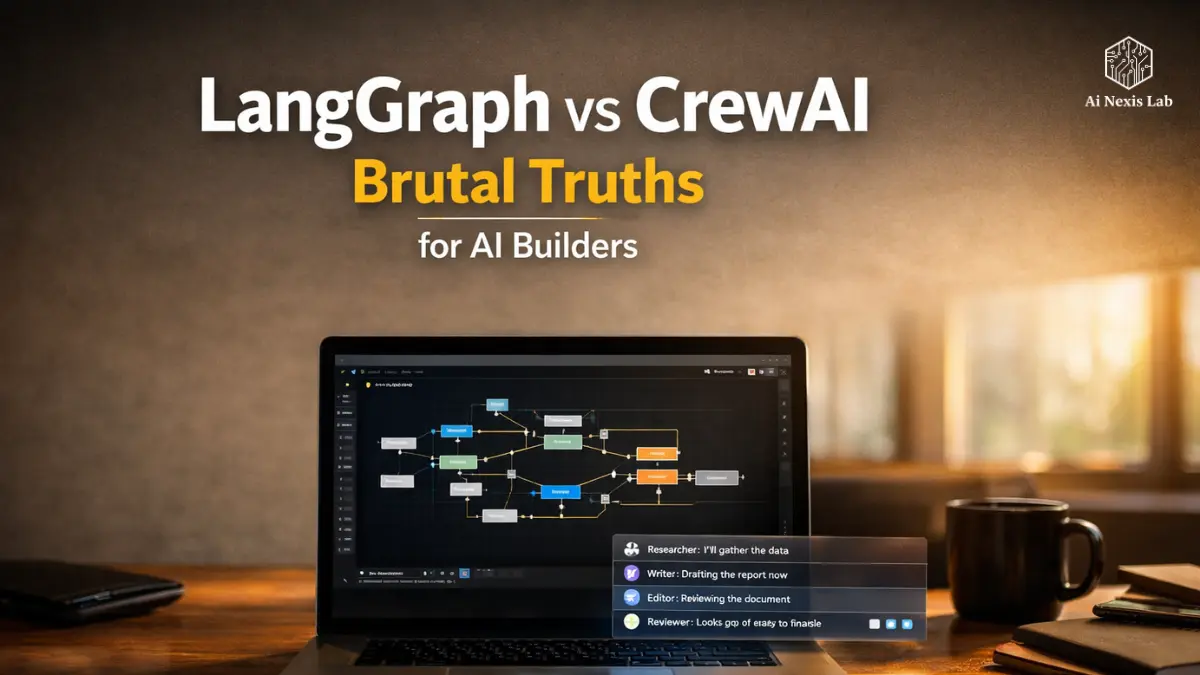
LangGraph vs CrewAI explained with 7 brutal truths. Discover which AI agent framework actually works in production and avoid costly mistakes in 2026.
Table of Contents
Why Isn’t This Just a Tool Choice (It’s a System Survival Decision)
You’re not choosing a library. You are choosing how your entire AI system behaves under pressure.
Most comparison articles lie to you – not intentionally, but through omission. They show you a clean demo. They don’t show you:
- What happens when an agent loops endlessly at 2 AM
- What happens when your API fails midway through a 30-minute run
- What happens when your LLM bill quietly doubles due to bad architecture
And that’s the difference between a great prototype and a system that actually survives in production.
The inconvenient truth:
Choose the wrong framework, and you won’t just refactor – you’ll rebuild.
One-Line Answer (That’s Not Enough)
Simple. But dangerously incomplete.
Because the real question is not which one is better.
It’s:
Which tools fail in a way that you can tolerate?
The Evolution That Brought Us Here
Before we compare tools, you need to understand the change from 2023 → 2026.
Act 1: Prompt Chains (2023)
- Linear Workflows
- Predictable but fragile
- Break one step → everything breaks
Act 2: Autonomous Agents (2024)
- React, AutoGPT-style loops
- Powerful… and chaotic
- Debugging nightmare
Act 3: Structured Orchestration (2025–2026)
- Controlled Agents
- Bounded Decision-Making
- Systems you can actually trust
This is where LangGraph and CrewAI live.
And they represent two completely different philosophies.
What These Tools Really Are (Without the Marketing BS)
LangGraph: You’re Building a System, Not a Script
LangGraph forces you to think like an engineer.
- Your workflow = a graph
- Each step = a node
- Decisions = clear logic
- Status = always visible
This is not just a tool – it’s a constraint system.
And that’s why it works in production.
CrewAI: You’re Managing a Team, Not a System
CrewAI breaks everything down into roles:
- Researcher
- Writer
- Editor
- Reviewer
Agents talk to each other like colleagues.
It feels intuitive. Fast. Natural.
And that’s why it breaks down on scale.
The Core Difference (That Actually Matters)
LangGraph thinks:
“What is the state of the system right now?”
CrewAI thinks:
“What did the last agent say?”
That difference seems small.
It’s not.
This is the difference between:
- Structured Data Flow
vs. - Conversational Memory Prediction

Architecture: Where Things Start to Fall Apart
LangGraph: State Is King
Each step reads and writes to shared state.
That means:
- You know exactly what data exists
- You can pinpoint failures
- You can restart from any step
What if something fails at 18 out of 20 steps?
You don’t start over. You keep going.
That could save you thousands in API costs over time.
CrewAI: Conversations Are State
CrewAI stores everything in chat history.
It poses two main problems:
1. Context Blot
Each agent inherits all previous messages.
Result:
- Higher token usage
- Slower response
- Increasing cost
2. Information Degradation
By agent 6 or 7:
- Original instructions become diluted
- Agents start to “interpret” the meanings
- Output quality decreases subtly
You won’t notice it right away.
You’ll notice it when your results start to look… bad.
No One Talks About Hard Ceilings
CrewAI works great for:
- 3-5 agents
- Short workflow
- Clean handoff
Go beyond that?
You hit:
- Reference Limit
- Noise Accumulation
- Debugging Hell
That’s not an opinion.
That is architecture.
Workflow Diagnosis Method (Use This Before Building Anything)
Stop guessing. Drive your use case using this.
1. Is your workflow linear or branching?
- Linear → CrewAI works
- Conditional loops → LangGraph required
2. How long does it last?
- Less than 5 minutes → Either
- 20-45 minutes → LangGraph
3. Do you need human input during the process?
- Yes → LangGraph handles it cleanly
- Maybe → CrewAI gets messy
4. How experienced is your team?
- Junior / Fast-paced → CrewAI
- Experienced / Long-term → LangGraph
5. Are your agents independent?
- Yes → CrewAI
- No → LangGraph
If you skip this step, you’re guessing.
And guessing leads to reconstruction.
Real-World Use (Not Theory)
Where LangGraph Wins (and Why)
Companies using LangGraph aren’t experimenting.
They are solving real problems:
- Automation systems deployment
- Developer copilots
- Code migration pipelines
- Enterprise workflows
Common features:
- Long-running processes
- Complex branching
- High reliability requirements
These systems cannot afford to fail halfway through.
Where CrewAI Really Shines
CrewAI excels in:
- Content Pipelines
- Marketing Automation
- MVP Prototypes
- Internal Tools
Why?
Because:
- It’s fast
- It’s easy
- It works “good enough” quickly
And for many teams, that’s all they need.
The Pattern That No One Mentions (But Happens Consistently)
Teams often do this:
- Build in CrewAI
- Hit scaling issues
- Rewrite in LangGraph
It’s not a failure.
It is predictable.
Head-to-Head (No Fluff)
| Category | LangGraph | CrewAI |
|---|---|---|
| Setup | Slower | Fast |
| Learning curve | Steep | Easy |
| State handling | Explicit | Implicit |
| Debugging | Strong | Weak |
| Long workflows | Excellent | Breaks |
| Branching logic | Native | Limited |
| Production readiness | High | Moderate |
Advanced Tactics (Where Smart Teams Set Themselves Apart)
1. Hybrid Model (Best of Both Worlds)
What most people miss here is:
You don’t have to choose.
Smart teams do this:
Result:
- Faster agent collaboration
- Stronger system control
It’s not overengineering.
It’s true architecture.
2. LangGraph “Time Travel” Debugging
This is greatly underestimated.
You can:
- Save state at each step
- Go back to any point
- Resume without restarting
It completely changes the way you debug.
Instead of guessing, you observe reality.
3 CrewAI Hierarchical Mode
If you insist on CrewAI for complex flows:
Use the Manager Agent.
It helps:
- Delegation
- Coordination
- Parallel tasks
But don’t fool yourself –
it doesn’t solve the main limitations.
Real Scenarios (Clear Decisions)
Scenario 1: Content Pipeline
- Research → Write → Edit → Publish
No loops. No branches.
Use CrewAI.
Anything else is excessive.
Scenario 2: Loan Approval System
- Data Analysis
- Risk Scoring
- Conditional Decisions
- Human Review
Use LangGraph. No discussion.
Scenario 3: Developer Automation Tool
- Code Generation
- Test Loops
- Error Handling
- Iteration Cycle
LangGraph Again.
CrewAI will break down under this.
Learning Roadmap (If You Really Want To Get Good)
Phase 1: Build something in CrewAI
- Quick wins
- Understand agent behavior
Phase 2: Rebuild it in LangGraph
- Learn state thinking
- Feel the difference
Phase 3: Add Complexity
- Loops
- Conditions
- Human checkpoints
Phase 4: Add Observability
- Track everything
- Stop guessing
If you skip steps, you’ll struggle.
Where Is This Going (2026 and Beyond)
LangGraph Direction
- More enterprise adoption
- Better tooling
- Strong observability
Becoming the default for production systems
CrewAI Direction
- More features
- Better enterprise support
- Easier onboarding
Becoming the default for rapid builds
Realistic Trend
They are converging.
- LangGraph → Simple
- CrewAI → More Structured
The future = composability, not competition.
Frequently Asked Questions
Is LangGraph “better” than CrewAI?
No – that’s the wrong question.
LangGraph is better for systems that should not fail.
CrewAI is better for systems that need to exist quickly.
If you’re building something real – not a demo –
LangGraph usually wins.
How difficult is LangGraph really?
Hard enough to slow you down at the very beginning.
You will need to understand:
1) State Management
2) Graph Logic
3) Flow Control
Expect a few days to feel comfortable and weeks to feel confident.
But once it clicks, you stop touching the ceiling.
Can I use both together?
Yes – and you probably should.
Use:
1) CrewAI → Internal Tasks
2) LangGraph → For Orchestration
This gives you:
1) Speed
2) Control
3) Reliability
It’s not overly complicated – it’s efficient.
What are the real limitations of CrewAI?
Two big issues:
1) Reduced context due to long workflow
2) Poor debugging tools
These are not visible in the demo.
They appear in the product.
And when they appear, they are painful.
Which one should I use for regulated industries?
If you need:
1) Audit Trails
2) Traceability
3) Reliability
LangGraph is the most secure default.
CrewAI can work – but usually at the enterprise level.
Final Verdict
If your system:
- Handles real users
- Runs for long periods
- Requires reliability
Use LangGraph.
If your goal is to:
- Prove an idea quickly
- Ship something this week
- Build a prototype
Use CrewAI.
The Truth That Most People Avoid
The best teams don’t choose one.
They:
It’s not indecisiveness.
That is maturity.
Now the real question:
What are you really building –
a demo, or something that’s meant to last?