DIRECTV’s Quiet Satellite Revolution: How a Software Overhaul Could Change What You Watch – and How You Watch It – Forever
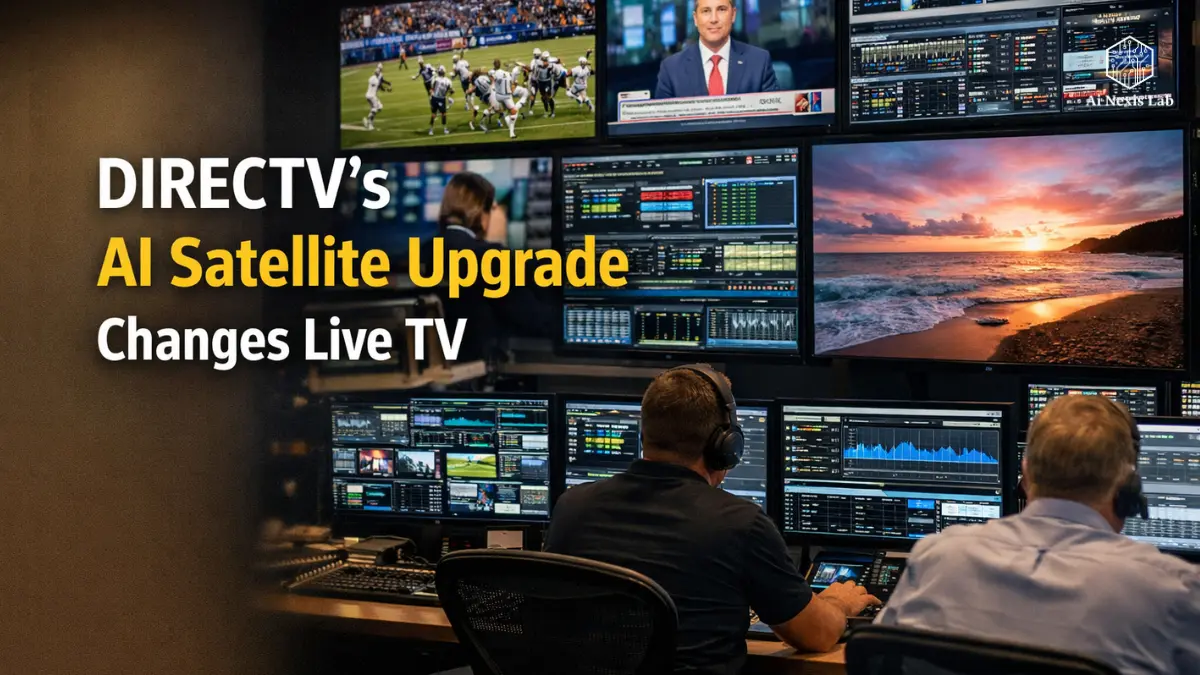
DIRECTV Satellite Upgrade 2026 reveals 7 powerful AI changes improving live sports, 4K TV, ad delivery, and satellite TV reliability across America.
Inside one of the biggest behind-the-scenes upgrades in American television history – and why it matters even if you’ve never heard of the company making it possible
Most people turning on their TVs tonight don’t realize that the biggest infrastructure change in modern television is taking place away from their living rooms.
No flashy app launches. No celebrity-fronted advertising campaigns. No “New Feature” banner appears on the screen.
Instead, deep within DIRECTV’s technical backbone, the company is rebuilding the system responsible for delivering live television from broadcasters to millions of American homes.
And honestly? This is more important than most streaming launches.
In April 2026, DIRECTV confirmed that it was replacing a large portion of its legacy satellite broadcast infrastructure with Harmonic’s VOS® Media Software Platform – a unified, cloud-native system designed to modernize how channels are ingested, encoded, scheduled, branded, monetized and delivered.
It sounds technical because it is technical. But it also impacts the things that ordinary people really care about:
- Better live sports quality
- Fewer broadcast glitches
- Stronger pay-per-view reliability
- Smarter ad delivery
- Potential 4K channel expansion
- Lower operating costs that can impact pricing
This isn’t just a backend upgrade.
It’s DIRECTV trying to prove that the future of satellite TV is still in a world dominated by Netflix, YouTube, and every streaming platform fighting for your attention.
And if they do this right, the effects will be felt on American television for years.
Let’s break down exactly what’s happening, why it matters, and what it says about where TV is going next.
Table of Contents
The Problem No One Saw: DIRECTV’s Aging Broadcast Backbone
Before you can understand why this upgrade is important, you need to understand what was broken.
To clarify: Your TV signal was probably still working.
That wasn’t the issue.
The problem was the machinery underneath it.
For years, large television providers like DIRECTV operated on what can only be described as a patchwork system of separate tools, separate vendors, and separate hardware boxes, all trying not to break at the same time.
The Old Broadcast Model Was Built For Another Era
Traditional TV delivery works like this:
- A channel feed comes in from a broadcaster
- Another system ingests it
- Another encodes it
- Another handles scheduling and playout
- Another inserts ads
- Another adds graphics and branding
- Another prepares it for satellite transmission
Each step often resides on separate hardware.
Different vendors. Different support agreements. Various upgrade schedules. Different failure points.
It’s like trying to run a modern airport using systems built in 1998.
It works… until it breaks.
And when a piece breaks, everything becomes painful.
Why “Siloed Systems” Get Expensive Quickly
Jeffrey Seto, DIRECTV’s VP of Satellite and Software Engineering, described an age-old problem head-on: siloed systems.
The term is important.
Because every silo means:
- More hardware to maintain
- More vendors to manage
- More engineers needed
- More integration headaches
- More risk during upgrades
- More operational costs every month
This becomes brutal on a national scale.
DIRECTV is not operating ten channels.
They are operating hundreds of linear channels, live sports events, pay-per-view programming, premium content security, and nationwide DTH (direct-to-home) delivery.
That level of complexity punishes old architecture.
Streaming Competitors Changed The Rules
Meanwhile, streaming platforms made everything differently.
Netflix, YouTube TV, Hulu Live, and modern cloud-native services were designed around software-first systems from day one.
They scale quickly.
They update quickly.
They deploy quickly.
They adapt quickly.
Legacy satellite providers like DIRECTV can’t just “start over.”
They currently have millions of subscribers relying on the service.
No one has the opportunity to pause live television to rebuild the system.
So the mission became clear:
Rebuild the engine while the car is running.
Harmonic’s VOS platform is designed to do this.
Meet Harmonic: The Company Most Viewers Have Never Heard Of
Harmonic is not a household name.
But in the media infrastructure world, they are a major player.
Based in San Jose, California, and publicly traded on NASDAQ under the ticker HLIT, Harmonic specializes in broadband delivery, video compression, and broadcast infrastructure.
Simply put:
They build software that helps large media companies move video efficiently.
They are the company behind the plumbing – not the faucet.
And in media, plumbing is important.
A lot.
Why DIRECTV Chose Harmonic
This wasn’t a casual vendor decision.
DIRECTV needed:
- National-level reliability
- AI-powered encoding improvements
- Private data center deployment
- Unified ad insertion and playout
- Robust API integration
- Support for high-value live events
Future hybrid satellite + streaming flexibility
That’s where Harmonic’s VOS platform is strongest.
This wasn’t about buying software.
It was about changing the operating system of television delivery.
That’s a very big bet.
What Harmonic’s VOS Media Software Actually Does
VOS stands for Video Operating System.
That name is accurate.
It is not a tool.
It is the main platform that manages the entire broadcast workflow.
Instead of seven separate systems performing seven separate tasks, VOS centralizes the stack.
Let’s break down the main pieces.
Ingest: Where Every Channel Begins
Every TV channel begins as a source feed.
Sports networks.
Local stations.
News channels.
Premium Movie Networks.
Pay-per-view event feeds.
It all has to be fed into the system first.
That process is called ingest.
Older systems often require dedicated hardware for each source.
It gets expensive quickly.
VOS converts ingest into software.
Need a new channel?
Spin up a new software instance.
No expensive rack installs. No need to wait on hardware purchases.
That speed is operationally important.
Advanced Playout: The Heartbeat of Live TV
Playout is where television becomes television.
It controls:
- Program scheduling
- Time precision
- Channel transitions
- Graphics overlay
- Break timing
- Interstitial content
- Event launch
It ensures that the game starts at 8pm at 8pm.
Not 8:03.
Not 8:07.
Exactly on time.
At DIRECTV’s scale, that means coordinating hundreds of channels at once.
This includes “occasional-use channels” such as live boxing events, seasonal sports packages, and pay-per-view broadcasts.
Those are high-value channels where mistakes quickly become costly.
VOS handles it centrally.
That’s a major operational benefit.
Inserting an ad: Where Does The Revenue Actually Come From
Let’s be clear.
Advertisements pay for television.
Even when the audience hates them.
Inserting an ad is not just “running an ad.”
It requires precision:
- Right time
- Right place
- Right targeting
- No missed ad windows
- No broken transitions
Missed ads = lost revenue.
Bad timing = angry viewers.
Entering late during live games = disaster.
DIRECTV’s modernization is a big focus here because advertising implementation directly impacts profits.
This is one of the least attractive but most financially important parts of the system.
AI-Powered Encoding: a Real Game Changer
This is where things get really interesting.
Traditional video encoding is slow.
It compresses content using fixed rules.
Same logic for a football game and a weather report.
It is inefficient.
AI-powered encoding changes that.
It analyzes the content itself.
Fast-moving sports action?
Allocate more bandwidth.
Static news anchor?
Use less.
The result:
- Better picture quality
- Less visible compression loss
- Lower bandwidth usage
- Better use of expensive satellite capacity
This is especially important for:
- NFL games
- NBA broadcasts
- UFC events
- Boxing pay-per-view
- Fast-action sports
These are precisely the moments when viewers see quality issues the most.
AI helps solve them.
Statistical Multiplexing: Smart Use of Satellite Space
Satellite bandwidth is brutally expensive.
Each transponder costs real money.
You don’t want to waste it.
Statistical multiplexing – or stat mux – allows multiple channels to dynamically share bandwidth.
Instead of each channel getting a fixed capacity:
- Sports get more when needed
- Documentaries get less when possible
- Live action gets priority
- Static content gets bandwidth back
That means better efficiency without needing more satellite space.
This is an invisible upgrade that viewers never see directly – but they get the full benefit of it.
Why Is It Important To Run It In a Private Data Center?
This part is constantly misunderstood.
People hear “cloud-native” and assume public cloud.
That is wrong.
DIRECTV is not running this on AWS or Azure.
They are running it in their own private data center.
That difference is important.
A lot.
Cloud-Native Does Not Mean Public Cloud
Cloud-native refers to the architecture principles:
- Microservices
- Containers
- API-first design
- Horizontal scaling
- Software-defined infrastructure
You can run it anywhere.
DIRECTV chose an on-premises deployment because live television has different priorities than typical SaaS software.
Why Public Cloud Isn’t Always Better
For live national TV delivery, issues include:
- Latency sensitivity
- Security concerns
- Massive cost
- Premium content security
- Operational control
Milliseconds matter in live sports.
Content security is important for premium PPV events.
Control is important when millions of subscribers rely on uptime.
Private Cloud gives DIRECTV the flexibility of modern software without giving up control.
It’s smart.
Not trendy – smart.
Why This Is Bold In 2026: Satellite TV Is Not Supposed To Be The Future
Let’s answer the obvious criticism.
Why invest heavily in satellite TV right now?
Isn’t streaming already winning?
Yes.
And no.
Cord-Cutting Is Real – But So Are The Benefits of Satellite
Traditional pay TV has been losing subscribers for years.
That is reality.
But satellite still solves problems that streaming completely solves.
Especially for:
- Rural America
- Weak broadband markets
- Live sports reliability
- Family viewing on the big screen
- Simple bundled TV experiences
Millions of homes still
Frequently Asked Questions (FAQ)
What will DIRECTV really change with its satellite system in 2026?
DIRECTV is replacing its aging, fragmented broadcast infrastructure with Harmonic’s VOS® media software platform. Instead of relying on multiple separate hardware systems for ingest, encoding, ad insertion, playout, branding, and delivery, everything goes into one unified software-based environment.
This helps reduce operational costs, improve video quality, strengthen reliability for live sports and pay-per-view events, and create a scalable foundation for future satellite and hybrid TV services in the United States.
Is DIRECTV shutting down satellite TV and going completely to streaming?
No, and that assumption is wrong. This upgrade proves that DIRECTV is still investing heavily in satellite television, especially for live sports, rural customers, and homes that rely on reliable TV without strong broadband internet.
Streaming is important, but DIRECTV is focusing on a hybrid future where satellite handles live TV and streaming supports on-demand content. It’s not replacement – it’s convergence.
What is Harmonic’s VOS Media Software and why is it important?
VOS stands for Video Operating System, and it acts as the central brain of DIRECTV’s broadcast delivery system. It manages channel ingest, playout scheduling, ad insertion, branding, encoding, compression, and satellite distribution from a single platform.
Instead of running separate hardware for each task, VOS handles everything through software. That means faster updates, fewer failures, lower costs, and better performance nationally.
What does AI-powered encoding actually improve for viewers?
Traditional encoding treats every video scene roughly the same, which wastes bandwidth and often causes quality degradation during fast-motion scenes like football, basketball, or boxing broadcasts.
AI-powered encoding analyzes content in real time and gives more bandwidth to complex action scenes while reducing waste on static scenes like news anchors. That means sharper live games, fewer blurry moments, and better overall picture quality.
Will DIRECTV subscribers really see a difference?
Yes, but mostly indirectly. You may not get a message saying “System Upgraded,” but you will see better game quality, smoother pay-per-view events, fewer broadcast glitches, and cleaner ad transitions during live programming.
The biggest improvements occur during high-value live events where reliability is most important. Good infrastructure is usually invisible – that’s the point.
Why is DIRECTV using a private data center instead of AWS or a public cloud?
Because live national television is not like running a normal software app. Public cloud can present latency, higher costs, and greater control issues for premium content like sports and pay-per-view.
DIRECTV chose a cloud-native architecture but runs it in its own private data centers. It gives them flexibility and scalability without losing control over security, speed, and performance.
How does this affect 4K and HDR channel expansion?
Satellite bandwidth is expensive, and because of that, DIRECTV has always been limited in how much 4K content it can offer. AI-powered compression helps use that bandwidth more efficiently, making 4K delivery more practical and affordable.
That means DIRECTV has a better chance of expanding its 4K and HDR channel lineup without dramatically increasing delivery costs over the next few years.
Why are ad insertion systems such a big deal?
Because advertisements are the main source of income. If ad breaks are timed incorrectly, skipped, or poorly inserted during live sports, DIRECTV loses money and viewers are frustrated.
The integrated system improves accuracy and reliability for ad distribution. Better ad placement makes it easier for subscribers to see and leads to better revenue for the business.
Is this upgrade enough to prevent the loss of satellite TV customers?
No, and it would be foolish to say anything else. The decline in subscribers is a real structural problem caused by cord-cutting and aggressive streaming competition.
This upgrade doesn’t magically fix it, but it does make DIRECTV more competitive by reducing costs, improving service quality, and helping the company protect those parts of the market where satellite still wins.
Why is this such a big win for Harmonic?
Because bringing DIRECTV as a customer is a huge industry recognition. When one of America’s largest satellite TV providers trusts your platform for nationwide direct-to-home service, other broadcasters take notice.
This gives Harmonic a powerful reference case for future deals in sports broadcasting, cable providers, telecom operators and global television networks. It’s not just another client – it’s a major win.