The $20 Billion AI Turning Point: How Nvidia’s Move to Groq Is Reshaping the Future of Artificial Intelligence
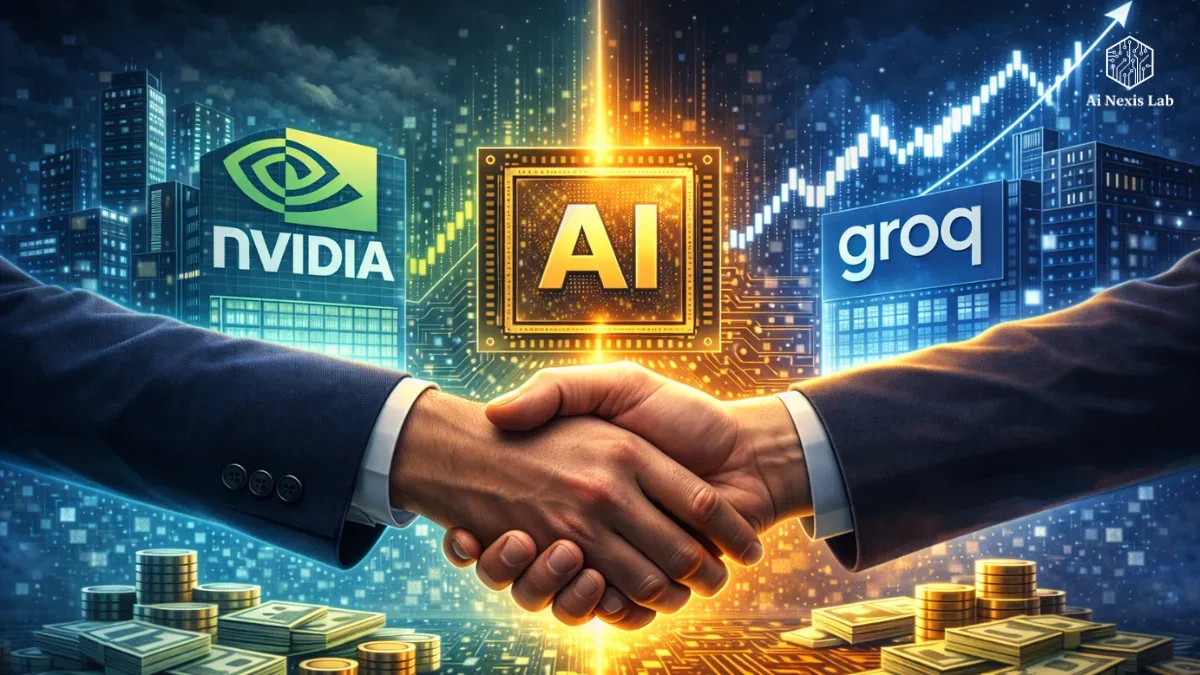
Nvidia’s $20 billion Groq deal delivers faster AI, lower costs, and innovation. See how this bold step could reshape the future of prediction and smart systems.
Just when you thought the AI hardware world couldn’t get any more competitive, the industry was hit with a Christmas-Eve bombshell: Nvidia, the company that has become synonymous with AI computing power, has struck a nearly $20 billion deal with Groq, a startup that was generating serious buzz for its ultra-fast AI chips. The number itself is eye-opening — but the real story is what the deal tells us about the direction of AI, competition, and where computing power is headed.
Before we move on, let’s take a breath and unpack this in a way that is grounded, clear, and free of confusing terms.
1. What Really Happened – A Deal, Not a Classic Buyout
Headlines have been mixed – some are calling it an “acquisition”, others a “mega-buy”, and still others a “licensing deal”. The truth is that Nvidia is paying around $20 billion to secure Groq’s core assets and technology, entering into a non-exclusive licensing agreement, and bringing top Groq talent, including the founder and other leaders, to Nvidia.
Importantly, Groq is not completely swallowing itself as an independent company with every division tied up in Nvidia. Instead, Groq will continue to operate independently in some capacities — for example, its cloud business remains separate — while Nvidia gains access to critical technologies and people to help build next-gen AI systems.
So why the ambiguity in the wording? Because this is a smart hybrid deal: part asset acquisition, part tech licensing, part talent hire, all wrapped up in a structure that could help Nvidia move quickly without triggering as much aggressive antitrust scrutiny as possible.
2. Who is Grok
To understand why this deal is really important, you need to know what Grok created.
Founded in 2016 by chip designer Jonathan Ross (a veteran of Google’s Tensor Processing Unit program), Grok created a very different type of AI processor known as a Language Processing Unit (LPU). Unlike traditional graphics chips or even the new Tensor Accelerators, Grok’s architecture was purpose-built to run AI models – particularly large language models – with extremely low latency and critical performance.
To put it bluntly:
- Typical AI chips are good for training large models—teaching them patterns and behaviors.
- Groq’s design excels at running existing models very quickly—especially for things like real-time inference, where speed and predictability matter a lot.
Developers turned to Groq’s cloud services to run models like Llama and others because of how fast and efficient they can be—a rare win in an industry where computing costs can skyrocket.
That’s what made them both interesting and threatening to the big players. Nvidia’s GPUs have dominated AI model training for years—but Groq showed a way where inference workloads could be dramatically faster and cheaper.
3. Why it’s a big deal (literally and strategically)
So why would Nvidia spend nearly $20 billion to get Groq’s technology and people into orbit?
A. Strengthening the dominant position in AI
There are two main stages of an AI model:
- Training – teaching the model.
- Inference – Using a model to actually answer questions or make decisions.
Nvidia’s GPUs are the undisputed leader in training. But the industry’s center of gravity is slowly shifting: As AI becomes mainstream, tech companies and developers are increasingly concerned with running models quickly and cheaply — i.e., inference. Groq’s chips were really competitive in that space.
Bringing that technology into Nvidia’s ecosystem gives Nvidia more tools to dominate both training and inference.
B. Talent is part of the package
Getting the brains behind great technology is always as important as the tech itself. This deal brings forward leading engineers and executives who truly understand how to make hardware predictable. It includes Grok’s founder and senior leadership.
In areas where expertise is scarce and technology is intense – such as hardware and AI – landing a team like Grok adds enormous strategic value.
C. Clever Regulatory Position
A big part of the narrative surrounding this deal is its clever legal structure: By licensing technology and acquiring assets rather than taking over the entire company, Nvidia is likely avoiding some of the tough antitrust hurdles that come with big tech acquisitions. Regulators around the world, including the US FTC and European authorities, have been increasingly wary of tech consolidation that could stifle competition.
That doesn’t mean opposition is off the table – but this structure gives Nvidia a bit more runway and flexibility.
D. A signal for the industry
This isn’t just another line item on Nvidia’s balance sheet.
At nearly three times Groq’s recent market valuation, the size of this transaction suggests that Nvidia is willing to spend heavily to own the future of AI hardware. The message for competitors, investors, and developers is clear: Nvidia plans to stay on top – not by riding on its past success, but by reinventing how AI is run.
4. Impact on Developers and the Broader AI Ecosystem
If you’re a developer, engineer, or startup founder wondering how this will work for your project, there’s a lot to unpack.
Pros:
- Unified tools and ecosystem: Nvidia has a large, mature software and hardware ecosystem (think CUDA, developer tools, integrations with cloud providers). If Groq-style inference is folded into that stack, developers can benefit from a cleaner, more efficient workflow.
- Broader reach for speed innovation: Specialized prediction technology can find its way into everyday devices and edge computing (robots, mobile AI devices, etc.), improving responsiveness and reducing costs.
- A more stable roadmap: A startup’s future can be uncertain – development timelines stretch, money dries up. With the support of this technology and talent from Nvidia, those innovations are more likely to stick around and scale.
Cons:
- Less competition: Groq was one of Nvidia’s few independent challenges in AI processing. Now that its tech and leaders are aligned with Nvidia’s path, the market may see less competition.
- The risk of monoculture: When most AI hardware and software decisions are driven by the priorities of a single company, innovation can become more incremental and less disruptive. Independent innovation often comes from different players who push the boundaries in different ways.
- Potential downside to options: With Groq away from the independent battleground, other contenders – while still active – could face a higher climb to gain serious traction.
5. What this means for AI everywhere
The implications of this deal go far beyond Cisco boardrooms or chip fabrication labs:
A. For the Edge
The efficiency of Grok’s design could ultimately make high-performance AI inference cheaper and faster outside of massive cloud data centers. It paves the way for AI:
- Industrial automation
- Autonomous vehicles
- Healthcare devices
- Robotics
- Consumer electronics
These are use cases where real-time response is critical—and you don’t want millisecond delays.
B. For Cloud Providers and Infrastructure
Cloud platforms will benefit from faster, more energy-efficient inference hardware as it reduces operational costs and provides better service for users. Integrating Nvidia Groq tech means that cloud GPUs can now get better at inference without dedicated third-party chips.
C. For AI Business Models
Lower compute costs can unlock business models that were previously unfeasible, especially for startups and research teams working with limited budgets. Imagine being able to run complex real-time AI without needing thousands of cloud credits.
6. Will the deal block regulators?
Even with a licensing framework designed to reduce antitrust risk, regulators will be closely watching whether the move effectively eliminates a competitor or reduces options in the AI prediction market.
Legally framing the deal as a technology license and talent acquisition – rather than an outright purchase – may be smart, but that doesn’t make it immune to scrutiny. People will argue whether this still reduces real competition.
So don’t be surprised if this deal is reviewed, debated, and analyzed in public and political forums for months or years.
Bottom Line:
A Strategic Move That Rewrites the AI Hardware Playbook
This is not an easy acquisition. It’s not just a talent hire. And it’s not just another licensing deal.
It’s all three at once.
At around $20 billion, this move shows that the future of AI isn’t just about building big language models. It’s about running them faster, more cheaply, and in more places than ever before. Whether you’re a developer, startup founder, or technology leader, this deal is a turning point worth paying attention to.
Frequently Asked Questions (FAQ)
Q1: Is Nvidia buying Groq outright?
Not exactly. The core of the deal is a non-exclusive technology licensing agreement and the transfer of key assets. Nvidia is also bringing in Groq’s top engineers. Groq itself will continue to operate independently in areas such as its cloud business.
Q2: Why is $20 billion such a big number?
Groq was valued at around $6.9 billion in its latest funding round just a few months ago. The scale of the deal – three times the valuation – signals Nvidia’s strategic urgency to secure its unique inference technology and the talent that created it.
Q3: Will this affect Nvidia’s competitors?
Yes. Chipmakers and cloud platforms will now have to factor this technology shift into their roadmaps. Rivals who hoped to challenge Nvidia in prediction are now facing a competitor armed with both GPU dominance and specialized prediction capabilities.
Q4: What about open-source models and independent AI development?
The long-term impact is complex. On the one hand, rapid inference helps in the broader reach of AI capabilities. On the other hand, the concentration of hardware influence can limit competitive diversity. The balance will depend on how Nvidia and the broader ecosystem evolve.
Q5: Could this deal be blocked by regulators?
Regulators, especially in the U.S. and Europe, are likely to be watching closely, as the deal integrates significant AI technology and talent. The structure – licensing rather than outright acquisition – may help Nvidia withstand some scrutiny, but it doesn’t make it immune.