You’re probably losing more money than you think by spending money
The 24-hour rule will still work in 2026 – and honestly, it’s one of the few money habits that doesn’t get overhyped.
It usually happens late.
You’re lying in bed, half-paying attention to a show, scrolling through your phone, and suddenly there it is: something you didn’t know existed five seconds ago exists but now somehow feels essential.
Maybe it’s a pair of sneakers. A kitchen gadget. A productivity app that promises to fix your life for $14.99 per month.
You hit “Buy Now”.
A week later, it shows up. The excitement is gone. Sometimes the box just sits there. Unopened.
That little moment? It’s costing people a ridiculous amount of money.
The latest Consumer Spending Survey, looking ahead to 2026, shows that Americans are still dropping about $3,000 to $3,500 annually on impulse purchases, despite inflationary pressures, higher borrowing costs, and all the talk of smart budgeting. And that’s the frustrating part: most people know they’re overspending.
They just keep doing it.
The good news is that this is not usually about discipline. It’s not because you’re irresponsible or “bad with money”. It’s lazy advice.
The real issue is that modern shopping systems are designed to use your brain function.
And one simple habit – the 24-hour rule – creates enough friction to break the cycle.
Table of Contents
Why Your Brain Is Basically Designed To Overspend
This may sound dramatic, but it’s true.
Buying ahead is mostly not a money problem. It’s a brain chemistry problem.
When you want something, your brain releases dopamine. Here’s the catch that most people miss: dopamine rises in anticipation, not in possession.
There is a rush before shopping.
That’s why clicking checkout feels strangely satisfying, while receiving the item often feels… flat.
Retailers know this. Social commerce platforms know this. Recommendation algorithms certainly know this.
That “only 2 left” alert? Engineered pressure.
The timer is counting down from 14 minutes? Manufactured urgency.
Is it a hyper-personalized ad showing exactly what you’re thinking about making a purchase? No coincidence.
In 2026, shopping has become terrifyingly efficient at compressing desire into action.
TikTok Shop, Instagram Checkout, one-click Amazon purchases, AI-personalized recommendations – they all eliminate the pause.
And a pause is exactly what your rational brain needs.
The 24-Hour Rule: Ridiculously Simple, Oddly Effective
This rule is almost insultingly straightforward:
Before making any non-essential purchases over a certain amount, wait 24 hours.
That’s it.
No complicated spreadsheets. No budget app subscriptions. No expense journal with color-coded categories that no one sticks to after two weeks.
Just wait.
If you need something:
- Screenshot it
- Save the link
- Write it down
- Leave it
Then revisit it another day.
That waiting period is important because it blocks what psychologists call the hot-cold empathy gap.
When you are emotionally activated – excited, bored, stressed, angry, tired – your decision-making becomes erratic.
Twenty-four hours allow the emotional surge to cool down.
And honestly? Most purchases do not survive the cooling period.
You either forget about them or realize they weren’t that attractive to begin with.
That is useful information.
What Really Happens During Those 24 Hours
A lot more than people think.
The urgency fades.
The emotional story you told yourself (“I need this”) starts to sound a little ridiculous.
You start asking better questions:
Do I already have something similar?
Would I still want this if it weren’t for the discount?
Am I buying the product or the fictional version of myself attached to it?
That last one hits the nail on the head.
A lot of purchases aren’t about utility.
It’s aspirational.
You’re not buying a stand mixer. You are buying into the idea of baking artisan bread every Sunday.
You are not buying an expensive note-taking app. You are buying into the idea of being hyper-organized.
Sometimes that’s good.
Usually it is an expensive self-imagination.
Hidden Costs Most People Ignore
Impulse spending isn’t just about what comes out of your account.
It’s about what that money could have done instead.
Say you spend $150 per month on impulse.
That sounds manageable. Almost harmless.
That’s $1,800 per year.
Invested consistently at historical market-average returns? That turns into serious money over a decade.
And sure, not every missed purchase should automatically become an investment contribution. That’s unrealistic.
But some of them can be.
That’s the point.
The real cost of an impulse purchase is rarely the purchase itself.
It’s that trade you never stop thinking about.
What This Looks Like In Real Life
The Online Shopping Spiral
You see an $89 jacket on Instagram at 11:30 PM.
Instead of buying it, you save it.
The next evening, you look again.
Now it just looks like… a jacket.
The urgency is gone.
Problem solved.
“Deals” In The Store
You get a device marked down 40%.
Your brain screams: Deal.
Reality check: The discount is still spending money on something you didn’t plan on buying.
Sometimes getting out is a real win.
Subscription Traps
This is more subtle.
The $12 monthly app seems trivial.
It’s not.
It’s $144 annually, often automatically renewing long after you stop using it.
The 24-hour rule should apply fully to subscriptions.
Honestly, maybe even 48.
Why Do Most People Fail To Use This Rule
Because they think of it as an intention rather than a system.
Good intentions are useless under a frictionless checkout design.
You need structure.
Set a Spending Threshold
Pick your number.
Maybe $30. Maybe $75.
Anything above that starts to stall.
Without a specific trigger, your brain negotiates every purchase.
And your brain is excellent at arguing for desired things.
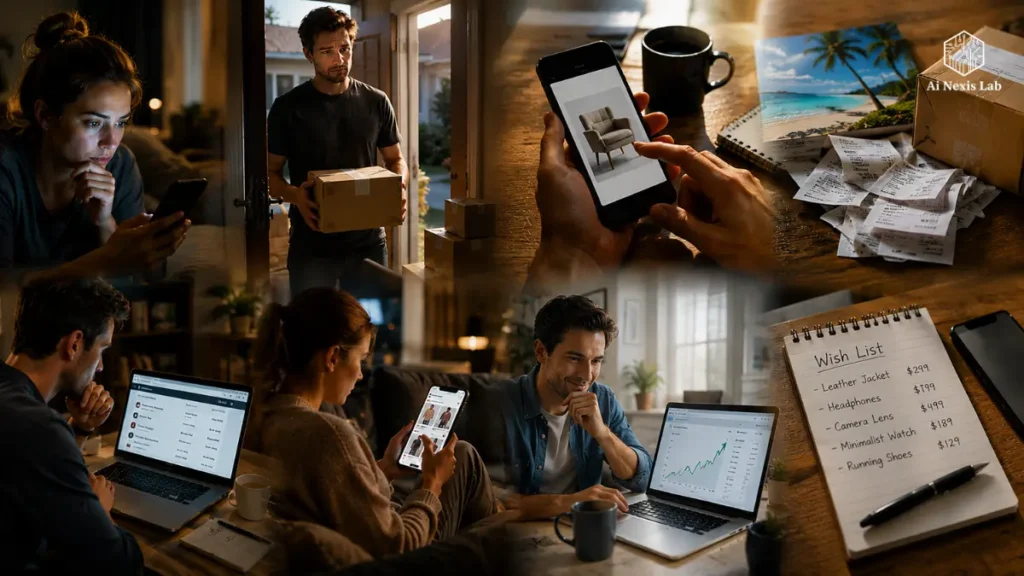
Create a Pause List
Use your notes app.
Track:
- Item
- Price
- Date
- Why you wanted it
The “why” is important.
Writing it down quickly reveals weak reasoning.
Remove Stored Payment Methods
This may seem trivial.
It’s not.
An extra 45 seconds of effort kills a surprising number of impulse purchases.
Convenience helps retailers, not you.
The Big Psychological Shift: Learning What “Enough” Feels Like
This is where things get interesting.
After a few months, something changes.
You stop automatically reacting to wants.
You start to see the gap between wanting something and needing it.
It seems obvious. It’s not.
Most people spend years trying to separate those two ideas into one.
The 24-hour rule teaches separation.
And once you develop that awareness, shopping becomes less emotional.
Less frenetic.
Less tied to boredom, stress, and random mood swings.
That’s the real fruit.
Not just more savings.
Better decisions.
Five Quick Filters That Make the Rule Stronger
Future-Self-Test
Will this still be important to me in six months?
If you can’t imagine using it regularly, skip it.
Work Hours Check
How many hours did you work to earn this?
This question quickly cuts through the marketing nonsense.
Memory Test
Will I remember to buy this in two months?
If not, it’s probably worth less.
Trade-Off Question
What meaningful goal funding will I lose if I buy this?
Trips. Savings. Paying off debt.
Make the competition real.
Trigger Audit
What was happening when I wanted this?
Stress? Boredom? Doomscrolling?
Patterns matter.
What Happens After a Year
This is where people usually expect dramatic changes in life.
It doesn’t work that way.
You probably won’t suddenly become a monk, at least not yet.
You will still buy things.
You should.
The goal is not deprivation.
The goal is purpose.
But if this habit helps you eliminate even half of your impulsive spending, it could mean $1,500+ in annual savings for many households.
That makes sense.
And perhaps more importantly, your purchases start to feel cleaner.
Less regrets.
More usefulness.
Fewer unopened boxes.
It’s not revolutionary.
It’s just healthy.
When The 24-Hour Rule Doesn’t Apply
Let’s not turn this into financial extremism.
You don’t have to wait 24 hours for:
- Groceries
- Medicine
- Urgent repairs
- Planned purchases you’ve already researched
Use discretion.
In fact, for larger purchases, you should extend the waiting period.
A good rule of thumb:
- Under $100 → 24 hours
- $100-$500 → 72 hours
- $500+ → At least a week
The more emotional the purchase, the more time it deserves.
Simple.
Final Thoughts
The reason the 24-hour rule works is almost annoyingly simple:
It gives your rational brain time to catch up.
That’s it.
It doesn’t require superhuman discipline.
It doesn’t tell you to stop wanting things.
It simply inserts a deliberate pause between desire and action.
And in a shopping environment designed to eliminate every interruption, that little delay is powerful.
The next time your thumb wanders at the checkout, don’t think too much about it.
Save it.
Walk away.
Come back tomorrow.
If it still seems worth buying, great.
At least then it will really be your decision.
Frequently Asked Questions
Does the 24-hour rule really reduce overspending?
Yes – if you use it consistently.
This rule works because most impulse-buying motivations are emotional and temporary. Once the initial dopamine spike subsides, your brain evaluates the purchase more rationally. Many things that seemed urgent suddenly seem unnecessary.
It won’t stop every bad purchase. It’s unrealistic. But it significantly reduces impulse-buying decision-making over time.
What if the sale ends before the waiting period is over?
Then let it expire.
It sounds harsh, but most “limited-time” discounts come back. Retailers keep repeating the urgency because it works.
If the only reason you’re buying something is because you’re afraid of missing out on a discount, that’s usually a strong sign that you shouldn’t buy it.
Can I use a shorter waiting period?
Sometimes.
For low-cost purchases, a two-hour break can also help.
But 24 hours is enough to break the emotional momentum and sleep on the decision, which is why it works better mentally.
Short breaks are often not enough to completely cool down the impulse.
Should this also apply to subscriptions?
Absolutely.
Honestly, subscriptions could be subject to stricter rules because they grow quietly.
The $15 monthly charge alone may seem small, but recurring costs add up quickly and often exceed your actual use of the service.
Always calculate the annual total before saying yes.
Why do I still need things after waiting?
Because some purchases are legitimate.
This rule is not meant to discourage purchases.
It is meant to separate real value from temporary emotional desire.
If you still want it after waiting – and it fits your budget and priorities – buy it without guilt.