AI Roadmap to 2026: 5 Real Transformations That Will Change the Way You Work, Think, and Build
AI Roadmap 2026 reveals 5 powerful predictions shaping work, shopping, jobs, and business. See what changes first and how to stay ahead.
Table of Contents
Introduction: This Is Not Another “AI Is The Future” Article
Let’s cut through the noise.
Most AI content is recycled fluff. Someone reads a few headlines, strings together buzzwords like “revolutionary” and “game-changing,” and calls it insight. You’ve seen it. Everything looks the same – and none of it really helps you make good decisions.
This isn’t the case.
This breakdown is based on what is actually happening in 2026 – not the hype cycle, not the marketing layer, but the real change underneath. And here’s the uncomfortable truth that most people are avoiding:
AI is no longer in the “wow” phase. It’s in the “prove it” phase.
The innovation is gone. The demos are done. Now comes the part that really matters – does it work consistently, does it create measurable value, and does it justify the price?
If you look at the first few months of 2026, the momentum itself tells you that something serious is happening. Major laboratories are advancing trillion-parameter multimodal systems. Coding agents are evolving from autocomplete tools to semi-autonomous builders. AI applications are moving from experimental tools into everyday workflows.
But here’s the twist: Despite all this progress, there’s growing pressure to answer a simple question:
Is this really useful at scale – or just impressive in isolation?
That tension is shaping everything.
This article breaks down five patterns that are already emerging – not guesses, not predictions, but changes you can see right now. If you understand this correctly, you won’t just keep up – you’ll keep yourself ahead of the curve.
Prediction 1: AI Agents Stop Working Alone – They Start Working As a Team
Right now, most people interact with AI as if it were a lone assistant.
You give it a prompt. It responds to you. Maybe it browses the web or writes some code. That’s useful – but limited.
It’s like hiring a highly capable freelancer who can only work on one task at a time, with no other context.
That model is already breaking down.
What’s Really Changing
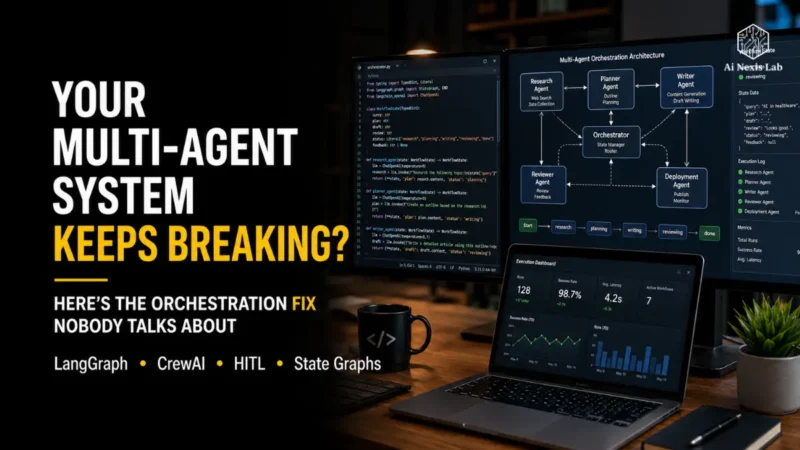
The next wave isn’t about better individual agents – it’s about multi-agent systems.
Instead of one model doing everything poorly, you get to work with multiple specialized agents:
- One handles research
- One analyzes competitors
- One generates content
- One validates output
- One manages execution flow
And it’s all integrated by the orchestrator layer.
This is not a theory. It’s already happening in enterprise environments.
Why This Matters
This changes how work gets done at a fundamental level.
A small team – three to five people – can now function like a full-scale department if they structure the workflow correctly. AI handles the implementation, humans handle the direction.
The hurdle shifts from working to designing a system that works.
The Real Hurdle: Reliability
This is where most people go wrong.
Agents are easy to build. They’re hard to keep reliable.
Multi-agent systems present problems such as:
- Error propagation across tasks
- Contradictory outputs
- Security risks (prompt injection, data leaks)
- Lack of long-term consistency
So the real innovation in 2026 is not just capability – it’s control.
Your Move: Think in Systems, Not Prompts
If you’re still treating AI as a single prompt-response tool, you’re behind.
You need to start thinking like this:
- What is the complete workflow?
- What are the individual steps?
- What parts can be automated?
- Where does the human decision-making reside?
Clarity Engine Technology – “Subtask Decomposer”
Most people fail at AI because they throw vague, oversized requests at it.
It doesn’t scale.
Instead, break everything down into components:
Bad approach:
“Write me a market analysis.”
Professional approach:
- Collect raw data
- Summarize trends
- Identify gaps
- Recommend strategies
- Format output
Each step becomes its own controlled input.
This is how AI teams are built in 2026 – not the tools.
Prediction 2: AI-Driven Shopping Becomes The Default Behavior
This may seem like an exaggeration until you look at the numbers.
AI-assisted commerce is no longer experimental – it is becoming infrastructure.
What It Looks Like in Practice
Instead of manually researching products, you:
- Describe what you want
- Set constraints (budget, features, brand preferences)
- Let the AI agent handle the rest
It will:
- Scan markets
- Compare specs
- Evaluate reviews
- Check availability
- Complete the purchase
All without opening a single tab.
Scale of Shift
This is not a specific feature – it is a behavioral change.
We are moving from:
Human decision-making → Machine-assisted decision-making → Machine-executed decision-making
And that last step is where things get disruptive.
Why This Changes Everything
When AI makes purchasing decisions:
- Branding is less important than structured data
- Emotional marketing loses ground to measurable value
- Product discoverability relies on machine readability
Simply put:
If an AI can’t clearly understand your product, it won’t recommend it.
The Death of Traditional SEO (Slowly)
Search isn’t disappearing – but it is evolving.
We are moving towards:
SEO → AEO (Agent Engine Optimization)
That means:
- Clean metadata
- Structured product information
- Transparent pricing
- Clear comparison points
Your website is no longer just for humans – it’s for machines evaluating you on behalf of humans.
Decision Filter Technique – “Agent-Ready Audit”
Ask a brutally simple question:
If an AI agent had to evaluate your product, profile, or service – would it have enough structured information to make a confident decision?
If the answer is no, you are invisible in the next wave.
Fix it.
Prediction 3: Logic Models Become Your Default Thinking Partner
Let’s address the obvious problem people have with AI:
It’s often wrong.
That has been the biggest obstacle to trust.
Previous models were fast – but shallow. They produced answers that were truly “without thinking”.
That is changing.
What Makes Reasoning Models Different
Instead of going straight to answers, reasoning models:
- Break problems down into steps
- Evaluate intermediate conclusions
- Step back when necessary
- Generate structured reasoning
It’s a completely different ability profile.
Where This Matters Most
Logic models dominate in:
- Complex coding tasks
- Financial modeling
- Legal analysis
- Medical diagnostics
These are areas where being wrong is costly.
Trade-Off
You don’t get this power for free.
Logic models are:
- Slower
- More expensive
- Computationally heavy
But in high-stakes scenarios, that trade-off is clear.
Big Shift
AI is moving from:
Answer Generator → Thought Partner
That’s a big change.
Proof-of-Chain Technique – “The Assumption Stack”
If you’re using AI for something important, stop asking for answers.
Start asking the structure:
- What assumptions are you making?
- Show your reasoning step-by-step
- What could be wrong?
- Where is the uncertainty highest?
This forces the model to function at its highest level – and forces you to really think.
Prediction 4: The AI Bubble Deflates – And It Needs To
Let’s be clear.
There is an AI bubble.
And yes – it will correct.
Why Is This Happening?
Over the past few years:
- Companies overpromised
- Investors overfunded
- Teams rushed implementation
The assumption was:
“Add AI → immediate productivity gains.”
Reality doesn’t work that way.
Where It Breaks
AI fails when:
- Data is messy
- Workflows are not integrated
- Teams are not trained
- Expectations are unrealistic
This is what most organizations are like today.
What Happens Next
Expectations:
- Failed AI projects
- Decreased hype
- Tighter budgets
- More scrutiny
But here’s the key point:
Technology isn’t going away. The nonsense disappears.
It’s healthy.
It forces real value to emerge.
Signal-from-Noise Technique – “The ROI Reality Test”
Before using any AI tool, ask:
- Can you clearly measure the output?
- Does it fit into your workflow – or disrupt it?
- Does it create real leverage – or just a marginal improvement?
Most tools fail this test.
The few that pass are worth serious attention.
Prediction 5: Physical AI Is About to Have Its Breakout Moment
So far everything has been screen-based.
That’s going to change.
What Does “Physical AI” Really Mean
These include:
- Robotics
- Autonomous systems
- AI interacting with real environments
- World models that simulate physical reality
Instead of generating text, these systems:
- Understand the environment
- Make decisions
- Perform actions
Why This Matters
This expands AI into industries such as:
- Manufacturing
- Logistics
- Healthcare
- Construction
These sectors were previously less impacted.
Not anymore.
Hidden Layer: World Models
AI is starting to simulate reality:
- Predict outcomes
- Train systems in virtual environments
- Model physical interactions
Important for:
- Robotics training
- Autonomous vehicles
- Scientific experimentation
Future-Proofing Technique – “The Embodied Skill Audit”
Ask yourself:
- What parts of your work in a real-world environment require human judgment?
- Which parts rely on the interpretation of structured physical data?
The second category is automated first.
Focus your skill development accordingly.
Prediction Bonus: Legal Counting Is Already Underway
This is not a side issue. It is a major obstacle.
What Is Being Decided
Courts are actively addressing:
- Liability for AI output
- Misinformation liability
- Data ownership training
- Defamation risks
Why This Matters
This will shape:
- Product design
- Compliance requirements
- Cost structures
- Risk tolerance
AI is no longer just a technical problem – it is a legal problem.
Insider Tips: What Really Works in 2026
People who get real results with AI are doing a few things differently:
1. They Use AI For Inputs, Not Final Outputs
AI is great for:
- Generating options
- Expanding perspectives
- Stress-testing ideas
Humans still make decisions.
2. They Operate a “Judgment Date”
Whenever you blindly trust AI, you undermine your own thinking.
It gets stronger and stronger.
3. They Build Connected Skills
Now the high-value skills are:
- Workflow design
- Output evaluation
- System orchestration
Not just “prompting”.
Common Pitfalls Most People Encounter Over And Over Again
Pitfall 1: Tool Hopping
Trying to do everything → mastering nothing.
Choose a stack. Go deep.
Pitfall 2: Ignoring Data Quality
Bad input = bad output.
Always.
Pitfall 3: Overconfidence
AI can sound right while being completely wrong.
Dangerous.
Pitfall 4: Waiting Too Long
This place is growing fast.
Delay = disadvantage.
Frequently Asked Questions
Will AI take my job in 2026?
No – but someone is using AI better than you.
That is the real danger. AI isn’t replacing entire roles overnight, but it is narrowing the skills gap.
Someone who understands workflow, automation, and output validation can produce significantly more value than someone who relies on manual processes.
Transformation isn’t about losing jobs – it’s about redefining jobs. If your role is repetitive, predictable, or data-driven, parts of it will be automated. If your role involves judgment, strategy, and decision-making, it evolves – not disappears.
Which AI model is currently the best?
There is no universal “best”.
Different models dominate different use cases:
1) Logic → Advanced models focused on logic
2) Coding → Specialized developer agents
3) Cost efficiency → Open-source ecosystems
The mistake people make is chasing the “best model” instead of building the best workflow.
Your stack is more important than an individual tool.
Will the AI bubble burst?
Not a collapse – true.
There is more talk than reality, and that gap is closing.
You will see failed startups, reduced valuations, and strict expectations. But that’s normal for any major technological change. This happened with the internet, mobile and cloud.
What survives is what really works.
How can I use AI without sounding robotic?
Stop using it to write your final output.
Use it for:
1) Research
2) Idea generation
3) Structure
Then write yourself.
The reason AI content feels empty is simple: it lacks lived experience and strong opinions.
Add that back.
What skills should I focus on right now?
Three areas:
1) Workflow design – connecting tools into systems
2) Critical evaluation – knowing when AI is wrong
3) Strategic thinking – whether to be automated or human
This is sustainable.
Everything else changes quickly.
Final Verdict
Here’s the reality most people don’t want to hear:
AI is already here.
2026 is not about discovery – it’s about differentiation.
The gap is growing between:
- People experimenting casually
- People deeply integrating AI
That gap is growing rapidly.
The five shifts you just read about are not predictions of the future – they are already unfolding.
The only real question is:
Are you adapting fast enough to stay relevant?
You don’t have to master everything.
Pick a field. Go deep for two weeks. Create something real.
This is how you stay ahead – not by using more stuff, but by actually using what’s already here.