
Your wrist, your ears, your face: The brutal truth about wearable AI in 2026
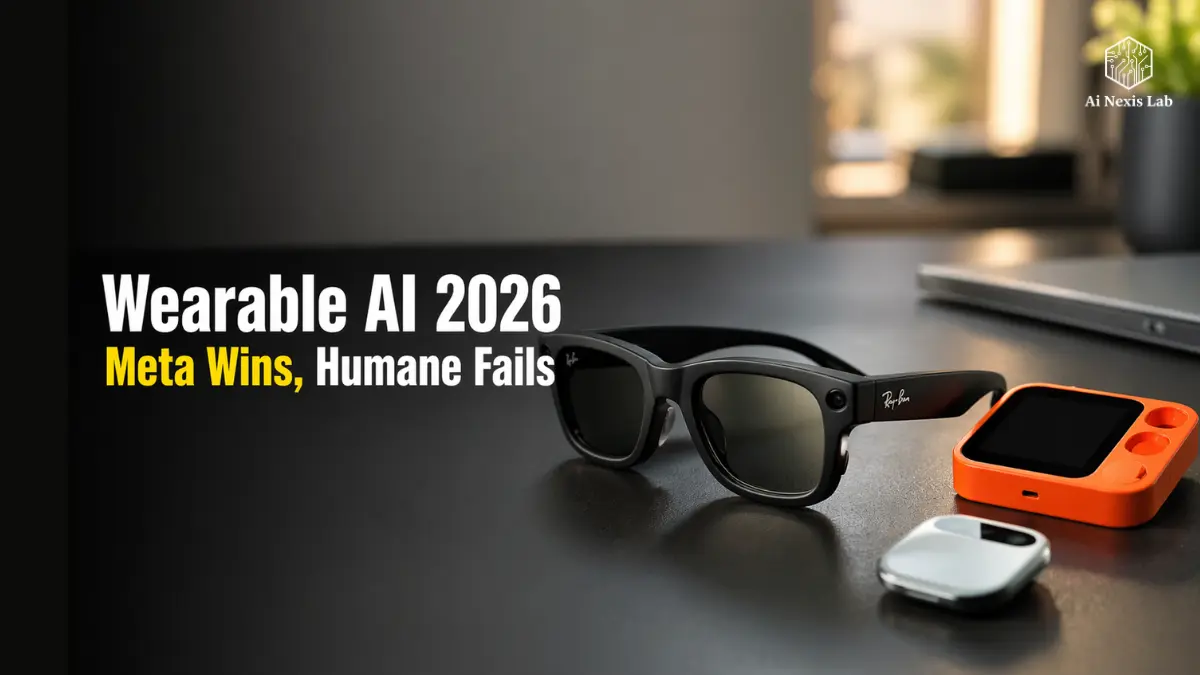
Wearable AI 2026 reveals 7 powerful winners and failures-Humane AI Pin, Rabbit R1, and Meta Ray-Ban Glasses. See what’s truly worth buying.
Human AI Pin vs. Rabbit R1 vs. Meta Ray-Ban Glasses – Who Failed, Who Survived, and Who Quietly Won
By a person who actually saw the hype, tested the promises, and paid attention after launch day.
Table of Contents
Introduction: The Gadget War Designed to Kill The Smartphone
Let’s be honest – 2024 was the year your phone started to become obsolete.
Everywhere you looked, the pitch was the same:
- “This pin on your shirt replaces your iPhone.”
- “This orange AI box manages your life for you.”
- “These glasses become your new assistant.”
It felt like the beginning of a sci-fi movie.
And for a minute, people believed him.
The biggest names in tech media were talking about the future of “ambient computing.” Venture capital flooded into the space. Former Apple executives were treated like prophets. The founders said that the smartphone era is already ending.
Then reality set in.
By early 2025, the Human AI PIN was effectively dead, with HP acquiring Human’s assets for $116 million and discontinuing core production. The devices stopped working after February 28, 2025, leaving many buyers suffering from expensive hardware.
The Rabbit R1, once derided as “barely reviewable,” somehow survived through relentless updates and product iterations.
And a “boring” product – the Meta Ray-Ban smart glasses – quietly became a mainstream winner, with more than 7 million AI glasses sold in 2025 alone, according to EssilorLuxottica’s 2025 results.
Three devices entered the race.
One died miraculously.
One adapted to survive.
One won by refusing to be too ambitious.
It tells us much more about the future of AI than any exciting keynote.
This breakdown is based on the original blog – but updated, expanded and rebuilt for 2026 to include what really happened after the hype faded.
Because hype is cheap.
Hardware isn’t.
Section 1: Why Everyone Lost Their Minds Over AI Hardware
To understand the fallout, you need context.
When OpenAI launched ChatGPT in late 2022, it didn’t just create another app.
It sparked a new obsession.
Suddenly, every founder and investor was asking the same question:
“If AI can do this inside a browser… what happens when it’s connected to your body?”
That question started the wearable AI gold rush.
And honestly, the logic made sense.
Your smartphone is powerful – but it demands constant attention.
You unlock it.
You check the notifications.
You scroll for no reason.
You lose an hour.
The dream of wearable AI was simple:
What if intelligence came to you instead?
No screens.
No app switching.
No need to take out your phone 200 times a day.
Just AI – always available, frictionless, invisible.
That dream is still powerful.
The problem is execution.
The Large Action Model Fantasy
The most exciting idea came from Rabbit.
They introduced this phrase:
Large Action Model (LAM)
Promise?
Instead of answering questions like ChatGPT, AI will actually do everything for you.
You would say:
“Order me an Uber.”
And instead of giving you directions, it:
- Log in to your Uber account
- Select your saved location
- Request a ride
- Complete the task
No app.
No tapping.
Just delegation.
That’s a great idea.
It is also very difficult to make it reliable.
Human had a similar dream.
His AI pin promised:
- Laser projection on your hand
- Real-time translation
- Voice-first computing
- Object recognition
- Message without a phone
Again: a beautiful concept.
Terrible product.
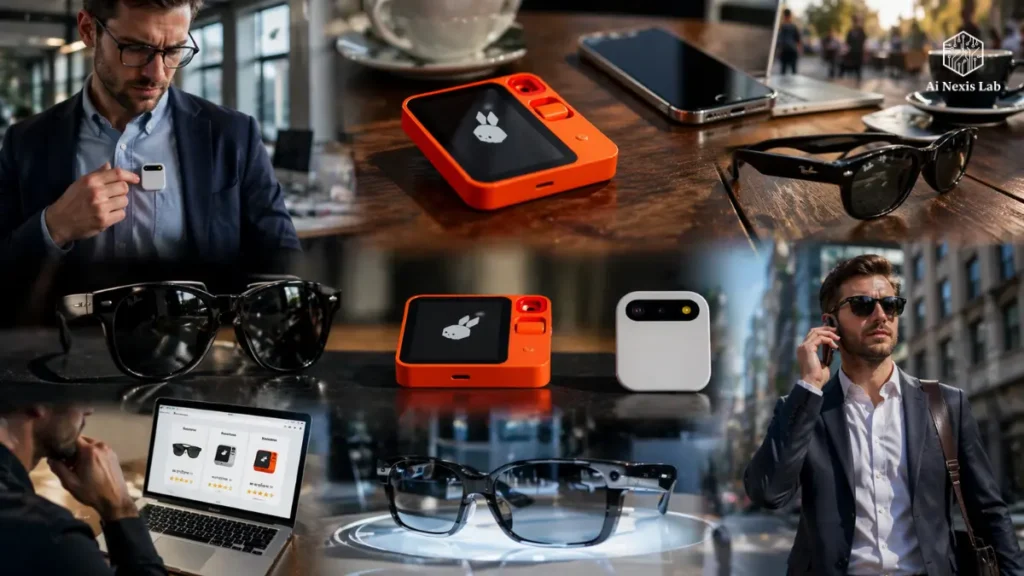
Meta Took the Opposite Approach
Meta saw all this and basically said:
“Maybe people don’t want a revolution. Maybe they just want useful glasses.”
It was a winning move.
Meta Ray-Ban glasses weren’t trying to replace your phone.
They just made everyday life a little better.
It seems less exciting.
They also made them infinitely more successful.
The first real lesson here is:
People don’t buy ambition.
They buy convenience.
Section 2: Human AI PIN – The Most Expensive Tech Funeral of The Decade
Dream
Humans had credibility.
Founders Imran Choudhary and Bethany Bongiorno came from Apple.
That was important.
These weren’t random startup founders with buzzwords and pitch decks.
These were people who worked on products that truly changed the world.
So when they said:
“The smartphone era is ending”
people listened.
The AI Pin launched with:
- A wearable chest-mounted device
- Projector display on your palm
- Camera
- Speaker
- Microphone
- Voice AI assistant
- Subscription-based connectivity
Price:
$699 upfront
+$24/month subscription required
That price should have been a warning.
But people ignored it because the presentation looked beautiful.
That was mistake number one.
Reality
Then the reviewers realized it.
And the reviews were brutal.
Marks Brownlee called it a production where the dream was real – but the execution wasn’t quite right.
Main complaints:
- Terrible battery life
- Overheating
- Painfully slow performance
- Projector useless in sunlight
- AI slower than using your phone
- Expensive subscription required
Translation:
It solved a problem that no one else had… badly.
It’s deadly.
Then the returns outweigh the sales.
That’s when you know the product is complete.
By February 2025:
HP purchased Humane’s assets for $116 million, including CosmOS, patents, and talent. Humane discontinued production, and AI pins stopped working on February 28, 2025.
Most customers did not receive any meaningful refunds.
Imagine having to pay almost $1,000 in the first year of ownership for a product that became a paperweight.
It’s not a novelty.
It’s a cautionary tale.
Essential Gadget Audit
Before buying any AI wearable, ask three questions:
1. Does it do something my phone literally can’t do?
Not “a little faster”.
It really can’t.
2. Does it eliminate real friction?
Not fake keynote friction.
Real daily annoyances.
3. Do I mind if he disappears tomorrow?
Because if the answer is “not really,” then you never needed it.
The human trio failed.
That’s why it died.
Not because people were “not ready”.
Because the product was not necessary.
Big difference.
Section 3: Rabbit R1 – The Strange Device That Refused to Die
The Hype
The Rabbit R1 looked great.
Designed with teenage engineering, it felt like something from the future.
Bright orange.
Pocket-sized.
Scroll wheel.
Push-to-talk button.
Rotating camera called the “Rabbit Eye.”
Price:
$199
That was important.
Unlike the Human, the Rabbit wasn’t asking for a luxury price.
It quickly sold over 100,000 units because people thought:
“Worst case, this is an interesting experiment.”
It was a pretty easy sell.
Disaster Launch
Then reality hit.
The reviews were bad.
Problems include:
- Poor integration
- Unreliable LAM features
- Poor Uber/DoorDash execution
- Poor battery
- Slow response times
Then came the big embarrassment:
A hacker showed off that he was running a fundamentally modified Android.
People immediately asked:
“Why do I need another Android device?”
Fair question.
Rabbit had a serious problem.
But unlike Human, they didn’t break up.
They kept pushing out updates.
That changed everything.
Iteration Engine
This is where Rabbit deserves credit.
Instead of pretending nothing was wrong, they kept improving.
Over time they added:
- Major battery improvements
- Faster interface performance
- Better AI responsiveness
- Magic Camera
- ElevenLabs voice integration
- r-cade gamification
- rabbitOS 2
- Creations (“Vibe Coding” mini apps)
Is it complete?
No.
Does it replace your phone?
Absolutely not.
But that is no longer an issue.
R1 became something different:
A Fun AI Playground for curious people
Not a phone killer.
It is a healthy identity.
And honestly, that’s probably the only reason it survived.
Section 4: Meta Ray-Ban Glasses – The Winner No One Took Seriously
The Smartest Strategy Was the Least Sexy
When Meta launched Ray-Ban smart glasses, people shrugged.
Tech reviewers said:
“They’re just glasses with cameras.”
Exactly.
It was genius.
Because people already wear glasses.
They don’t need behavior modification.
They need usability.
Meta understood something that humans completely missed:
Customers hate changing habits.
The best technology can seem boring at first.
Because it fits into current life.
Not because he demands something new.
Why These Glasses Actually Work
The current Meta glasses allow you to:
- Ask AI questions with “Hey Meta”
- Take hands-free photos and videos
- Listen to music
- Make calls
- Translate conversations
- Recognize objects using multimodal AI
It’s useful.
Not revolutionary.
Useful.
And a useful win.
As of 2026, EssilorLuxottica confirmed that over 7 million units had been sold in 2025, making this a real series – not a niche gadget experiment.
That’s important.
Because once a product becomes commonplace, competitors panic.
We are there now.
The Privacy Problem Is Real
Let’s not pretend otherwise.
These glasses have cameras.
That poses obvious problems.
People around you may not know that they are being recorded.
It’s important in:
- Schools
- Gyms
- Offices
- Hospitals
- Private conversations
Privacy groups in Europe have already pushed back hard.
And frankly, they should.
This is the trade-off:
Convenience versus Trust
If you buy this, understand it clearly.
Don’t be naive.
Section 5: Five Reality Checks Before Buying Any AI Wearable
Most people buy gadgets emotionally.
That’s stupid.
Use this instead.
1. Replacement Test
Can it replace three real tasks?
Not a single innovative gimmick.
Three.
If not, it’s a toy.
2. Battery First, Everything Else Second
No battery = no trust.
If your wearable dies halfway through the day, it’s not wearable.
It is decorative.
3. Server Dependency Audit
Ask:
If the company dies tomorrow, does my device die too?
Humans learned this lesson the hard way.
Never ignore it again.
4. Community Signal Test
Check:
- Discord
- Forum
Users tell the truth faster than PR teams.
Always listen there first.
5. The Six Month Review Rule
Never buy based on launch reviews.
Never.
Wait.
Six months later, the story tells the true story.
Launch day tells the story of marketing.
Frequently Asked Questions
Is Human AI PIN worth buying in 2026?
No. Not remotely.
The servers were shut down in February 2025, and with them the core functionality died. HP bought Human’s assets, not Pin’s customer future. Buying one secondhand right now is like buying a dead smart thermostat and hoping the vibes will power it.
It is a collector’s item, not a useful product.
Don’t confuse those two things.
Is the Rabbit R1 really good now?
“Good” depends on your expectations.
If you’re expecting a phone replacement, no – it still falls short. If you consider it a $199 experimental AI companion, it becomes even more interesting. The updates helped a lot, and Rabbit deserves credit for not abandoning users.
If you like emerging technology, buy it.
If you want reliability, don’t buy it.
Is it okay to wear Meta Ray-Ban glasses?
For most mainstream buyers: yes.
They work, they fit into normal life, and they solve real daily use cases like audio, hands-free capture, and AI assistance without forcing behavioral changes. That’s why they are winning.
The only serious hesitation should be privacy.
If that’s very important to you, think carefully before buying.
Should I wait for Apple AI glasses?
Maybe.
Because every time Apple enters a hardware category, the standards rise exponentially.
Meta gets cheaper. Competitors panic. Product quality improves.
If you don’t need smart glasses right now, waiting 12-18 months is a logical step.
Buying too early ends up with people with human pins.
Final Verdict: What Wearable AI Really Taught Us
Here’s the plain truth.
Wearable AI works.
But only when he respects your life.
Human failed because it asked people to abandon smartphones for something worse.
Rabbit struggled because it asked people to have another device without adequate compensation.
Meta succeeded because it asked for almost nothing.
This is the lesson.
Zero friction beats ten features.
Every time.
If you are buying today:
Buy Meta Ray-Ban glasses.
If you are curious and like to experiment:
Try the Rabbit R1.
If someone tries to sell you a human AI pin:
Laugh. Then leave.
And if you’re waiting for the real next chapter – Apple, Meta Orion, prescription AI glasses – you’re probably making the smartest decision.
Because the first wave of wearable AI was tuition.
The second wave will be actual manufacturing.