The $1 Trillion Bet: Inside Nvidia’s high-stakes race to rewrite the laws of computing
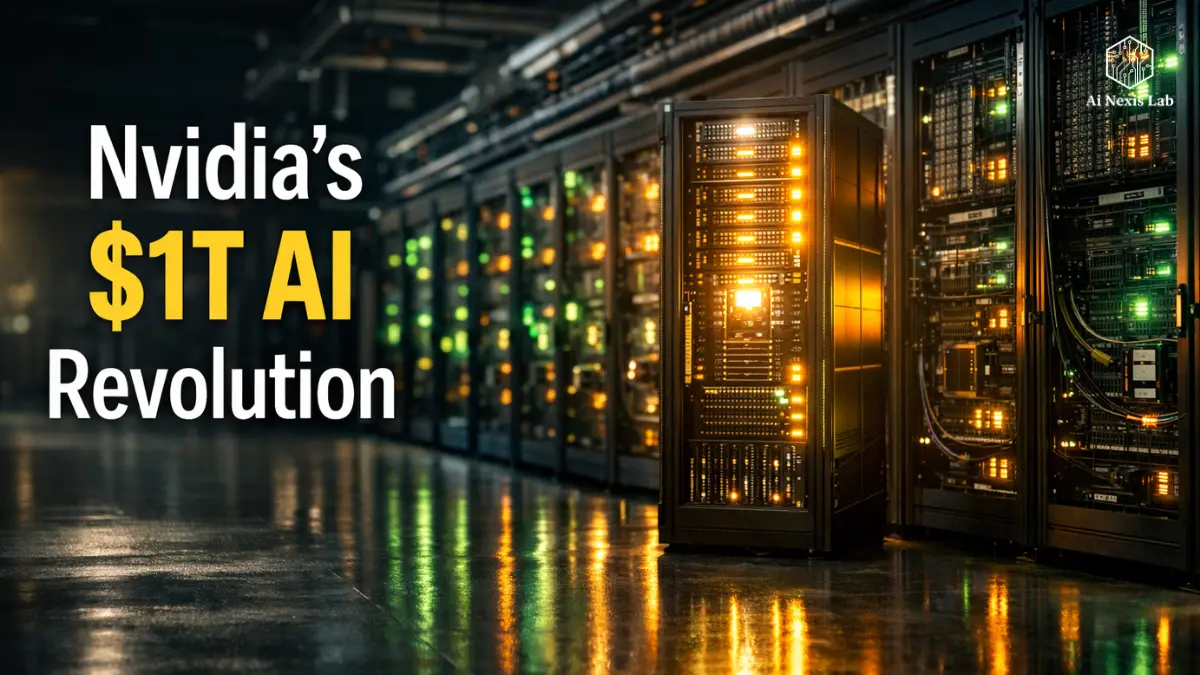
Nvidia AI Revolution is reshaping computing fast. Discover 9 bold bets behind the $1 trillion shift to AI factories, agentic systems, and next-gen chips.
Take a second and look at the device you are reading this on.
Your phone, your laptop, your tablet – they are the product of one of the most reliable technological trends in human history. For nearly six decades, computing followed a predictable curve: chips became smaller, faster, cheaper. Software got more powerful. And every two years, the industry took a leap forward like clockwork.
That era is over.
Not metaphorically. Not philosophically. Physically.
We’ve reached a point where shrinking transistors isn’t just becoming difficult – it’s starting to break the laws of physics in ways that engineers can’t ignore. Electrons leak. Heat spikes. Gains flatten. The old playbook no longer works.
And while most of the industry is still trying to push that old model a little further, Nvidia is doing something else entirely: rewriting the rules.
At this year’s GTC (GPU Technology Conference), Jensen Huang did not present incremental upgrades. He presented a thesis – the $1 trillion thesis – which says computing will be rebuilt from scratch. Not around CPUs. Not around software. But specifically around accelerated systems designed for artificial intelligence.
This isn’t about fast graphics cards. It’s about turning data centers into “AI factories.” It’s about moving from tools that help humans to those that function independently. And it’s about positioning Nvidia as the infrastructure layer of that whole transformation.
If you strip away the hype, what remains is still huge:
- A complete architectural shift in computing
- A redefinition of how software interacts with hardware
- A global race to build intelligent infrastructure
This isn’t just a tech story. It’s an economic story. And whether you’re building a business, writing code, or just trying to stay relevant, it directly affects you.
Let’s break it down properly.
Table of Contents
1. The Death of Moore’s Law and the Birth of “Huang’s Law”
For decades, Moore’s Law was the bedrock of the tech industry: Transistor density doubled roughly every two years, improving performance, and reducing costs. This is why everything from smartphones to cloud computing became possible.
But here’s the uncomfortable reality: Moore’s Law didn’t suddenly “die” – it’s been slowing down for years. We are now working at the nanometer scale where atomic-level effects begin to interfere with predicted behavior.
Why Physics Is Now a Barrier
At advanced nodes (3nm, 2nm and below), you run into real physical limitations:
- Electrons leak through barriers due to quantum tunneling
- Heat density becomes difficult to remove
- Manufacturing complexity explodes in cost
This means that shrinking transistors no longer guarantees meaningful performance gains.
So the barrier changes.
It’s no longer just about computation – it’s about data movement.
Moving data between memory and processors is now slower and more expensive than computation. This is the real obstacle that modern systems are facing.
Nvidia’s Response: Architecture Over Shrinkage
Instead of chasing smaller transistors, Nvidia changed strategy years ago:
- Parallel processing (GPU on CPU)
- High-bandwidth memory integration
- Advanced packaging (multi-die systems)
- Interconnect dominance (NVLink)
This is what people loosely call “Huang’s Law” – not an official law, but a pattern: performance improvements now come from system-level design, not from transistor scaling.
$1 Trillion Logic
Here’s where Huang’s argument gets aggressive – but not illogical.
Global data center infrastructure is a nearly trillion-dollar market. Most of it is still built around general-purpose computing.
Nvidia’s claim is simple:
That entire stack will be replaced by an accelerated AI infrastructure.
It won’t happen overnight. Even partial replacement – say 20-30% – still has billions of opportunities.
This isn’t about selling more GPUs. It’s about redefining what a data center is.
2. Meet Vera: A CPU Built For a World of Agents
For years, Nvidia relied on external CPUs (Intel, AMD) to coordinate GPU workloads.
That dependency has now become a liability.
Enter Vera.
Now, to be precise: Nvidia hasn’t publicly released every detail as your draft suggests. But the direction is clear – Nvidia is moving toward tighter CPU-GPU integration designed specifically for AI workloads.
Why CPUs Are Still Important
Even in GPU-dominated systems, the CPU handles:
- Task orchestration
- Scheduling
- Decision logic
- Input/output coordination
Traditional CPUs are built for general-purpose computing. It is inefficient for AI-heavy environments.
What Does “Agentic AI” Really Mean?
Let’s cut through the buzzwords.
Most AI today is reactive:
- Input → Output
- Prompt → Response
Agentic systems are different. They:
- Maintain context over time
- Break tasks into steps
- Use tools (APIs, software, systems)
- Automate actions
Require a different computation pattern:
- Frequent small decisions
- Low-latency branching logic
- Persistent state management
Vera Advantage (Conceptually)
If Nvidia executes this correctly, Vera-class CPUs will:
- Reduce latency between decisions
- Optimize orchestration of GPU workloads
- Handle agent loops efficiently
- Lower energy cost per decision cycle
This isn’t about replacing GPUs – it’s about eliminating the inefficiencies between CPU and GPU coordination.
And that’s important because agent systems quickly increase inefficiencies.
3. “Blackwell” Shadow: Why GPUs Are Only Half the Story
Blackwell is Nvidia’s next-generation GPU architecture, and yes – it’s powerful. But focusing only on raw compute misses the point.
The real innovation is at the system-level.
Scale Changes Everything
We’re not talking about single GPUs anymore.
We’re talking about:
- Thousands of GPUs connected together
- Unified memory pools
- Distributed workloads acting as one system
That’s where Nvidia’s advantage comes in.
NVLink: The Hidden Weapon
Most people underestimate this.
NVLink isn’t just fast communication – it’s what allows the GPU to behave like a giant processor.
Without it:
- Latency kills performance
- Scaling breaks down
- Distributed systems become inefficient
With it:
- Memory is shared efficiently
- Workloads scale cleanly
- Training large models becomes possible
Real-World Example: Digital Twins
This is not theoretical.
Industries are already using simulation at scale:
- Automotive manufacturing
- Semiconductor design
- Robotics training
“Digital twins” simulate real-world systems before physical implementation.
The value is straightforward:
- Fewer costly errors
- Faster iteration cycles
- Better optimization before deployment
Blackwell-class systems push this simulation closer to real-time.
It’s not just efficiency – it’s competitive advantage.
4. The Economic Gravity
Let’s talk money – because most people here either overhype or completely misunderstand what’s going on.
Capex Isn’t a Bubble – But It’s Not Risk-Free Either
Companies like Microsoft, Google, Meta and Amazon are spending billions annually on AI infrastructure.
It’s real.
But here’s the nuance:
- The demand for compute is real
- Revenue models are still evolving
- ROI timelines are uncertain
So no, this is not Pets.com 2.0. But that doesn’t guarantee smooth growth either.
It’s an infrastructure bet – like building railroads without knowing exactly which routes will be profitable.
“AI Factories” Explained
Huang’s framing of data centers as “AI factories” is actually useful.
Traditional data centers:
- Store data
- Serve applications
AI factories:
- Generate intelligence (models, predictions, automation)
- Continuously train and refine systems
That transformation changes the way value is created.
Sovereign AI: The Underrated Driver
This is one of the most important – and least discussed – trends.
Governments don’t want:
- Dependence on foreign AI infrastructure
- Loss of data sovereignty
- Strategic vulnerability
So they are investing in:
- National AI compute clusters
- Local model development
- Domestic infrastructure
That creates a non-commercial demand layer – and it’s huge.
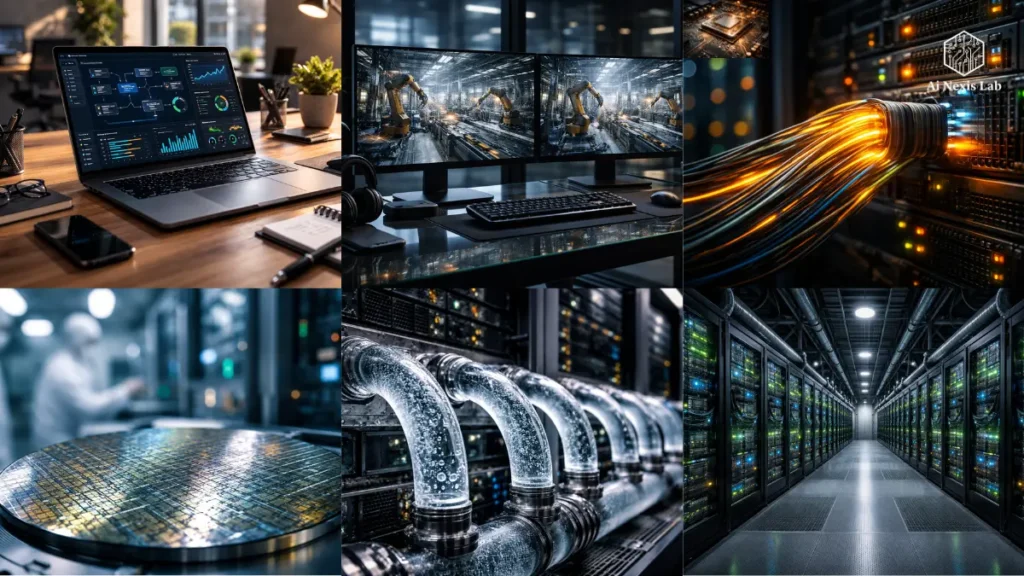
5. Overcoming the Thermal Wall: Liquid Cooling Mandate
This is where reality hits hard.
You can’t scale the calculation indefinitely without addressing the heat.
Air Cooling Is Breaking Down
High-density GPU clusters generate a lot of heat.
Air cooling:
- Becomes inefficient at scale
- Requires large amounts of airflow
- Touches physical limits
Liquid Cooling Is No Longer An Option
Modern AI data centers are moving towards:
- Direct-to-chip liquid cooling
- Immersion cooling systems
- Advanced thermal management
This is not a small upgrade – it’s a complete infrastructure shift.
Why This Matters More Than You Think
This creates new barriers:
- Power availability
- Cooling infrastructure
- Physical space limitations
Compute is no longer entirely digital.
It is becoming a physical resource problem.
Who controls:
- Power
- Cooling
- Infrastructure
…controls access to large-scale AI.
6. The “Small Model” Counter-Intuition
This is where most people get it wrong.
Everyone is obsessed with big models.
But in practice:
- Smaller models are cheaper
- Faster to deploy
- Easier to customize
- More efficient at scale
Why SLMs (Small Language Models) Are Important
For most businesses:
- You don’t need trillion-parameter models
- You need reliable, fast, domain-specific systems
Edge AI + Small Models = Real-World Utility.
This is where tax-type architectures become important.
7. Developer’s Dilemma: CUDA vs. The World
Nvidia’s real issue isn’t hardware.
It is software.
CUDA Lock-In Is Real
CUDA has:
- Over a decade of ecosystem development
- Deep integration with AI frameworks
- Wide developer adoption
Switching is not trivial.
It is expensive, slow and dangerous.
The Problem of Competition
- Can match hardware in some areas
- Conflicts with software ecosystem
That’s why “better specs” don’t automatically win.
Open Source Pressure
Yes, alternatives are emerging:
- Triton
- OpenAI Kernel Abstractions
- Cross-platform frameworks
But Nvidia is not standing still.
They are integrating:
- AI-assisted coding
- Better tooling
- Simple optimization
They are not just building a pit – they are making it comfortable to live in.
8. Moral And Physical “Speed Limits”
Let’s address the uncomfortable parts.
Power Problem
AI infrastructure is extremely energy-intensive.
Even with an increase in efficiency:
- Total consumption increases
- Demand increases faster than efficiency
This is a classic Jevons paradox.
More efficiency → more usage → more total consumption.
Job Displacement Is Not A Fantasy
Agentic systems:
- Will automate workflows
- Replace repetitive cognitive tasks
- Reduce the need for specific roles
This is not about “AI support workers.”
It is about replacing entire process layers.
If you ignore it, you are not real.
9. How To Position Yourself In A Post-GTC World
This is where most people resort to vague advice.
Let’s keep it concrete.
1. Stop Thinking In Tools
Think:
- “How can I use ChatGPT?”
It’s outdated.
Start thinking:
- “What entire workflows can I automate?”
2. Focus On Systems, Not Outputs
Value comes from:
- Planning multiple tools
- Designing processes
- Managing automation
Not just generating content.
3. Understand The Limitations
If your idea relies on:
- Cheap compute
- Unlimited scaling
…it’s fragile.
Build for:
- Efficiency
- Cost Awareness
- Scalability Under Constraints
Friction-Reducing Framework
1. Silicon-Stress Testing
Break down problems into:
- Computational Constraints
- Data Movement
- Latency Constraints
If it’s a hardware problem, software won’t fix it.
2. Agentic Audit
Map your tasks:
- Cognitive → Human
- Algorithmic → Automated
Then automate aggressively.
3. Thermal Reality Check
Ask:
- Does this work even if the computational cost doubles?
If not, it is not sustainable.
Frequently Asked Questions
Is Nvidia really a bubble?
Not in the traditional sense – but expectations have been stretched.
There is real demand, real infrastructure construction, and real long-term utility. It is fundamentally different from a speculative bubble with no underlying value.
However, markets may still overestimate future growth. If revenue growth slows or spending tightens, the stock can correct sharply without the underlying thesis being proven wrong.
So, industry change is real. Valuation risk is real, too.
Will Vera-class systems replace everyday computers?
Not directly.
For common tasks – browsing, documents, media – your current devices will be sufficient for years.
But:
1) Local AI workloads
2) Automation systems
3) Advanced productivity tools
New architectures will become standard.
Think of it like GPUs in gaming – optional at first, then essential.
What makes agentic AI different economically?
The difference is in implementation.
Traditional AI:
1) Provides information
Agentic AI:
1) Performs action
It shifts value from:
1) Assistance → Labor replacement
Which means:
1) Higher ROI potential
2) More disruption
3) Rapid adoption where economics make sense
Can Nvidia really “beat physics”?
No – and that’s where your original framing needed improvement.
They are not violating physics. They are working around the limitations:
1) Shorter data paths
2) Better packaging
3) Faster interconnects
4) Parallelization
That’s optimization, not defiance.
But at scale, that optimization looks like exponential progress.
What should someone really learn right now?
Forget chasing tools.
Focus on:
1) Workflow design
2) Automation logic
3) Systems thinking
4) AI orchestration
The people who win won’t be the best prompt writers.
They will be the people who design systems that run without them.
Final Verdict: Sovereign of a New Era
Nvidia didn’t just launch products at GTC.
They presented a direction:
- Computation becomes infrastructure
- Intelligence becomes output
- Systems replace tools
They are not guaranteed to dominate forever. The competition is coming, and the limitations are real.
But right now, they are at the center of change.
And that change is bigger than most people realize.
The real question isn’t whether Nvidia gets the $1 trillion opportunity or not.
It’s whether you understand what kind of world it would be if they did this.
Because that world doesn’t run on apps.
It runs on systems.
And if you’re still thinking like a user instead of a system designer, you’re already behind.