The 2026 Agentic Web Roadmap

How the Web Quietly Learned to Think, Act, and Improve Itself
Explore the Agentic Web Roadmap 2026 and the powerful architectural shifts driving self-developed applications, autonomous AI agents, and the modern web.
By 2026, something subtle but profound has happened on the internet.
The noisy phase of artificial intelligence – the hype, the demos, the endless “look what this chatbot can do” posts – has largely burned out. What remains is something much more powerful: usability. AI is no longer an innovation layered on top of software. It has melted into the foundation of how software is created, shipped, and improved.
If 2024 was the year we talked to machines, and 2025 was the year machines helped us write code, then 2026 was the year software stopped being completely passive.
The web has become agentic.
That means apps no longer just wait for notifications. They observe. They reason. They make decisions. They test ideas. And, under carefully defined rules, they improve themselves.
This roadmap is not about another AI coding tool or smart autocomplete. It’s about a deep transformation – moving from “running applications” to systems that function with purpose. What follows is a human-first, practical look at how we got here, how agentic systems actually work, and what this means for developers, founders, and anyone building on the web.
From Hype to Utility: Why 2026 Looks Different
The early AI years were noisy for a reason. We were looking for what was possible.
Chatbots surprised us by writing poems and answering questions. AI IDE surprised us by shipping features in hours instead of weeks. But behind that enthusiasm was a harsh truth: most AI tools were still auxiliary. They helped humans move faster, but didn’t fundamentally change how the software behaved once it went live.
In 2026, that line has finally been crossed.
The defined change is this:
AI is no longer just part of the development process. It is just part of the running system.
That single change unlocks everything else.

Phase 1: The End of Static Interfaces
For decades, the web worked like a vending machine.
You clicked something. A predefined script ran. You got output. Even the most “intelligent” applications were elaborate chains of situations written by humans months or years ago.
Agentic applications replace that model with something closer to a living system.
From buttons to behavior
In an agentic application, the core logic is not just a collection of routes and handlers. It’s a goal-oriented logic loop.
Think about how this evolution unfolded:
- Early 2020s: “Click here to submit form.”
- Mid-2020s: “Chat with an assistant who fills out forms for you.”
- 2026: “The system noticed that users were hesitant about this step, tested options, and adjusted the flow without asking.”
There is no chatbot window bolted to the side. The agent is the application.
From Generating to Executing
This is the most important mental shift.
- Generative AI creates output.
- Agentic AI follows through on results.
The agent doesn’t just answer questions. He is given a goal – reduce churn, improve conversion, shorten onboarding time – and he constantly finds how to achieve that goal within the set limits.
The software stops being responsive. It becomes proactive.
Phase 2: A new architecture for a new kind of software
Traditional web architectures were never designed for this.
MVC, REST APIs, and stateless services assume that intelligence resides in the developer’s head, not inside the system. Agentic software completely reverses that perception.
By 2026, a new architectural pattern has become dominant.
The Reasoning Runtime: The New “Brain”
In classic applications, business logic is frozen in code. If the world changes, human logic updates.
In an agentic system, the “brain” is a persistent reasoning runtime. This is an ever-changing environment where the language model:
- Maintains context over time
- Calls tools and services
- Interprets real-world cues
- Makes decisions under uncertainty
The model doesn’t just generate text. It is planning actions.
Think of it less like a function and more like a long-standing process with memory, decision, and purpose.
A Shared Language for Agents
As multiple agents come into existence, communication becomes a barrier.
Success in 2026 wasn’t smart models – it was standardized reference exchange. A universal way for agents to:
- Access tools
- Read and write data
- Request actions from other agents
- Operate under shared security rules
This standardization did for agent systems what HTTP once did for the web. It made interoperability normal instead of painful.
Suddenly, agents created by different teams – or even different companies – could collaborate securely.


Phase 3: Self-Developed Workflow (Real Success)
This is where things get interesting – and a little uncomfortable.
A self-developed application does not simply adapt its behavior. It improves its own logic.
Not randomly. Not carelessly. But through tightly controlled feedback loops.
The Closed Feedback Loop
Modern agentic systems follow an iterative cycle:
1. Observe
The system observes actual usage: logs, metrics, errors, friction points, and user signals.
2. Evaluate
A dedicated evaluation agent compares what is happening with the set goals and KPIs.
3. Proposals
suggest system changes—code edits, prompt refinements, UI tweaks, workflow adjustments.
4. Verify
The proposed changes are tested in isolation. Unit tests, simulations, and security checks run automatically.
5. Deploy (or reject)
Only approved fixes make it into production, often with human approval at critical milestones.
This loop runs continuously, silently, and securely.
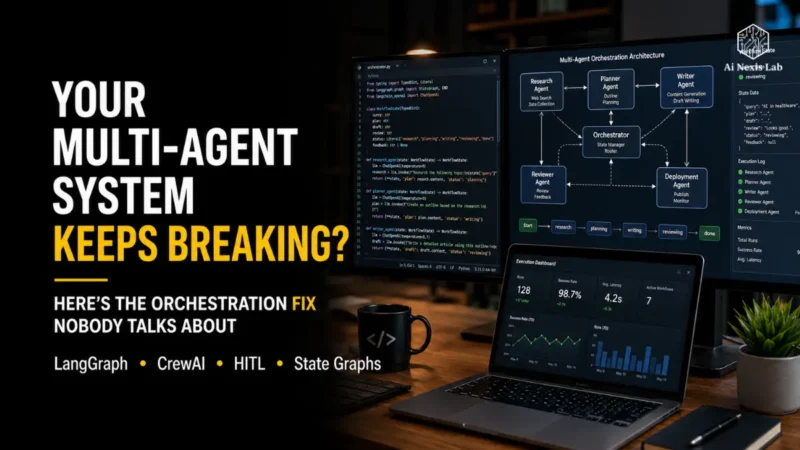
The Rise of Multi-Agent “Teams”
A single agent who tries to do everything quickly becomes unreliable. In hindsight the solution was clear: specialization.
By 2026, critical systems will look like small digital companies:
- A planning agent defines strategy
- A builder agent implements changes
- A reviewer agent checks for correctness
- A safety agent enforces boundaries
- A UX-focused agent monitors user behavior
No single agent has absolute power. Decisions arise from collaboration, checks, and balances.
As a human, your role changes from “writing code” to directing a system of specialists.
Phase 4: The Agentic Tech Stack of 2026
The modern stack reflects this new reality. Instead of a framework optimized for rendering pages, the focus is on logic, orchestration, and observability.
Foundational Models
Large, general-purpose models act as raw cognitive engines. Their job isn’t perfection—it’s adaptability.
Orchestration Layers
These tools manage state, memory, branching decisions, and coordination between agents.
Communication Protocol
Standardized interfaces allow agents to securely access equipment, data, and other agents without custom glue code.
Infrastructure for Autonomy
Agentic systems require an environment designed for long-running logic loops, not just request-response cycles.
Observability for thought
Traditional logs show what happened. Agentic observability shows why it happened – tracking decisions, assumptions, and internal reasoning paths.
Phase 5: Real-world use cases of the Agentic Web in 2026
For a long time, the agentic web seemed like a thought experiment. Interesting in concept, impressive in demo, but far from everyday software. By 2026, that gap has closed. Agentic systems are no longer limited to research labs or experimental startups. They are quietly walking into products that people use every day.
The change didn’t happen because AI suddenly became smarter. It happened because the software finally stopped pretending the world was static.
Traditional applications assume that once a feature is shipped, the job is done. Agentic applications assume the opposite. Shipping is the beginning, not the end.
Consider what this means in practice.
In modern commerce platforms, the application no longer treats the checkout flow as sacred code. It treats it as a living hypothesis. The system observes where users hesitate, which interactions cause friction, and how behavior changes across devices. Instead of sending this data to a human team weeks later, the agent proposes adjustments, tests variations in a controlled environment, and deploys improvements when a confidence threshold is met. The storefront roadmap evolves continuously without waiting for a meeting.
In SaaS products, onboarding has become a dynamic conversation rather than a fixed funnel. The system identifies the objective at the very beginning. It understands whether the new user is exploring, evaluating, or trying to solve an immediate problem. Each path triggers a different experience, shaped and reshaped by live feedback. The result is not personalization for the sake of innovation, but consistency that feels natural.
Customer support is where the agentic change becomes most apparent. The old model treated support as a downstream function – something that responded to users after they encountered problems. Agentic systems reverse that relationship. They detect emerging problems by correlating error logs, usage anomalies, and user sentiment. In many cases, the system resolves the underlying cause before a ticket is created. Support becomes preventative rather than reactive.
The internal software has also changed. Dashboards no longer exist simply to report numbers. They interpret patterns, highlight risks, and suggest actions. Instead of asking teams to find insights, agentic systems proactively surface them. The interface feels less like a spreadsheet and more like a strategic partner.
This is where the agentic web clearly becomes real.
Why this inflection point came in 2026
The emergence of agentic applications was not driven by a single breakthrough. It was the result of many slow-moving forces that finally aligned.
The models became able to maintain logic for a long time. Tooling matured to the point where multi-agent orchestration was stable and observable. And perhaps most importantly, organizations reached the limits of manual optimization. There was too much data, too many variables, and too much change for human-driven iteration.
Agentic systems filled that gap – not by replacing people, but by extending their reach. They work continuously, at a scale and pace that human teams cannot sustain on their own.
A Subtle but Permanent Change
One of the most misunderstood aspects of the agentic web is how it looks to the end user.
There is no dramatic moment where the application announces its autonomy. No flashing indicators. No open display of intelligence. Instead, things just work better. Friction disappears. Repetition fades away. The software anticipates needs rather than responding to complaints.
It’s a matter of subtlety.
The agentic web is not intended to be influential. It’s meant to adapt.
And that, more than any headline or demo, marks a permanent shift in how the 2026 web is built – and how it behaves.
The Hard Part: Trust, Control, and Accountability
The biggest challenges of the agentic web are not technical. They’re human.
Reliability without rigidity
Autonomous systems must be flexible, but not inflexible. That balance is achieved through:
- Explicit goal definitions
- Hard constraints around sensitive actions
- Gradual permission escalation
- Continuous verification
Creativity exists within the fence.
Governance and Accountability
When software operates autonomously, accountability does not disappear. It’s centralized.
Successful teams in 2026 treat agentic systems like junior employees:
- Clear scope
- Audible decisions
- Mandatory supervision for high-impact actions
Autonomy is earned, not assumed.
The New Role of the Developer
This change does not eliminate developers. It’s elevating them.
The most valuable builders in 2026 are not the fastest typists. They’re the best system designers. People who can:
- Clearly define goals
- Structure feedback loops
- Design safe constraints
- Curate high-quality data
- Anticipate failure modes
You don’t just ship features anymore. You’re shaping behavior.
Software stops being a static artifact and becomes a living system – one that grows under your guidance.
Final Thoughts: A Web That Wakes Up
The agentic web doesn’t speak loudly. It doesn’t announce itself with an attractive demo.
It appears quietly:
- In applications that improve themselves
- In workflows that adapt automatically
- In systems that seem strangely “aware” of user needs
The roadmap is clear. The question is not whether this change will happen or not – it has already happened.
The real question is, will you build for a web that waits… or a web that thinks?
Frequently Asked Questions (FAQ)
Q1: What does “agentic” really mean in software?
That means the system can achieve goals, make decisions, and take action autonomously within defined boundaries, rather than simply responding to inputs.
Q2: Is Agentic Web only for large companies?
No. Small teams often benefit the most because agents reduce operational overhead and accelerate iteration.
Q3: Does this replace traditional backend logic?
Not entirely. Deterministic logic still exists, but it is wrapped in adaptive layers that determine when and how to use it.
Q4: Is self-developed software safe?
It can be possible if designed properly. Secure systems rely on testing, sandboxing, permission controls, and human oversight.
Q5: Will developers need to learn completely new skills?
The core skills remain the same, but the emphasis is shifted towards system design, evaluation, and governance rather than manual implementation.
Q6: Can agentic systems explain their decisions?
Modern systems increasingly track logic steps, making decisions observable and auditable.
Q7: Is this the end of manual coding?
No. Coding becomes one tool among many, not the center of the universe.
Q8: What should I learn first to prepare?
Start by designing agent orchestration concepts, feedback loops, and clear goals and constraints. The mindset is more important than any single tool.