Midjourney v7 vs Flux.1 (2026): Which brand really delivers on assets?
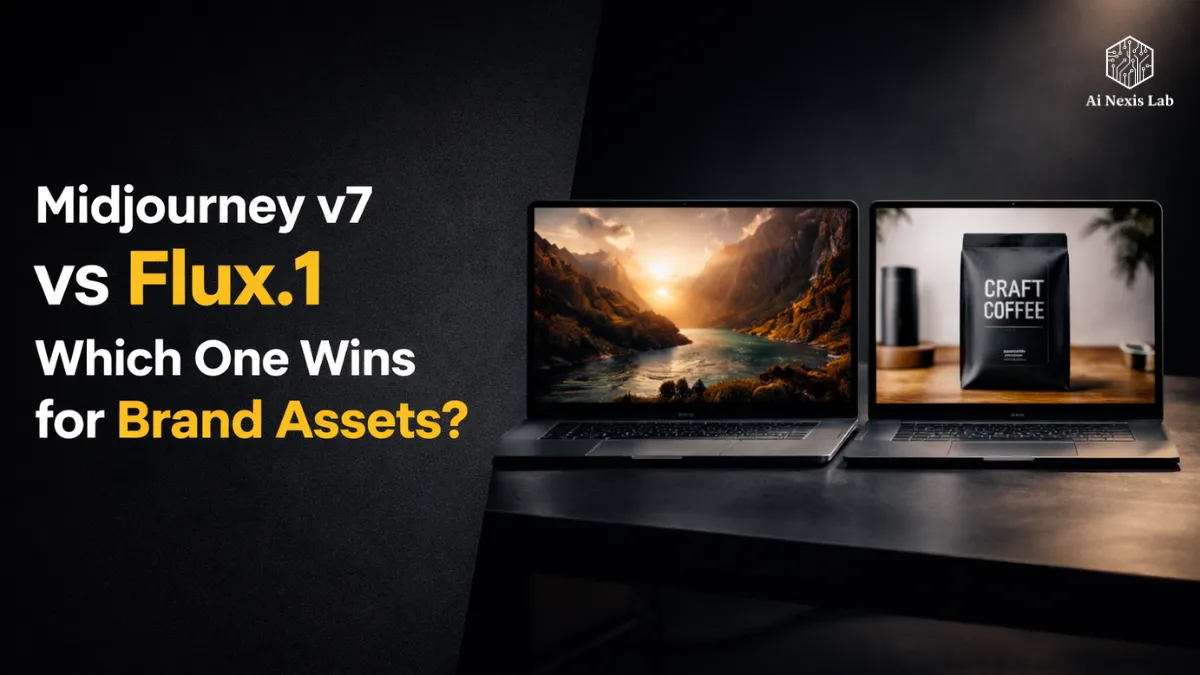
Midjourney v7 vs. Flux.1 comparison explained with real results as of 2026. Discover 7 powerful truths, pros and cons, and which AI tool really wins for branding and design work.
The Real Question That No One Wants To Answer
Let’s skip the surface-level nonsense.
This is not about which tool creates “cooler images”. It’s about what happens when your AI-generated visual ends up:
- On a landing page with real traffic
- In a paid ad with a real budget
- On packaging that customers will actually keep
At that point, aesthetics alone just won’t cut it. If your visuals look even a little off – cheap lighting, broken text, odd proportions – you’re not just missing design points. You are losing faith.
So here’s the only question that matters:
Which tool consistently generates brand equity that you can actually use without shame?
After extensive real-world testing and updated 2026 capabilities, the answer is not simple – but it is clear.
Table of Contents
Original Story: Why These Tools Think Differently
Before comparing outputs, you need to understand the mindset. These tools were not created for the same purpose.
Midjourney: The Test Machine
Midjourney has always been about aesthetic judgment.
- Built around an artistic sensibility
- Optimized for “what looks good”
- Strong bias towards cinematic, stylized output
It behaves less like software and more like a creative collaborator with strong opinions.
That’s why his images seem intentional. Not necessarily accurate – but intentional.
Flux.1: The Precision Engine
Created by the engineers behind modern diffusion models, Flux.1 takes the opposite approach:
- Focus on precision, control, and realism
- Designed for integration into workflow
- Built for repeatability and production scale
It acts like a tool, not a creative partner.
Why This Distinction Is Important
Here’s the mistake most people make:
They assume these tools are in direct competition.
They don’t.
They solve different problems:
- Midjourney → Inspiration, Emotion, Visual Impact
- Flux.1 → Execution, Precision, Scalability
If you treat them as interchangeable, your workflow breaks down.
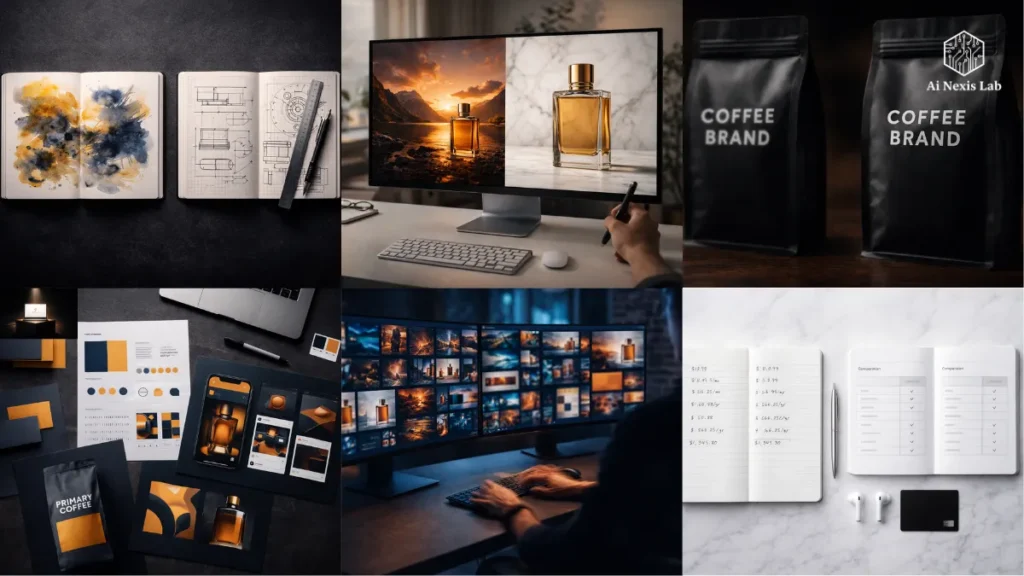
Brand Asset Test: What Really Works In a Product
Let’s get specific. Three asset types are important in real brand work:
- Campaign visuals
- Product imagery
- Logo-related design elements
Hero Campaign Imagery
This is where brands win attention – or instantly lose it.
Midjourney dominates here.
Why?
- Superior Lighting Composition
- A natural sense of depth and drama
- Built-in “cinematic bias”
You don’t have to fight for something to look premium.
Flux can produce similar visuals – but they often feel:
- Too literal
- A little sterile
- Less emotionally engaging
Verdict:
If your goal is scroll-stopping visuals, Midjourney wins. No discussion.
Product Mockups and Packaging
Now reverse the situation.
You need:
- Clean product shots
- Realistic content
- Accurate proportions
- Consistent lighting
Midjourney struggles here.
You’ll see:
- Distorted packaging
- Inconsistent reflections
- “Almost realistic” surfaces that fail under scrutiny
On the other hand, Flux.1:
- Handles materials like a 3D renderer
- Produces consistent lighting physics
- Maintains fidelity
Verdict:
Flux isn’t just better – it’s in a different league.
Logo-Adjacent Visuals
Let’s be clear: no tool should be used to create the final logo.
But it’s useful for:
- Brand directions
- Icon search
- Visual identity mood boards
Midjourney gives you:
- More creative variety
- Unexpected design directions
Flux gives you:
- Cleaner geometry
- More usable structure
Verdict:
Use both – but for different stages.
Smarter Workflow (Most People Miss This)
Stop choosing one tool.
Use this to:
- Create creative directions in midjourney
- Refine and produce in flux
This single shift eliminates 80% of the frustration in AI-driven brand work.
Typography: Where Most AI Work Breaks
This is where things get real.
If your brand includes text (and it does), this section is more important than all others.
Midjourney’s Problems
Midjourney still struggles with:
- Character consistency
- Kerning accuracy
- Complex words
It may look good at a glance – but zoom in, and it breaks.
It’s not a small problem. It is a product failure.
Advantages of Flux.1
Flux handles text significantly better:
- Higher positional accuracy
- Better character consistency
- More reliable output for real-world use
Is it perfect? No.
But it is useful.
And it is important that it is useful.
The Hard Truth Most Designers Ignore
If your workflow is:
“I’ll fix the text later in Photoshop”
You’re creating unnecessary work.
At scale, this becomes a barrier:
- Slower turnaround
- More labor costs
- More inconsistencies
Reality check:
If text is part of your asset, start with Flux. Don’t solve problems you can avoid.
Color Consistency and Brand Control
Here’s something that casual users don’t care about – but professionals do:
Consistency across assets.
Your brand is not an image. It is a system.
Midjourney’s Strengths (and Weaknesses)
Midjourney excels at:
- Mood consistency
- Style consistency
- Visual richness
But it often changes:
- Colors get warmer
- Saturation increases
- Brand palettes get distorted
You get beauty – but not always accuracy.
Flux.1 Advantage
Flux offers something that Midjourney doesn’t:
Fine-tuning capabilities
You can:
- Train on brand visuals
- Lock in style patterns
- Maintain consistency in output
It’s not a feature – it’s a strategic advantage.
Practical Solution: Stop Being Vague
Most people ask like this:
“Blue packaging”
That’s lazy – and the model guesses.
Instead of:
“Matte Deep Navy (#001F3F), soft diffused lighting, minimal reflections”
Precision = better output.
Every time.
Speed, Editing and Workflow Reality
Speed is important – but not in the way people think.
Raw Generation Speed
Flow is fast. Period.
- Fast full-resolution output
- No reliance on upscaling
- Better performance at high detail
Midjourney’s draft mode is fast – but only useful for ideation.
Workflow editing (This Changes Everything)
Midjourney:
- Edit = Regenerate
- No real recursive chain
- Workflow friction builds up quickly
Flux Kontext:
- Edit existing image directly
- Natural language editing
- Chain multiple edits seamlessly
Example:
“Change background to white, make product black, add logo to top-left”
Done in one step.
Why Is This Important In Real Work?
A brand product is not an image.
They are:
- 10 sizes
- 5 variations
- 3 color options
- 2 markets
Midjourney multiplies the effort.
Flux compresses it.
The Brutal Reality
If you are doing serious production work and are still relying solely on midjourney:
You are wasting time.
Pricing: What You Really Pay (Not What You Think)
Let’s cut through the marketing noise.
Midjourney
- Subscription-based
- Estimated costs
- Good for low volume
Best for:
- Freelancers
- Solo creators
- Small teams
Flux.1
- API-based or local
- Scales with usage
- More complex setups
Best for:
- Agencies
- Production teams
- High-volume pipelines
Real Cost Insights
Low volume → Midjourney wins
High volume → Flux gets cheaper
As you scale, Midjourney becomes limited.
5 Proven Frameworks That Really Work
No Fluff. These are practical systems.
1. Split Persona Method
Run the same prompt in both tools.
- Midjourney → Creative Direction
- Flux → Product Output
You avoid creative dead ends.
2. Reference Chain Repetition
Use Flux to:
- Start with one image
- Generate all variations of it
Result:
- Consistency
- Fast
- Less effort
3. Blind Audience Testing
Show output without branding.
Track:
- What images do people choose
- What really resonates
Stop guessing. Use data.
4. Style Anchor System
Create a library of strong visuals.
Reuse them as references.
Over time:
- Quality improves
- Consistency increases
5. Rapid Concept Sprints
Use midjourney draft mode:
- Generate 50+ rough ideas quickly
- Kill weak concepts early
Speed of thinking saves time later.
Head-to-Head Scorecard (2026 Reality)
Midjourney v7
- Aesthetic Impact: 9.5
- Creativity: 9.5
- Text Credibility: 5.5
- Workflow Efficiency: 6
- Automation: 1
Flux.1
- Aesthetic Impact: 7.5
- Reality: 9.2
- Text Credibility: 8.8
- Workflow Efficiency: 9.2
- Automation: 9.7
Honest Summary
Midjourney = Emotional Power
Flux = Executive Power
You need both if you’re serious.
The Missing Layer: Where Human Decision Still Wins
Most AI-heavy workflows get it wrong: they assume the tool is the decision maker. That’s not the case. It is a generator. And that distinction is more important than ever in 2026.
Both Midjourney v7 and Flux.1 can produce high-quality output, but neither understands context like a human. They don’t know your customer’s emotional triggers, your market position, or the subtle differences between “premium” and “hypocritical.” It’s still your job.
The biggest difference appears in the final selection, not the generation. You can generate 50 strong images – but choosing the right image is where brand value is created or destroyed. Most people make choices based on what looks impressive. Smart teams make choices based on what aligns with strategy.
There is also the issue of overproduction. Just because you can produce infinite variations doesn’t mean you should. More options often lead to poorer decisions, not better ones.
The advantage in 2026 is that there is no access to AI tools. Everyone has them. The advantage is restraint, taste, and the ability to filter aggressively.
If you don’t develop that level, better tools won’t make your work better – they’ll just make your mistakes faster.
Frequently Asked Questions
Is Flux.1 better for commercial use?
Yes – if your definition of “better” includes:
1) Scalability
2) Text accuracy
3) Workflow efficiency
Midjourney still wins in visual storytelling. But Flux wins where it really makes money – production.
Can Midjourney reliably generate useful text?
No.
It has improved, but is not reliable enough for professional use.
You can avoid it – but it adds friction.
What makes Flux Kontext so important?
It completely changes the workflow.
Instead of:
1) generating from scratch every time
you can:
1) intelligently edit existing images
which can reduce the same production time by 50-70%.
Which tool is cheaper?
Depends on usage:
1) Small scale → Midjourney
2) Large scale → Flux
The mistake is to make a choice based on cost rather than workflow.
Will AI-generated visuals damage brand credibility?
Only if it’s bad.
The audience doesn’t care how it turns out.
They care about how it looks:
1) Cheap
2) Inconsistent
3) Unprofessional
The implementation is important. Not original.
Final Verdict: Stop Trying to Choose One
Here’s the plain truth:
If you’re trying to choose between Midjourney and Flux, you’re asking the wrong question.
Correct Answer:
- Midjourney = Creative Direction
- Flux = Product Execution
- The best teams don’t discuss tools.
They combine them.
What You Should Really Do Next
Simple:
- Take your next brand brief
- Run it through both tools
- Compare the output side by side
You’ll immediately see:
- Where each tool shines
- Where each fails
That single test will teach you more than any article.
Bottom Line
AI is not replacing designers.
But designers who understand these tools will replace those who don’t.
You don’t need much equipment.
You need a smart system.
And now you have one.