Stop trying to beat the market. Data is cruel – and it’s not on your side.

Index fund investing is better than stock picking for most investors. Learn 10 proven strategies today to grow wealth faster, reduce risk, and invest smarter.
Let’s not pretend.
At some point, you believed you could beat the market.
Not in a reckless, gambling way – but smart, calculatedly. You read the articles. You watched the breakdowns. You followed the earnings calls. You chose companies that you understood. Maybe you used it every day.
And it seemed logical.
Until it didn’t.
Because here’s an uncomfortable truth that most people avoid:
Effort does not equal return on investment.
You can do everything “right” – research, time, diversification into a few choices – and still underperform someone who has done almost nothing.
That’s not an opinion. That’s decades of data.
This is not about shaming stock-picking. It’s about showing you what the statistics really say – and why the game is stacked in a way that most people don’t fully understand.
Table of Contents
01 – The Real Problem
Stock Picking Seems Smart. The Math Says Otherwise.
Let’s address the noise directly.
Most individual stocks don’t just underperform the market – they fail altogether to create meaningful long-term wealth.
Nearly a century of research into U.S. market data reveals something that will completely change the way you think about investing:
About 4% of stocks account for almost all of the market’s gains
Most either:
- Underperform Treasury bills
- Go nowhere
- Or disappear completely
That means the market’s growth is not evenly distributed.
It is highly concentrated.
Think about what that means:
If you’re picking stocks, your job isn’t to pick “good companies.”
Your job is to:
- Find the small minority of extreme winners
- Let them ride out the volatility
- Avoid selling too early
- Allocate enough capital to the essential
It’s not an investment by accident. That’s decades of repeated needle threading.
Now contrast that with index funds.
They don’t try to identify winners.
They have everything – so they automatically grab the winners.
No guessing. No timing. No luck required.
02 – The Playing Field
You Are Not Competing Against Amateurs
There are two sides to every trade.
That’s obvious. But most people don’t take the next step:
Who is on the other side of your trade?
It’s not “the market.”
They are:
- Institutional traders with real-time data feeds
- Hedge funds running futures models
- Algorithms trained on decades of price behavior
- Full-time expert analysts at a company
And you?
You’re checking the chart between meetings or after dinner.
It’s not a fair fight.
Even worse:
Professional fund managers – people with the teams, the tools, and the full-time attention – still fail to consistently beat the market.
Over a 10-15 year period:
- About 80-90% of people underperform their benchmark
So if they can’t reliably do it…
What do you really have?
Be honest. If you can’t clearly define it, you’re not investing – you’re speculating.
03 – The Silent Killer
Fees Don’t Seem Dangerous – Until You Zoom Out
Fees are the easiest thing to ignore.
They’re small. Quiet. Invisible.
But over time, it becomes cruel.
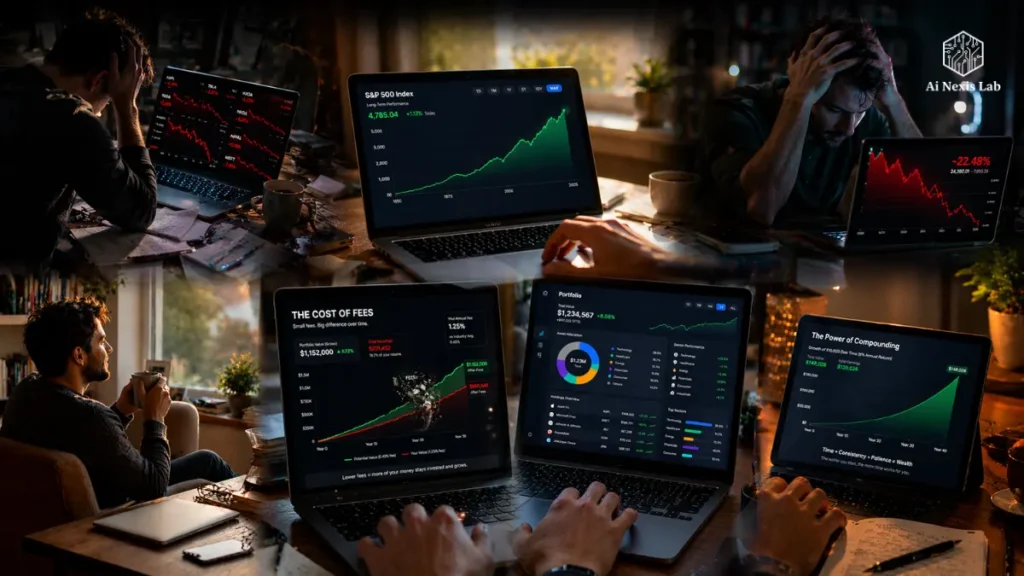
Let’s look at a simple scenario:
- Start with $50,000
- Invest for 35 years
- Average return: 7%
Now compare:
Low-Cost Index Fund (~0.05%)
Final value: ~$530,000
Actively Managed Fund (~1.25%)
Final value: ~$350,000
Difference: ~$180,000 lost
Not lost to the market.
Not because of bad decisions.
Just slowly worn out by fees.
And that’s before:
- Trading Costs
- Tax Inaccuracies
- Behavioral Mistakes
This is where most investors quietly break themselves.
They focus on returns…
But ignore what is leaking out every year.
04 – Psychology Trap
Your Brain Is The Weakest Link In Your Portfolio
You are not rational when money is involved.
No one is.
And the problem isn’t intelligence – it’s wiring.
Avoiding losses
Loss hurts about 2 times more than gains feel good
Results:
- You sell winners too early
- You hold losers too long
Confirmation Bias
Once you buy a stock:
- You look for information that supports it
- You ignore anything negative
Recency Bias
You assume:
- What just happened will continue
So you:
- Buy high (when things look safe)
- Sell low (when things look scary)
This is why the average investor consistently underperforms their invested funds.
It doesn’t mean that the funding is bad.
It’s because their behavior is bad.
05 – Compounding Reality
Consistency Beats Intelligence
Forget “perfect timing”.
It doesn’t exist.
Let’s compare two people:
Active Investor
- Constantly adjusts positions
- Tries best to enter/exit
- Pays taxes frequently
- Misses major market days
Passive Investor
- Invests monthly
- Never stops
- Rarely checks portfolio
After 30-40 years?
Passive investor often wins.
Why?
Because:
- Cyclical growth works relentlessly
- Taxes are reduced
- No emotional mistakes
Here are the key statistics:
Missing the best 20 market days in decades can halve returns.
And those days usually happen:
- Right after the crash
- When the fear is highest
So the more you “manage”, the more you
06 – Diversification
Owning Everything Is a Strategy – Not a Cop-Out
When you buy a single stock, you take on two risks:
- Market risk (everything goes down)
- Company risk (that particular business fails)
You can’t eliminate market risk.
But you can almost eliminate the company’s risk.
Index funds do just that.
The total market capitalization consists of:
- Thousands of companies
- Across sectors
- Across sizes
so if:
- One company fails → irrelevant
- One sector struggles → thin
you are not betting on any company.
You are betting on the growth of the entire economy.
Historically, it has been a very good bet.
07 – Taxes
The Benefit That No One Talks About Enough
This is greatly underestimated.
Active investing creates:
- Frequent buying/selling
- Short-term gains
- Immediate tax liabilities
Index funds do the opposite:
- Low turnover
- Long holding periods
- Deferred taxes
That means more money is invested for a longer period of time.
Which means more compounding.
And over the decades, that difference becomes larger.
There are also:
- Tax-loss harvesting
- Long-term capital gains benefits
- Increase in basis (estate benefits)
All of which favor passive strategies.
08 – Buffett Argument
Let’s End This Discussion Properly
Yes, some people beat the market.
Very few.
And they are:
- Outliers
- Highly specialized
- Often working with advantages that you don’t have
The mistake is assuming:
“Someone did it → I can do it too.”
That’s not logic. That’s survivorship bias.
Here’s a reality check:
Even the biggest investors recommend index funds for most people.
Not because they’re easy.
Because they’re effective.
09 – 2026 Reality
Investing Has Never Been Easier – or More Misunderstood
Today:
- Zero-fee funds exist
- Fractional shares are standard
- Automation is built-in
- Accounts take minutes to open
No barriers remain.
The only remaining problem?
Behavior.
People still:
- Chase trends
- Overtrade
- Panic sell
Even though the best strategies are now easier than ever.
10 – Practical Frameworks
What Really Works (No Theory – Just Execution)
The Glacier Method
Slow, Consistent Investing.
- Monthly Contributions Fixed
- No Adjustments
- No Reactions
No Core + Satellite Approach
- 80-90% Index Funds
- 10-20% Experimental (If You Need It)
Annual Reality Check
Ask:
“Am I Really Benefiting Here?”
If not → go to index.
Time Horizon Filter
- <5 years → Don’t use equities
- 20+ years → Keep investing
Expense Awareness Rule
Always check:
- Expense ratio
- Hidden fees
If it’s high → Walk away.
Frequently Asked Questions
Are index funds just “average”?
No. That’s a misunderstanding.
“Average” = market return.
Most investors perform poorly accordingly.
So index funds are not average – they are above average in real-world results.
Can I still invest in trends like AI?
Yes – but don’t be reckless.
Use:
1) Small allocation (5–10%)
2) Diversified ETFs instead of individual stocks
Your core should remain broad and stable.
What if the market crashes?
It will happen.
It’s guaranteed to happen.
The real question:
Will you continue to invest?
Because historically:
1) Markets improve
2) Individual companies often
Is there a reason to choose stocks?
Yes – but only if:
You actually have the skills
You keep positions small
Otherwise, you’re just guessing by taking extra steps.
How to start with little money?
Simple:
1) Open a brokerage account
2) Choose a broad index fund
3) Automate monthly investing
4) Ignore the noise
Start small if necessary.
Consistency is more important than size.
The Ultimate Reality Check
Stop Trying To Be Smart
This is where most people go wrong.
They think:
- Complexity = intelligence
- Activity = progress
- Control = good results
None of these matters in investing.
The truth is simple:
- It’s hard to beat the market
- Fee and behavior destroy returns
- Time and consistency win
So the real question is:
Can you do less – and stick with it?
Because that’s the real edge.
Bottom Line
You don’t need:
- Better stock picks
- More information
- Smart timing
You need:
- Discipline
- Simplicity
- Time
That’s it.
And if you can commit to it?
You will outperform most people – not by being smarter…
but by avoiding the mistakes they often make.