ElevenLabs Studio: An in-depth study on creating full-length AI audiobooks in 2026 (without wasting time or money)
Table of Contents
The Harsh Reality That Most Authors Ignore
Let’s start with a bitter truth:
More than 90% of books still don’t have audiobook versions.
It’s not because they shouldn’t exist. The reason is that, historically, the economics were terrible.
You are writing a book. You edit it. You publish it. Then you watch the audio and realize:
- Narrator: $2,000–$10,000
- Studio + Editing: Thousands more
- Time: 3–6 months minimum
- ROI: Completely uncertain
For most writers, especially independent writers with multiple books, it’s a losing equation.
So what happens?
The books are sitting. Silence.
And that’s a problem – because in 2026, audio is no longer optional.
- Audiobook consumption is growing faster than ebooks
- Younger audiences prefer listening to reading
- Multitasking culture = audio wins
If your book isn’t in audio, you’re invisible to a huge segment of your market.
What Changed (And Why This Really Matters Now)
Tools like ElevenLabs Studio haven’t just improved text-to-speech.
They broke down the entire audiobook production pipeline into a single interface.
That is real change.
You are no longer:
- Hiring narrators
- Booking studios
- Managing editors
- Waiting months
You are:
- Uploading manuscripts
- Choosing voices
- Editing deliveries
- Exporting finished audiobooks
In days.
Not in a hypothetical way. In practice.
And yes – people are already doing it on a large scale.
What ElevenLabs Studio Really Is (and What It Isn’t)
It’s Not “Just TTS”
If your mental model is robotic narration, reset it.
ElevenLabs Studio is close to:
Document Editor + Voice Engine + Production Studio combined
You’re not just generating audio – you’re controlling it.
Core Differences vs. Older Tools
Traditional TTS:
- Paste text → get audio → complete
- No control
- No editing flexibility
ElevenLabs Studio:
- Upload entire manuscript
- Edit at paragraph or sentence level
- Assign multiple voices
- Adjust pace, tone, pronunciation
- Recreate specific lines without touching the rest
That last point is more important than you might think.
If one sentence seems wrong, you fix one sentence – not the entire chapter.
It just saves hours.
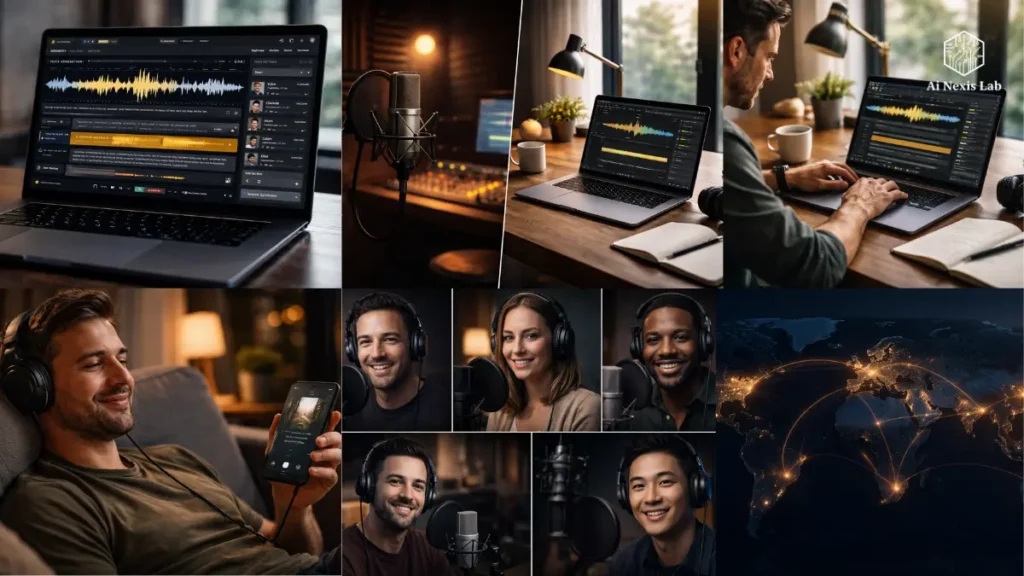
Interface (Why It’s Actually Useful)
Most “advanced” tools are a mess.
It’s not.
Think of it like Google Docs – but every paragraph can speak.
You:
- Upload your file (.epub, .docx, etc.)
- It auto-structures the chapters
- You click on text segments
- Assign voices
- Generate audio
- Edit where needed
No steep learning curve. No audio engineering knowledge required.
That’s why it is spreading rapidly.
The Voice Library: Where Most People Go Wrong
Here’s where people go wrong:
They consider voice choice a small decision.
It’s not.
This is the most important decision in the entire process.
Why Voice Choice Matters
Your listener will spend:
- 6 hours
- 10 hours
- Maybe 15+ hours
with that voice.
If it’s annoying, flat, or inconsistent – your audiobook is dead.
There is no need to correct it later.
How to Really Choose a Voice (Stop Guessing)
Most People:
- Click on the Demo
- Think “Sounds Good”
- Move On
That’s Lazy – and It’ll Cost You.
Instead, do this:
1. Use Your Own Content
Past actual paragraphs from your book.
Not ordinary samples.
Your writing has a unique rhythm. Test it.
2. Stress-Test Emotion
Select:
- High-tension scene
- Quiet narrative section
If the voice fails, it is not useful.
3. Test Dialogue (For Fiction)
Listen:
- Clarity
- Natural flow
- No robotic switching
4. Use Headphones
Speakers hide flaws.
Your audience uses earbuds. Test accordingly.
Voice Cloning: Powerful, But Don’t Be Naive
You can clone your voice.
Yes, it’s impressive.
But here’s the honest breakdown:
Instant Voice Cloning (IVC)
- Fast
- Requires minimal audio
- Good for short content
Problem:
It can drift on longer content.
Professional Voice Cloning (PVC)
- Requires more data
- Much more stable
- Better for full books
If you’re serious, use PVC.
Otherwise you will find inconsistencies in the middle of your audiobook.
When Should You Clone Your Voice
Do it if:
- You already have an audience
- People recognize your voice (YouTube, podcasts, etc.)
- Your brand is connected to your personality
Don’t do it if:
- Your voice is not strong
- You are not consistent in tone
- You are trying to show “fake authority”
Because listeners can sense it.
Step-by-Step Workflow (No Fluff Version)
Let’s get this down to reality.
Step 1: Proofread Your Manuscript First
AI reads exactly what you have written.
If your text is messy, your audio will be worse.
Fix:
- Strange formatting
- Abbreviations
- Hard-to-pronounce names
Create a pronunciation list in advance.
Not later.
Step 2: Upload and Structure
Upload your file.
The system breaks it down into:
- Chapters
- Paragraphs
Check the structure before generating.
Trash → Trash out.
Step 3: Assign Voices
For non-fiction:
- One strong narrator voice
For fiction:
- One narrator
- Different voices for main characters
Don’t overdo it.
Too many voices = chaos.
Step 4: Generate In Parts (Serious)
Never generate the entire book at once.
That’s a new mistake.
Why?
Because if something goes wrong:
- You waste credit
- You waste time
- You redo everything
Instead of:
- Generate a chapter
- Validate everything
- Then continue
Step 5: Smart Edit (Not Perfect)
You want to fix everything.
Don’t.
Improvement:
- Obvious problems
- Distracting moments
Ignore:
- Minor imperfections
Because listeners don’t analyze sentence-by-sentence.
They experience flow.
Step 6: Export
Final Output:
- 128kbps MP3 (industry standard)
You have the files.
That’s important.
Multilingual Capabilities (Largely Undervalued)
Most writers ignore this.
That’s a mistake.
Reality Check
The fastest growing audiobook markets are:
- Spanish
- Portuguese
- German
- Hindi
Not just English.
What This Means For You
If your book works in English:
You can:
- Translate it
- Generate audio in another language
- Tap new markets
Without writing a new book.
That’s leverage.
But Don’t Be Stupid About It
AI description ≠ AI translation.
You still need:
- A real translator
- Cultural accuracy
Otherwise you will produce garbage in another language.
Smart Production Frameworks (Where You Really Win)
These are the systems that separate the amateurs from the money makers.
1. Chapter-One Method
Already covered, but worth repeating:
Never generate everything at once.
You’re not saving time – you’re increasing risk.
2. Pronunciation Before The Flight
Do this first:
- Names
- Places
- Technical terms
- Acronyms
Fix once → avoid hundreds of corrections later.
3. Emotional Mapping
For Fiction:
Mark key moments:
- Intense
- Quiet
- Ironic
- Calm
Guide AI before generation.
Not after.
4. Two-Pass listening System
This is underrated.
Pass 1: Passive Listening
- Walk, Drive, Multitask
- Pay attention to what breaks immersion
Pass 2: Focused Fixing
- Go back
- Fix only those problems
This prevents over-editing.
5. Voice Consistency Audit
Every few chapters:
- Compare the previous and next sections
- Make sure the voices don’t flow
because they can.
Distribution: Where You Make or Lose Money
Creating an audiobook is only half the battle.
Distribution determines income.
Spotify (via Findway Voice)
- Accepted since 2025
- AI Description Allowed
- Disclosure Required
Good Reach.
Moderate earnings.
ElevenReader (High Upside, But Early)
- ~60% Royalties
- No Exclusivity
- Still Growing Audience
If it scales, this becomes very powerful.
Now:
- Opportunity > Certainty
Wide Distribution
You can:
- Sell directly
- Use multiple platforms
- Stay in control
This flexibility is rare.
Use it.
Cost Breakdown (Stop Overthinking This)
Here’s the real math.
Traditional Manufacturing
- $2,000–$10,000+
- Months of Work
ElevenLabs
- ~$20–$100/month
- Days to weeks
Even if you redo the parts, the cost difference isn’t close.
Smart Ways to Use Price
Don’t stay subscribed forever.
Do this:
- Subscribe
- Product
- Export
- Cancel
Repeat as needed.
Fiction vs. Nonfiction (Different Game)
Nonfiction
Simple:
- Single voice
- Constant tone
- Low complexity
Best use case for AI narration.
Fiction
More complex:
- Multiple voices
- Emotional variety
- Dialogue handling
Also:
- Higher progression
- More immersive possibilities
Big Change: It’s Not Just About Audiobooks
This is where most people are thinking too small.
You’re Not Just Creating Audiobooks
You’re creating:
- An audio version of your brand
- A consistent voice across platforms
- Scalable content
A consistent voice for:
- Books
- Blog descriptions
- Podcasts
- Courses
That consistency becomes even stronger.
Ethical Reality (No BS Version)
Some people don’t like the AI narrative.
That’s okay.
But here’s the reality:
- The market is accepting it
- The platforms are allowing it
- The audience is using it
The only rule that matters:
Don’t lie about it.
Publish it.
Move on.
Comparison: AI vs. Traditional (No Spin)
| Factor | AI (ElevenLabs) | Traditional |
|---|---|---|
| Cost | Low | High |
| Time | Fast | Slow |
| Control | Full | Limited |
| Flexibility | High | Low |
| Emotion | Improving | Better (for now) |
If you are waiting for perfection, you will never begin.
Frequently Asked Questions
Can you really publish AI audiobooks on major platforms?
Yes – and this is no longer practical. Platforms like Spotify have already integrated AI-narrated audiobooks into their ecosystem, provided you comply with disclosure rules.
The gatekeeping barrier that existed before has been removed. The only real requirement now is quality. If your audiobook sounds amateurish, it won’t work. If it looks professional, platforms don’t care how it was created – they care whether listeners stay engaged.
Is this quality really comparable to human storytellers?
For non-fiction, it’s already so close that most listeners won’t notice or care. Delivery is clean, consistent, and professional.
For fiction, especially for emotionally complex scenes, human storytellers still have an edge – but that gap is rapidly narrowing.
The real question is “Is it perfect?” It’s not “Is it good enough to sell?” In most cases today, the answer is yes.
How much does a complete audiobook actually cost using this approach?
For a standard-length book (70,000-90,000 words), if you’re efficient, you’re realistically spending less than $100.It will probably cost a little more if you rebuild sections multiple times.
Compare that to thousands of dollars in traditional manufacturing. The big price isn’t money – it’s time for you to learn the workflow and make smart decisions in advance.
Do you have full rights to your audiobook?
Yes. This is the biggest advantage here. You are not signing royalties or exclusivity just to complete the product.
You own the files, you control the distribution, and you decide where and how they are sold. This flexibility is a key strategic advantage over traditional audiobook deals.
Is this suitable for new writers without an audience?
This is where you need to be honest with yourself. If your book isn’t selling in text form, turning it into an audiobook won’t magically fix that.
Audio enhances what is already working – it doesn’t save weak content. If your book has traction, this is a force multiplier. If it doesn’t, focus on fixing the product before expanding the format.
Final Verdict (Straightforward Answer)
Yes – it’s worth it.
But only if you use it correctly.
If you:
- Hasty voice selection
- Skip manuscript preparation
- Over-edit or under-edit
- Ignore distribution strategy
You will get mediocre results.
And mediocre doesn’t sell.
Real Opportunity
The biggest change is not technology.
It’s this:
Audiobooks are no longer controlled by money. They’re driven by execution.
And most people still won’t execute well.
That is your advantage.
Action Plan (No Excuses Version)
- Test 5 voices with your real content
- Fix pronunciation issues in advance
- Generate a chapter
- Validate quality
- Then scale
Don’t make it too complicated.
Get start.