What if every student had a talented tutor 24/7?: AI tutor agents are about to disrupt education (in a good way)
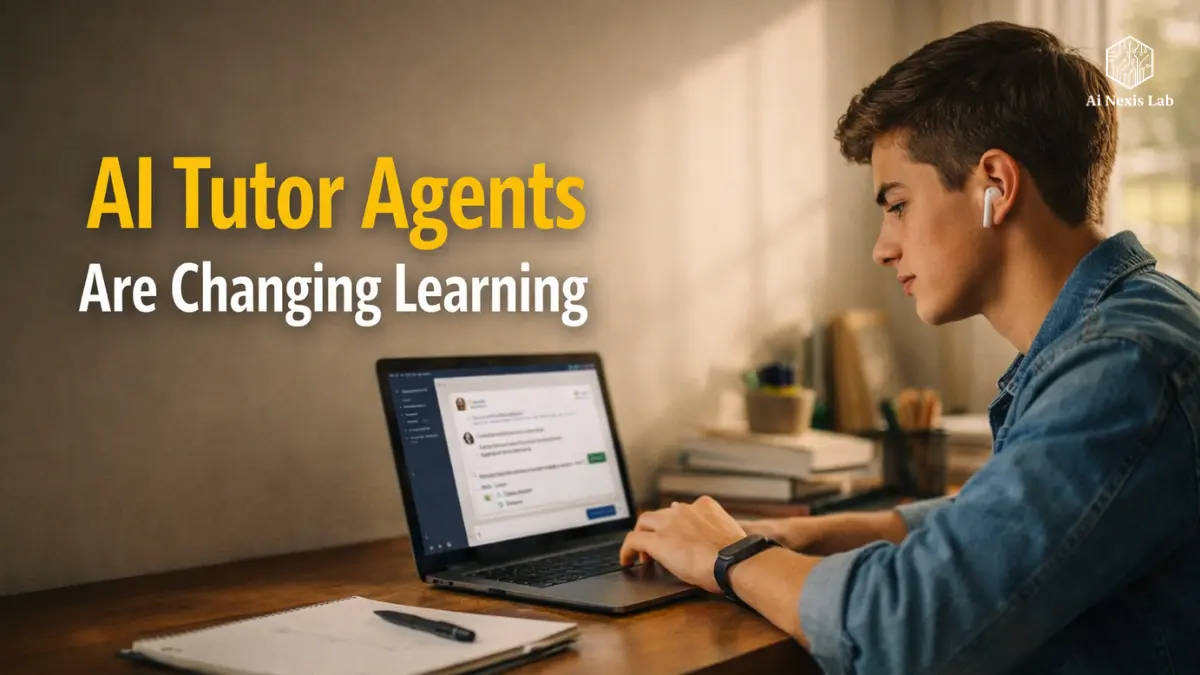
Table of Contents
Introduction
The problem that everyone calmly accepts
Let’s start with something uncomfortable.
Most people believe that the education system is “good enough”. Not perfect, but functional. It is a lie that we have collectively agreed to tolerate.
Think of school. Not the main points – real everyday experience.
You are sitting in class. The teacher explains something once. Maybe twice. Then the class moves on. If you get it, great. If you haven’t figured it out, you’re already behind.
That moment – where you stop asking questions because you don’t want to appear slow – is when learning breaks down.
And it’s not rare. It is systemic.
The modern classroom is built around skills, not mastery. One teacher. Twenty-five to thirty students. Fixed schedule. Fixed pace. Fixed curriculum.
That model assumes something that is not true:
People learn at roughly the same pace, in roughly the same way.
They don’t.
And we have known that for decades.
The 2-Sigma Reality That Most People Ignore
In 1984, educational psychologist Benjamin Bloom conducted one of the most important studies in science learning.
Their conclusion was simple – and brutal:
Students with one-on-one tutoring performed two standard deviations better than students in traditional classrooms.
That’s no small advantage. This is the difference between the average and the elite class.
A student in the 50th percentile jumps to the 98th percentile.
Same kid. Same intelligence. Different learning environment.
So why didn’t we improve education at that time?
Because we couldn’t scale it.
Private tutoring costs. Real money. $60-$150 per hour is common in the US.
It is not accessible. It is a luxury product.
So instead of solving the problem, we worked around it:
- Special programs
- Intervention systems
- Standardized testing adjustments
- Learning labels
It’s all trying to patch a broken core.
Now that core is being challenged for the first time.
What an AI Tutor Agent Really Is (And What It Isn’t)
Let’s Cut the Hype.
Most tools that call themselves “AI tutors” are not real tutor agents. They are dressed-up content platforms.
A true AI tutor agent has four non-negotiable capabilities:
1. Persistent Memory
This is a big one.
A true tutor remembers you.
Not just your answers – but your ways of thinking:
- Where you hesitate
- What misconceptions you repeat
- What explanations really work
It creates consistency across sessions.
If the system resets every time, it is not a tutor. It is a tool.
2. Real-Time Adaptation
It doesn’t just track right or wrong.
It analyzes how you got there:
- Fast wrong answers = confident misunderstanding
- Slow right answers = fragile understanding
- Partial answers = gap searching
Then it adjusts:
- Difficulty
- Pacing
- Explanation style
Lively.
3. Multi-Modal Teaching
A good teacher does not repeat the same explanation out loud. They change approaches.
AI tutor agents can:
- Use generalizations
- Draw conceptual models
- Ask guiding questions
- Show working examples
It’s all based on what’s truly right for the student.
4. Metacognitive Coaching
This is where things get serious.
Most systems teach content. Great systems teach thinking.
They force reflection:
- “What are you unsure about?”
- “Why do you think this works?”
- “How confident are you?”
This is how you build independent learners – not just test performers.
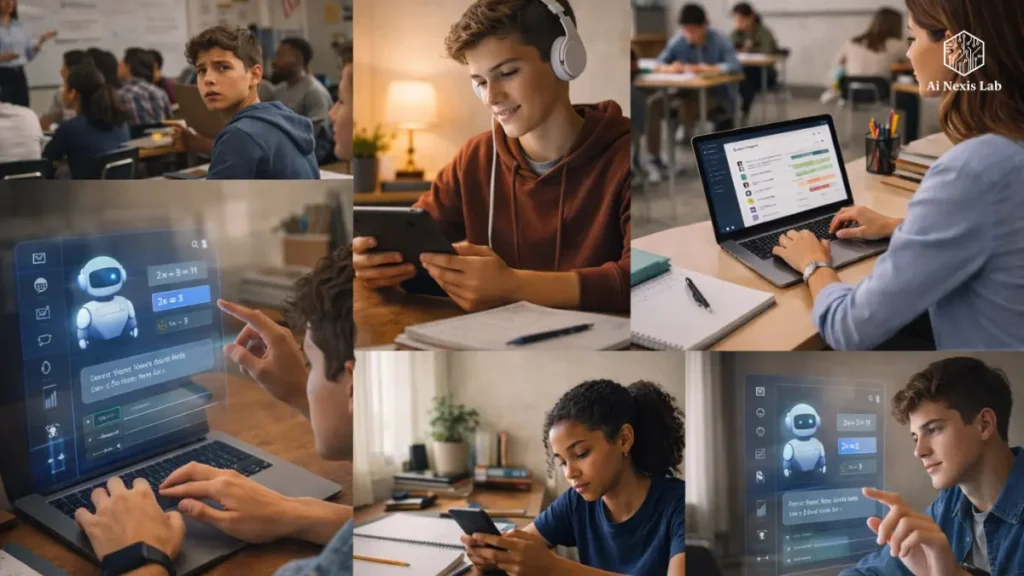
Why the One-Size-Fits-All Model Was Always a Broken One
Here’s some raw math that no one likes to say out loud:
A teacher with 30 students has ~2 minutes per student per day for individual attention.
That’s it.
Everything else is group instruction, classroom management, and administrative overhead.
Now compare that to an AI tutor session:
100% attention on one student.
No competition. No time division. No pace compromise.
The Science Is Already Clear
This is not guesswork. Cognitive science has been pointing here for decades.
Spaced Repetition
We quickly forget information unless we review it at appropriate intervals.
What is the problem?
The best time is different for each student and each concept.
AI solves it.
It tracks when you’re about to forget something – and reinforces it at exactly the right time.
Zone of Proximal Development
Learning occurs in a narrow band:
- Too easy → boredom
- Too difficult → frustration
Traditional classrooms consistently miss this.
AI tutors aim straight at that zone every time.
Recovery Practice
Reading is not learning. Watching is not learning.
Retrieving information is learning.
AI tutors push engagement:
- Asking questions
- Challenging assumptions
- Fostering active recall
That’s why they outperform passive tools.
The SPARK Method: How AI Tutors Really Accelerate Learning
This is where most people underestimate the impact.
AI tutor agents don’t just deliver content – they use specific cognitive strategies.
Let’s break them down.
S – Socratic Spiral
Rather than providing answers, the system guides thinking.
It forces the student to construct the answer.
It creates:
- Deep understanding
- Installable logic
- Long-term retention
P – Pattern Interrupt
Bad systems say “wrong”.
Good systems recognize why it’s wrong.
They target a specific misunderstanding.
That’s where real improvement happens.
A – Anchor Bridging
New knowledge sticks when it is connected to something meaningful.
AI tutors personalize examples:
- Sports
- Gaming
- Music
- Real-life scenarios
This doesn’t “make it fun”.
It’s making it memorable.
R – Reflection Checkpoints
Each session includes a pause:
- What’s clear?
- What’s not?
- How confident are you?
Students who reflect learn more. Period.
K – Knowledge Stress Test
Understanding is not proven by solving simple problems.
AI advances edge cases:
- “What if this changes?”
- “What breaks here?”
It creates flexible thinking – not a fragile memory.
Real Systems Are Already Doing This
This is not theoretical.
The systems are already in use – and producing measurable results.
Academy’s AI tutor
Instead of giving answers, it forces students to think.
That design decision simply changes behavior:
- More persistence
- Better problem-solving habits
Carnegie Learning (MATHia)
This system creates a potential model of each student’s knowledge.
It tracks:
- Mastery
- Confidence
- Gameplay
Schools that use it consistently outperform average – especially struggling students.
Duolingo Max
Moves beyond drills into real conversations.
Key results:
- Higher engagement
- Lower dropout rate
That’s more important than attractive features.
Synthesis
Focuses on ideas – not content.
It trains:
- Decision-making
- Collaboration
- Adaptability
Skills that most schools rarely touch.
What The Data Shows
AI tutoring systems show measurable benefits over traditional instruction.
Not perfect – but directionally undeniable.
The Equality Argument (and Why It’s Complicated)
Here’s an uncomfortable truth:
Wealthy families already have “AI tutors.”
They are called:
- Private tutors
- Academic coaches
- Enrichment programs
And they work.
AI tutor agents are the first opportunity to scale that support to everyone.
But There’s a Catch
This doesn’t automatically fix the inequality.
1. Access Gap
No device. No internet. No AI.
Millions of people still lack reliable broadband.
It’s not a small problem – it’s a structural barrier.
2. Engagement Gap
Technology doesn’t fix mindsets.
A disengaged student remains disengaged unless:
- Motivation is addressed
- Confidence is rebuilt
AI helps – but it doesn’t solve the problem alone.
3. Cultural Gap
Most systems are built with narrow assumptions.
Examples and references don’t always resonate in the background.
It reduces effectiveness.
Bottom Line
AI can reduce inequality.
But poorly implemented, it can increase it.
What Teachers Are Really Afraid of (and What’s Real)
Let’s not hide it.
Some parts of education are being replaced:
- Content explanation
- Practice drills
- Basic feedback
AI can do this faster and more accurately.
But What It Can’t Replace Here Is
Human trust
Students learn better when they feel safe.
It comes from real relationships – not from algorithms.
Social Development
School teaches:
- Collaboration
- Conflict Resolution
- Emotional Regulation
AI doesn’t repeat it.
Inspiration
A great teacher makes students care.
AI does not inspire. It makes the best.
Big difference.
Real Future
Not replacement.
Division of Labor:
- AI → Instruction + Feedback
- Teachers → Relationships + Meaning
If schools don’t adapt to this, they will fall behind.
The Data Problem No One Wants to Face
This is where things get serious.
AI tutors collect deep behavioral data:
- Thinking patterns
- Weaknesses
- Persistence levels
- Cognitive tendencies
Over time, this becomes a detailed psychological profile.
Risk
Whose data is that?
Because if it’s misused:
- Employers can screen candidates
- Colleges can profile applicants
- Companies can monetize learning behavior
It’s not fiction. That’s where the incentives point.
Current Laws Are Weak
US frameworks like FERPA were not designed for this level of data.
They’re outdated.
What You Should Ask
Before using any system:
- What data is collected?
- Who has access?
- Can it be deleted?
If the answers are unclear, assume the worst.
What AI Tutors Will Look Like by 2030
Right now, we’re at version 1.
What’s coming next is significantly more advanced.
Multi-Modal Interaction
Not just text:
- Voice
- Handwriting
- Behavioral cues
The system will detect:
- Frustration
- Focus
- Engagement
and adjust immediately.
Cross-Subject Intelligence
No subject silos.
Math connects to science. Writing connects to history.
AI will strengthen knowledge in all fields.
Collaborative AI Learning
Students work together – AI agents coordinate:
- Group dynamics
- Contribution balance
- Problem-solving roles
This is already being tested.
Teacher Integration
AI won’t just report – it’ll guide:
- Lesson planning
- Intervention strategies
- Group differentiation
Think of it as a data-driven assistant.
How to Use AI Tutoring Effectively (For Now)
Most people will use this incorrectly.
Here’s how not to waste it.
1. Stop Using Them For Answers
If you give up on the struggle, you give up on learning.
Use it to think – not a shortcut.
2. Target Weaknesses
Ask directly:
“What am I bad at?”
Then focus there.
Common practice is inefficient.
3. Set Clear Goals
Don’t “do the math”.
Do:
- “Understand why this works”
- “Fix this specific gap”
Precision is important.
4. Review Without AI
After each session:
- Write down what you learned
- Explain it out loud
This is how knowledge lasts.
Frequently Asked Questions
Can AI tutor agents replace teachers?
No – and it is naive to think they can.
AI is better at:
1) Personalization
2) Repetition
3) Instant Response
But it lacks:
1) Emotional Intelligence
2) Social Awareness
3) Human Connection
The best model is a hybrid. Anyone pushing for complete replacement does not understand education or human behavior.
Is it safe for kids?
It can happen – but only if you pay attention.
Risks include:
1) Data privacy
2) Overreliance
3) Passive usage habits
You need to actively evaluate tools – don’t blindly trust them.
How is this different from apps?
Applications follow scripts.
AI tutors adapt in real time.
This is the difference:
1) Workbook
2) Conversation
Provides a response. The other gives guidance.
Does it work for ADHD or dyslexia?
Maybe yes – but not as a standalone solution.
Advantages:
1) Self-paced learning
2) Flexible format
3) Reduces social pressure
But it should complement – not replace – specialized support.
Where does he struggle?
Required Topics:
1) Creativity
2) Mindful Decision Making
3) Interpretation
AI can help – but can’t lead reliably yet.
Human supervision is still important.
Final Verdict
This Is a Structural Change – Not a Trend
Let’s be clear:
This is not the “second edtech wave.”
This is a fundamental change in the way of learning.
For the first time, personalized learning is scalable.
It is huge.
Opportunity
Done right:
- Better outcomes
- Reduced inequality
- More effective teachers
Risk
Done wrong:
- Data exploitation
- Wide gaps
- Shallow learning habits
Reality
Technology will happen anyway.
The only question is:
Do we shape it – or let it shape us?