$100 Billion Gambling: Why Xbox Project Helix Could Change Gaming Forever
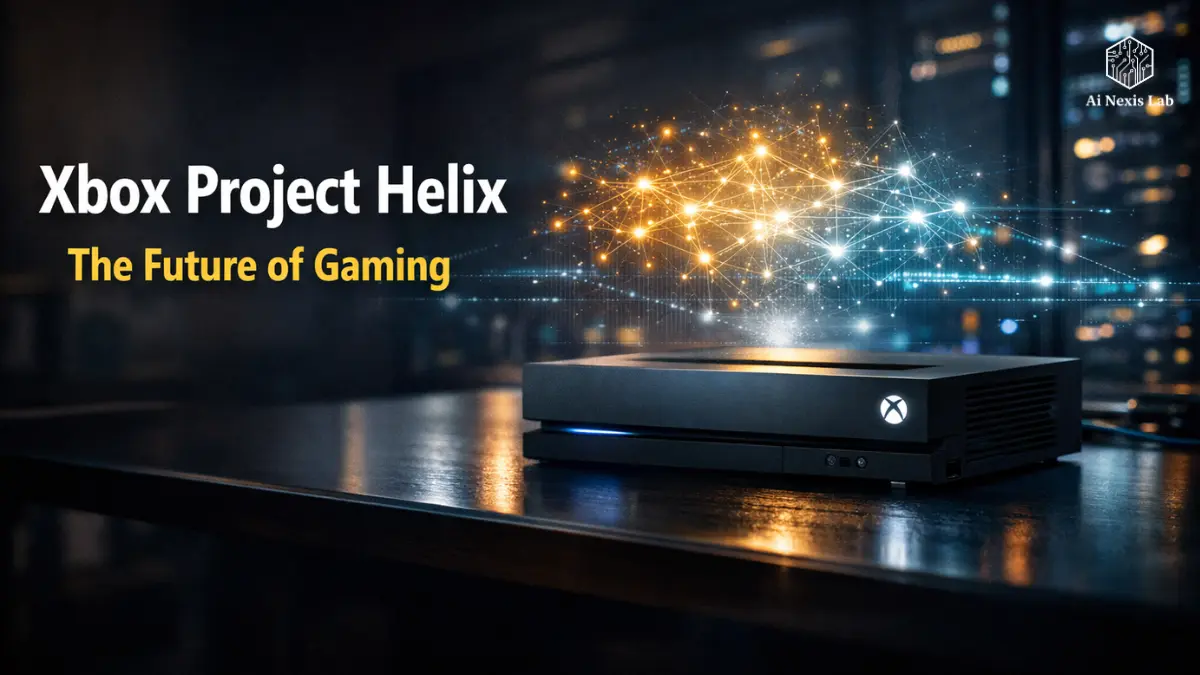
Xbox Project Helix could reshape gaming forever. Discover 9 powerful secrets behind Microsoft’s next-gen hybrid console, AI hardware, cloud tech, and launch plans.
The lights dimmed at the Game Developers Conference in San Francisco, and for a moment the vast hall fell silent.
Then the Xbox team took the stage.
If you’ve seen enough industry keynotes, you know the routine. New console specs, some marketing buzzwords, maybe a teaser trailer, and a promise that everything will be “more powerful than ever before.”
But this time it felt different.
When Microsoft revealed the initial architecture behind Project Helix, the message was not subtle. This wasn’t just another Xbox refresh. It wasn’t about a slightly faster GPU or a bigger SSD.
Microsoft was laying the groundwork for something bigger: the slow death of the traditional console generation.
For the past three decades, the gaming industry has operated on a predictable rhythm.
- A new console is launched.
- Developers slowly learn the hardware.
- Games gradually push the system to its limits.
- After six to seven years, the cycle repeats.
That model created the modern gaming industry.
But it’s starting to show its age.
We live in a world where software updates arrive overnight, AI writes code in seconds, and cloud computing powers everything from Netflix to Wall Street trading algorithms. Against that backdrop, the idea of buying a static piece of hardware every seven years seems increasingly outdated.
Microsoft sees this change coming.
With Project Helix, the company is trying something bold: blending local gaming hardware with a massive cloud infrastructure to create a system that evolves over time rather than becoming obsolete.
The company has already confirmed that developer prototype kits will arrive in 2027, with a consumer launch expected around 2028 or 2029.
If that timeline holds, Project Helix could represent the biggest architectural shift in gaming hardware since the original Xbox was released in 2001.
But marketing hype is cheap.
The real question is simple:
Is Project Helix really the future of gaming – or just another expensive tech gamble?
Let’s break it down piece by piece.
Table of Contents
1. Beyond the Teraflop: The Rise of NPU-Centric Architectures
For years, console power has been measured using one number: teraflops.
It’s basically an acronym for raw graphical display. The higher the number, the more graphics rendering the GPU can perform.
During the last console cycle, that metric dominated the conversation.
Xbox Series X launched with 12 teraflops
PlayStation 5 delivered around 10.3 teraflops
Gamers debated those numbers endlessly.
But Project Helix suggests that the industry is moving beyond that mindset.
Instead of focusing solely on GPU power, Microsoft is building the next Xbox with something different:
A massive neural processing unit (NPU).
Why a GPU Alone Isn’t Enough
Modern games demand more than just graphics rendering.
Today’s open-world titles combine vast systems together:
- AI decision-making for hundreds of NPCs
- Dynamic weather systems
- Advanced physics simulations
- Procedural world generation
- Real-time lighting calculations
- Voice recognition and AI dialogue systems
Traditionally, these workloads compete with graphics rendering on the same hardware.
That’s inefficient.
By adding a dedicated AI accelerator (NPU), Project Helix allows certain tasks to move completely away from the GPU.
This means that the GPU focuses on a single task:
Rendering visuals.
Everything else – AI behavior, procedural systems, machine learning tasks – runs on specialized silicon designed specifically for those workloads.
Real-World Impact: Living Game Worlds
This architectural shift could fundamentally change how games behave.
Currently, most open-world games have fake complexity.
NPCs follow predictable routines. Towns reset when you leave the area. Systems freeze when they’re off-screen.
This is all smoke and mirrors designed to save processing power.
An NPU-powered system could change that.
Imagine a medieval RPG where every merchant runs a realistic supply chain simulation. Prices fluctuate based on supply and demand. Drought affects crops. Trade routes are disrupted by bandit raids.
None of that should affect frame rates if the NPU handles the heavy lifting.
Suddenly, the game world stops feeling scripted.
They start to behave like a simulation.
2. Project Helix and the “Edge-to-Local” Pipeline
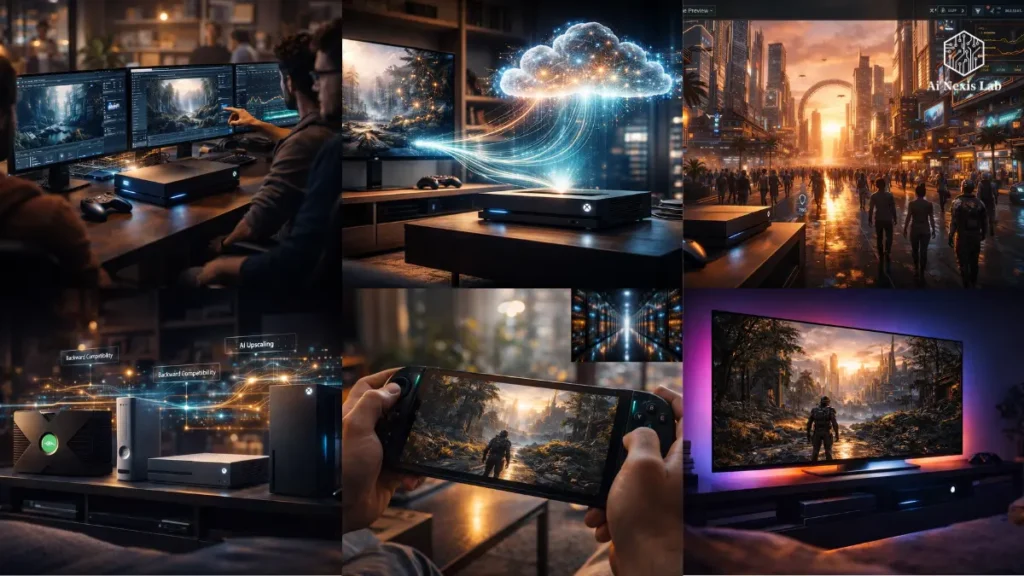
The second major pillar of Project Helix is what Microsoft calls Helix-Link.
At its core, Helix-Link is a hybrid computing model.
Part of the game runs locally.
Part of the game runs in the cloud.
And ideally, the player never notices the difference.
Cloud Gaming Problem
Cloud gaming has been around for years.
Microsoft’s own Xbox cloud gaming service already allows players to stream games to phones, tablets, and smart TVs.
But there has always been one big problem:
Latency.
Each button press requires a journey from your controller to a remote data center, then back to your screen.
Even small delays can make games seem sluggish.
Competitive shooters, racing games, and fighting games are particularly affected.
This is why cloud gaming has never completely replaced traditional hardware.
How Helix-Link Works
Helix-Link attempts to solve the problem by intelligently dividing the workload.
Latency-critical tasks remain local.
Examples include:
- Player movement
- Aiming
- Camera control
- Real-time physics interactions
Meanwhile, the big tasks go to Azure servers.
This includes:
- Global lighting calculations
- Large world simulation
- AI training models
- Ultra-high-resolution asset rendering
Local console and cloud server collaborate essentially in real time.
Microsoft calls this the edge-to-local pipeline.
“Invisible Handshake”
In theory, players should never know where the process takes place.
If your internet connection slows down, the console quietly handles more workload locally.
Visual fidelity may be slightly reduced, but the gameplay remains smooth.
If your connection is fast – think fiber internet – the system can pull in vast cloud resources to augment the world.
This could mean:
- Better lighting
- Higher resolution textures
- More detailed environments
- More advanced AI behaviors
The goal is simple:
Maximum performance without visible compromise.
3. 2027 Prototype Timeline: Why Developers Are Getting Hardware Early
The most interesting details about Project Helix aren’t the hardware.
It’s the timeline.
Microsoft has confirmed that developer prototype kits will arrive in 2027, years before the expected consumer launch.
That’s unusually early.
Historically, developer kits come very close to launching Windows.
So why the long runway?
Building For Complexity, Not Just Resolution
The answer lies in the architecture itself.
Developers don’t just need to optimize graphics for Helix.
They need to rethink how games are made.
Effective use of NPUs requires completely new development techniques.
The studio will need to design systems that rely on machine learning models and dynamic simulations.
It takes time.
Giving developers a two-year trial could lead to Helix-specific games launching alongside the hardware.
The “Cross-Generation” Trap
The biggest problem with console launches is cross-generation development.
Studios are making games that run on both old and new hardware.
It limits innovation.
Many early PlayStation 5 and Xbox Series X games still ran on previous consoles.
The result?
The new systems didn’t seem dramatically different.
Microsoft wants to avoid that trap.
If developers start building for Helix early, the launch lineup could truly showcase next-generation systems.
4. The End of Physical Discs? Digital-First Mandate
One detail is missing from the early Project Helix discussions.
There is no confirmed disk drive.
That omission is not accidental.
Microsoft has been slowly moving towards a full digital ecosystem for years.
Game Pass subscriptions continue to grow, and digital downloads dominate modern game sales.
By 2026, most Xbox software purchases will already be made digitally.
Console Economics
Disk drives aren’t cheap.
They add:
- Production costs
- Physical complexity
- Potential hardware failure points
Eliminating them simplifies the hardware.
More importantly, it pushes players towards digital purchases and subscriptions.
It aligns perfectly with Microsoft’s broader strategy.
Game Pass is already one of the company’s most valuable gaming assets.
Project Helix could dramatically boost that ecosystem.
What This Means For Your Game Library
The shift won’t be painless.
Many players still have large collections of physical discs.
Microsoft may offer a modular external drive for backward compatibility testing.
But the direction is clear.
Gaming is moving towards streaming and downloads, not plastic media.
It may frustrate collectors, but from a business standpoint, this trend is difficult to stop.
5. Backward Compatibility: The “Infinite Library” Promise
One area where Xbox consistently outperforms competitors is backward compatibility.
Project Helix aims to expand on that philosophy.
But the company doesn’t just promise that older games will run.
They are promising that they will do better.
AI-Powered Visual Upgrades
With the NPU in the hardware stack, Microsoft can apply machine learning techniques to legacy games.
These include:
- AI Upscaling
- Dynamic Texture Reconstruction
- Automated HDR Lighting
- Improved Anti-Aliasing
Older titles may automatically receive visual upgrades.
No remastering required.
A Hypothetical Example: Halo 3 in 2028
Imagine loading up Halo 3, which was originally released in 2007.
On older hardware, it still feels like a game from the mid-2000s.
On Project Helix, the system analyzes the original textures and replaces them with AI-generated high-resolution counterparts.
Lighting is recalculated using modern rendering techniques.
Suddenly, a 20-year-old game feels surprisingly modern.
This is the potential power of machine learning-driven relevance.
6. “Helix Portable” Rumors: A Unified OS
Another interesting rumor is the possibility of a handheld companion device.
Microsoft has not confirmed it yet.
But industry signals suggest that a unified Windows-Xbox operating system could power multiple devices.
Steam Deck Effect
Valve’s Steam Deck proved that there was a huge demand for portable PC-quality gaming.
Devices like the ASUS ROG Ally quickly followed.
Microsoft doesn’t want Xbox games to run on handhelds that rely on the clunky desktop Windows interface.
A dedicated Helix handheld could replace that.
Seamless Gaming Lifestyle
The vision is simple.
You start a game on your living-room TV.
Afterwards, you continue on the portable device without interruption.
Cloud synchronization and Helix-Link keep the game state perfectly aligned.
No loading screens.
No manual transfers.
Just pick up and keep playing.
7. Competitive Landscape: Sony’s Response
No discussion of Xbox strategy is complete without mentioning Sony.
Companies approach gaming from different angles.
Sony focuses heavily on premium hardware and exclusive titles.
Microsoft is focused on ecosystem reach.
Hardware vs. Ecosystem
Sony builds powerful consoles designed for high-end experiences.
Microsoft builds platforms that reach multiple devices.
Project Helix fits perfectly into that philosophy.
It’s not just a console.
It is the center of a very large gaming network.
Subscription Economy
Microsoft also has a powerful advantage.
Game Pass.
By bundling the hardware with subscription services, the company can sell the Helix console at a lower starting price.
Players effectively finance the hardware through ongoing subscriptions.
The smartphone industry already uses this model.
Gaming could follow suit.
8. Development Obstacles: Mid-Genesis Crisis
For all its potential, Project Helix also presents real risks.
Hybrid architecture is complex.
Developers will need to manage workloads across both local hardware and cloud infrastructure.
It’s not trivial.
Latency Ceiling
Physics still matters.
If a player lives far from Microsoft data centers, cloud latency becomes inevitable.
It can reduce the benefits of helix-link.
Players in rural areas may rely primarily on local hardware.
It creates inconsistent experiences across different regions.
Always-Online Risk
There is another concern.
What happens if the servers go offline?
If certain game systems rely on cloud processing, an outage could break key mechanics.
Microsoft will need robust offline fallback modes.
Otherwise, players may resist the hybrid model altogether.
9. Strategic Blueprinting: Preparing for The Helix Era
If Project Helix launches around 2028 or 2029, players still have time to prepare.
But ignoring shifts can quickly make your setup outdated.
Here are three areas that are worth evaluating now.
Bandwidth Auditing
Hybrid gaming will use a large amount of data.
Check your internet plan.
Many American ISPs still enforce monthly data caps.
Streaming high-fidelity assets can push players beyond those limits quickly.
Display Future-Proofing
Modern consoles already support HDMI 2.1, 4K at 120Hz, and variable refresh rate (VRR).
Project Helix will likely push those standards even further.
Upgrading to a compatible display ensures that you really see the benefits.
Digital Library Consolidation
If Helix truly moves towards an all-digital ecosystem, physical collections will gradually become less practical.
Transitioning to digital libraries now can make the transition easier later.
Frequently Asked Questions
Will Project Helix replace the Xbox Series X?
Yes, but not immediately. Microsoft traditionally supports older consoles for several years after the launch of a new generation. Even after Helix arrives, Series X owners will continue to receive cross-generation releases via cloud streaming or scaled-down versions. Think of it less as a hard cutoff and more as a gradual transition. Over time, Helix-specific games will become commonplace, but the current Xbox ecosystem isn’t going to disappear overnight.
When can players actually buy Project Helix?
Based on current information, developer prototype kits are scheduled for 2027. That usually means a customer release about one to two years later. Industry analysts expect a launch window of late 2028 and early 2029. Of course, hardware development timelines can change, especially with new architectures. But if Microsoft sticks to its roadmap, Helix could define the next gaming generation before the end of the decade.
Do you need ultra-fast internet to use Project Helix?
Not necessary, but a strong connection will significantly enhance the experience. The system is designed to run games locally if cloud connectivity isn’t ideal. However, some of the advanced visual features enabled by Helix-Link rely on fast, stable internet. Microsoft suggests 50 Mbps or higher for best performance. Slow connections will still work, but the system may reduce certain enhancements.
Will the console be more expensive than Series X?
Pricing is still unknown, but industry rumors suggest a two-tier strategy. The premium Helix model could target high-level players who want maximum local performance. A lower-cost version may rely more on cloud processing. If Microsoft subsidizes the hardware through Game Pass subscriptions, the starting price could remain competitive with previous consoles, despite the more advanced architecture.
Can you still play old physical Xbox games?
This is still one of the biggest unanswered questions. The Helix operating system will almost certainly support older titles digitally. However, if the console launches without an internal disc drive, players may need an external accessory to verify physical copies. Microsoft has yet to confirm its approach, but maintaining backward compatibility has been a key selling point for the Xbox ecosystem.
Final Verdict: Is Xbox playing the long game?
Project Helix isn’t just another console.
It is a strategic axis.
Microsoft is betting that the future of gaming will blend local hardware, AI acceleration, and cloud infrastructure into a single ecosystem.
It’s a big gamble.
If the technology works, Helix could extend the lifespan of gaming hardware far beyond the traditional console cycle.
If that fails, players can reject the complexity entirely.
Right now, the outcome is still uncertain.
But one thing is clear.
Microsoft isn’t building the next Xbox for the world of 2015.
They’re building it for the world of 2030.
The real question is whether the rest of the gaming industry – and the players themselves – are ready to follow suit.