
The Great American Scavenger Hunt – 2026 Edition
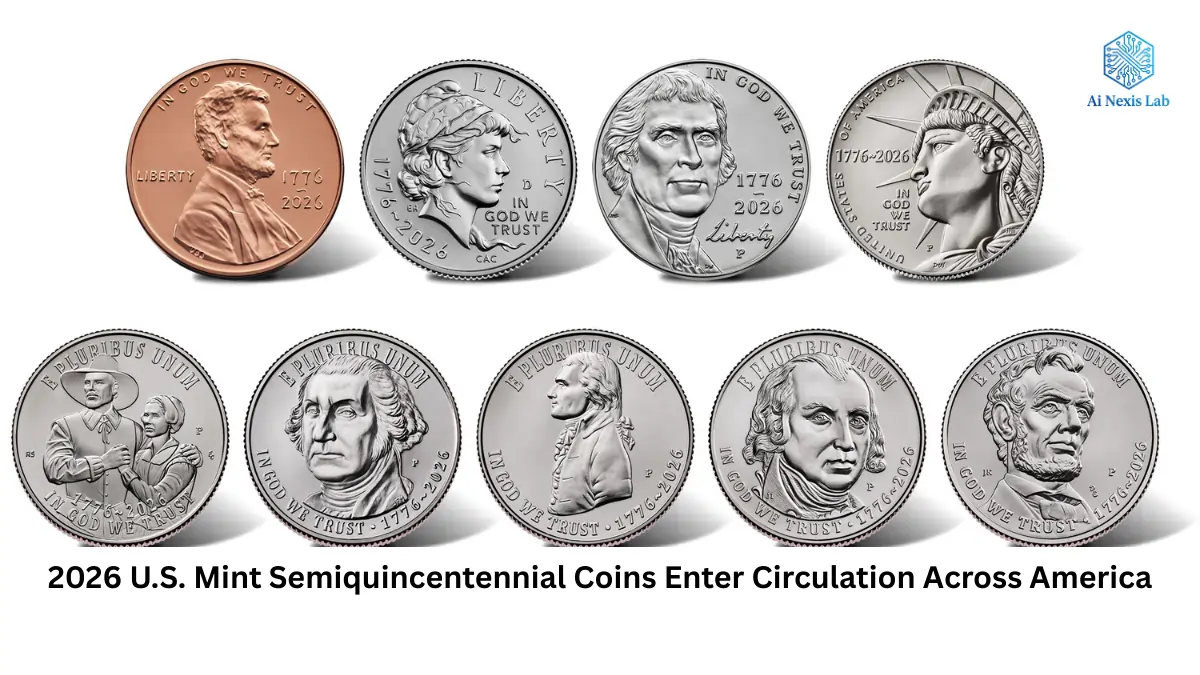
Explore 7 proven facts about the 2026 U.S. Mint coin release, Semiquincentennial designs, circulation details, and real collector value insights.
Semiquincentennial Coins, the 1976 Bicentennial Reality Check, and Why the Change in Your Pocket Matters Again
You know that moment when you throw a handful of coins on the counter and arrange them like archaeology? Well, in 2026, that old habit became interesting again – and it wasn’t because of TikTok hype or some wild internet story about a $4 million quarter.
We are in a truly historic moment: the United States is celebrating its 250th anniversary. It’s the semiquincentennial, and it’s not just another token anniversary. The U.S. Mint is issuing new circulating coins with dual dates of 1776 ~ 2026 – and they are already entering circulation.
This isn’t a side project. Everyday U.S. coins since 1976 have been This is perhaps the biggest change in coinage, and it is affecting collectors, cash users, banks and coin-hunters across the country.
Part I – 2026 Semiquincentennial Coin Program: The Facts
What’s Actually Being Issued
In 2026, the U.S. Mint redesigned multiple coins that will circulate not only as collector pieces, but also as everyday money:
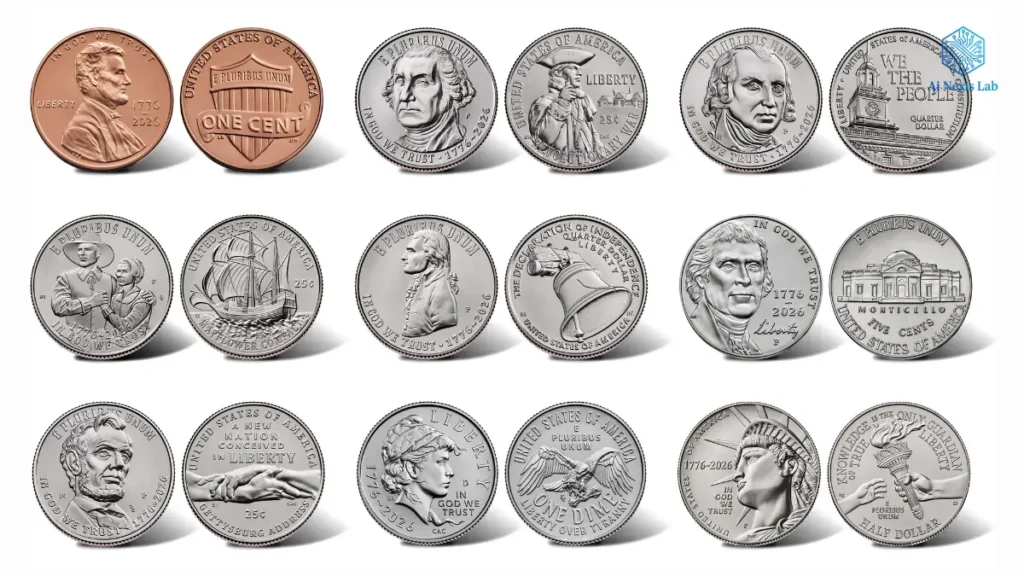
The coins circulating with the new designs and dual dates include:
- Dime – Rising Liberty design.
- Quarters – The Mayflower Compact is the first of five themed quarters.
- Half Dollar – Enduring Liberty Semi-Commemorative.
- Nickel – Updated dual date on Jefferson design.
- Penny – Dual-dated but produced primarily for collector sets (not wide circulation).
This large-scale change is part of the Semiquincentennial Circulating Coin Program authorized under existing law; It is not a “limited experiment”.
To put it bluntly: For the first time since 1976, ordinary spending money will look different in 2026.
How these coins are reaching your pocket
The U.S. Mint began sending these coins to the Federal Reserve Banks in early January 2026. That means they are filtering into:
- Local bank coin inventories
- Grocery store changes
- Gas station mints
- Cash registers everywhere
Distribution patterns vary by region, so you may see 1776 ~ 2026 coins earlier than others – that’s normal.
Part II – Why This Matters to Everyday People
This is an honest thought: Most people believe that coins are worthless until something shiny is made. That has changed.
Not just quarters — a whole bunch of redesigns
Unlike 1976 (which only redesigned quarters, dimes, and half dollars), 2026 touches almost every coin in your pocket — even nickels and pennies.
This is important because:
- Coins are now more visible – people actually notice them.
- Collectors are taking notice again – interest in the hobby is growing.
- Ordinary Americans can legally find something rare in currency – if they know what to look for.
And yes – unlike digital tokens or NFTs – these are tangible pieces of metal that can end up in your pocket.
Part III – Social Media Hype Machine vs. Reality
Let’s be clear:
Social media loves exaggeration. Headlines like:
“Rare Quarters Could Make You a Millionaire!”
are pure clickbait.
Digital creators use stories about incredibly rare coins to get views – but that’s not the real economic reality.
Here’s the basic truth:
- 99% of old Bicentennial quarters (1976) are worth their face value – $0.25.
- Very few have any real collector value, and that value depends on condition, mint errors, and grading.
And no – most people don’t walk around with wealth in their pockets.
Part IV – The Truth About the 1976 Bicentennial Quarter
You may have seen the headlines. TikTok influencers and lifestyle sites share stories claiming your old 1976 quarter is worth thousands or even millions.
Hold on. Let’s unpack the real market:
Why the 1976 Bicentennial Quarter was Special
In 1976 the U.S. Mint struck a number of Bicentennial quarters with dual dates of 1776-1976 and a colonial drummer design. They were everywhere – billions of them.
That means:
- Almost all are common and worthless as collectibles.
- They’re face value in change unless specific features apply.
When They Are Valuable
Here’s the cold, hard breakdown:
Only these conditions bring real market value:
- Silver Proof or Silver Strikes (40% silver) – worth more than face value.
- Coins with errors or incorrect strikes – actual value confirmed by grading.
- High grade, professionally graded coins (MS67+, MS68+) – These can reach hundreds or even thousands when sold at auction.
What is not true
- The chances of you taking a coin worth millions out of circulation are very slim.
- Headlines claiming a particular quarter was worth $2.5 billion or $4 million? That’s internet fiction, not monetary reality.
The real drivers of value are rarity, condition, and verified errors, not just nostalgia.
Part V – What Happened at the 71st Fun Show (and Why It Matters)
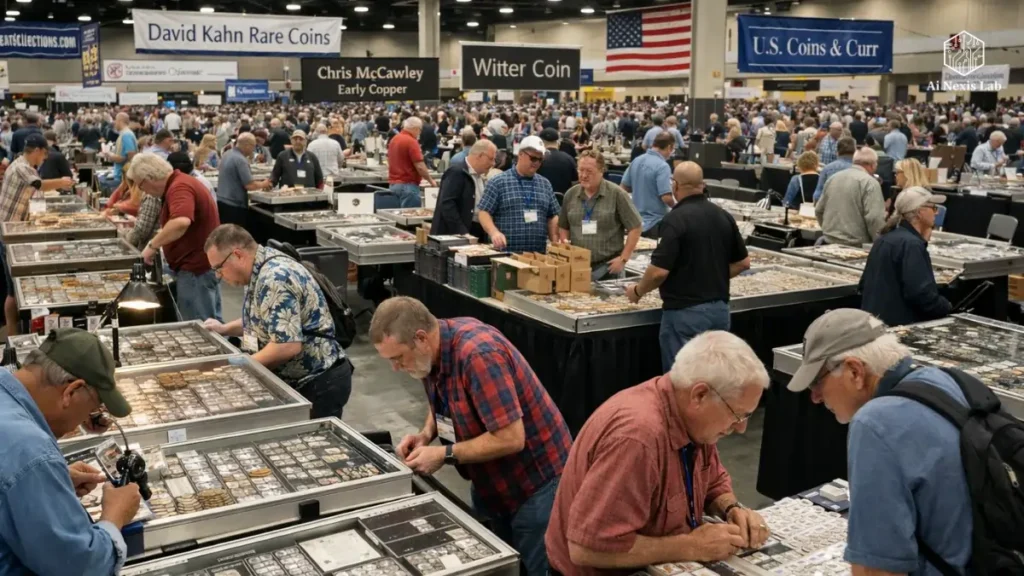
If you’re wondering where the serious collectors are right now – they’re at the Fun Show (Florida United Numismatists), the largest coin show in the Western Hemisphere.
Here’s what’s important:
1. Mint shows commercial and circulation coins
For the first time in years, the Mint wasn’t just talking about collector sets. It shows actual circulating coins before they reach the Federal Reserve warehouse.
It changes the hobbyist mindset:
- You’re not chasing something that’s deep in thousands of storage…
- You’re chasing what might actually show up in your edit.
2. Early Collector Behavior
Serious hobbyists were already hunting for:
- First strike coins – those that were minted early on.
- Mint packaging coins – untouched sheets or rolls.
- Proof and silver issues for investment-grade sets.
The story isn’t just “coins are cool close-ups”. It is a major collector event, which legitimizes the 2026 issue in traditional markets.
Part VI – The Reality of Currency in 2026
Let’s turn to the uncomfortable truth:
Coins are Dying as Currency
We use less cash than ever before. Digital payments are dominant. People are hoarding coins in jars. This means that:
- Even with all this attention, physical coins may be circulating less, not more.
This is the paradox of 2026:
The more popular these coins are, the less likely they are to circulate.
That’s not the Mint’s fault – it’s just economics.
Where can you actually find 2026 coins
If you want to have them on hand quickly:
- Ask your local bank for a roll – they may have the 2026 issues.
- Use cash in stores – returns are where they will appear first.
- U.S. Buy directly from the mint – collector sets, proof sets and specialty issues available.
Part VII – If you are considering this as an investment
Stop thinking emotionally. A coin is only an investment if:
- You understand its rarity and grading,
- You accept that value is driven by collectors and markets, not hype,
- You keep it safe and have it professionally graded at the appropriate time.
Here are the actual categories that can retain value:
A. Mint Errors
- Off-Center Strikes
- Double Dies
- Die Cracks and Planchet Defects
These should be checked and graded – and even then they are special items.
B. Collector Mint Issues
Coins from San Francisco or West Point, or the Mint’s Proof/Silver sets, often command a higher premium – because they are made for collectors, not for circulation.
C. 2026 Half Dollars and Dimes
These may have better long-term interest because:
- They are less common in circulation.
- They are involved in a one-year program.
Again – this is collector interest, not guaranteed financial appreciation.
Part VIII – A Cultural Perspective That Really Matters
Coins aren’t just metal discs – they’re cultural artifacts.
In 1976, the Bicentennial series was part of national reconstruction – helping the country heal after political conflict. The 2026 series, whether you’re on the left or the right, tapped into a common need: something tangible that we all share.
That’s why this is important.
It’s not about quick cash.
It’s about shared history, art, and memory.
And for the first time in a long time, coin collecting isn’t just a hobby – it’s part of the nationwide conversation again.
Frequently Asked Questions
Q: Are the 2026 coins already in circulation?
A: Yes. The U.S. Mint began shipping semi-centennial coins in early January 2026, including the first redesigned quarters, dimes, and half dollars.
Q: Will these coins make me rich?
A: No. Most new 2026 coins will be of original value unless they are in exceptional condition or have verified errors. Only a small fraction acquire strong collector value.
Q: Are Bicentennial quarters (1976) suddenly valuable?
A: Almost all of them are still in circulation at a value of $0.25. Some silver or error coins may command a collector premium, but most are not valuable.
Q: Can I find valuable errors in the circulation?
A: Yes – but it’s rare. If you find an error coin, have it graded by a professional service before assuming any market value.
Q: Should I collect coins from every year from 1776 to 2026?
A: Not necessary. Keep a few for interest and personal savings, but don’t expect automatic investment returns. Value depends on rarity and collector demand.
Q: How can I get certified values for old or new coins?
A: Use reputable grading services like PCGS or NGC; Raw coins are worth as much as someone is willing to pay for them – period.
Q: Do these coins affect federal monetary policy or the economy?
A: No – they are still legal tender and part of the common coinage. Their collectible aspect does not change how money works.
Takeaway – Cut Through the Noise
Here’s the honest, absurd truth:
- The 2026 coin release is a once-in-a-generation event for U.S. circulating coins.
- Most everyday coins are still just money, not an investment.
- Only certain rare errors or high-grade pieces have collector value.
- Hype doesn’t translate into guaranteed value.
If you want to enjoy hunting, go for it. But know the difference between history in your hands and a financial jackpot that almost never materializes.
Happy coin hunting – but do it with your eyes open.