
Your city already has a brain – you just don’t know it yet
Discover how smart city AI systems are transforming traffic, energy, and infrastructure. 7 powerful innovations shaping the future of modern cities.
Quietly inside AI systems running your commute, your power grid, and your city’s future – right now
Table of Contents
Thinking City
Let’s cut out the buzzwords.
You are already living in a system that is making decisions without you.
Right now, somewhere near you, an intersection is adjusting its signal timing – not based on a fixed schedule, but based on live data. It is counting vehicles, predicting congestion, and optimizing flow in real time. He has changed his time several times at the last minute.
No man has touched it.
It is not an experimental technique. It is infrastructure deployed in U.S. cities.
And here’s where most people get it wrong:
They think “smart city” means the future.
It doesn’t. It means current – just unevenly distributed.
The scale of this change is not subtle. U.S. The smart cities market is growing so rapidly, reaching an estimated $172 billion in 2025, that ignoring it is no longer a neutral decision. Governments don’t invest billions of dollars in speculative assets. These are now operational infrastructure facilities.
What has changed in the last few years is not just the result of better hardware. It is that systems have crossed a milestone:
- Enough sensors
- Enough data
- Enough computation
- And – crucially – feedback loops
that combination turns a passive structure into an active system.
The result? Cities that don’t just function – they adapt.
And that changes everything.
How AI Is Rewiring Traffic In Real Time
Traffic systems were stupid. Not “kind of stupid” – really stupid.
For decades, signals followed a fixed cycle. Later, they would react a little to the sensors along the way. But they never understood the context. They didn’t know what was coming next.
This is the difference today:
AI traffic systems are predictive, not reactive.
What It Really Means
Modern systems draw from:
- Real-time sensor data (loops, cameras, radar)
- Historical traffic patterns
- Event data (games, concerts, school schedules)
- GPS and connected vehicle inputs
They don’t just ask “What’s going on here?”
They ask:
“What’s going to happen on the network?”
And then they make arrangements ahead of time.
Old Road vs. New Road
Old System:
- Cars pile up
- Signals react late
- Congestion spreads
AI System:
- Predicts upcoming surge
- Adjusts upstream signals early
- Prevents congestion
It is not an incremental improvement. It’s a completely different system.
Why Is This More Important Than Speed?
Most people assume that fast traffic is the goal.
Wrong.
The real benefits are:
- Reduced idle time
- Lower emissions
- More predictable travel
- Better emergency response
The last one is big.
AI-controlled corridors can clear the way for ambulances in seconds. It’s not a convenience – it’s existence.
Three Cities, Three Successes
Let’s be specific. Different cities solved this in completely different ways – and that’s important.
Pittsburgh – Decentralized Intelligence
Pittsburgh’s SurTrack system flipped the model.
Instead of one central brain, each intersection has its own intelligence. Signals talk to each other, but make local decisions.
Think of it as a mob rather than a command center.
Results:
- 25% travel time reduction
- 40% less idle time
- 21% emissions reduction
This works because it is resilient. If one node fails, the system does not collapse.
Los Angeles – Centralized Scale
LA took the opposite approach.
Their ATSAC system is a huge centralized network that controls thousands of signals.
Results:
- 4,800+ signals connected
- 32% latency reduction
- Millions saved annually
It’s less flexible than Pittsburgh’s model – but incredibly powerful at scale.
New York – Behavioral Control
New York didn’t just optimize traffic.
They reduced it.
Crowd pricing uses AI to model human behavior and dynamically adjust prices.
Result:
- ~1 million fewer vehicles in the main zone (first month)
- 10-30% faster travel times
That’s the key insight:
Sometimes the best traffic system isn’t better flow – it’s less demand.
The Invisible Hand on Your Power Grid
Now turn your attention from roads to electricity.
This is where things get serious.
The grid acts on the edge of a knife. Supply must match demand every second. There is no buffer.
Historically, utilities have controlled this by over-building capacity.
It is inefficient. And with renewables, it breaks down completely.
AI Fixes The Main Problem: Uncertainty
Modern systems predict demand using:
- Weather patterns
- Historical consumption
- Behavioral trends
- Event signals
And they do it with high accuracy.
Why It Changes The Game
If you know demand 24 hours ahead:
- You reduce waste
- You reduce emergency capacity
- You better integrate renewable energy
Utilities like EverGrey are already using hundreds of AI systems to automate operations and predict demand with accuracy.
That’s not optimization – that’s transformation.
Demand Response: You’re Already Part of the System
Here’s the part most people don’t understand:
Your devices are becoming grid assets.
- Thermostats adjust slightly
- EV charging times change
- Devices differentiate usage
Personally? Invisible.
Collectively? Equivalent to a power plant.
And that is the future of energy:
Distributed, Integrated, Invisible.
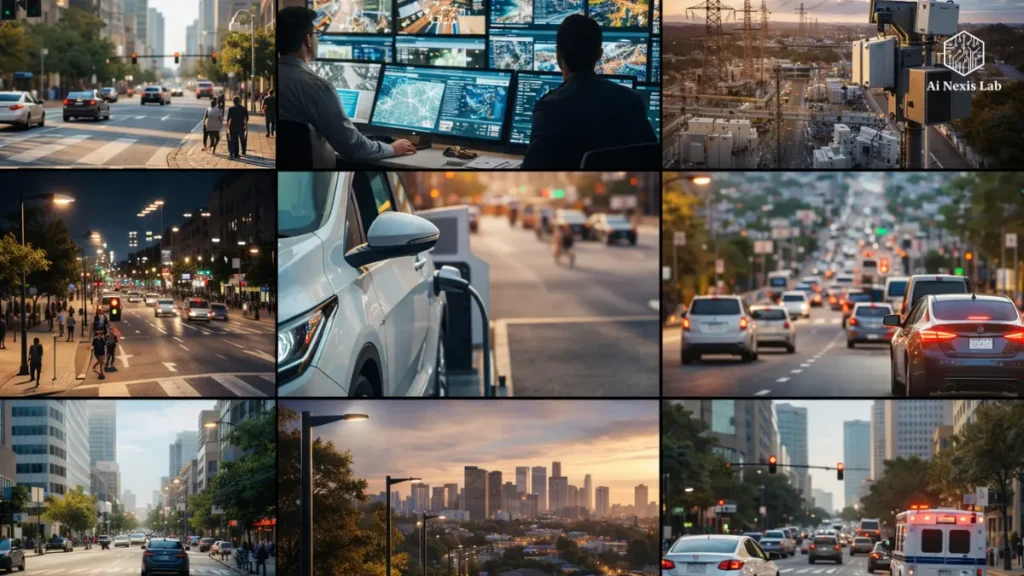
Digital Twins: The City Inside the Computer
This is where things start to seem almost unreal.
Digital twins are real-time simulations of a city.
Not a static model – a living system.
What It Tracks
- Traffic flow
- Infrastructure stress
- Energy consumption
- Water systems
- Environmental conditions
Everything feeds into dynamic simulations.
Why It Matters
Cities can test decisions before implementing them:
- Road closures
- Infrastructure upgrades
- Policy changes
Instead of predicting, they simulate.
Real Advantage
Predictive maintenance.
Instead of reacting to failures, systems detect patterns that signal upcoming problems.
Using this approach, New York prevented dozens of major water leaks.
This is the shift:
From fixing problems → to avoiding them altogether
Smart Grids and The Renewable Revolution
Let’s be clear:
Renewable energy disrupts the traditional grid.
Solar and wind are incompatible. Demand is not.
That mismatch is the main challenge.
AI Solves The Coordination Problem
It performs three functions at once:
- Predicts supply (weather, solar, wind)
- Predicts demand (behavior, patterns)
- Balances both in real time
This requires constant adjustment of:
- Batteries
- Power plants
- Demand-response systems
Results
- ~15% energy savings
- 25-30% cost reduction
- More stable renewable coordination
It’s not theoretical. It’s already happening.
What’s Next: Your Car as a Power Source
Electric vehicles are huge batteries.
Millions of them = a huge distributed collection.
Vehicle-to-Grid (V2G) systems:
- Will draw energy during peak demand
- Recharge during low demand
It turns your car into part of the grid.
Like it or not.
Urban Intelligence Playbook: 6 Frameworks That Actually Work
Most cities fail not because of tech – but because of implementation.
Here’s what really works.
1. Corridor Domino Method
Start small. Prove value. Expand.
Cities that try to scale immediately usually fail.
2. Data Gravity Strategy
Centralize data early.
No shared data = no real intelligence.
3. Feedback Loop Accelerator
Systems should continuously learn.
Static AI = wasted investment.
4. Modular Stack Approach
Avoid vendor lock-in.
If you can’t swap components, you’re stuck.
5. Resident Co-Design
If people don’t believe in it, it fails.
Simple as that.
6. Human-In-The-Loop Firewall
Some decisions should remain human.
Not just for ethics – for risk control.
What Are Smart Cities Still Getting Wrong
Now let’s be honest.
This is not working perfectly.
1. Equity Problem
Deposits follow money.
High-income areas get upgrades first.
It widens inequality.
If it is not actively corrected, the system reinforces the existing gap.
2. Integration Failure
Different departments, different systems.
No communication.
The result? Fragmented intelligence.
3. Cybersecurity Risk
Connected Infrastructure = Attack Surface.
A hacked traffic system isn’t just inconvenient – it’s dangerous.
Costs are rising, but many cities are still lagging behind.
Biggest Mistake
Installing sensors ≠ building a smart city.
Without:
- Data Governance
- Analytics
- Skilled Teams
…it just sounds expensive.
The Next Five Years: What’s Really Coming
Let’s skip the hype and focus on what’s real.
Autonomous Intersections
Signals and vehicles coordinate directly.
Less stopping. Less waste.
Already in pilot phase.
Microgrids
Neighborhood-level energy systems.
May be disconnected from the main grid during an outage.
Huge increase in elasticity.
Predictive Maintenance at Scale
Failures become rare.
Systems detect problems weeks in advance.
This will become standard.
AI-Native Urban Planning
Cities simulate policy outcomes before implementation.
Traffic, energy, housing – all modeled together.
It eliminates a lot of bad decisions.
Bigger Picture
Cities are moving towards integrated systems.
Traffic, energy, water, transportation – everything is connected.
That’s what a real “smart city” is.
Everything else is just pieces.
Frequently Asked Questions
Are smart cities really improving everyday life, or has this been overhyped?
They are improving certain things – not everything.
In cities where these systems have been used properly, traffic flow, emergency response, and energy efficiency are already better. But the benefits are not shared equally, and many cities still operate fragmented systems. So yes, it is real – but inconsistent.
Is this just the government spending too much on technology?
Sometimes, yes.
Bad implementations waste money – especially when cities buy hardware without a strategy. But when done correctly, the ROI is measurable: lower energy costs, less congestion, fewer failures. The difference lies in the implementation, not the technology.
Should people worry about privacy?
You should be aware, not panicked.
These systems rely on data, but most of it is aggregated and anonymized. The real risk is not oversight – it is abuse or poor governance. Cities that don’t define clear rules will get into trouble. The issue is not the technology – it’s how it’s managed.
Will AI replace city workers?
Not in a big way.
It automates repetitive decision-making and monitoring, but it also creates demand for new roles – data analysts, system operators, AI monitoring. The workforce changes, but does not disappear. The big risk is that cities are not training people fast enough.
What happens if these systems fail?
If designed properly, it degrades beautifully.
Decentralized systems (like Pittsburgh) are more resilient. Centralized systems may be more vulnerable but easier to control. The real threat lies in poor design – not the AI itself.
Final Verdict: The City That Waits Will Pay the Price
Here’s the reality that most cities don’t want to accept:
This transition is not optional.
Infrastructure built for the 20th century cannot meet the demands of the 21st century without intelligence at the top.
Cities that move early reap compounding benefits:
- Better data
- Better models
- Better outcomes
Cities that wait don’t just get left behind.
They fall further behind every year.
If you live in one of these cities, you are already part of the system – whether you realize it or not.
And that’s the real solution:
Your city already has brains.
The only question is whether he is learning fast enough.