Search Apocalypse: Why Your Clicks Are Disappearing – and What Really Still Works
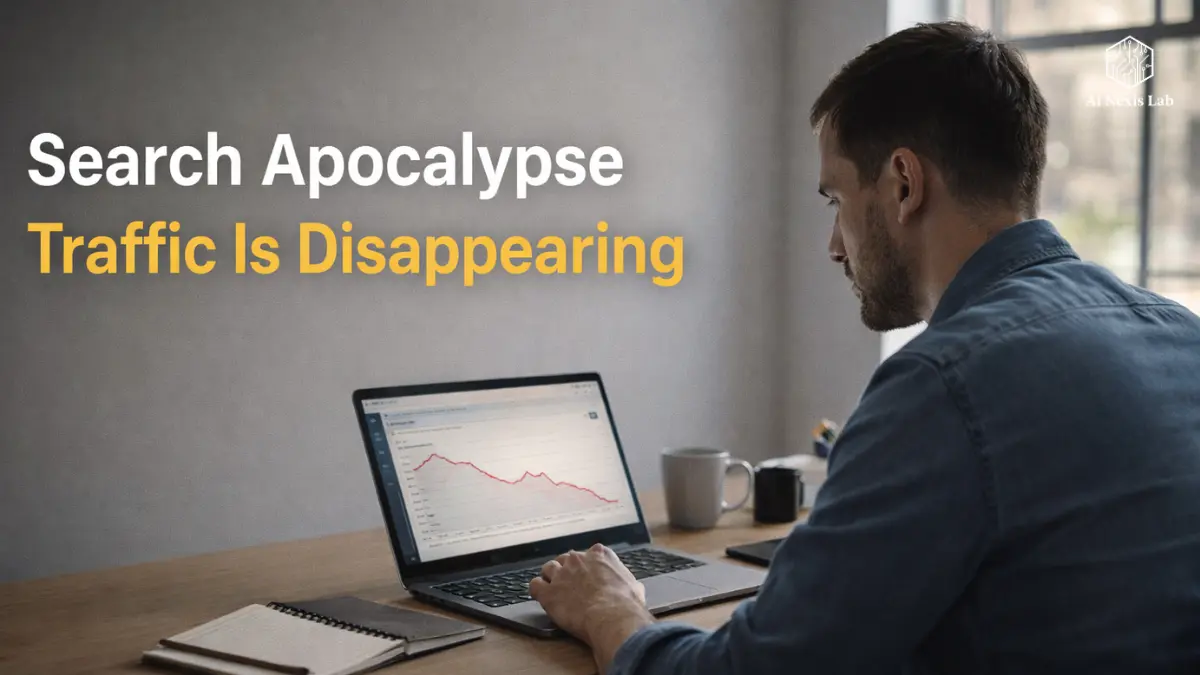
The search apocalypse is rapidly killing clicks. Learn 10 shocking SEO shifts, zero-click trends, and smart strategies to protect and grow traffic in 2026.
I remember not clicking on the search result the first time.
It was stupidly simple – “How to boil an egg.” Google gave me the answer above. Clean. Fast. No blogs. No scrolling. No ads. I followed the steps, closed the tab, and moved on.
At the time, it seemed efficient.
Now? That moment feels like a wake-up call.
Because that same behavior is now happening in millions of searches every day – and it’s quietly breaking the web’s entire business model.
Table of Contents
The End of The Old Deal
For almost 20 years, the system was simple:
- You publish content
- Google indexes it
- Users click through to your site
- You monetize the traffic
That deal is over.
Search engines are not sending users to websites like they used to. They are answering direct questions. Between AI overviews, generative search, featured snippets, and zero-click results, Google is becoming the ultimate destination – not the middleman.
And here’s the part that most people are still underestimating:
This is not a temporary phase. It is a structural change.
Recent industry data shows that more than 60% of Google searches in the US now end without a click, and this number continues to grow as AI responses get better. Informative questions – the bread and butter of blogs – are being destroyed first.
So if your traffic is down but your rankings appear stable, you’re not crazy.
You’re just playing a game where the rules changed in the middle of the match.
1. The Death of the “Definition” Interview
Let’s be clear: basic informational content is now dead weight.
For years, people built entire sites around keywords like:
- “What is X?”
- “How does Y work?”
- “Benefits of Z?”
It used to work because Google needed your content to answer the question.
It doesn’t anymore.
Why Did This Happen?
AI models have already been trained on billions of pages of this particular type of content. They have assimilated the definitions, the summaries, the explanations – everything.
So when a user asks a question like this:
- “What is compound interest?”
- “How does inflation work?”
- “What is quantum entanglement?”
Google doesn’t need your page.
It needs a sentence.
And it can generate it immediately.
What It Means For You
If your content only exists to explain something that can be summarized in 20 seconds, your value in search has been reduced to zero.
Not “reduce.”
Zero.
The Only Way: Move From Definition to Application
You need to stop answering “What is this?” and start answering:
- “What does this mean in real life?”
- “Where does this break?”
- “What happens when this goes wrong?”
Compare this to:
- Dead Content: “What is a diversified portfolio?”
- Sustainable Content: “Why My Diversified Portfolio Still Lost Money in 2022 – And What I Changed”
Another reason:
- It involves experience
- It involves failure
- It involves decision-making under uncertainty
AI can explain the theory.
It struggles with the living trade-offs.
That’s your beginning.
2. The Rise of Answer Engine Optimization (AEO)
If users don’t click, your goal changes.
You are no longer optimizing just to get traffic.
You are optimizing to be quoted by the machine.
The answer is Answer Engine Optimization (AEO).
How AI Chooses What to Cite
AI systems don’t “rank” content like traditional search. They extract it.
They are looking for:
- Clear structure
- High information density
- Direct answers at the beginning of the content
- Reliable cues (sources, data, authority)
If your article takes 800 words to get to the point, you’ve already lost.
“Nugget” Strategy
Every section of your content should have at least one extractable insight – something clean enough that an AI system can pick it up and reuse it.
Consider this:
- A sharp conclusion
- A unique data point
- A distilled structure
- A memorable one-liner
No fluff. No filler.
Real substance.
Structure Is More Important Than Ever
Disorganized writing doesn’t just annoy readers – it gets ignored by AI systems.
You need:
- Clear headers
- Tight paragraphs
- Bullet points where appropriate
- Direct answers near the top
And yes – schema markup (FAQ, how-to, product) is still important because it tells machines exactly where your key information lives.
3. Trust Tax: Why E-E-A-T Is Now Mandatory
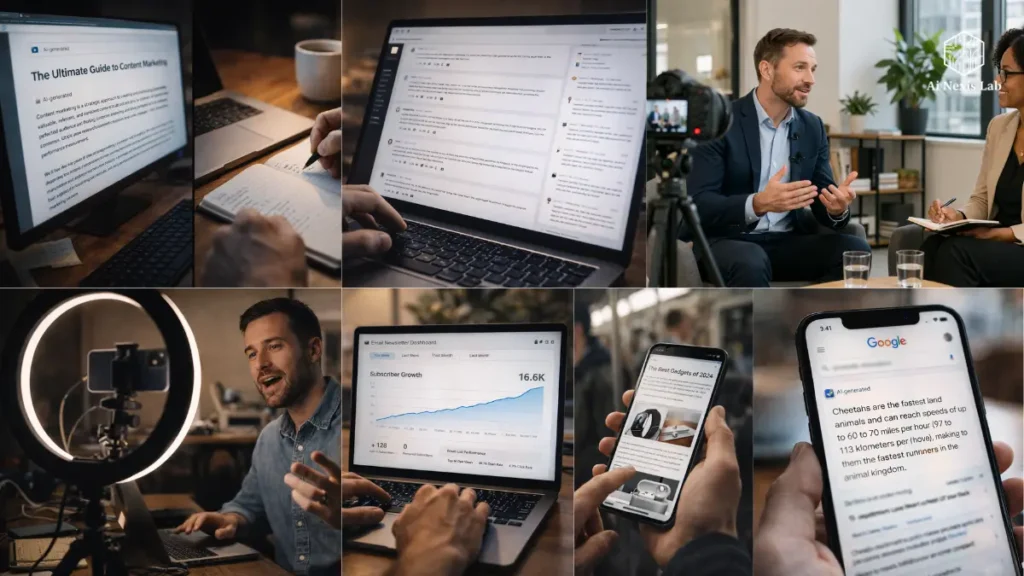
Google’s E-E-A-T framework – Experience, Expertise, Authentication, Trustworthiness – was previously a guideline.
Now it’s enforcement.
New Emphasis: Experience
That extra “E” (experience) changed everything.
Because here’s the reality:
AI can explain how to do something.
It can’t prove it did it.
And users are starting to care about that difference.
What The Real Experience Looks Like
- Screenshots of actual work
- First-hand results (including failures)
- Photos taken by you, not stock libraries
- Certain, unbiased details
If your content is written by someone reading it, it might as well be.
Create a Hole That AI Can’t Cross
Your only real defense is identity.
You need to be the person people search for by name.
Because once this happens, Google has no choice.
It has to show you.
Practical Moves
- Publish case studies with real numbers
- Include original images, not stock photos
- Quote real experts – not recycled Wikipedia summaries
- Maintain a consistent voice throughout the content
The generic authority is gone.
Specific authority wins.
4. Surviving In A World Where Half Your Clicks Are Gone
Let’s assume something uncomfortable:
You’re not getting that traffic back.
So what now?
You increase the value of the traffic you still have.
Shift From Traffic to Conversions
If you used to get 100,000 visitors and now you get 40,000, the math is simple:
Each visitor should be more valuable.
That means:
- Better offers
- Strong hooks
- Faster engagement
Get People Off Google Immediately
Search traffic is rented.
Email is owned.
You need to remove users from the search platform as quickly as possible.
Focus on:
- Email lists
- Private communities (Discord, Slack, Circles)
- Direct subscriptions
Because relying on Google for the long term is like building a business on borrowed land.
A Real-World Example
Let’s say you run a travel blog.
Old model:
- “Top 10 Things to Do in Paris”
- More traffic, less purpose
New model:
- “Anti-Paris Guide: Where I Got Scammed, What I’ll Leave Behind, and the One Place Worth Your Money”
Less traffic.
More trust.
Much higher conversion probability.
5. Rethinking Keyword Research (Most People Are Doing It Wrong)
The old strategy – high volume, low competition – has now become a trap.
Why?
Because those are the questions that AI eats first.
The Only Question That Matters Now
“Can AI answer this in under 20 seconds?”
If yes, walk away.
Target “Unanswerable” Questions
Requires:
- Decision
- Trade-off
- Reference
- Opinion
Examples:
- Weak: “Average salary of a software engineer”
- Strong: “Is it still worth being a software engineer with AI tools instead of junior roles in 2026?”
Needs to be thought of for another.
That’s where humans still win.
6. Search Is Becoming Fragmented (Google Is No Longer The Center)
People no longer search solely on Google.
They search everywhere.
Where Is The Attention Going
- YouTube – for depth and trust
- TikTok / Reels – for quick discovery
- Reddit – for unfiltered opinions
The last one is especially important.
People are literally adding “Reddit” to their searches because they no longer trust polished content.
What This Means
If your entire strategy relies on Google:
You are open.
You don’t need to be everywhere.
But you do need to be somewhere else.
Preferably where your audience already spends time.
7. Technical Reality Still Matters (Don’t Ignore It)
All the strategy in the world won’t help if your site is slow or unreadable.
Minimum Requirements
- Fast Load Time
- Clean Layout
- Mobile-First Design
- No Intrusive Popups
If your page takes 4-5 seconds to load, you’re already losing.
Not just users – machines too.
Mobile Is Where This War Is Taking Place
The majority of AI-powered search interactions happen on mobile devices.
If your content is not easy to scan on a phone:
You are invisible.
8. Stop Trying to Be Perfect (It’s Killing Your Content)
Here’s a Mistake That’s Getting Worse:
People are Trying to “Out-AI” AI.
They produce:
- Perfect grammar
- Safe tone
- No personality
And the result?
Completely forgettable content.
The Uncanny Valley Problem
AI content now has “emotion”.
Too clean.
Too neutral.
Too predictable.
And users are starting to notice.
What Really Works
- Strong opinions
- Clear stance
- Occasional edge
- A real voice
If your writing doesn’t sound like a human with a point of view, people won’t stick around.
Even Technical Content Needs a Story
Each piece should have:
- Problem
- Tension
- Solution
Even if it is instructional.
Because people don’t just consume information.
They follow stories.
9. Add Friction To The Purpose (Yes, Really)
Most marketing advice says: reduce friction.
It’s outdated.
You need selective friction.
Why?
Because friction creates engagement.
And engagement creates value.
What This Looks Like
- Deep, gated reports
- Premium newsletters
- Exclusive content tiers
If everything is free and shallow, nothing seems worth paying attention to.
Create Content Clusters (Not Random Posts)
Instead of scattered articles:
Create topic silos:
- 1 main pillar
- 8–12 supporting articles
- Strong internal linking
This signals authority to both users and machines.
10. Solve Problems People Don’t Know They Have Yet
This is where most content completely fails.
It reacts instead of expecting.
Three Frameworks That Really Work
1. Contextual Audit
Ask:
“What does this content offer that AI can’t replicate?”
If the answer is nothing:
Delete it.
2. Inverse Intent Mapping
Instead of targeting the first search, target the second search.
Example:
User search: “Best CRM tools”
Next thought: “Why did my CRM fail last time?”
That’s the second layer where the opportunity lies.
3. Authority Anchor
Every few months, create something that requires:
- Physical presence
- Real interaction
- Original work
Examples:
- Interviews
- Experiments
- Case studies
This grounds your content in reality.
AI can’t fake it for sure.
Frequently Asked Questions
Is SEO dead?
No – but the version most people learned is outdated. Ranking pages for basic informational questions is no longer a reliable strategy because those questions are answered directly on search results pages.
What still works is aligning content with deep intent, complex decision-making, and real-world uses that require human judgment.
Should I stop using AI tools to create content?
No, but you need to be honest about what they are good at. AI is great for outlining, summarizing, and speeding up research, but it basically produces generic output.
If you rely on it for the final draft without injecting your own thinking and experience, your content will get mixed up with thousands of similar pages and perform poorly.
Will small websites be able to survive this change?
Most people won’t do that – and that’s the reality. Small sites built on generic, interchangeable content are already losing visibility and will continue to decline.
However, smaller sites with a clear voice, strong niche focus, and direct audience relationships can really stand out because they offer something that machines can’t replicate.
What is the most important criterion now?
Raw traffic is no longer the best indicator of success. Metrics like time on page, return visits, email sign-ups, and conversion rate per visitor are more important because they reflect real engagement and trust. Smaller, more engaged audiences are much more valuable than larger, passive audiences.
How do I know if my content is secure?
A simple test: delete your name and replace it with someone else’s name. If the content still functions without losing meaning or credibility, it is not salvageable. Strong content has a distinct perspective, specific experiences, and recognizable thinking that cannot be easily changed.
The Reality That Most People Don’t Want to Accept Is That
the Internet is not dying.
But the simplified version of it is.
The version where you could:
- Repackage common sense
- Rank for basic keywords
- Monetize passive traffic
That version is gone.
What’s left is harder – but more valuable.
The rest of the focus is on people who:
- Think clearly
- Speak directly
- Show their work
- Build real trust
Everyone complaining about “lost clicks”?
Those were the lowest-cost clicks anyway.
What’s left is harder to earn – and much more valuable.
If you adapt, you can’t just survive this change.
You get ahead of the people who still pretend nothing has changed.