
Your phone can detect that you are getting sick, even before you do. The Quiet Rise of Personal AI Health Assistants (2026 Deep Dive)
The important signal at 3 am no one asked
Imagine this.
You wake up, grab your phone, and see a notification you weren’t expecting:
“Your resting heart rate increased overnight. HRV decreased significantly. Recommend monitoring. Consider resting.”
You feel fine. No symptoms. There is no reason to worry.
But two days later? You are sick.
That gap – that silent early warning – is where the real story of AI in healthcare is happening.
Not in robotic surgery. Not in hospital automation. Not in chatbots arguing with insurance companies.
It’s happening on your wrist. In your pocket. Quietly.
And here’s the uncomfortable truth: most people are still completely misunderstanding it.
Table of Contents
What Is a Personal AI Health Assistant Really?
Let’s cut to the chase.
A personal AI health assistant is not:
- A chatbot
- A telehealth app
- A glorified step counter
It’s a system that performs three functions in a row:
- Collects biometric data
- Learns your personal baseline
- Predicts deviations before symptoms appear
That last part is what changes everything.
Traditional healthcare waits for symptoms.
AI reverses the timeline.
The Three-Tier System (and Where Most People Get It Wrong)
Every real AI health assistant operates on three layers:
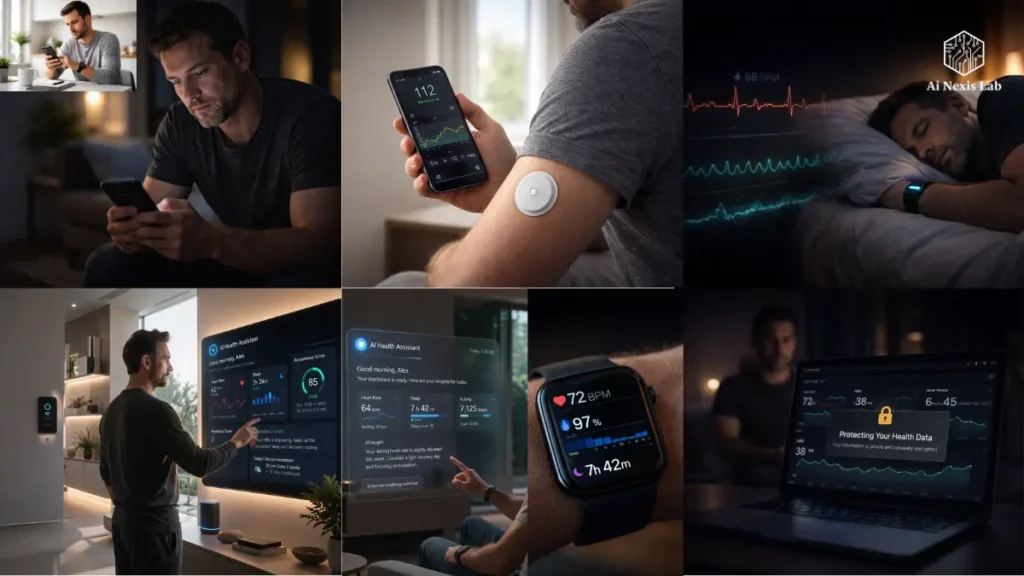
1. Sensing Layer (Data Collection)
This is the hardware:
- Smartwatch (heart rate, ECG, oxygen)
- Rings (temperature, HRV, sleep)
- Patch (glucose, cardiac rhythm)
- Phone (motion, voice, behavior)
Raw data alone is useless. Most people overestimate this level.
2. The Intelligence Layer (Where The Real Value Lives)
This is where AI really makes its money.
- Filters detect noise
- Finds patterns
- Builds your baseline
- Identifies anomalies
This is where things can go wrong:
- Bad models = false alarms
- Biased data = inaccurate predictions
- Weak validation = dangerous conclusions
If the intelligence level is weak, the whole system breaks down.
3. Action Layer (What You Actually See)
This is what your app looks like:
- Alerts
- Scores
- Trends
- Recommendations
This is where most platforms fail.
Why?
Because translating complex physical signals into clear, actionable advice is more difficult than creating AI.
The Brutal Reality
Most people believe they are using “AI health tools”.
They are not.
They are using data trackers with fundamental analysis.
True AI health assistants are still emerging – and the gap between marketing and reality is huge.
The Science of Continuous Monitoring – How It Really Works
Your body is constantly transmitting data.
Until recently, no one was listening.
Now he is being tracked 24/7.
Real Pipeline (Simple, no BS)
Step 1: Data Collection
Sensors measure:
- Heart rate (up to 100 times per second)
- Speed
- Temperature
- Sleep cycle
This is not occasional tracking. It is continuous.
Step 2: Feature Extraction
The raw data is unstructured.
AI converts it into useful signals:
- Trends
- Changes
- Variations
- Patterns over time
This is where most of the proprietary advantage exists.
Step 3: Baseline Creation
This is important – and most users skip it.
Your AI needs at least 2-4 weeks to understand:
- Your normal resting heart rate
- Your normal HRV
- Your sleep patterns
- Your behavioral rhythms
Without this, alerts are basically guesswork.
Step 4: Inconsistency Detection
The system now asks:
“Is this different from your usual?”
Not the population average.
You.
That is change.
Step 5: Insight Generation
This is where systems still struggle.
Good systems:
- Filter out noise
- Prioritize meaningful signals
- Avoid over-alerts
Bad systems:
- Spam notifications
- Incite anxiety
- Provide vague recommendations
Hard Truths
Tech is impressive.
But interpretation is still the weak link.
Early Warning Systems: Catching Disease Before You Know It
This is where things get real.
Real Scenario (Not Hypothetical)
The user’s wearable detects:
- High resting heart rate
- Rising temperature
- Decreased HRV
The user feels normal.
48 hours later: Onset of full-blown illness.
This pattern has been validated repeatedly since COVID-era studies – and expanded with broader datasets in 2026.
Why This Matters
Healthcare works like this today:
- You get symptoms
- You seek care
- You wait
- You misunderstand
- The doctor guesses
AI reverses it:
- Your body changes
- AI detects it
- You get an early warning
- You act sooner
It’s not incremental improvement.
It is a structural change.
Cardiac Monitoring: The Most Mature Use Case
This is where AI is already providing real value.
- Often Silent
- Intermittent
- High Stroke Risk
Traditional Systems Miss It.
AI-enabled wearables:
- Detect irregular rhythms
- Flag events early
- Trigger clinical follow-up
Appropriate Model (Pay Attention)
AI does not replace doctors.
It does this instead:
- AI detects → human confirms → treatment begins
Anything else is marketing nonsense.
HRV: The Metric That Most People Misuse
Let’s be clear.
People obsess over HRV without understanding it.
What it actually reflects:
- Nervous system balance
- Recovery status
- Stress load
What it doesn’t:
- Diagnose disease
- Reliably provide daily “good/bad” scores
Use trends. Ignore daily fluctuations.
Chronic Disease Management Gets Personal
This is where AI goes from “interesting” to “transformative.”
Diabetes: Best Example
Continuous Glucose Monitoring (CGM):
- Tracks glucose every few minutes
- Creates a personalized response model
- Predicts spikes before they happen
Key insight:
Two people can eat the same meal and have completely different glucose responses.
AI doesn’t care about averages.
It learns your metabolism.
Hypertension (Blood Pressure)
AI systems now track:
- Daily patterns
- Stress response
- Sleep impact
- Drug timing
This creates behavioral insights, not just numbers.
Heart Failure Monitoring
This is a life-or-death level effect.
AI systems detect:
- Fluid retention patterns
- Weight changes
- Decreased activity
- Sleep disturbances
Before hospitalization.
The Brutal Truth
For chronic disease, AI is no longer an option.
It is becoming standard.
Biggest Mistake: Alert Fatigue
If your device constantly bothers you:
- You ignore it
- Or develop anxiety
Solution:
- Turn off low-value alerts
- Focus on 1-2 important metrics
More data ≠ better decisions.
Mental Health Monitoring: The Most Underrated (and Dangerous) Landmark
This is where things get complicated.
What AI Is Actually Tracking
Your devices already track:
- Movement patterns
- Location changes
- Phone usage
- Sleep cycles
- Voice patterns
These are related to:
- Depression
- Anxiety
- Burnout
- Behavioral changes
Reality
AI can detect mental health signals before you consciously recognize them.
It is powerful.
And dangerous.
Voice AI Is Advancing Rapidly
Short recordings can reveal:
- Emotional state
- Cognitive load
- Mood changes
Not entirely. But increasingly reliably.
The Problem No One Wants To Talk About
Mental health data is:
- Highly sensitive
- Easy to abuse
- Weakly regulated
This is not theoretical.
That is a real risk.
Privacy: The Elephant In The Exam Room
Let’s be straightforward.
Most of your health data is not protected by HIPAA.
Yes, really.
Why It Matters
HIPAA applies to:
- Hospitals
- Doctors
- Insurance companies
It does not apply to:
- Most wearable apps
- Consumer health platforms
What It Means For You
Your data can be:
- Shared (even if “anonymized”)
- Used to train AI models
- Sold in aggregated datasets
“Anonymized” Data Is Not Safe
It is surprisingly easy to re-identify.
A few data points can identify you.
So don’t assume it’s safe.
What You Should Really Do
- Read privacy policies (yes, seriously)
- Check data-sharing terms
- Avoid apps that aggressively monetize health data
- Beware of employer wellness programs
Reality Check
Convenience comes at a price.
You are trading data for insights.
Just be aware of it.
5 Smart Health Optimization Frameworks (That Actually Work)
These are not “tips”.
These are systems.
1. Baseline Audit Protocol
Do nothing for 30 days.
Just track.
If you leave this out, everything else is flawed.
2. Single-Variable Experiment
Change one thing:
- Sleep time
- Diet
- Exercise
Track impact.
This is how real optimization works.
3. Traffic Light System
Every morning:
- HRV Trend
- HR Rest
- Sleep Quality
Green = Work Hard
Yellow = Moderate
Red = Recover
Easy. Effective.
4. Pre-Appointment Data Summary
Bring:
- 90-day trends
- Key anomalies
- Simple summary
Doctors don’t want raw data.
They want insight.
5. Stress-Recovery Mapping
Track weekly patterns:
- When you are intense
- When you are tired
Adjust your life accordingly.
Most people fight their biology.
That’s stupid.
The Future: Where Is This Really Going (Next 5 Years)
Ignore the hype. Focus on the direction.
1. Non-Invasive Glucose Monitoring
No needles.
No patches.
If this affects clinical accuracy, it changes everything.
2. Voice-Based Diagnostics
Your voice will reveal:
- Cardiac risk
- Neurological problems
- Mental state
Early stage, but progressing quickly.
3. Passive Home Monitoring
No wearables required.
Your environment tracks you:
- Movement
- Sleep
- Feels
- Behavior
Large for the elderly population.
4. AI That Explains Your Data
Not just numbers.
Realistic explanations such as:
“Your HRV dropped due to sleep disruption + increased stress load.”
This is the next level.
Big Picture
We are building a personalized health intelligence system.
Between you and the healthcare system.
This is real change.
The Equality Problem That No One Talks About
Let’s not say that this is evenly distributed.
Reality
These tools favor:
- Affluent users
- Tech-savvy users
- Urban population
Cost Barrier
- Premium devices = expensive
- Subscriptions = ongoing costs
Bias Problem
AI trained on a limited population = flawed output.
Especially diverse:
- Skin tone
- Socioeconomic differences
- Lifestyle variations
Hard Truth
Right now, the people who need it most can’t access it.
It needs to be fixed.
Frequently Asked Questions
Can AI health assistants replace doctors?
No. Not even close.
They are pattern detectors, not decision makers. They do not diagnose, prescribe, or handle complications. What they do well is continuous monitoring – something doctors simply don’t have the time or infrastructure to do.
Think of them as filters. They bring signs to the surface early so that the right people can get medical help sooner. It is valuable. But removing doctors from the loop would be reckless and dangerous.
How accurate will wearable devices be in 2026?
Mixed. Some metrics are solid. Others are still unstable.
Reliable:
1) Heart rate monitoring
2) HRV trends
3) Sleep duration
Less reliable:
1) Blood oxygen (especially in skin tone)
2) Blood pressure estimation
3) Calories burned
Accuracy depends on the quality of the device and how you use it. If you treat weak metrics as medical truth, you are setting yourself up for bad decisions.
Is my data really private?
Partially.
Your data is protected by company policies – not strong federal law in most cases. That means security varies greatly between platforms.
Some companies prioritize privacy. Others aggressively monetize data. And “anonymous” doesn’t mean untraceable.
If you are not reading privacy terms, you are blindly trusting companies with highly sensitive data.
What is the best setup for chronic diseases?
Depends on the situation.
1) Diabetes → CGM (Dexcom/Libre)
2) Heart Problems → ECG-Enabled Wearable
3) General Monitoring → Long-Term Tracking Ecosystem
But here’s the key point that most people miss:
If your doctor can’t access or use the data, it’s worth much less.
Integration is more important than brand.
How can I get real value from this technology?
Stop chasing metrics.
Instead:
1) Focus on trends
2) Run simple experiments
3) Align behavior with data
Most people collect data endlessly and don’t change anything.
It’s useless.
Final Verdict: Is This Really The Future?
Yes.
But not in the way people think.
What’s Real
- Early detection is improving
- Continuous monitoring is valuable
- Individual baselines are important
What’s Overrated
- AI is replacing doctors
- Complete accuracy
- “Fully automated health”
Honest Idea
This technology is powerful.
But only if you:
- Use it properly
- Understand its limitations
- Connect it to real medical care
Bottom Line
AI is not replacing healthcare.
It’s changing when it starts.
And for the first time, you’re not going to the doctor’s office guessing.
You’re walking into a data-driven office.