
Nvidia just bought into Intel – and the chip war will never be the same
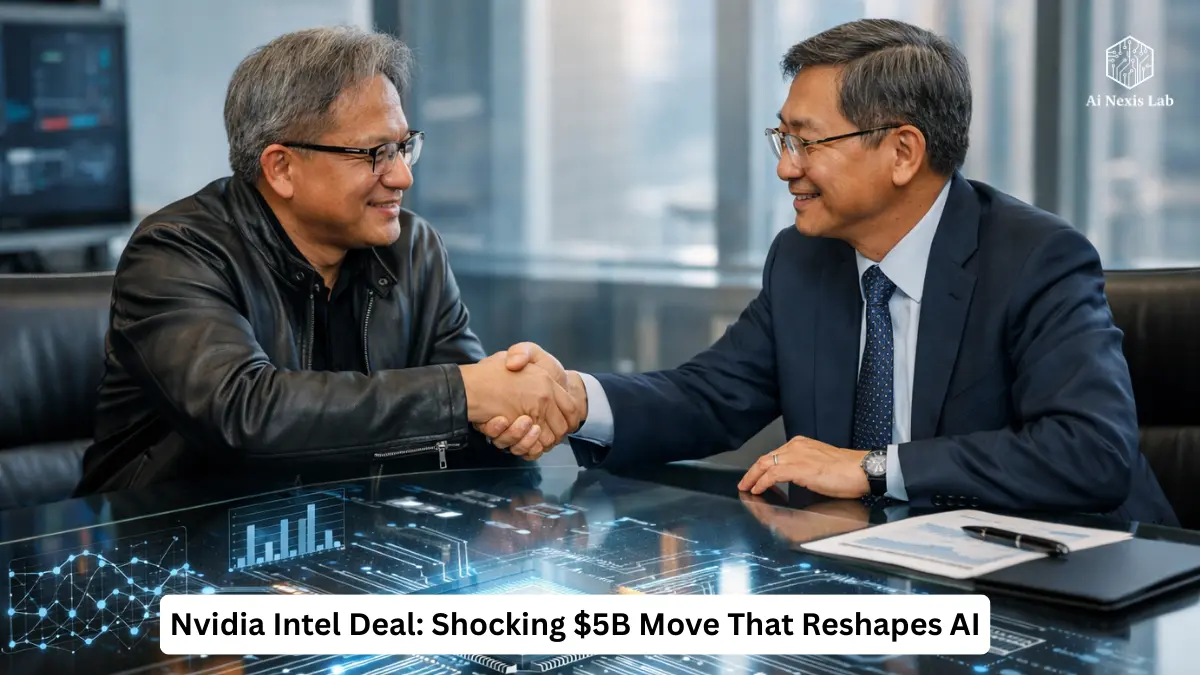
Discover how the Nvidia Intel deal rewires chip power, AI strategy, and supply chains. See what this $5B partnership means for rivals, PCs, and the future.
In technology, there are headlines – and then there are moments that feel like the ground shifts from beneath our feet.
December 29, 2025 was one of those moments.
On paper, it seemed simple:
Nvidia finalized a $5 billion investment in Intel, taking a roughly 4% ownership stake in a company that had been both a rival and a benchmark for decades.
But this wasn’t just another transaction.
This was the company that replaced Intel in the Dow Jones and quietly slipped onto Intel’s shareholder list – and not as a passive observer, but as one of its biggest believers.
And that changed everything.
Industries rarely change because of a single product launch or earnings report. They change when competitors stop playing the same game – and start completely rewriting the rules.
This is that moment.
This deal signals something bigger than money, bigger than ego, bigger than competition.
It’s about:
- Survival in an AI-dominated world,
- Supply chains being rebuilt in real time,
- Governments quietly shaping corporate destinies, and
- Uneasy marriages between competitors who suddenly realize they need each other.
Let’s pull back the curtain.
The deal: $5 billion, a big bet, and a lifeline
In September, the agreement sounded bold, but believable:
Nvidia would buy 214.7 million Intel shares at $23.28 per share.
At the time, Intel’s stock was floundering. Layoffs, a suspended dividend, a stalled strategy — Wall Street had already written its obituary.
The fixed price was presented as a premium, a stabilizer, a vote of confidence.
Then something unexpected happened.
Intel bounced back.
By the time the ink dried in December, those once-life-saving $23.28 shares looked like a clearance-rack bargain for Nvidia. What started as a rescue operation turned into an investment with massively enhanced potential.
For Nvidia, the deal became a financial and strategic win.
For Intel, it became oxygen.
After the brutal 2024 — the kind where executives stop using metaphors and start saying, “We’re in trouble” — the company was in dire need of speed, confidence, and capital. $5 billion wasn’t just funding. It was:
- Believability,
- Time,
- Breathing space,
- and the foundation of a comeback story.
Add to that:
- The U.S. government’s commitment to the U.S. through the CHIPS Act. $8.9 billion from the government,
- $2 billion from SoftBank,
and suddenly Intel was no longer limping to existence. It was armed.
A balance sheet of a fortress built brick by brick, deliberately, to support one of the most daring turnaround plans in modern technology.

Intel’s Brutal Restructuring – and the Leader Behind It
To truly understand this partnership, you have to understand Lip-Bu Tan.
When he stepped into the CEO role in early 2025, Intel was not “conflicting.” It was spiraling.
Tan didn’t come in as a caretaker. He came in as a surgeon.
He:
- cut about 20% of his workforce,
- sold off non-core divisions – including legacy assets like Altera,
- destroyed pet projects and vanity bets,
- narrowed his focus to a single passion
turn Intel into a world-class foundry – or fade into history.
He was tough. He got criticized. He couldn’t blink.
And here’s the thing about ruthless turnarounds:
They either fail spectacularly – or attract powerful allies who see the deeper strategy.
Nvidia’s investment isn’t just money.
It’s recognition.
It signals to markets, governments, suppliers, competitors, and customers:
- Intel is not a relic.
- Intel is infrastructure.
- And infrastructure is too important to let it collapse.
From Enemies to “Collaborators”
The wildest part of this partnership isn’t the money.
That’s the roadmap.
Nvidia and Intel aren’t just investing in each other. They’re building together.
Three years ago, that phrase seemed absurd. Today, it seems inevitable.
The deal opens up two major technical collaborations – both potential game-changers.
1. “x86 RTX” PC Chip – AI, Graphics, and Power in One Package
For years, companies have promised the era of AI PCs.
Most of it seemed like marketing garnishes sprinkled on a typical laptop.
This changes that.
Intel and Nvidia are co-designing a system-on-chip (SoC) that merges:
- Intel’s legendary x86 CPU architecture
- Nvidia’s RTX graphics and AI compute
all on a single integrated platform.
What does that really mean?
That means:
- Creative professionals edit ultra-high-resolution video without lag,
- Gamers run photorealistic environments without an external GPU,
- Developers train local AI tools right on their machines,
- Everyday users run AI assistants offline, securely, and efficiently.
And most importantly:
Battery life is not destroyed in the process.
This changes the battleground.
AMD – long praised for its CPU/GPU harmony – suddenly becomes a real competitor.
And Apple?
Its sleek M-Series dominance is starting to look less invincible.

2. Nvidia Custom Data-Center CPUs Built Specifically for AI
The data center is where the real money flows.
Here, the pair isn’t just collaborating – they’re optimizing for each other.
Intel will now design custom x86 CPUs that are designed to work seamlessly with:
- Nvidia’s Blackwell architecture
- Future generations of Nvidia AI platforms
These CPUs will use NVLink, Nvidia’s proprietary interconnect that moves data between the CPU and GPU very quickly.
The translation?
- Low latency,
- Faster training of large AI models,
- Low latency in inference,
- Cleaner scaling in supercomputers.
This is not an incremental improvement.
It’s a system-level redesign.
And the implications are spreading across cloud providers, research labs, enterprise AI, and hyperscale computing.
Why would Nvidia help a rival? Because it’s playing the long game.
At first glance, Jensen Huang’s $5 billion check to Intel seems contradictory.
Why bolster a competitor whose downfall helped make Nvidia the king of AI?
Because Huang doesn’t think about wars.
He’s thinking about war.
Here’s the real strategic calculation.
1. Reducing Dependence on Taiwan – and Securing Product Sovereignty
Nvidia’s Achilles Heel is Not Technology.
It’s geography.
Nearly all of its cutting-edge chips rely on TSMC in Taiwan.
In a world where geopolitical instability is increasing – that risk is measured not in dollars, but in the probability of survival.
Supporting Intel Foundry does two things:
- Nvidia gets local manufacturing backup,
- Invites Nvidia into the decision-making room as Intel scales its 18A process node.
If Intel succeeds, Nvidia wins manufacturing resilience.
If Intel fails, Nvidia still has a strategic advantage.
Either way: smart supply chain positioning.
2. Solving the CPU Bottleneck
Nvidia doesn’t make mainstream CPUs.
And every GPU — no matter how powerful — needs one.
If competitors like AMD optimize CPU-to-GPU paths quickly, they eliminate Nvidia’s AI dominance.
The partnership with Intel ensures:
- x86 remains perfectly tuned for Nvidia hardware,
- Nvidia maintains influence on integration standards,
- Performance remains aligned with Nvidia’s software ecosystem.
In short:
It puts Nvidia in the driver’s seat without having to build a CPU empire from scratch.
3. Protecting the x86 ecosystem from ARM – and rewriting it
ARM-based chips have proliferated:
- Amazon’s Graviton
- Google’s in-house server chips
- Apple’s M-Series revolution
They threaten to completely move both cloud infrastructure and personal computing away from x86.
Nvidia’s investment acts like ballast:
- stabilizing Intel,
- slowing down ARM,
- maintaining decades of compatibility with Nvidia software – especially CUDA.
Nvidia isn’t just betting on Intel.
It is betting on the continuation of the architecture that helped make Nvidia indispensable.
Ripple Effects: Who Wins – and Who Starts to Sweat
When two giants collide, shock waves ensue.
Some companies benefit. Other companies suddenly find the ground much less stable.
AMD: From Confident Challenger to Cornered Competitor
AMD has spent the last decade enjoying a rare role – the “smart option” that provides:
- Efficient CPUs,
- Strong GPUs,
- Strong integrated performance across the range.
Now?
Intel and Nvidia threaten to reclaim exactly that position – but with:
- deep pockets,
- broader ecosystems,
- tighter software integration.
AMD is not out – but the margin for error has shrunk dramatically.
TSMC: Still King – But No Longer Untouchable
Nothing about this deal changes the fact that TSMC is the world’s undisputed manufacturing leader.
But something subtle has changed.
The U.S. government, Nvidia, and Intel are now clearly aligned in this direction:
de-risking dependency on Taiwan
Over time, this means:
- More fabrication investment in the U.S.,
- Prioritizing development at Intel’s foundry,
- New incentives directing orders away from Asia.
TSMC isn’t losing — yet.
But it faces a new kind of competition: not from a single company, but from a national strategy itself.
Customer: Quietly Becoming the Biggest Winner
For everyday users, this is a rare corporate change that meaningfully improves lives.
Imagine a laptop that:
- Instantly boots AI tools,
- Edits video without beach-ball spinning,
- Generates music, art, text, and code locally,
- Plays AAA games with ease,
- Does it all without the need for constant charging.
AI PCs stop being ambitious marketing.
It becomes infrastructure.
The stakes: culture clashes, regulation, and big “ifs”
This deal is not guaranteed to go smoothly.
In fact, the biggest risks are human and structural – not technological.
Corporate cultures don’t merge easily
Intel is traditional, hierarchical, deeply engineering-driven.
Nvidia is aggressive, fast-paced, founder-led.
Working together requires:
- Openness without oversharing proprietary secrets,
- Aligned priorities without total control,
- Ego-management among world-class engineers.
It’s harder than making chips.
Governments will be watching
The Federal Trade Commission approved the move.
That doesn’t mean scrutiny goes away.
Any indication Nvidia gets unfair product selection… or Intel has been manipulated into anti-competitive behavior… will quickly launch an investigation.
This partnership will live under the microscope.
And then there’s the biggest unknown
that Intel has yet to implement.
Foundries aren’t “products.” They are:
- Multi-billion-dollar logistical organizations,
- Fractiously complex industrial ecosystems,
- Dependent on precision across thousands of failure points.
To beat – or even match – TSMC, Intel must:
- Improve yield,
- Stabilize costs,
- Deliver on a consistent timeline,
- Assuring the industry that its comeback is not symbolic – it is real.
The story is compelling.
But implementation determines history.
What this moment really means
We have entered a new phase of the chip race.
For decades, the model was simple:
They compete, they posture, they innovate – separately.
That world is gone.
The new era is defined as:
- Integration,
- Alliances across traditional battle lines,
- Governments acting as financial partners,
- AI hardware directing strategy, rather than the other way around.
The message is clear:
In the age of artificial intelligence, no company can win alone.
And so, a competitor became a shareholder.
A competitor became a collaborator.
A lifeline became a turnpike.
Intel has been thrown into deep water.
Now the world is waiting to see how fast it swims.
Frequently Asked Questions
Q1: Why did Nvidia invest in Intel instead of competing further?
Because competition without resilience is dangerous. Nvidia relies on Taiwan-based manufacturing, relies on external CPUs, and benefits greatly from a strong x86 ecosystem. Investing in Intel:
1) Stabilizes supply chains,
2) Strengthens Nvidia-optimized hardware,
3) Prevents competing architectures (like ARM) from overtaking the market too quickly.
It’s less about friendship and more about future-proofing.
Q2: Is Intel now controlled by Nvidia?
No. A 4% stake gives Nvidia influence – not control.
Intel remains independent, with its own leadership, board, and strategy. But Nvidia undoubtedly benefits:
1) Deep insights,
2) Access to collaboration opportunities,
3) A stronger voice in the ecosystem conversation.
Q3: Will this make PCs more expensive?
In the short term, high-end AI-ready laptops may remain more expensive.
Over time, however, integrated manufacturing and competition typically drive down prices while improving performance. Expect:
1) More capable mid-range laptops,
2) AI features becoming standard rather than premium.
Q4: Is this why AMD is in trouble?
The “difficulty” may be very strong – but the pressure is real.
AMD now faces:
1) Intel’s product resurgence,
2) Nvidia’s AI dominance,
3) Tight integration between x86 and RTX platforms.
It forces AMD to innovate faster – which can actually benefit customers in the long term.
Q5: Does this permanently weaken TSMC?
Not immediately.
TSMC remains the gold standard in fabrication. However, this partnership hints at a future where:
1) More capacity moves to U.S. soil,
2) Intel becomes a meaningful option,
3) Political forces shape manufacturing strategy.
TSMC will remain central – but not alone.
Q6: What does this mean for AI development?
It speeds it up.
Better CPU-GPU coordination reduces bottlenecks, improves power efficiency, and allows for:
1) Faster training,
2) Simple real-time AI,
3) Local AI on consumer devices.
Expect AI to become more capable — and more personal.
Q7: Can regulators block future collaboration?
Yes — if Nvidia and Intel cross anti-competitive lines.
Regulators will tolerate partnerships as long as they maintain separation, transparency, and fair product access. Step outside that boundary, and the scrutiny will quickly intensify.
Q8: Is this partnership permanent?
No partnership in technology is permanent.
If goals diverge or strategy changes, Nvidia could sell its stake. But for now, both companies see clear mutual benefits – and unprecedented opportunity.