
LLC Tax Shield: What It Really Does (and Doesn’t) for U.S. Small Business Owners
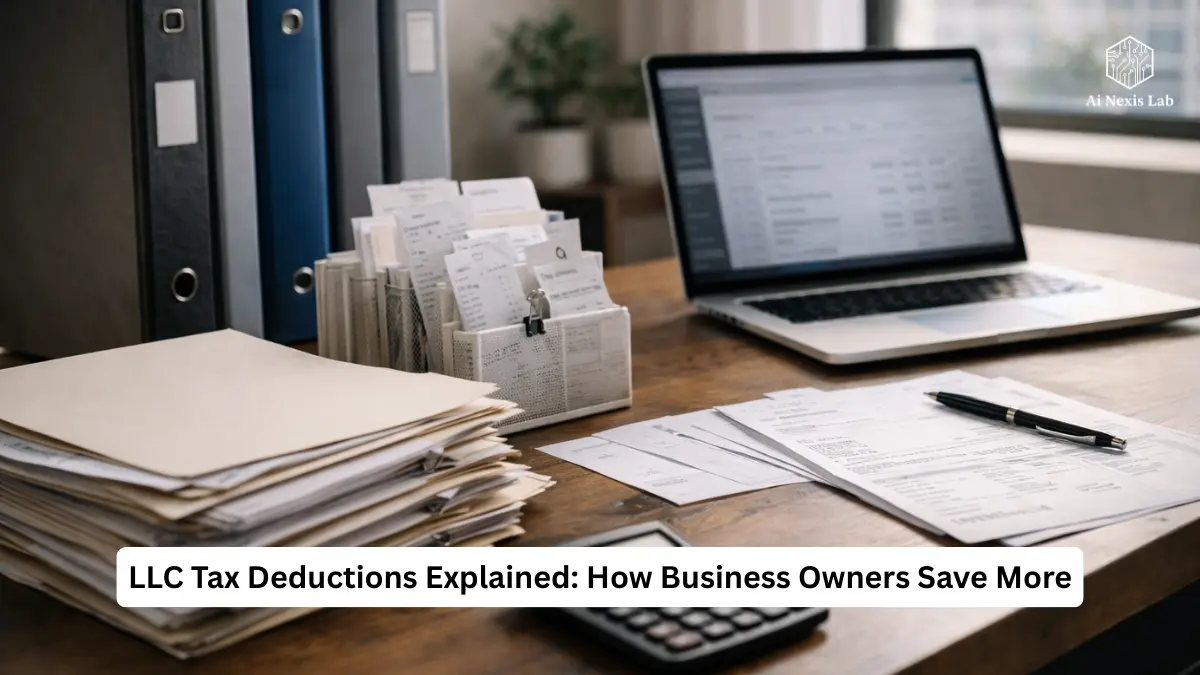
Discover the top LLC tax deductions for 2026, including QBI, vehicle write-offs, home office, and more tips to slash your tax bill legally.
Picture from April 15. Not an Instagram fictional version – real life. You’re logged into your tax software or sitting in front of a CPA, keeping an eye on the numbers that really matter. The question is not “How do I pay less tax?” It is:
“Did I organize my business in a way that would prevent me from overpaying?”
That distinction is important. The U.S. tax code does not reward hustle. It rewards structure. And a limited liability company (LLC), when used properly, is one of the most flexible structures available to small business owners.
But let’s get something straight right away:
The LLC itself is not a tax cheat code.
It’s a container. What you put into it – and how you choose to tax it – determines whether it saves you money or does nothing.
Most people form an LLC and then run it like a sole proprietorship with a good name. That’s why they don’t see any tax benefits and wrongly conclude that “LLCs don’t help with taxes.”
They are half right – and miss the point entirely.
Table of Contents
1. Pass-Through Taxation: What It Really Means
The default tax treatment of an LLC is pass-through taxation.
For single-member LLCs, the IRS treats the business as a disregarded entity. That doesn’t mean income is ignored. That means the IRS ignores the entity itself and imposes taxes directly on the owner.
What Really Happens
- Your LLC earns income
- Your LLC deducts ordinary and necessary business expenses
- Net profit flows to Schedule C of your personal Form 1040
- You pay:
Federal income tax
State income tax (if applicable)
Self-employment tax (15.3%)
This is similar to a sole proprietorship from a tax perspective.
So what’s the benefit?
Two things:
- Separation of liability (legal, not tax)
- Optionality – the ability to change how the business is taxed later
If you never make a tax election, your LLC does nothing on its own to reduce federal taxes. Anyone who claims otherwise is selling you vibes.
2. Qualified Business Income (QBI) Deduction: Real, Valuable, but Not Magic
The Qualified Business Income Deduction (Section 199A) allows eligible owners of pass-through businesses to deduct up to 20% of qualified net business income.
This deduction:
- Was created by the Tax Cuts and Jobs Act of 2017
- Currently scheduled to expire after 2025 unless Congress extends it
- Not guaranteed, permanent, or universal
No legislation has currently been enacted to make it permanent or to add a “minimum QBI deduction.” Any claim otherwise is speculative.
How QBI Really Works
If your LLC generates $80,000 in qualified profits:
- Potential deduction: $16,000
- Your taxable income is reduced to $64,000 based on income tax only
- QBI does not reduce self-employment taxes
That last point is one that most blogs quietly talk about.
Who is limited or excluded
If you run a Specified Service Trade or Business (SSTB) – consulting, law, accounting, health, coaching – the deduction is phased out at higher income levels.
Estimated thresholds (indexed annually):
- Single filers: ~$190,000 – $240,000
- Married filing jointly: ~$380,000 – $480,000
Above that range, QBI may disappear entirely.

3. The S-Corporation Election: Where the Real Tax Savings Actually Happen
This is the first place in your original draft where the hype matches reality – with conditions.
An LLC can elect to be taxed as an S-corporation using Form 2553. This does not change your legal structure. It changes how taxes are imposed on income.
Self-Employment Tax Problem
As a Standard LLC Owner:
- 15.3% self-employment tax applies to 100% of net profit (up to Social Security wage base, then Medicare continues)
As an S-Corp:
- Only wages are subject to payroll tax
- Not distributions
The catch no one likes to talk about
You must pay yourself a fair salary.
That salary:
- Subject to payroll tax
- Must be protected
- Aggressively scrutinized by the IRS
If you make $100,000 and pay yourself $20,000, you’re in trouble.
Real Example
- LLC Profit: $100,000
- Fair Salary: $55,000
- Distribution: $45,000
Payroll tax savings only apply to $45,000.
Estimated Savings:
- ~$6,000 – $7,000 before additional costs
Now subtract:
- Payroll software
- Bookkeeping
- S-corp tax returns
- CPA fees
Net savings often approach $3,000 – $4,000.
It’s still worth it – but only after you’ve made ~$50,000 – $70,000 in consistent profits.
4. Home Office Deduction: Legal, Boring, and Often Overstated
The home office deduction is not an audit trigger. There is a messy record.
Two methods
Simple method
- $5 per square foot
- Maximum 300 square feet
- Maximum deduction: $1,500
Actual cost method
- Percentage of home used exclusively for business
- Applies to:
1) Rent or mortgage interest
2) Utilities
3) Insurance
4) Repairs
5) Abatements (owners only)
People who violate the rule
Exclusive use means exclusive.
A desk in your bedroom is not appropriate if the room has non-commercial use. Period.
5. Section 179 and Bonus Depreciation: Timing Matters
Section 179 allows businesses to immediately expense qualified equipment rather than depreciate it.
Current Reality:
- Section 179 limit is over $1 million
- Bonus depreciation is phasing out, not increasing
- Vehicles are heavily restricted and under investigation
Buying equipment just to reduce taxes is almost always a bad idea.
You are trading cash for a partial deduction – not a refund.
6. Health Insurance Deduction: Real but Narrow
Self-employed health insurance premiums can be deducted above the limit if:
- The business is profitable
- The owner is not eligible for an employer-subsidized plan elsewhere
This reduces AGI, not self-employment tax.
In an S-Corp, the mechanics are more complex and must be properly run through payroll.
7. Travel and Meals: Where the IRS Really Draws the Line
Business travel is only deductible if business is the primary purpose.
Important rules:
- Transportation is only deductible if business days exceed personal days
- Meals are usually 50% deductible
- Family expenses are never deductible
- “Board meetings” do not survive an audit
If your strategy relies on clever naming rather than actual activity, it is weak.
8. Retirement Accounts: The Most Undervalued Tax Tool
Solo 401(k)s and SEP IRAs allow for higher contributions, but:
- Contributions are limited by earned income
- S-Corp owners are limited by W-2 wages
- Poor salary planning limits retirement contributions
This is planning, not automation.
Why Most LLC Owners Still Pay Too Much Tax (And Don’t Realize It)
Forming an LLC is often considered the finish line. In fact, that is the starting point. The biggest mistake small business owners make is assuming that only structure creates tax savings. It doesn’t. What creates savings is how the LLC is managed, taxed, and documented over time.
Many owners form an LLC, open a bank account, and then move on:
- Run personal expenses through the business
- Leave bookkeeping until tax season
- Ignore tax elections completely
- Pay yourself randomly instead of strategically
At that point, the LLC is just a label – not a system. The IRS does not award labels. It rewards compliance and intent.
LLCs Don’t Eliminate Taxes – They Change How Taxes Are Calculated
This distinction is important. LLC does not make income “tax free”. It changes:
- Who is taxed (the owner, not the entity)
- How income is classified (earned vs. distributed)
- What deductions are available
When used properly, an LLC allows business owners to:
- Deduct expenses that employees can’t afford
- Time income and expenses more strategically
- Choose tax treatment (sole prop vs. S-corp)
- Create a clean separation between personal and business activity
When used poorly, it does none of these things—and sometimes makes things worse.
Why Recordkeeping Is a Real Tax Strategy
Tax savings live and die with documentation. Not inspiration. Not hustle.
The IRS does not deny the deduction because it is “too aggressive.” He rejects them because:
- No receipts
- No mileage logs
- No documented business purpose
- Expenses seem personal
LLC owners who consistently save money do the boring things well:
- Monthly bookkeeping
- Separate accounts
- Clear descriptions on transactions
- Consistent classification
That’s it. No hacks. No loopholes. Just discipline.
When an LLC Becomes a Strategic Advantage
An LLC becomes powerful when at least one of these is true:
- You have not only income, but also consistent profits
- You plan to grow income over time
- You want the flexibility to make tax election changes
- You want to separate liabilities from personal assets
- You intend to strategically use retirement and health deductions
If none of these apply, an LLC won’t magically help you. It may still make sense legally – but the tax benefits will be minimal.
The Cost of Waiting Too Long
One of the silent costs of poor planning is lost opportunity. You cannot retroactively elect S-Corp status for previous years. You can’t go back and accurately recreate the mileage log. You cannot fix mixed accounts after the audit has started.
Most tax savings come from decisions made throughout the year, not from scrambling in March.
That’s why the real advantage of an LLC isn’t what happens at tax filing time – it’s what it forces you to think about before then.
Frequently Asked Questions
Q: Can I deduct my car if I use it for my LLC?
A: Yes, but only the business use portion. You can choose between the IRS standard mileage rate (set annually) or the actual expense method (gas, insurance, repairs, depreciation). Vehicles weighing more than 6,000 pounds may qualify for higher depreciation, but full write-off requires stricter rules and high commercial use.
Q: Does an LLC protect me from IRS audits?
A: No. LLC audits do not reduce risk. However, proper LLC setup – separate bank accounts, clean books and documentation – makes surviving audits easier and much less expensive.
Q: Can I deduct startup costs before making any sales?
A: Yes. You can deduct up to $5,000 in startup costs and $5,000 in organizational costs in your first active year. If total startup costs exceed $50,000, the deduction is phased out and the remaining amount is amortized over 15 years.
Q: Is the QBI deduction available to consultants and freelancers?
A: Generally, yes. However, if you are in a Specified Service Trade or Business (SSTB) and your income exceeds the IRS phaseout threshold (adjusted annually), the deduction may be reduced or eliminated.
Q: Do I need a separate bank account for my LLC?
A: Yes – this is mandatory. The mixing (“mixing”) of personal and business funds can destroy liability protection and create serious tax and audit problems. Separate accounts are required for legal and tax compliance.
Final Thought: A Structure Without a Strategy Is Just Paperwork
LLC is not a cheat code. It is a framework. The equipment itself does not work.
Used intentionally, an LLC can:
- Reduce effective tax rate
- Increase after-tax cash flow
- Improve audit resilience
- Create long-term financial benefits
Used incidentally, it is the second form filed in the state.
If you want benefits, you have to act like a business owner – not just like someone selling something on the side.
Most people miss this difference.