$0 to $1,000+ Sprint: How to Build a Bulletproof Emergency Fund in Exactly 180 Days (2026 Deep Dive)
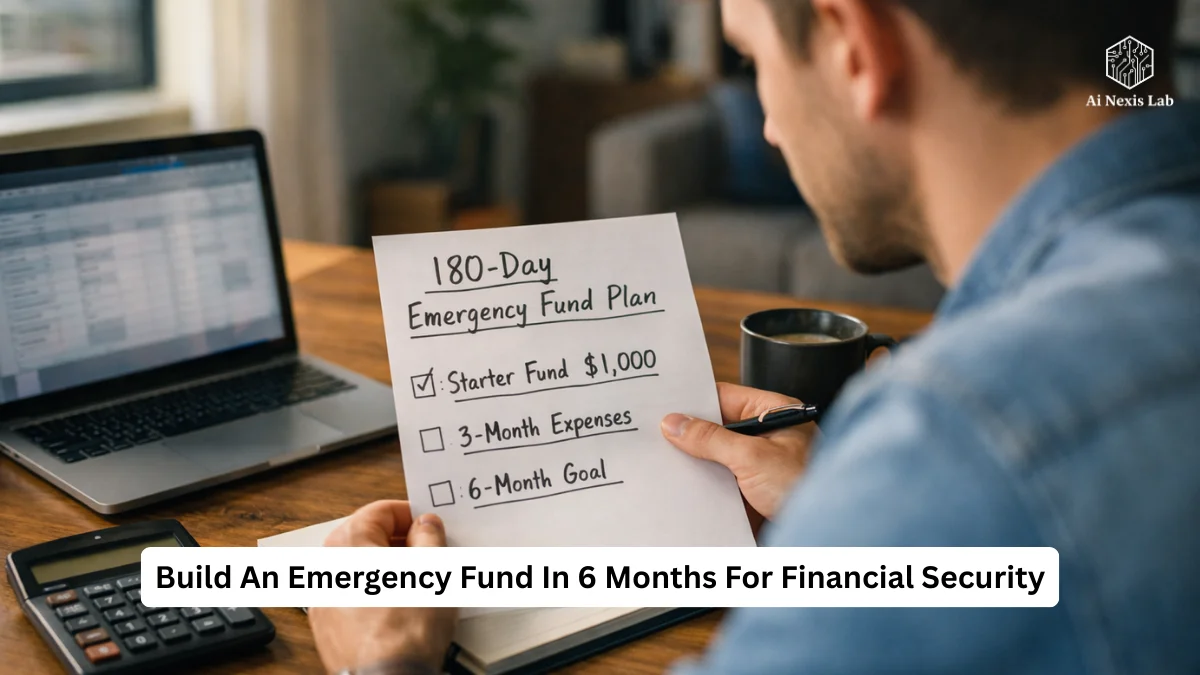
Build an emergency fund in 6 months with a proven 180-day plan. Cut expenses, boost income, and create financial security faster than you think.
Let’s start with reality.
If you were living in the US in 2026, you might have felt the pressure. Groceries are still more expensive than they were a few years ago. Rents haven’t magically dropped. Layoffs still make headlines every quarter. And while there has been a strong pullback in the stock market, it reminds everyone that volatility is not theoretical.
The old advice – “just cut out the coffee” – is lazy. A $5 latte habit is not the reason most people are financially stressed. The real problem is that most households operate without a buffer. A transmission failure. A dental emergency. An unexpected job change. That’s all it takes to send everything into chaos.
Emergency funding is not about being frugal for sports. It’s about control. It’s about sleeping through the night when something goes wrong.
This is a complete, modern blueprint for building your first $1,000 – and then expanding it into a 3 to 6 month emergency fund in 180 days.
No fluff. No fancy budgeting. Just execution.
Table of Contents
Why Emergency Funds Are More Important in 2026
Let’s zoom out for a second.
As of 2026:
- Inflation has cooled since the 2022-2023 hike, but prices remain structurally high.
- The Federal Reserve’s interest rate cycle has normalized somewhat, but borrowing is still expensive compared to before 2020.
- Credit card APRs regularly remain above 20%.
- Job stability depends heavily on industry – tech and media have seen waves of restructuring, healthcare and skilled trades are tight.
Meanwhile, many Americans still can’t cover a $1,000 emergency without borrowing.
That’s not a moral failing. It’s math.
Without liquidity, every setback becomes high-interest debt. And high-interest debt is a trap.
An emergency fund is not an investment. It’s insulation.
Step 1: Calculate Your Actual Survival Number (Not Your Income)
Most people think, “I need six months of my salary saved.”
Wrong.
You don’t have to change your entire income. You need to cover your essential burn rate.
What Is Your Essential Burn Rate?
Your required burn rate is the minimum monthly expenses needed to:
- Keep a roof over your head
- Keep utilities running
- Buy basic groceries
- Maintain insurance
- Cover minimum debt payments
That’s it.
Not:
- Streaming subscriptions
- Dining out
- Travel
- Gym upgrades
- Shopping
- “Treat yourself” expenses
Get surgical.
Example Breakdown (2026 Mid-Cost City)
- Rent: $1,800
- Utilities + Internet: $250
- Groceries: $500
- Insurance: $300
- Minimum Debt Payment: $350
- Gas/Transportation: $250
Required Burn Rate: $3,450/month
If your take-home pay is $5,000, that’s irrelevant to the emergency math.
Your 3-month survival number = $10,350
Your 6-month goal = $20,700
This is the fort you are building.

Step 2: Start With a $1,000 “Stability Floor”
Before you even think about six months of expenses, your first goal is simple:
$1,000 minimum.
Why?
Because without it, every surprise goes straight to a credit card charging a 22% APR. It is financial sand.
This first $1,000 is your mental breakthrough. Once you see four digits sitting untouched, something changes. You stop reacting emotionally to small problems.
Flat tire? Annoying.
Not devastating.
Step 3: Where Your Money Matters (High-Yield Savings in 2026)
Keeping your emergency fund in a traditional brick-and-mortar savings account is financially reckless, earning 0.01%.
You want a high-yield savings account (HYSA).
In 2026, competitive online banks are offering around 3.75%–4.50% APY, depending on market conditions.
Examples include:
- Ally Bank
- Marcus by Goldman Sachs
- SoFi
These institutions are FDIC-insured up to $250,000. Your money is safe.
Why HYSA Is Non-Negotiable
- Inflation offset – You can’t beat long-term inflation, but you can reduce erosion.
- Psychological isolation – It’s hard to “accidentally” spend money in a separate application.
- Visible Growth – Seeing monthly interest hits increases momentum.
Your emergency fund should not be invested in stocks, crypto, or speculative assets. This is where liquidity beats returns.
Step 4: 180-Day Blueprint
Now let’s break it down into a six-month strategic plan.
Month 1–2: Stabilize and Cut Clarity
You are not trying to become a monk. You are identifying garbage.
Perform a 30-day spending audit
Look at every transaction from the last month.
Ask a question:
Did this give me a house, food, insurance, or employment?
If the answer is no, it’s a candidate for a temporary break.
Common 2026 leaks:
- Streaming stacking (Netflix + Hulu + Apple TV + YouTube Premium)
- Multiple food delivery subscriptions
- Unused app memberships
- Impulse Amazon buys
Cancel or aggressively pause.
Negotiate fixed costs
Call providers. Script:
“I’m reviewing my budget and considering switching. What can you do to lower my rates?”
This works more often than people think.
Internet, cell phone, insurance – all negotiable.
If you cut $200 every month and turn it into savings, that adds up to $1,200 in six months.
That’s really money.
Month 3–6: Increase income (because there is a limit to how much you can cut)
You can only cut so much. You still need to eat.
There is no theoretical limit to income, however.
Option 1: Liquidate Idle Assets
Most homes are sitting on:
- Unused electronics
- Old gaming consoles
- Furniture
- Camera gear
- Designer clothing
List everything on Facebook Marketplace over the course of a weekend.
Even a conservative cleaning can generate $800–$2,000.
Option 2: Skill Arbitrage
Can you:
- Write?
- Edit videos?
- Build websites?
- Do bookkeeping?
- Tutor?
- Organize?
- Fix things?
Freelance platform + local Facebook groups = opportunity.
Even a $500 per month project equals $2,000 in four months.
It dramatically speeds up your timeline.
Step 5: Automate Like a Machine
Discipline fails. Systems don’t.
Set up a split direct deposit.
If you want to save $600/month:
- $300 of every bi-weekly paycheck is automatically routed to HYSA.
- Never hits the checkbook.
- Never gets tempted.
This eliminates what psychologists call decision fatigue.
You don’t “decide” to save every two weeks. It happens.
Step 6: Create a three-tiered emergency architecture
Not all emergencies are created equal. Structure is important.
Tier 1: Starter Fund ($1,000–$2,000)
Purpose: Flat tire, minor repairs, emergency travel.
Location: Instant-access savings.
Tier 2: Core Fund (3 months of expenses)
Purpose: Major repairs, medical events, short-term unemployment.
Location: HYSA.
Tier 3: Fortress Fund (6+ months)
Purpose: Retrenchment, relocation, major career objective.
Location: HYSA or conservative money market.
If you are in this field:
- Freelance work
- Commission-based income
- Single-income household with dependents
You may need 9-12 months.
Stability is proportional to risk.
Step 7: Avoid the Biggest Mistakes
Mistake 1: Calling everything an emergency
A vacation deal is not an emergency.
Holiday shopping isn’t an emergency.
A new iPhone release isn’t an emergency.
If it’s predictable, it stays in a sinking fund.
Mistake 2: Investing Your Emergency Fund
Yes, the stock market has higher long-term returns.
But if the market drops 20% the week you get laid off, your “six-month cushion” shrinks overnight.
Flow > return.
Mistake 3: Lifestyle Creep
You get a raise.
You upgrade your apartment.
You increase your car payment.
You’ve just locked yourself into a higher burn rate.
Before you upgrade your life, upgrade your security.
Step 8: Psychological Hacks That Really Work
Reverse Budget (Inverted Budget)
Saving First. Spend second.
You don’t spend and hope that money is left over.
You save and live on the rest of the money.
24-Hour Rule
Any non-essential purchase over $50 has a 24-hour wait.
In most cases, the desire subsides.
Impulse spending is emotional. Procrastination restores logic.
Visual Tracking
Use a physical progress chart on your wall.
Color in growth.
Visible progress triggers motivation loops.
Digital-only tracking is less powerful.
Should You Build This Up While Paying Off Debt?
Yes – but strategically.
If you have high-interest credit card debt:
- Build up $1,000–$2,000 first.
- Then attack the debt aggressively.
- Once you’re stable, expand your emergency fund.
Without that initial cushion, you’ll sink back into debt the first time something breaks.
Frequently Asked Questions
How much should I really aim for if I’m single and have stable employment?
If your business is relatively stable and you have no dependents, three months of essential expenses may be sufficient. However, consider the flexibility of geographic employment. If relocation is required to replace income, six months provides a strong buffer. The labor market can change quickly. Buy cushion options.
What if I am freelance or self-employed?
You need more than the average employee. Income volatility means cash flow gaps are common. Aim for at least six months – ideally nine months. Also, keep a separate tax savings account. Mixing emergency funds and tax reserves is a common and costly mistake.
Is a money market account better than HYSA?
Sometimes. Money market accounts can offer comparable yields and check-writing privileges. The key factors are FDIC insurance, liquidity, and stability. Avoid chasing yield with risky instruments. If access is delayed or the value fluctuates, it is not a true emergency fund.
What will happen after I turn six months old?
Redirect automatic savings to:
1) 401(k) contributions
2) Roth IRA
3) Taxable brokerage investments
4) Home down payment funds
The hardest part – consistent savings – has already been done. Now you reassign the goal.
What if I lose motivation halfway through?
That’s normal. Progress levels can seem boring. Rethink your “why.” Crises are inevitable. The question is not if – it’s when. Financial resilience is built before crises, not during them.
Final Word
This is not about perfection.
It’s about margin.
The 180-day emergency fund sprint is less about math and more about behavior. You are creating a system that protects your future self from chaos.
When your car breaks down and your reaction is mild irritation rather than panic – that’s a win.
When a job transition becomes strategic rather than daunting – that’s a win.
Money sitting quietly in a high-yield account can seem boring.
But boring is stable.
And stable is powerful.
Build a buffer. Then build a life.