$1,000 Monthly Dividend Blueprint: How to Build a Private Cash Machine While You Sleep
Build a reliable dividend income plan in 2026. Learn exact math, stock filters, and investing steps to reach $1000/month passive income – start smart today.
A push notification comes to someone’s phone: “$147.32 dividend received – realty income.” Another one: “Received $92.18 in dividends – Lowe’s.” It sounds easy. It’s as if someone has cracked the cheat code in the financial system.
They didn’t.
What you are seeing is the end result of a disciplined, numbers-based strategy built over years. No hype. No crypto moonshots. No day trading. Only own profitable businesses that send you cash every quarter (or every month), whether you’re working, sleeping, or stuck in traffic.
Dividend investing is not sexy. It won’t double your money next week. But if your goal is to generate $1,000 per month in reliable income, it’s one of the most proven systems available.
This isn’t motivational fluff. We will analyze the following:
- The exact math behind $1,000/month
- The psychology trap that destroys most investors
- Important filters and financial metrics in 2026
- The role of AI-driven cash flow growth
- Most bloggers conveniently ignore tax realities
If you are looking for quick money, this is not it. If you want a sustainable income that grows for decades, keep reading.
Table of Contents
1. The $1000/Month Math: Reverse Engineering Your Freedom
Let’s start with reality.
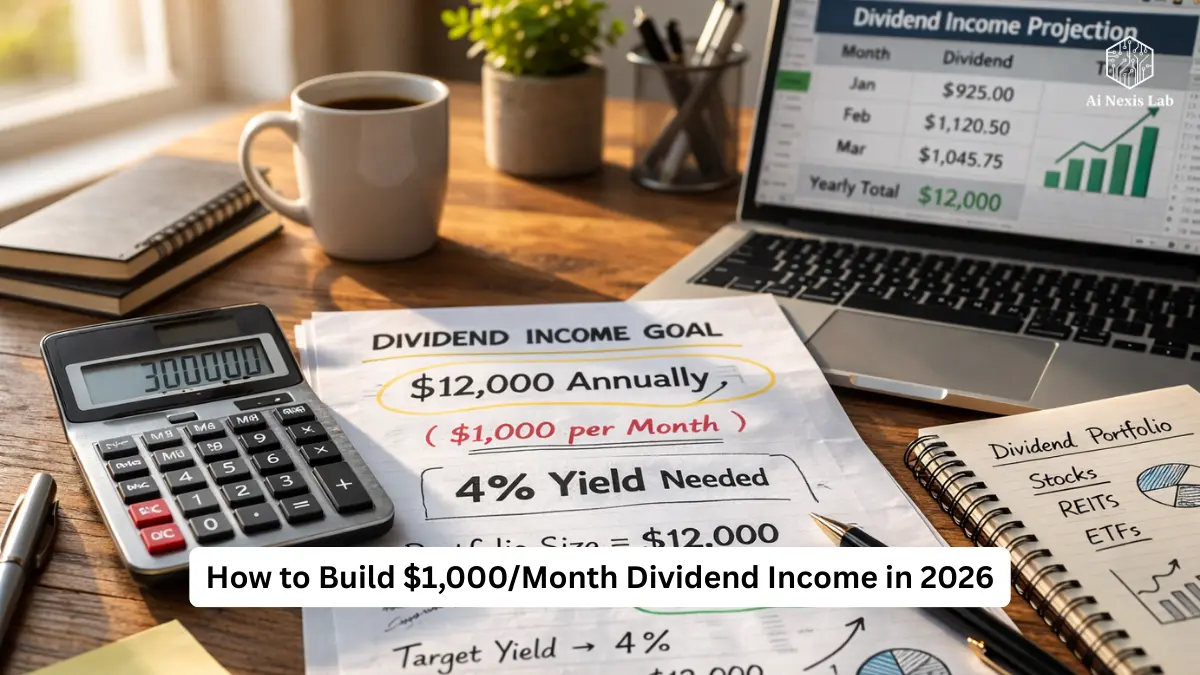
$1,000 per month = $12,000 per year.
It all comes down to yield.
Dividend yield = annual dividend ÷ stock price.
In 2026, the S&P 500 average yield is about 1.3%–1.5%. That’s not enough to live on. So to reach $12,000 annually, your required portfolio size depends on what yield you are targeting.
Portfolio Size by Yield Target
| Target Yield | Portfolio Required | Risk Level |
|---|---|---|
| 3% | $400,000 | Conservative |
| 4% | $300,000 | Moderate |
| 6% | $200,000 | Aggressive |
Let’s be clear.
If someone promises $1,000 per month from a $20,000 portfolio, they are selling imaginary things. 60% yields do not exist in legitimate public markets without catastrophic risk.
A Trade-Off No One Wants to Accept
High yield = high risk.
- A 3% yield usually means dominant blue-chip companies.
- A 4% yield often mixes in stable dividend payers with some high-yield sectors.
- A 6% yield pushes you into REITs, BDCs, energy pipelines, or covered-call ETFs.
Your job is not to chase the highest number. Your job is to choose a number that you can live with for 10-20 years.
Because the real engine isn’t yield.
It’s time.
2. The Yield Trap: The Siren Song of 10% Dividends
Here’s how beginners blow up their portfolios.
They screen for the “highest dividend yield.” They find a stock paying 11%. They think they’ve found a loophole.
Three months later:
- Earnings are paid.
- Dividends are cut.
- Stocks fall 30%.
- Income evaporates.
Welcome to the yield trap.
Why Yields Rise
Dividend yields rise when:
- Dividends rise.
- Stock prices crash.
Most often, it’s #2.
A falling stock price signals that the market expects trouble – falling profits, debt problems, regulatory risk.
Payout Ratio Filter
Before buying any dividend stock, check:
Payout Ratio = Dividends ÷ Net Income
Healthy Range (General Guideline):
- 40%–60% for most corporations
- Up to 75% for stable industries
- 90%+ is riskier territory (outside of REITs/MLPs)
If a company earns $1 per share but pays $0.95, there is zero margin for error.
Recession hit?
Dividends gone.
Don’t be tempted by yield. Obsess with sustainability.
3. Dividend Aristocrats: Investing in the “Unstoppable”
If you want sustainability, start here.
Dividend Aristocrats are companies in the S&P 500 that have collected dividends for 25+ consecutive years.
Think about what that includes:
- Dot-com crash
- 2008 financial crisis
- COVID shutdown
- 2022 inflation spike
2023-2024 rate hike
And they still raised the dividend.
Examples That Are Still Relevant in 2026
Johnson & Johnson
Demand for health care does not disappear in a recession. Medical products, pharmaceuticals, consumer health – diverse revenue sources. Boring. Predictable. Profitable.
PepsiCo
This isn’t just soda. This is Frito-Lay, Quaker, global snack distribution. People eat in times of recession. They snack more during times of stress.
Procter & Gamble
Soap. Toothpaste. Diapers. Razor blades. These are repeat purchases with pricing power.
These are not “moonshot” stocks. They are infrastructure for everyday life.
If you want dividends to help you sleep at night, this is your foundation.

4. The Power of Yield Over Cost: The Hidden Multiplier
This is where long-term investors quietly win.
Suppose you buy a stock at $100, paying $3 annually (3% yield).
If that company increases its dividend at a rate of 8% annually, your annual dividend after 10 years becomes approximately $6.48.
Your yield on costs?
6.48%.
After 20 years, that dividend could grow to $14.
You’re now earning 14% on your original $100 investment.
It’s the compounding effect that people underestimate.
Real-World Example
Investors who bought in decades ago are now earning double-digit yields on their original purchase prices. The stock didn’t have to triple overnight. It had to keep increasing its payout.
Time turns average yields into powerful income.
But only if you don’t sell.
5. Sector Diversification: Build a Weatherproof Machine
Concentration Risk Kills Income Portfolios.
You don’t want 80% of your dividends to come from one area.
Major Dividend Sectors
Consumer Staples
Non-cyclical spending. Recession-resistant.
Healthcare
Aging demographics. Infrastructure demand.
Utilities
Regular monopolies. Predictable cash flow.
Energy Infrastructure
Pipelines with long-term contracts.
REITs
are legally required to distribute 90% of taxable income.
Monthly Payer Benefits
Most companies pay quarterly. If you want easy income:
Real Estate Income
Known as “The Monthly Dividend Company”. Primarily retail real estate under long-term leases.
Main Street Capital
BDCs provide capital to middle-market companies. Higher yield, higher risk.
A tiered pay schedule can create a steady monthly cash flow.
6. Tax Reality: Qualified vs. Ordinary Dividends
You don’t keep 100% of your dividends in taxable accounts.
Qualified Dividends
Taxed at Long-Term Capital Gains Rate:
- 0%
- 15%
- 20%
Most large US corporations come here.
Ordinary Dividends
Taxed at regular income rates.
REITs and BDCs typically fall into this category.
Account Strategy
- Taxable Brokerage: Favor qualified dividends.
- Roth IRA: High-yield REITs shine here (tax-free growth).
- Traditional IRA: Tax-deferred but taxed on future withdrawals.
Ignore taxes and your “4% yield” becomes 3.2% faster.
Plan accordingly.
7. DRIP: The Snowball Effect in Action
DRIP = Dividend Reinvestment Plan.
Instead of taking the dividend as cash, they automatically buy more shares.
This creates exponential growth.
Compounding Example
If you:
- Invest $500/month
- Earn a total return of 8%
- Reinvest dividends
After 20 years, you’re looking at millions in capital – and growing dividend income every year.
The early years seem slow. Very slow.
But around the age of 8-10, the speed becomes significant.
By years 15+, dividends often exceed your annual contributions.
That’s the tipping point.
8. The Impact of AI on Dividend Growth
AI is not just hype. It is margin expansion.
Companies that reduce costs through automation improve:
- Operating margin
- Free cash flow
- Return on invested capital
More free cash flow means:
- Higher dividends
- Share buybacks
- Debt reduction
Retail, logistics, and healthcare companies that use AI-powered efficiencies could generate strong dividend growth through 2030 and beyond.
The question isn’t “Who pays today?”
It’s “Who will still dominate in 2035?”
9. Why Most Investors Quit
Let’s be honest.
Most people don’t fail because dividend investing doesn’t work.
They fail because they can’t sit still.
Common Self-Sabotage
Chasing hype stocks
Jumping on returns that doubled last month to steady dividend payers.
Ignoring valuations
Overpaying reduces future returns.
Panic selling
The market drops 15% and people go bankrupt.
Dividend investors should view the correction as an income discount – assuming fundamentals remain intact.
Discipline beats brilliance.
10. 3-Step Starter Plan
Step 1: Open a Dedicated Dividend Account
Separate income investing from speculation.
Step 2: Build a Core Base
Start with diversification.
Example:
- Schwab U.S. Dividend Equity ETF
Broad exposure to high-quality dividend payers. - 2-3 personal holdings for stability.
Step 3: Automate Contributions
Set up recurring transfers.
$50/week = $2,600/year.
Small amounts add up to large amounts over decades.
Consistency > intensity.
Frequently Asked Questions
How much money do I really need for $1,000 per month?
At a sustainable 4% yield, you need to invest approximately $300,000. This is math – there are no shortcuts.
However, you probably won’t put all $300,000 in personally. Dividend growth and reinvestment compound over time, meaning a significant portion of that capital will come from market returns and reinvested payments.
The real variable is not just the initial capital. It’s how early you start and how consistently you invest. Starting at 25 versus 35 can dramatically reduce the monthly contributions needed due to compounding.
Are dividend stocks better than growth stocks?
They serve different purposes. Growth stocks aim for capital growth. Dividends provide income and mental stability.
During volatile markets, dividend payments provide tangible returns even if share prices fluctuate. That income level reduces panic selling.
Many investors mix both strategies: growth in the early years, transitioning to dividends as income becomes a priority.
Can companies reduce dividends?
Sure. And they do.
Dividend cuts usually come after declining earnings, excessive debt, or a decline in structural business. That’s why payout ratios, free cash flow, and debt levels are important.
Companies with long dividend growth streaks often consider cuts as a last resort because breaking this streak erodes credibility among investors. But no dividends are guaranteed.
Should I rely on high-yield ETFs like JEPI or QYLD?
Covered-call ETFs generate income through an options strategy. They can produce attractive yields, often 6-8%+.
However, they usually sacrifice upward growth. In strong bull markets, they tend to underperform the broader equity index.
They can serve as income supplements, especially for retirees who need cash flow now – but building your entire strategy around them can limit long-term capital growth.
Is dividend investing still possible in 2026?
Yes – but expectations are important.
With interest rates stabilizing after the tightening cycle of 2023-2024, quality dividend stocks remain competitive compared to bonds. Companies with strong balance sheets and AI-driven efficiencies are generating record free cash flow.
Dividend growth investing remains viable because it is rooted in the ownership of profitable businesses. As long as capitalism works, companies that generate excess cash will continue to return capital to shareholders.
Final Verdict: Build a Machine
$1,000 in dividends per month is not magic.
It’s math.
It’s patience.
It’s discipline.
Stop looking at daily price changes. Start tracking annual income.
If the value of your portfolio drops by $5,000 but your annual dividend income increases by $300 because you reinvested at a lower price, you have improved your long-term position.
Income investing is about freedom, not about entertainment.
Buy quality.
Reinvest consistently.
Ignore the noise.
Let time do the heavy lifting.
The first dividend might be $0.42.
That’s okay.
The important thing is to create enough of those little digital workers until they generate $1,000 per month – whether you join them or not.
Now the real question:
Are you willing to be consistent long enough to make that possible?
Disclaimer
This material is for informational and educational purposes only and should not be considered investment advice under U.S. securities laws. The author is not acting as a registered investment advisor, broker-dealer, or fiduciary. Nothing in this article represents a personal recommendation or an offer to buy or sell any security.
Investing in stocks, ETFs, REITs and other securities involves risk, including market volatility and the possible loss of principal. Dividend payments are not guaranteed and may change at any time. Past performance does not guarantee future results.
Readers are responsible for their own financial decisions and should consult with a registered investment advisor (RIA), CPA, or other licensed professional regarding their specific financial situation before acting on any information presented herein.