
The Moynihan Brief: Fed Independence, Tariffs, and the Global Outlook
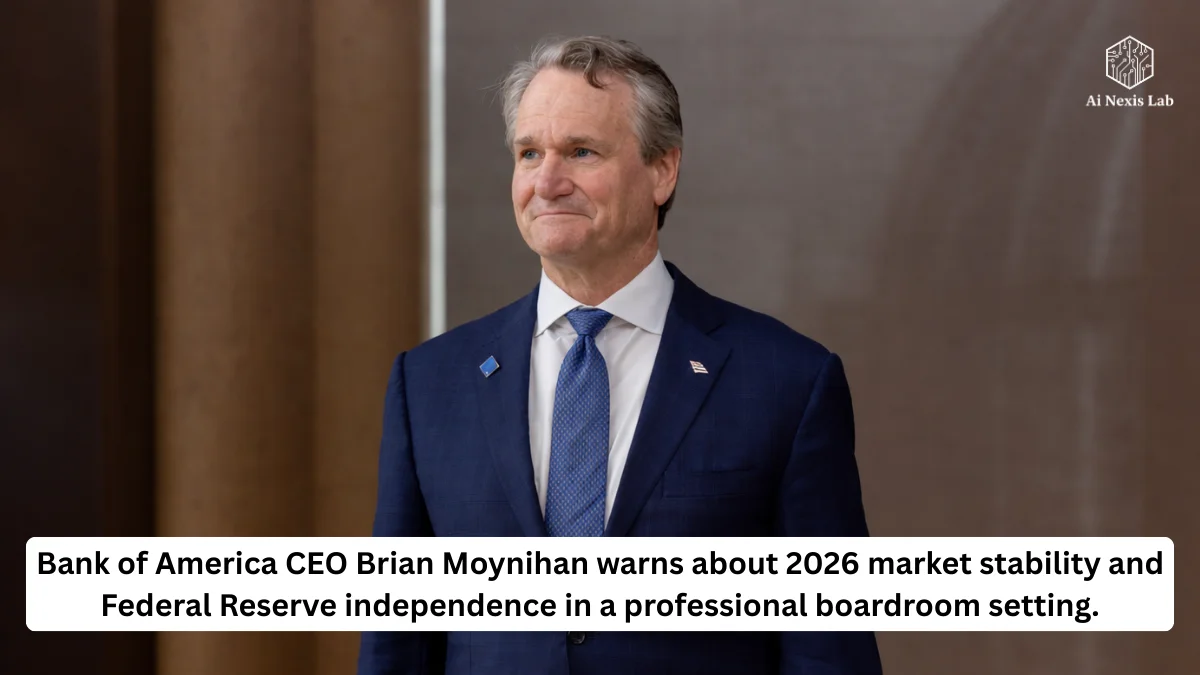
High-stakes balancing act: What Brian Moynihan thinks about Fed independence, tariffs and the global economy — and why it matters more than ever
Bank of America CEO Brian Moynihan warns that markets will “punish” the US if Fed independence is lost. Get his 2026 data on spending, tariffs, and interest rates.
In the global financial arena, there are many big opinions. There are very few voices that the markets really stop and respect.
Brian Moynihan is one of such voices.
As chairman and CEO of Bank of America, he sits at a unique crossroads: He can watch everyday families swipe their debit cards, but he is constantly watching how trillions of dollars of capital flow through the system. This combination gives them a rare vantage point – based on data, but shaped by experience.
And recently, during interviews Moynihan delivered something that sounded like a warning and a pep talk.
He believes that the U.S. economy is fundamentally strong.
He believes that consumers are still spending carefully.
He believes that inflation is cooling sustainably.
But there is a catch.
None of this will continue if the country forgets one essential rule:
The Federal Reserve must remain independent.
For Moynihan, that idea is not academic. It’s not political. It is not theoretical.
It’s the basis of the financial system – and something they think people underestimate until it’s too late.
Let’s look at what they mean, how they connect to tariffs and trade policy, what they say about the future of the global economy, and what everyday people should take from them – whether you invest, own a business, or simply want financial stability.
1. Why Moynihan calls Fed independence “non-negotiable”
To most of us, the Federal Reserve seems distant—a group of officials in suits talking about interest rates in language that sounds deliberately complicated.
But Moynihan cuts through that fog.
To them, the Fed is not just another government agency. He is the custodian of something fragile: faith in the US dollar.
And trust, once lost, is brutal to rebuild.
During the interview, he did not mention what could happen if politicians overreached in monetary policy:
“If we don’t have an independent Fed, the markets will punish people.”
Why would the market react so harshly? Because freedom is the firewall that prevents short-term political goals from destroying long-term economic stability.
Politicians vs. Central Bankers – Different Jobs, Different Incentives
Think about it this way.
Politicians want to win elections. That usually means:
- Keeping the economy warm
- Making borrowing cheaper
- Promoting more spending now
Central bankers, on the other hand, have a different mission:
- Keeping prices stable
- Keeping inflation under control
- Slowing things down when they start to overheat
Sometimes, that means raising rates when people least want them to.
Moynihan’s concern is simple: If the White House — any administration, current or future — can pressure or override the Fed, markets will no longer consider the decisions neutral. It looks political. And once this perception spreads, investors start asking tough questions:
- Will inflation increase?
- Will the dollar weaken?
- Will U.S. debt turn out to be riskier than advertised?
Global capital is not waiting to be discovered. It moves.
Fast.
And the results are visible everywhere – high borrowing costs, a weak currency, shrinking investment, and potentially a crisis of confidence that is spreading to every corner of the economy.
Why Jerome Powell is important in this conversation
Moynihan also points to Fed Chairman Jerome Powell as an example of what stable leadership looks like.
Powell steered the economy through something incredibly fragile:
High inflation + rising rates – without destroying jobs.
Two years ago, many economists insisted that avoiding a deep recession would be nearly impossible. And yet, unemployment remained low while inflation gradually cooled.
Moynihan doesn’t claim the Fed is perfect. But he credits Powell for focusing on data and resisting emotional, reaction-based decision-making.
In his view, the Fed’s independence offers exactly that protection – and what political interference really threatens.

2. Tariffs, Trade Wars, and What “De-Escalation” Really Means
Tariffs often seem dramatic in the headlines. When they are announced, they sound like blaring sirens: trade war, retaliation, crisis is coming.
But Moynihan sees something more strategic at play.
In his conversation with Bloomberg, he described tariffs under the Trump administration not as permanent barriers, but more as negotiating tools — aggressive, yes, but also flexible.
The three-stage playbook he observed
He breaks it down like this:
- Announce a big tariff.
This creates urgency, pressure, and leverage. - Use threats to negotiate.
The conversation turns to issues of border security, trade balance, intellectual property, or drug trafficking. - Scale back after a deal is made.
Tariffs can be paused, reduced, or reshaped rather than applied indefinitely.
From the perspective of a bank like Bank of America – which finances cross-border commerce in large quantities – that pattern is important. In the long run, the overall tariff acts as a hidden tax. They force companies to raise prices. They disrupt supply chains. They fuel inflation.
But temporary, strategic tariffs?
They create tension, not necessarily structural damage.
Moynihan hopes policymakers recognize that distinction. He believes the administration understands the inflationary risk that comes with full-blown trade wars, and therefore prefers deals that end in compromise rather than escalation.
Why it matters to ordinary people
Tariffs seem abstract until you see them in real life:
- Grocery items are getting more expensive
- Electronics are sliding upwards
- Car repairs are getting more expensive
When businesses pay higher import costs, they pass them on. Consumers unwittingly absorb them.
A world with constant tariffs becomes a world where your salary buys less – even if inflation remains technically “under control”.
That’s why Moynihan pays so much attention to this issue. Trade policy isn’t just a Washington chess match. It quietly and repeatedly hits household budgets.
3. The American Consumer: Still Strong, Just More Cautious
Moynihan’s perspective makes consumer spending particularly attractive.
Bank of America processes an extraordinary amount of transaction data – everything from gas station receipts to luxury boutique purchases. It doesn’t just tell Moynihan how people feel about the economy. It shows how they really are behaving.
And the story he shares isn’t gloomy.
It is realistic, measured, and surprisingly optimistic.
Spending is still rising – and not just recklessly
Yes, spending growth has cooled off since the post-pandemic surge. But it hasn’t collapsed.
Instead, it hovers in the 3-4% range, which economists generally consider consistent with a stable, healthy environment.
That’s not “boom” territory.
It is a “stable and sustainable” region.
The return of real wage growth
For the first time in many years, wage growth is actually beating inflation again. That means people aren’t just making more money on paper – their dollars are stretching further.
When real wages rise:
- Families feel less stressed
- Savings stabilize
- Debt becomes easier to manage
It’s like taking the pressure off austerity.
From “replacement spending” to smart budgeting
During the early repurposing period, spending had a certain emotional tone – travel expenses, big purchases, experiences at any cost.
Now the mood is changing.
Consumers are still spending. But they are prioritizing differently:
- More comparison shopping
- Waiting longer before making big purchases
- Focusing more on needs before wants
Moynihan calls this behavior disciplined, not fearful. And disciplined consumption is exactly what the economy needs when it is recovering from high inflation.
4. Can we really avoid a recession?
Ask ten economists about the risk of recession and you’ll get twelve different answers.
Moynihan’s opinion falls somewhere between cautious and optimistic.
He believes the Fed has already done the hardest thing – aggressively raising rates to cool inflation – and is now entering a more delicate phase: deciding when to start cutting and how quickly to proceed.
Get it right, and the U.S. can continue on what is known as the “golden path,” where:
- Jobs remain plentiful
- Inflation is subdued
- Growth continues peacefully
Get it wrong, and things become unstable.
“Known unknowns” that could disrupt everything
Moynihan highlights three big wildcards:
- Geopolitical conflicts
Wars and tensions can drive up oil prices, disrupt trade routes, and inject fear into markets. - Explosive deficits
Government debt continues to grow. Ignoring it forever is not an option, and fixing it ultimately requires difficult choices. - Policy overreach
Pushing tariffs too hard, meddling in the Fed, or over-legislating the economy – any of these can accidentally push the system into recession.
Their message is not full of doom. It’s more like this:
“We’re on a good path – please, don’t mess with the basics.”
5. What does all this mean for investors and everyday households?
Moynihan isn’t just talking to policymakers. His comments also have practical meaning for ordinary people.
If you invest
They recommend focusing on signals, not noise.
Tweets, political drama and temporary market swings grab attention – but they are not a long-term guide. Instead:
- Listen to the Fed press conference
- Watch interest rate expectations
- Focus on earnings and fundamentals
They also emphasize diversification. If tariffs remain in the realm of “negotiating tools” rather than permanent barriers, globally open areas can become stable rather than becoming volatile battlegrounds.
If you’re just trying to manage life
Interest rates may be falling, but the era of ultra-cheap borrowing is probably behind us. Mortgages, car loans and credit cards may ease, yet they probably won’t return to 2020 levels.
And prices?
They’re stabilizing — not reversing.
That means creating a budget based on current price realities, not hoping for everything to reset to the past.
In other words: plan ahead, not backward.
6. The big message: Institutions matter
Moynihan doesn’t describe himself as a pessimist. He’s a pragmatist. And pragmatism leads them to a broad conclusion:
The American economic engine is powerful – but it is not invincible.
It relies on rules.
It relies on stability.
It relies on institutions that weather political storms.
The metaphor he uses is vivid:
The economy is like a high-performance sports car. It accelerates beautifully. It withstands pressure. But it also requires precision engineering. The Fade acts like an expert mechanic – constantly tuning, adjusting, and preventing overheating. If the driver decides to override the mechanic and starts turning knobs blindly, the engine is damaged.
Respect the mechanic, and the car will last for decades.
Ignore the mechanic, and you burn out the engine.
For Moynihan, it’s a real lesson for Washington – and for voters watching from the sidelines.
7. So where are we leaving ourselves in the future?
As we move into 2025 and beyond, the world is trying to understand whether the United States will be able to maintain this mix of resilience and caution.
Will the Fed remain independent?
Will the tariffs be strategic rather than permanent?
Will the government address the deficit before markets push for painful reforms?
Will consumers continue to balance optimism and discipline?
Moynihan doesn’t pretend to know every answer. But they are confident of one thing:
If leaders respect the structures that build economic strength – and if they resist reckless use of short-term leverage – the U.S. has a real shot at extending its growth period without returning to a crisis.
And if they don’t?
The markets won’t wait quietly on the sidelines. They never will.
Frequently Asked Questions
Q1: What does “Fed independence” mean?
That means the Federal Reserve makes monetary policy decisions – such as setting interest rates – without political mandates from the White House or Congress. Leaders can express opinions, but they cannot determine outcomes. Independence protects long-term economic stability from short-term political interests.
Q2: Can Fed intervention really cause a crisis?
Yes. Investors may be concerned that inflation could be manipulated for political gain. This fear alone could drive up borrowing costs, drive investors out of US bonds, weaken the dollar and create financial instability.
Q3: Are tariffs always bad for the economy?
Not always. They can act as a bargaining chip or protection in certain situations. But permanent, broad tariffs typically raise the prices of imported goods and increase the risk of inflationary pressures that hurt consumers over time.
Q4: Is the U.S. consumer still strong?
According to Bank of America data, yes – but be extra careful. Spending is on the rise, wages are outpacing inflation again, and people are getting smarter about budgeting instead of spending impulsively.
Q5: Are we likely to see a recession soon?
Moynihan believes a “soft landing” is possible – meaning inflation falls without a major economic downturn. But that outcome depends on avoiding policy mistakes and carefully navigating global risks.
Q6: Should investors be afraid of politics?
They advise focusing more on Fed guidance, economic fundamentals, and diversification than on the daily political drama. Short-term noise often fades away more quickly than people expect.
Q7: Will interest rates ever go back to pre-pandemic lows?
Unlikely. Rates will gradually fall, but the near-zero borrowing environment of 2020-2021 was extraordinary and policymakers did not want to repeat anything like that unless forced by a crisis.
Q8: What is Moynihan’s biggest benefit to ordinary families?
Make financial plans based on today’s price and interest realities – not nostalgia for low prices or cheap money. Stability in the future is more important than waiting for a world that may never return.
Final Thoughts
The Brian Moynihan play doesn’t ring alarm bells.
He does this because he has seen what happens when confidence is broken. And he would want the country to avoid learning that lesson the hard way.
The road ahead is not about new heroic financial experiments. It is about protecting the structures that already work: independent central banking, smart trade negotiations, disciplined consumer behavior, and long-term thinking about debt and policy.
If those principles survive, the U.S. will not only survive this period – it can thrive from it.
And what if they don’t?
The “market punishment” that Moynihan warns about would not be theoretical. It will appear in the budget of every household across the country.