Kling vs. Sora 2: The 2026 Battle for the Soul of Hyper-Realistic AI Video
You’ve probably seen the clips by now.
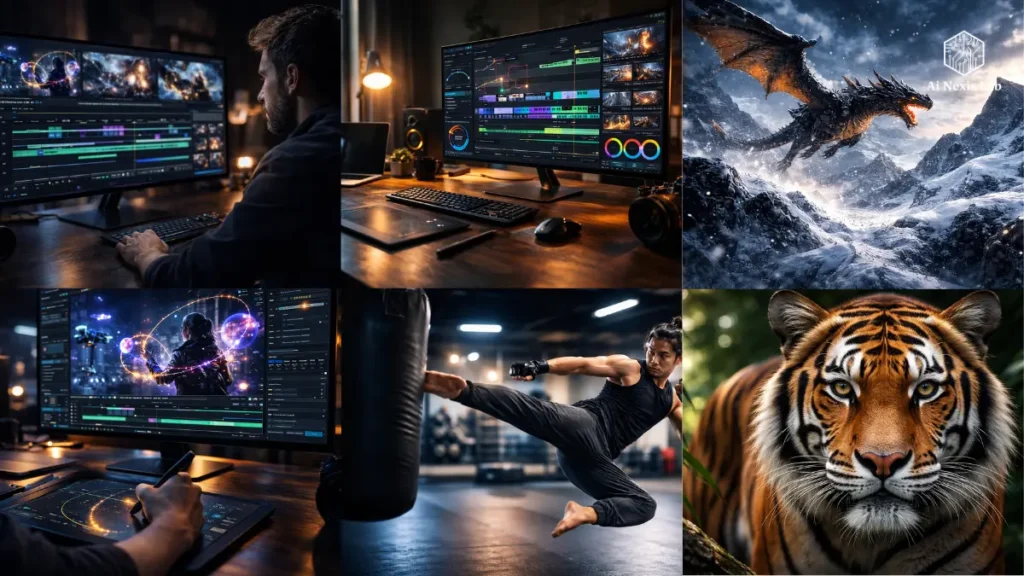
A dragon cutting through icy mountains with a scale texture so sharp you can feel the frost. Slow-motion barista pouring latte art where the flow of milk follows realistic fluid dynamics. A parkour athlete is running across a rooftop with camera motion that looks like it came straight out of a Hollywood drone rig.
Two years ago this kind of realism would have been ridiculous for AI video. Early models were charming disasters. Faces melted. Hands had seven fingers. People would start walking and somehow transform into a different person halfway through the shot.
That era is over.
In 2026, AI video generation has crossed a threshold. We are not talking about experimental demos anymore. We are talking about production-level tools capable of replacing entire segments of traditional video pipelines.
And two systems currently dominate the conversation:
OpenAI’s Sora 2 and Kuaishou’s Kling 3.0.
These aren’t just incremental improvements over previous AI video models. They represent two fundamentally different philosophies on how artificial video should be generated.
One tries to simulate the physical world, like a physics engine.
The other focuses on precision, control, and creator workflow.
For the past three months, I’ve been living in both ecosystems – testing prompts, running experiments, burning credits, and discovering where each system excels and where it differs.
If you’re a creator, filmmaker, marketer, YouTuber, or agency owner, this comparison is more important than you think.
Because the question is no longer:
“Can AI make real video?”
The real question is now:
Which AI video system should you actually build your workflow around?
Let’s see what’s really happening.
Table of Contents
1. Physics Engine: Simulation vs. Estimation
At the heart of every AI video model is a decision about how to represent reality.
Some models attempt to simulate the world as a series of physical systems. Others create frames that look plausible enough to fool the human eye.
This is where Sora 2 and Kling 3.0 differ dramatically.
Sora 2: A World Simulator
When people say Sora feels different, they’re usually reacting to something subtle but powerful:
The model seems to understand physical continuity.
OpenAI refers to this internally as spatiotemporal coherence.
In practice this means that Sora does not treat each frame independently. Instead, it attempts to model the state of the world over time.
So when something happens in frame 1, the system remembers it in frame 200.
What this enables is:
- Objects obey gravity
- Lighting remains consistent throughout camera movement
- Characters maintain continuity
- Environmental physics behave realistically
For example:
If a glass falls off a table in Sora 2:
- It accelerates downward according to gravity.
- It rotates naturally as it falls.
- It breaks depending on the angle of impact.
- The pieces are logically scattered.
Older models would simply dissolve the object into visual noise.
Sora treats the environment more like a game engine simulation than a frame generator.
“World State” Advantage
One of Sora’s greatest powers is World State Memory.
Imagine a 20-second shot:
A person walks behind a tree.
The camera moves.
They reappear on the other side.
Many AI models lose track of characters during an obstacle course.
Sora doesn’t.
The character emerges in the same clothes, the same lighting, the same posture.
It may seem like a small detail, but it’s everything in filmmaking.
Continuity errors instantly destroy reality.
Kling 3.0: Precision over Simulation
Kling approaches the problem differently.
Rather than attempting a complete physical simulation of reality, Kling focuses on the structural accuracy of motion.
Its core architecture uses a 3D-VAE framework (variational autoencoder) designed to maintain anatomical and spatial accuracy.
What this means in practice:
Human movement seems more reliable in Kling.
Examples where Kling consistently outperforms Sora:
- Martial arts sequences
- Gymnastics
- Dance
- Sports mechanics
- Hand interactions
Sora sometimes exhibits subtle “floating”.
Characters move properly but feel a bit weightless.
Kling’s movements appear heavy and grounded, especially in athletic motion.
Internal Strategy
If your scene includes:
Complex environmental physics
Use Sora 2
Examples:
- Explosions
- Liquids
- Ocean waves
- Glass breakage
- Fire behavior
If your scene includes:
Precise human motion
Use Kling 3.0
Examples:
- Sports action
- Martial arts
- Character performance
- Physical interactions
Understanding this difference alone can dramatically improve the quality of your output.
2. Resolution Wars: Is 4K Really Real?
Resolution is currently one of the most controversial topics in AI video.
Marketing claims are often… generous.
Let’s distinguish between actual resolution and upscaled resolution.
Sora 2’s Cinematic Approach
Sora typically generates footage at native 1080p resolution.
However, OpenAI implements internal super-resolution techniques that increase the perceived sharpness.
The result is a look that many filmmakers describe as “filmic”.
Features include:
- Soft natural grain
- Subtle texture blending
- Cinematic dynamic range
- Realistic depth falloff
The image often looks like footage from an ARRI or RED camera rather than hyper-sharp digital video.
For narrative filmmaking, that’s actually an advantage.
Kling 3.0’s Original 4K Strategy
Kuashou took a different approach.
In early 2026, Kling launched the original 4K generation.
Resolution:
3840 × 2160
The main difference is that the model actually generates video at this resolution internally, rather than upscaling from lower resolution frames.
The results can be extremely detailed.
Zoom in on the tiger’s Kling clip and you can see:
- Individual fur strands
- Variations in skin texture
- Micro shadows between hairs
Sora renders similar surfaces more colorfully.
The Hidden Cost of Native 4K
is a tradeoff.
The original 4K generation is computationally expensive.
Typical render time:
10-second clip in 4K:
10-15 minutes
For creators producing daily social media content, that latency is critical.
Most platforms compress videos heavily anyway.
So unless you’re producing:
- commercials
- High-end YouTube
- Cinematic content
4K may not be necessary.
But for professional work?
It’s a huge advantage.
3. The Sound of Silence: Native Audio Integration
AI video had one big problem before:
It was completely silent.
Creators had to manually stitch the audio together.
This added hours to the production.
Both Sora and Kling now try to solve this – but their strategies are different.
Sora 2’s Narrative Sync
Sora generates audio alongside the video.
This includes:
- Ambient Sound
- Dialogue
- Environmental Noise
- Synchronized Events
For example:
If a dragon roars in a scene:
The roar only occurs when the mouth is opened.
But Sora also produces small environmental details:
- Wind
- Footsteps
- Rustling leaves
- Distant traffic
These diegetic sounds dramatically enhance the realism.
Kling’s Voice Binding
Kling took a different path.
It introduced voice binding technology.
Creators can upload:
5 seconds of voice audio
The model then associates that voice with characters in the generated video.
This enables:
- Consistent voice recognition
- Accurate lip sync
- Multilingual speech generation
Kling currently supports:
- English
- Mandarin
- Japanese
- Spanish
- Korean
Lip sync quality is currently considered industry leading.
4. Character Consistency: The Holy Grail
AI video has historically struggled with one major problem:
keeping characters consistent across shots.
Early systems treated each generation as a new individual.
It is unacceptable for storytelling.
Both companies have developed solutions.
Sora’s Cameo System
Sora introduced cameos.
This allows creators to embed character identities into the model.
Once trained, the system can generate the same character repeatedly.
But there is also a disadvantage.
OpenAI has extremely strict safety filters.
If the character looks like a real person or celebrity, the model may refuse to generate it.
This can sometimes block legitimate content.
Kling’s Element Library
An alternative to Kling is the Element Library.
Creators upload:
4-10 photos of the character from different angles.
The model then creates a 3D understanding of the face.
Advantages:
- Better consistency in lighting changes
- Maintaining a strong identity
- Better facial animations
You can place the same character in:
- Deserts
- Snowstorms
- Underwater scenes
and they remain recognizable.
This consistency is a major reason why many creators prefer Kling.
5. Workflow Philosophy: Director vs. Editor
Besides technical capability, the two systems feel very different to use.
The difference comes in the workflow philosophy.
Sora: The Director Experience
Using Sora feels like giving instructions to a director.
You describe:
- Shot
- Camera lens
- Lighting
- Atmosphere
Example prompt:
“Wide cinematic shot, 35mm anamorphic lens, golden hour lighting, cowboy riding through dusty desert canyon.”
Sora produces a polished result.
But small changes can be frustrating.
If you want to adjust something small — like the color of a hat — you may have to recreate the entire scene.
Kling: The Editor Experience
Kling is designed more like a video editing tool.
One of its most powerful features is the Motion Brush.
This allows creators to paint motion directly onto elements in the video.
Examples:
- Color a car → change its direction
- Color clouds → increase speed
- Color water → change wave speed
This gives creators fine-grained control.
Kling also has robust video-to-video capabilities.
Upload a real video and transform it.
Example:
Upload yourself dancing.
Hint:
“Turn the dancer into a futuristic chrome robot.”
The results can be surprisingly convincing.
6. The Cost of Power
Let’s talk about money.
Because pricing shapes what tools creators actually use.
Sora Pricing Reality
Full access to Sora is usually bundled with premium tiers such as:
ChatGPT Pro / Sora Pro
Estimated Price:
$200/month
It is also geographically restricted in some regions.
Many users are still on the waiting list.
Kling Price
Kling adopted the opposite strategy.
It launched with:
- Global access
- Free credits
- Affordable subscription
Typical price:
~$26/month
The free tier often includes around 60+ daily credits.
For independent creators, the ROI difference is huge.
7. Strategic Workflow: How Creators Combine Sora 2 and Kling 3.0
Instead of choosing one system, advanced creators often combine them.
Here is a practical framework.
Directive A: Parallel Rendering
Use both systems strategically.
Workflow:
- Generate environment shots in Sora
- Generate character scenes in Kling
- Combine in editing
This produces extremely high quality results.
Directive B: Negative Prompt Shielding
Always make it clear what you don’t want.
Example Negative Prompt:
“Extra limbs, morphing face, floating objects, blur, watermark”
This helps stabilize the generation.
Director C: Start-End Frame Anchoring
When using a Kling, anchor your shot.
Steps:
- Generate start image
- Generate end image
- Use image-to-video
This forces the AI to follow a logical motion path.
8. Common Pitfalls
Even advanced users make these mistakes.
Prompt Overload
Long prompts confuse the model.
Use the structure:
Subject + Action + Environment + Camera
Example:
“Mountaineer climbing icy cliff, snowstorm, cinematic drone shot.”
Skipping The Seed
If you like a scene but want to make changes:
Lock the seed number.
This keeps the main structure consistent.
Expecting One-Click Perfection
Reality Check:
Professional AI creators still have a 1 in 5 success rate.
Most generations are abandoned.
Plan your credit usage accordingly.
Frequently Asked Questions
Is Sora 2 objectively better than Kling 3.0?
Not really. They solve different problems.
Sora excels in cinematic realism and environmental physics. The scenes look consistent because the model tracks the state of the world over time.
Kling focuses more on creator control and character motion accuracy. Its editing tools and motion manipulation features allow users to adjust details generation after generation, which is something Sora still struggles with.
If you are creating a film-quality narrative environment, Sora is often a better choice. If you’re producing high-volume creator content or commercial social media video, Kling’s flexibility can make it a better tool.
Can you legally use AI-generated videos commercially?
Generally yes, but it depends on the platform and subscription level.
Most paid plans give creators full commercial rights to the generated content, which means you can use the videos in ads, YouTube channels, or client projects.
However, copyright rules still apply if your prompt attempts to imitate an identifiable person, franchise character, or trademark design. Some platforms enforce stricter safety rules than others to prevent abuse.
Always review the latest platform licensing terms before starting commercial projects.
Do these tools require a powerful computer?
No.
Both Sora and Kling are cloud-based systems.
All rendering takes place on remote GPU clusters inside large data centers. Your computer only needs to be running a web browser and maintain a stable internet connection.
Even relatively old laptops can run the interface. The only real limitations during the rendering queue are bandwidth and patience.
Why do AI videos sometimes break physics?
Despite major improvements, these models are still probabilistic systems.
They predict what the next frame should look like based on patterns in the training data, rather than running a full physics engine like Unreal Engine or Blender.
When scenes involve extremely complex motion – especially fast camera movements or crowded environments – the model sometimes loses track of object relationships. This causes visual disturbances such as morphing shapes or impossible motion.
Reducing the intensity of the movement and using an anchor frame can significantly improve stability.
Will AI video replace traditional filmmaking?
It will completely disrupt some parts of the industry, but it won’t completely eliminate filmmaking.
AI video excels in:
1) Concept visualization
2) Social media content
3) Marketing videos
4) Animation pipelines
But large productions still require human direction, story design, artists, and editing decisions.
More likely is that AI becomes a force multiplier, allowing smaller teams to produce scenes that previously required larger budgets.
Final Verdict: Who Wins the Battle of 2026?
If you are a filmmaker or a premium brand studio, Sora 2 is hard to ignore.
Its physics simulation, environmental continuity, and synchronized audio footage create what truly feels like a high-level cinematic production.
It’s expensive and sometimes prohibitive, but the results can be amazing.
If you’re a creator, YouTuber, or digital marketer, Kling 3.0 is probably a more practical tool.
Its combination of:
- Native 4K output
- Motion brush editing
- Strong character compatibility
- Affordable price
makes it incredibly powerful for daily content creation.
Think of the comparison like this:
Sora 2 is a Ferrari.
Beautiful. Powerful. Built to perfection.
Kling 3.0 is a Tesla.
Fast. Accessible. Designed for everyday use.
But the real winner in this war is not any one company.
It’s the creators.
Two years ago, the most viral AI video on the internet was a bizarre clip of someone eating spaghetti with spaghetti-like fingers.
Today we are discussing whether the microscopic structure of dragon scales is realistic enough.
How quickly this technology is advancing.
And the next generation of creators is just getting started.