The End of “Vibe Coding” — And Why the Future Belongs to AI Engineers
Explore the top AI Engineer 2026 skills, tools, and trends that tech teams demand now – from agent systems to evaluations and deterministic workflows.
In early 2025, something unusual happened in the software.
One phrase – Vibe Coding – suddenly started circulating around Twitter threads, dev Slack channels, and startup demo day pitches. It came from one of the most influential minds in AI, Andrej Karpathy, and he captured an intoxicating idea:
What if building software no longer required wrestling with syntax, frameworks, debugging, and endless documentation?
If you could just tell AI what you wanted…
And the app just appeared empty?
People loved it.
And honestly, it felt magical for a while. Tools like Cursor, Cloud Code, GitHub Copilot, and emerging “AI IDEs” made it seem like we had crossed a threshold. Hobbyists were sending out full-stack applications over the weekend. Marketing teams were turning out dashboards. Non-technical founders suddenly believed they could ship products without hiring engineers.
We went through endless screenshots:
- “I built this in 2 hours with AI”
- “Zero coding experience — shipped my MVP this weekend”
- “AI built this entire SaaS app for me”
The vibes were great.
But here we are — closer to the reality of 2026 — and the mood is very different.
The discussion, the innovation, the wide-eyed wonder?
It’s gone.
Why?
Because those discarded projects eventually had to face the messy realities of security audits, customers, uptime guarantees, scalability demands, privacy regulations, and production systems.
And we collectively learned a harsh truth:
You can’t afford a memory leak, a compliance violation, or a 3 A.M. outage.
2025 could be the year of the “vibe coder”.
2026 — and beyond — belongs to the AI engineer.
And the gap between those two roles is very large.
Why “Vibe Coding” Was Inevitable – and Why It Broke
Let’s be fair.
Vibe coding wasn’t stupid.
It wasn’t irresponsible.
It was the natural first stage of a powerful new capability. Whenever technology makes something dramatically easier, people test its limits.
Low-code tools, website builders, drag-and-drop app creators – they all followed the same pattern:
- Lower the barrier to entry.
- Create a wave of exciting experiments.
- Hit the wall when things get real.
AI accelerated that cycle.
Where Vibe Coding Shined
For prototypes, experiments, proofs of concept, and small personal tools, AI has proven to be miraculous.
- Need a landing page?
- Want to automate spreadsheet workflows?
- Trying to quickly piece together APIs?
- Want to test an idea months in advance?
AI can deliver.
And honestly – that win was important.
Vibe Coding democratized software.
Non-technical builders finally got to play.
The industry needed it.
But…
The Moment Reality Arrived
Realistic production systems quickly revealed cracks.
Vibe coding, when stripped down, was basically probabilistic programming:
You describe what you want.
The model predicts which code might make it work.
You cross your fingers.
And in modern engineering, “cross your fingers” is not a strategy.
In practice, things failed here.
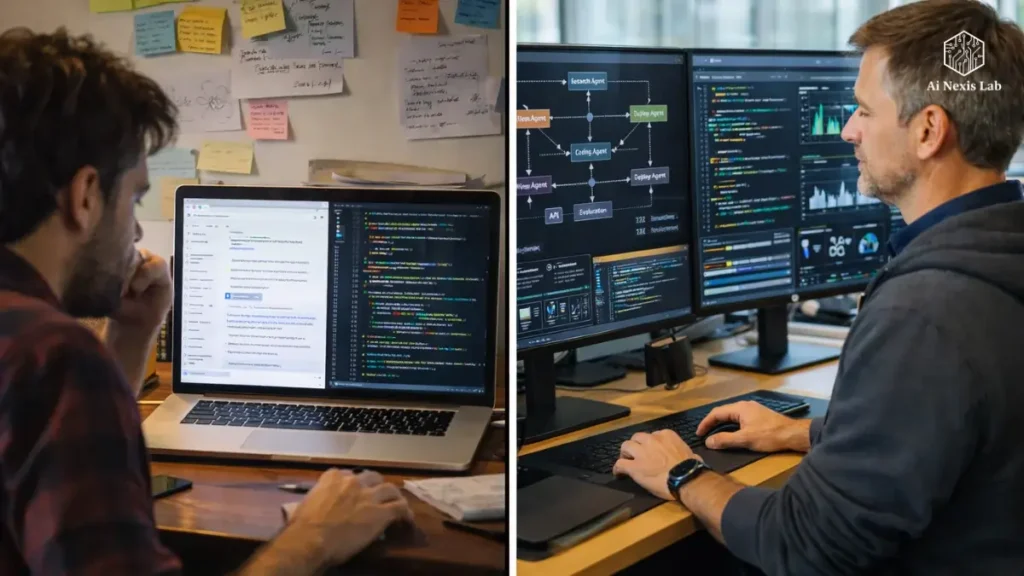
Hidden Problems Killing Vibe Coding
1. Black Box Crisis
If AI generates your code…
…and you don’t fully understand what it’s generating…
…what do you do when it crashes in the middle of a mission-critical process?
This happened everywhere:
- A startup deploys AI-assembled microservices.
- It works well until there is an increase in traffic.
- Suddenly performance crashes, logs explode, and no one understands the architecture well enough to debug it.
When the people responsible for the codebase were not actually the logical owners of the code – outages came into existence.
2. Security Nightmares
By mid-2025, researchers and security firms reported a disturbing pattern:
Thousands of AI-generated apps are shipping with serious vulnerabilities.
Why?
Because LLM sometimes “misleads” patterns – including faulty authentication checks, unsafe defaults, and unsafe data handling.
The developers assumed:
“If the AI wrote with confidence, it must be true”.
Attackers quickly realized:
“AI builders don’t fully validate security”.
The results included:
- Open admin dashboards
- Weak password storage
- Invalid inputs
- Hard-coded secrets
- Poorly isolated containers
Companies quietly began to withdraw AI-generated services – or paid a high price to refactor them.
3. Technical Debt – At a Slow Pace
Humans build up technical debt slowly.
AI built it right up.
When LLM doesn’t fully understand your codebase – but continues to generate patches, layers, and “fixes” – you end up with a disjointed, inconsistent architecture that no one can reason about.
Ask AI for a backend fix today, and a week later:
- Naming conventions drift
- Schema logic quietly changes
- Assumptives change
- Implicit behaviors stack up
Not long ago, repeated AI-generated changes created a confusing mess.
Not because AI is “bad”…
But because software still needs architects.
And that’s the key turning point.
Enter the AI Engineer
Contrary to propaganda, AI has not eliminated engineering.
It’s reshaped it.
The future is not like this:
“AI replaces developers”.
That is:
Developers who understand AI are replacing those who don’t — and they are operating at a higher level than ever before.
AI engineers don’t treat AI like magic.
They treat it as a subsystem.
A tool.
A collaborator.
A component with strengths and failure modes.
What makes an AI engineer different?
Not the ability to “prompt well”.
That’s the baseline now.
An AI engineer understands:
- Software architecture
- Deterministic systems
- Data handling
- Evaluation strategies
- Deployment constraints
- Security boundaries
- Reproducibility
- Monitoring and lifecycle maintenance
They don’t copy-paste what the AI writes.
They design systems in which AI plays a controlling role.
Here is a simple comparison.
| Feature | Vibe Coder (2025) | AI Engineer (2026) |
|---|---|---|
| Primary Tool | Natural Language Signaling | Orchestrated Agent Framework |
| Mindset | “Let AI Build It” | “Let AI Assist Inside the Guardrails” |
| Focus | Speed & Demo | Reliability, Scalability, Audit |
| Output | Personal Tools, MVPs | Production AI Systems |
| Verification | “Looks Good” | Evaluation, Tests, Error Budget |
| Control | Reactive | Deliberate Architecture |
| Risk Model | Hope | Metrics, Monitoring, Failsafe |
This distinction is not academic.
This is the difference between:
A personal project that impresses friends…
…and an AI-powered product that handles millions of users without being isolated.
The Biggest Shifts Defining AI Engineering in 2026
Three themes dominate the new era:
- Agentic Workflows
- Layered Determinism over Probabilistic Models
- Local and Privacy-First AI
Let’s walk through them.
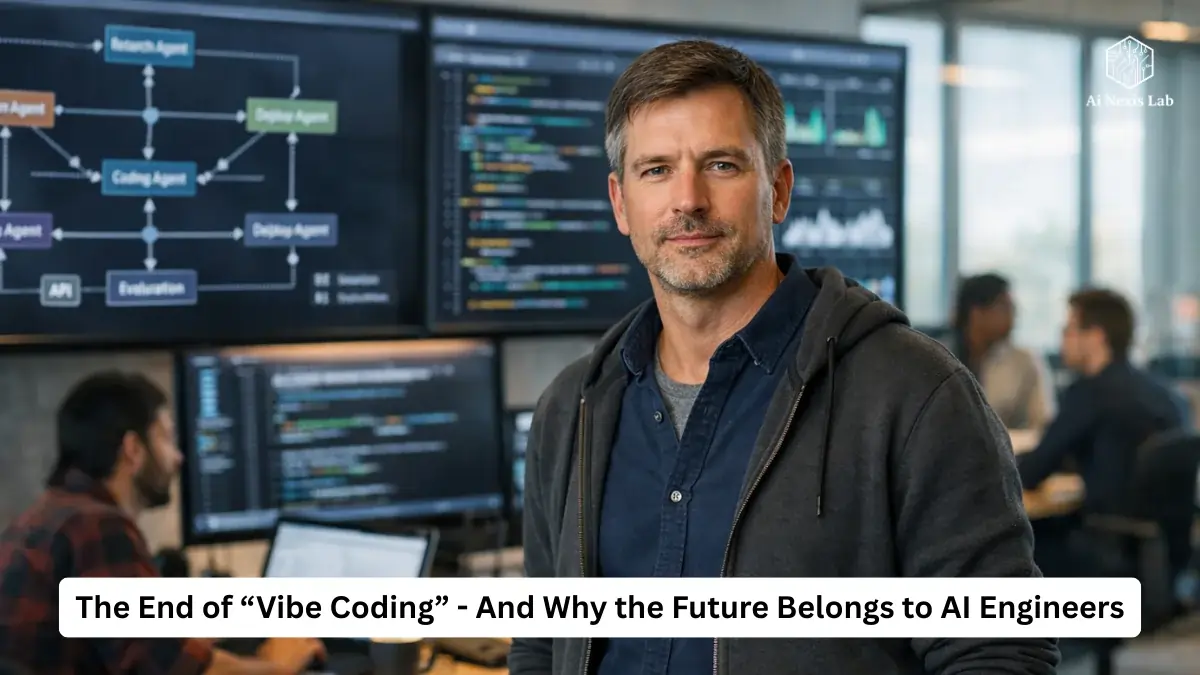
1. From Chatbots to Agentic Systems
We have moved away from asking questions of a single AI model.
Now we create agents.
A research agent.
A coding agent.
A testing agent.
A planning agent.
A deployment agent.
Each with specific rules, responsibilities, and tools.
They collaborate – not unlike human teams – with surveillance and checkpoints.
This transformation is sometimes called:
AgenticOps
And it’s not science fiction. That’s already how advanced AI-powered systems work.
Why are agents important
- They can gain information instead of being confused.
- They can use APIs, tools, and scripts.
- They can run assessments before returning answers.
- They maintain context and workflow beyond a single conversation.
- They can coordinate tasks and pipelines.
But agents are only powerful when properly aligned.
And orchestration is where AI engineers thrive.
2. Making AI Predictable: The Return of Determinism
LLM is probabilistic in nature.
It means:
Ask the same question twice
You may get two different answers.
Great for creativity.
Terrible for product reliability.
AI engineers don’t try to change that nature. They build layers around it.
- Structured prompts
- Validation plans
- Defined implementation paths
- Reproducible evaluation suites
- Failure fallback behaviors
- Audit logs
- Canary testing before rollout
They ask questions like:
- Does this model behave consistently across cases?
- What happens when it fails?
- What guarantees can we enforce?
Standard:
“It worked once”
Changed to:
“We proved that it works predictably”.
3. Local and Edge AI: Privacy Comes Home
Cloud-hosted AI models were a step forward.
But as costs rose, regulations became stricter, and latency became unacceptable for certain industries – the pendulum began to swing back.
Now we see:
- Small Language Models (SLMs)
- On-device inference
- Quantized models running on consumer hardware
- AI baked into local workflows
- Private AI trained on internal documents without leaving a secure environment
This is not theoretical.
Healthcare, finance, legal teams, and privacy-first startups are already doing it.
In this world, AI engineers learn:
- Model compression
- Memory optimization
- Privacy boundaries
- Edge deployment
The cloud isn’t going away – but it’s no longer the only option.
So… how do you actually become an AI engineer?
Not by collecting random YouTube tutorials.
Not by “learning prompts”.
You build a hybrid skillset – part software engineer, part systems thinker, part data practitioner.
Here is a realistic roadmap during the first year.
Phase 1 (Months 1-3): Build a strong modern foundation
You don’t need to be a deep ML researcher.
But you need to be fluent in Python – as a conductor, not as a scripting hobbyist.
Focus on:
- Asynchronous workflows
- API handling
- Event loops and concurrency
- Data ingestion pipelines
Also invest time in data literacy:
- Pandas / Pollers
- Cleaning up pipelines
- Handling messy real-world inputs
Because AI is driven less by the cleverness of the code…
…and more by the quality of the data flowing through it.
Phase 2 (Months 4-6): Learn “AI Glue”
Here you combine traditional coding with applied AI.
Key Areas:
Recovery-Augmented Generation (RAG)
No more “PDF copy-paste into a chatbot”.
But:
- Intelligently indexing documents
- Building vector searches
- Linking AI responses to sources
- Avoiding confusion through grounding
Structured prompting and output control
You move beyond casual chatting to:
- JSON output constraints
- Schema validation
- Multi-step reasoning patterns
The goal here is predictability and composability – not clever prompts.
Phase 3 (Months 7-9): Agentic Architecture
Now the puzzle pieces click.
You start building agentic systems:
- One agent for research,
- One agent for coding,
- One for evaluation,
- One for summarization.
Every agent has tools.
Each agent runs under supervision.
Everything logs and traces.
Create something tangible here:
For example, an AI system that watches the repo, generates tests for each PR, runs evaluations, and posts a summary on Slack.
You are no longer “using AI”.
You are engineering with it.
Phase 4 (Months 10-12): MLOps and Evaluation
This phase separates the hobbyists from the professionals.
You learn:
- Metrics and dashboards
- Drift detection
- Model comparison
- Regression testing for AI behavior
- Guardrails and privacy filters
You stop trusting your gut…
…and start trusting the instrumentation.
Businesses don’t buy hype.
They buy predictable outcomes.
The Big Picture: Why the World Needs AI Engineers
The tech industry is no longer swayed by flashy demos.
The board asks:
- “What happens if it fails?”
- “Is it relevant?”
- “Can we scale this safely?”
- “How do we prove that it works consistently?”
An AI engineer is the answer to those questions.
Their job is not just to build.
They are:
- Design,
- Monitoring,
- Validating,
- Secure,
- Maintain,
- Develop.
They don’t destroy the magic of AI.
They make that magic safe for the real world.
And as autonomy increases – as AI takes on more operational responsibility – this role becomes fundamental.
Not propaganda.
Not optional.
Fundamental.
Frequently Asked Questions — General Questions About AI Engineering (2026 Edition)
Q1: Does this mean that traditional developers are now obsolete?
Not at all.
But the job description is changing.
If you ignore AI completely, your role shrinks over time. If you accept it intelligently, your leverage increases dramatically.
Software is not disappearing.
The way we make software is.
Q2: Can someone become an AI engineer starting from scratch?
Yes – but it’s not a shortcut career.
You still need discipline, fundamentals, curiosity, and patience. AI helps you speed up the learning process, rather than abandoning it entirely.
Think of AI as your co-driver – not your replacement.
Q3: Do I need heavy knowledge of mathematics or in-depth knowledge of machine learning?
Not at first.
You don’t have to build a model from scratch.
You need to:
1) Understand how models behave,
2) Know their limitations,
3) And engineer systems that use them intelligently.
If curiosity takes you deeper later – that’s fine. But that’s not the starting line.
Q4: Is “prompt engineering” still a thing?
Yes – but not in the way it was marketed.
Today it’s more like:
1) Designing structured instructions,
2) Shaping context windows,
3) Connecting output to schema,
4) Planning multi-step reasoning pipelines.
In other words:
Less “magic spells”.
More system design.
Q5: Aren’t agent systems unreliable?
Out-of-the-box, yes.
But AI engineers create:
1) Checkpoints
2) Logs
3) Retries
4) Tool Boundaries
5) Evaluation Harness
This is how they transform “unpredictable models” into reliable workflows.
Q6: Will everything go to local AI?
Not everything — but a lot more than people initially expected.
Sensitive industries, mobile devices, offline equipment, home automation systems, privacy-critical applications — all of these benefit greatly from local inference.
Expect hybrid ecosystems:
Local control + cloud growth when needed.
Q7: What is the most important mindset change for 2026?
Stop thinking:
“AI writes code for me”.
Start thinking:
“I design systems where AI plays specific, controlled roles – and I remain responsible for the results”.
That mindset is the difference between hobbyists and professionals.
Final Thoughts: A More Mature, More Grounded AI Era
Vibe coding was not a failure.
It was the creative spark the industry needed.
It showed people what was possible. It pulled millions of people into the conversation. He broke down barriers that kept non-engineers aside.
But now the industry is maturing.
Companies don’t want glossy demos anymore.
They want:
Reliability
Accountability
Auditability
Security
Measurable ROI
The AI engineer stands at that intersection.
They don’t kill the “vibes”.
They refine them.
They take raw, chaotic AI power – and turn it into systems that people trust.
In other words:
AI engineers do not replace developers.
Developers represent what naturally evolves when software gains autonomy.
We are not moving towards a world without engineers.
We are moving towards a world where engineering matters again – not despite AI, but because of it.