Sora Is Dead. So What Now? Veo 3 vs CapCut AI for Instagram Reels in 2026
Veo 3 vs CapCut AI compared: discover 5 Shocking 2026 differences for Instagram Reels creators and find the best AI video tool to grow faster.
No one wanted a post-Sora reality check, but honestly… maybe it was needed.
By May 2026, most creators had gone through the five stages of grief for Sora.
First came denial. Then panic. Then on Reddit, creator Discords, and every short-form video forum, “What’s the best replacement?”
And now? We are finally at the part where people are becoming practical.
Because if there’s one thing creators learn quickly, it’s this: platform loyalty is expensive.
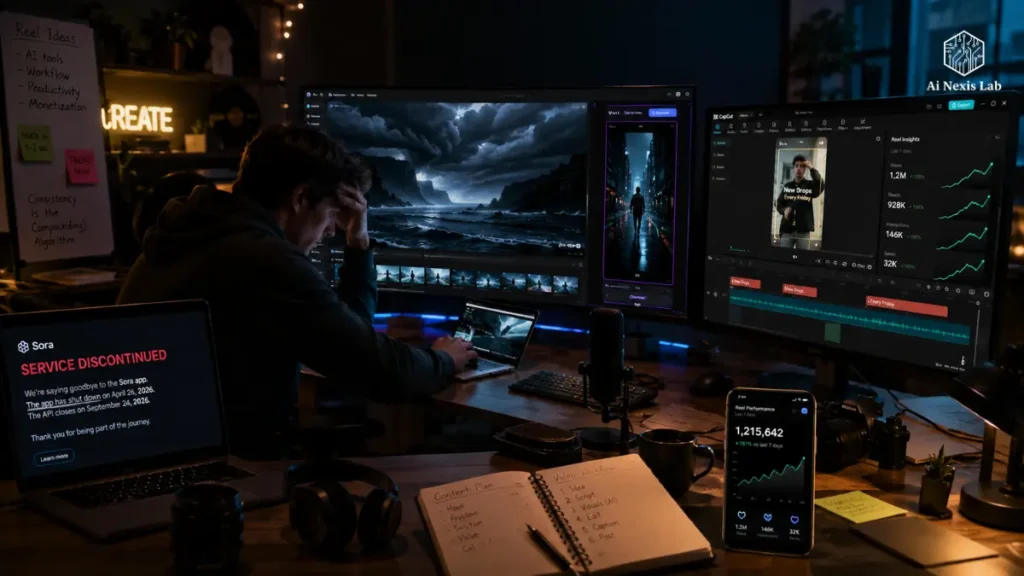
When OpenAI officially shut down Sora’s consumer app earlier this year, it felt dramatic. Not because shutdowns are rare in tech – they happen constantly – but because Sora was positioned as the future of AI video creation.
Turns out, futures can be canceled.
The bigger issue wasn’t the shutdown itself. It was what it exposed.
Many creators had quietly built an entire workflow around a tool they didn’t control.
It is dangerous.
And it forced everyone to ask the same uncomfortable question:
What’s really working for creators making Instagram Reels right now?
Not flashy demos.
Not launch-day hype.
Not cinematic samples created by internal production teams.
Real tools. Real workflows. Real output.
Two platforms keep coming up for a reason:
- Google Veo 3
- CapCut AI
Both are legal.
Both solve real problems.
And honestly? They are solving completely different problems.
That’s where people keep thinking this wrong.
Table of Contents
Why The Fall of Sora Really Changed The Creative Economy
The Sora shutdown wasn’t just another product sunset.
It was a warning shot.
When Sora launched, it exploded. Creators were posting generated mini-films that looked almost unreal. Agencies began to launch AI-first campaigns. People were seriously restructuring content pipelines around it.
Then, months later, it was over.
No slow sunset.
No comfortable migration window.
Just done.
This kind of thing shakes trust.
And maybe that’s a good thing.
The creators remembered something people usually learn the hard way:
If your entire creative workflow relies on an unstable platform, you’re not building a business. You are renting a facility.
That’s why Veo 3 and CapCut are important now.
They are supported by an ecosystem with real long-term incentives.
Google is not building Veo as a side experiment. It is connected to Gemini, Workspace, enterprise tools, and a comprehensive AI infrastructure.
CapCut is deeply embedded in ByteDance’s content machine. Whether people like ByteDance politically or not, the economics are very real.
It matters.
A lot.
2026 Creator Survival Framework
Before comparing tools, here is a practical framework that smart creators are currently using.
1. Stop Relying On One AI Stack
This is basic risk management.
If one tool disappears tomorrow, your content pipeline doesn’t break with it.
If that seems obvious, look at how many creators were blindsided by Sora.
2. Use AI For Leverage, Not Dependency
This is where people overcorrect.
Some creators have completely stopped at everything AI-generated.
Bad move.
AI works best as an enhancer.
B-roll. Hooks. Concept generation. Visual texture.
It struggles when it becomes your entire brand voice.
Audiences can sense that weird artificial flatness sooner than creators think.
3. Archive Everything
Prompts.
Templates.
Winning workflows.
Exported assets.
Store them externally.
Cloud-native platforms are convenient until they’re not.
4. Test Results, Not Aesthetics
A beautiful video means nothing if retention dies in 1.8 seconds.
A lot of Veo-generated content looks amazing… and performs terribly.
Capcut edits may look simple but can completely crush retention.
The algorithm doesn’t care how “cinematic” your shot looks.
It doesn’t care if people stay or not.
What Exactly Is Veo 3
Let’s make something clear.
Veo 3 is not a capcut.
And if you go into it expecting a capcut, you’ll probably like it.
Veo 3 is basically a generation engine.
It creates a video from the prompt.
That’s his job.
And when it works, it’s honestly ridiculous.
The reality is now so good that the average viewer often can’t tell what has been generated.
Not always. It still misses the odd detail sometimes. Hands still do weird hand things sometimes. Physics can drift.
But where was AI video even 18 months ago?
It’s not even close.
Where The Veo 3 Shines
Cinematic B-roll
This is the Veo’s killer use case.
Need a moody neon alley for a storytelling reel?
A luxurious penthouse in a snowstorm?
A yacht cabin during rough seas?
That’s Veo territory.
It creates scenes that most solo creators could never realistically shoot.
Reference Consistency
This is more important than people realize.
You can now maintain visual consistency across scenes using context inputs.
It makes episodic storytelling much more practical.
Before this, continuity was a mess.
Native Vertical Output
A big win for reels creators.
No awkward cropping gymnastics.
No reframing disasters.
Where Veo 3 Gets Frustrating
Prompting is still difficult.
People oversell how “easy” prompt-based video creation is.
It’s not.
You are basically directing in text.
Camera movement.
Lighting.
Scene physics.
Motion speed.
Atmosphere.
And if your prompt is bad, your output is bad.
No amount of model sophistication fixes the ambiguous direction.
People here seriously underestimate the learning curve.
What Has Capcut AI Become?
Capcut’s evolution has been kind of wild.
A few years ago, people thought of it as a casual mobile editor.
It’s outdated.
In 2026, CapCut is basically a short-form production operating system.
And honestly?
It’s terrifyingly efficient.
AI Auto-Edit System
This is where CapCut continues to win.
You put in the footage.
Describe what you want.
It makes something shockingly useful quickly.
It’s not perfect.
Sometimes the cuts feel generic.
Sometimes the pacing is weird.
Sometimes it overuses transitions like an over-caffeinated intern.
But as a first draft?
It saves an absurd amount of time.
Captions Are Still CapCut’s Unfair Advantage
This sounds boring until you actually look at the retention data.
Caption quality greatly impacts completion rates.
CapCut understands mobile readability better than almost anyone.
Its positioning, pacing, and styling consistently outperform most standalone caption tools.
It’s not sexy.
But it matters.
Platform-Native Optimization
This is where Veo still feels incomplete.
CapCut understands social distribution.
Aspect ratio.
Compression.
Hook framing.
Audio sync.
Export presets.
These details seem minor until they quietly destroy your performance.
Veo 3 vs. Capcut: The Real Comparison
Here’s the clear version.
Choose Veo 3 if:
You need visuals that don’t exist.
Luxurious environments.
Impossible cinematic shots.
A generated storytelling world.
Brand campaigns where visual originality is the product.
Choose Capcut if:
You are posting continuously.
Editing raw footage.
Scaling daily content.
Optimizing for speed and output volume.
Really trying to grow the account.
The Hidden Tradeoff That No One Talks About
Veo offers creative freedom but costs iteration time.
Capcut sacrifices some originality for brutal efficiency.
That’s the trade-off.
There’s no absolute winner.
Just a better fit with your workflow.
The Hybrid Workflow That’s Winning in 2026
This is where serious creators are landing.
And honestly, it’s the smartest setup.
Step 1: Create a Concept In CapCut
Use conversational scripting tools.
Outline hook structure.
Draft pacing.
Step 2: Generate Premium Visuals in Veo
Create cinematic scenes.
Generate impossible B-roll.
Create emotional atmosphere.
Step 3: Return to CapCut
Assemble.
Caption.
Optimize.
Export.
Post.
That workflow gives you:
- The cinematic originality of Veo
- The execution speed of CapCut
- Better retention mechanics
It’s not the fastest way.
But it is probably the strongest.
Pricing Reality Check
This is more important than creators admit.
Veo 3
Free generation allowance is useful for testing.
Not enough for serious volume.
If you are publishing aggressively, paid tiers quickly become necessary.
And if you do heavy repetition the costs can stack up quickly.
CapCut
CapCut’s free tier is almost suspiciously generous.
Still, the best AI automation features are increasingly being pushed behind the Pro.
Classic freemium pattern.
You’ll probably upgrade eventually.
Still, it’s hard to argue against the value.
Final Verdict
Here’s the honest answer.
There is no universal winner.
And whoever sells you one is oversimplifying.
If you care most about cinematic originality, Veo 3 wins.
If you care most about practical creative output, CapCut wins.
If you are building a serious short-form content machine?
Use both.
That’s where the real leverage is.
Sora’s disappearance came as a shock.
In hindsight, it may have been a correction.
The creator space was forced to stop chasing hype and start choosing tools based on sustainability.
That’s probably healthy.
And honestly?
Creators who adapt quickly usually get ahead no matter what.
Frequently Asked Questions
If I’m just starting Instagram Reels, is it worth paying for Veo 3?
Maybe not right now.
If you’re new, your biggest hurdle is usually not visual production quality. It’s about understanding the hook, the pace, the audience psychology, and the relevance. Veo can create beautiful footage, but beautiful footage won’t fix a poor content strategy.
Start simple. Learn what works first. Then upgrade your visuals.
Can CapCut completely replace Veo 3 for cinematic content?
Not really.
Capcut can polish footage exceptionally well, but it doesn’t create the photoreal cinematic atmosphere that Veo created from scratch.
If your content is based on impossible scenes or surreal cinematic scenes, Capcut alone won’t get you there.
It’s an editor first.
It’s not a world-builder.
Which tool is better for developing an Instagram theme page in 2026?
For most people, Capcut.
Theme pages usually win through relevance and posting volume.
Capcut supports it better.
Veo can help create outstanding moments, but relying on it for every post slows down production and increases friction.
Growth usually rewards systems, not artistic perfection.
What is the biggest mistake creators make with AI video tools?
They focus too much on visuals and ignore performance metrics.
This happens all the time.
People spend hours perfecting cinematic output and never test whether the reel actually grabs attention.
Retention beats aesthetics.
Every time.
Should former Sora users switch completely or diversify?
Diversify.
Absolutely.
If Sora has taught creators anything, it’s that putting all your workflow eggs on one platform is reckless.
Use multiple tools.
Build transferable systems.
Keep your process flexible.
This is the real long-term benefit in 2026.