They’re creating faceless YouTube channels in 2026 – but most won’t get a penny.

The internet loves the fantasy of making good money.
Some people claim to have created a faceless YouTube channel that now makes $30,000 a month while they sleep. Then comes the screenshot. Dashboard. Course link.
And yes, some of those statistics are real.
What’s usually left behind is everything that happened before the screenshot: months of dead uploads, wasted software subscriptions, mediocre thumbnails, weak scripts, and the quiet realization that uploading AI-generated junk doesn’t magically turn into business.
Faceless YouTube in 2026 is still one of the most accessible online business models out there. That part is true. But it’s also gotten a lot harder. YouTube has gotten much better at finding AI content with less effort, viewers have become more selective, and the window of easy money that people enjoyed in 2023 and 2024 has largely disappeared.
However, for those willing to consider this as building a real media asset – not a shortcut – it is entirely viable.
Here’s what this model actually looks like now.
Table of Contents
01 – Foundation
What is the Faceless YouTube Channel Really
Many people hear “Faceless Channel” and picture a robotic voiceover over stock footage.
That just doesn’t work anymore.
A truly faceless channel is simply a channel where the content is the product, not the personality of the creator. There is no talking-head setup. No personal branding reliance. No need to be on camera.
Think explainer channels, documentary-style storytelling, financial breakdowns, sleep ambiance videos, historical in-depth visuals, or educational visual essays.
The channels that survive have one thing in common: they still feel human.
It seems counterintuitive, especially now that AI handles scripting, voice generation, editing, and visuals. But viewers can tell when something feels empty. They don’t consciously know why, but they bounce.
It’s usually because the content lacks perspective.
A good faceless channel has perspective. It intentionally organizes information. It tells a story. It seems like someone has thought about what’s important.
This is the difference between content business and algorithmic byte.
02 – Market Intelligence
Niches That Will Really Make Sense in 2026
This is where most beginners mess up.
They choose niches based on what they find exciting rather than actual advertiser demand and sustainable search behavior.
It’s a quick way to spend six months making videos that no one makes much money on.
Here’s the reality: not all views are of equal value.
A 100,000-view gaming compilation may earn less than a 15,000-view personal finance explainer.
The strongest Faceless niches currently are:
Personal Finance and Wealth Education
Still one of the highest paying categories. CPMs can range from $15–$35 depending on geography and depth of topic.
The downside? Brutally competitive.
Business and SaaS Education
Solid monetization and strong affiliate potential.
This works especially well if you can explain complex tools in a simple way.
Psychology and Human Behavior
High evergreen value, decent CPM, huge curiosity factor.
But the usual “self-help fluff” is quickly ignored.
History / Documentary Storytelling
Not always the highest RPM, but great long-tail traffic.
A good history video can quietly pull in views for years.
Sleep / Ambient / Relaxation
Large volume, easy production.
But low revenue per thousand views and crowded areas.
Honestly, if you’re just starting out, jumping straight into ultra-competitive finance because someone said it pays well is usually a mistake.
You’re better off finding a narrow lane that you can actually win.
03 – Toolkit
What The 2026 AI Stack Really Looks Like
People overestimate the tool stack.
You don’t need a $300 monthly software setup on day one.
This way beginners spend money before proving they can publish consistently.
A real startup stack looks like this:
Script Development
Use a robust language model for outline and research support.
But don’t blindly copy the output. AI still defaults to the general framework unless hard pushed.
Voice Generation
Modern AI voices are now surprisingly good.
However, they require pacing adjustments. A perfectly generated sound with bad rhythm sounds strangely fast.
Editing
Easy win.
Most beginners are obsessed with cinematic edits when clean pacing is more important.
Thumbnail Testing
This is more important than almost everything else.
A mediocre video with a strong title-thumbnail combo often beats a better video packaged poorly.
Monthly budget for a lean setup? Typically $40–$120.
That’s enough.
If you are spending more than you are earning, you are probably compensating for a poor strategy with the software.
It never works in the long run.
04 – System
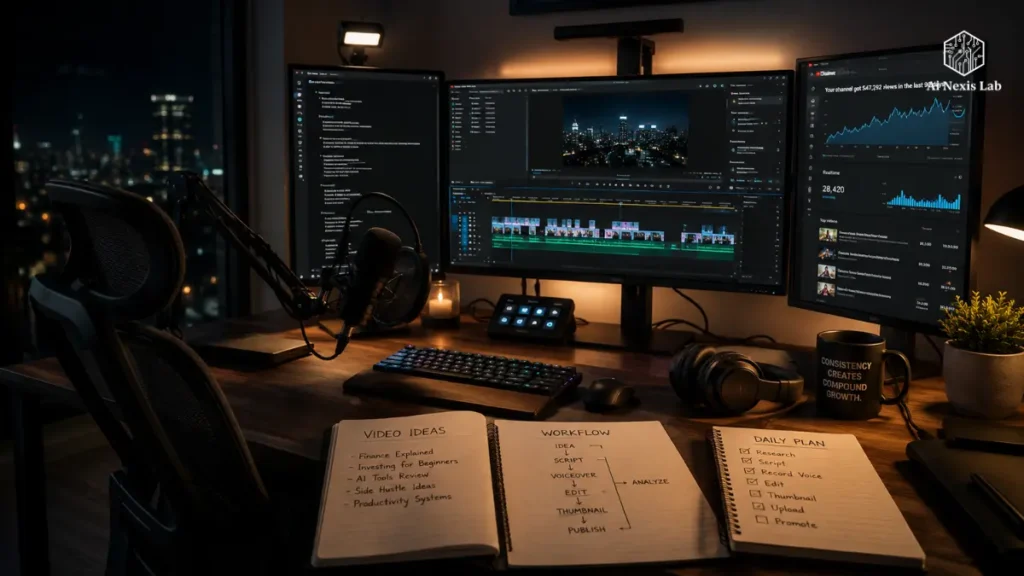
Weekly Workflow That Scales
This is where the fantasy breaks down.
Faceless YouTube seems passive until you actually try to do it.
A sustainable workflow typically looks like this:
Monday: Research
Find the search gap.
Not just trending topics.
Questions that people are actively trying to solve.
This is where the real channels are created.
Tuesday: Script Development
Good scripts are not summaries.
They are structured arguments.
Have a hook, tension, progression, payoff.
A poor script kills everything downstream.
Wednesday: Voice + Rough Assembly
Generate narration, fix pacing, map visual beats.
This usually takes longer than people expect.
Thursday: Editing + Thumbnail Creation
Thumbnails often deserve just as much strategic thought as the video itself.
Until you realize that CTR determines whether the algorithm even tests your content or not.
Friday: Published + Analyze
Then review retention curves.
That data tells you what really matters.
Not your opinion.
Not your effort.
Data.
In reality?
Expect 10-15 hours per week for serious single-channel operations.
Anyone selling “30 Minutes a Week Passive Content Systems” is selling fiction.
05 – Growth Engineering
What Really Drives Channel Growth
There is no secret algorithm hack.
There are only recurring benefits.
Content Gap Method
Instead of copying successful videos, identify what they left unexplained.
The opportunity lies there.
Evergreen Over Viral
Trending topics can rise.
Evergreen videos combination.
One solid evergreen video can quietly outlast ten short-term trend plays.
Human Editorial Input
This is more important than ever.
AI can gather information.
It still struggles to make compelling decisions.
The strongest channels inject meaning.
This is why people trust and subscribe.
Portfolio Thinking
It seems smart to run multiple channels.
It usually isn’t – at least not early on.
Most people split focus too soon.
One channel with 60 strong uploads beats four abandoned experiments.
06 – Revenue Architecture
Where The Money Really Comes From
This is where a lot of online advice becomes misleading.
AdSense alone is usually not enough unless the volume becomes serious.
For smaller channels, revenue often looks like this:
Advertising Revenue
Ultimately reliable, but slow to build.
Affiliate Offers
Often the first meaningful income source.
Referrals in good condition can perform much better than advertising revenue.
Digital Products
Only work if the audience trusts them.
Selling random PDFs to an unconnected audience doesn’t work.
Licensing / Reuse of Assets
Some operators reuse scripts in blogs, newsletters, short-form clips, or translated versions.
That’s where scale gets interesting.
A healthy faceless business rarely relies on just one revenue stream.
If your entire plan relies on YouTube RPM staying stable forever, it’s fragile.
07 – Honest Statistics
What Profitability Actually Looks Like
This is the part that most “success stories” leave out.
A realistic timeline:
Months 1-3
Learning.
Maybe no revenue.
Maybe weak videos.
That’s normal.
Months 4-6
Patterns emerge.
You start to understand packaging, pacing, and retention.
If you stay consistent, monetization becomes possible.
Months 6-12
This is where traction can begin.
Maybe $50. Maybe $300. Maybe nothing.
That uncertainty is real.
A good channel can earn $200–$2,000 monthly after a year.
Yes, some reach $10K+.
Those are exceptions, not expectations.
Most failures happen because people give up in the middle of a boring set – after enough effort to feel invested, but before enough reps to improve.
08 – Platform Intelligence
YouTube’s 2026 AI Policies
YouTube is now stricter.
Not anti-AI. Just anti-lazy.
Three rules are important:
Disclose Artificial Content
Omit this and you’re asking for monetization problems.
Add Original Value
If your content looks like it was assembled rather than created, it’s buried.
Avoid Reused Content Signals
Heavy stock footage with minimal conversion is risky.
YouTube wants clear editorial contributions.
The winning formula in 2026 is quite clear:
Use AI for speed. Use human judgment for quality.
That hybrid model is the only one that survives.
Frequently Asked Questions
How much money can a faceless YouTube channel realistically make in 2026?
Most new channels don’t produce anything for months, and that’s the truth people don’t like to hear.
A channel with strong implementation can earn a few hundred dollars monthly in the first year alone. It’s entirely possible to reach $5,000+ monthly, but it usually requires serious consistency, topic selection discipline, and dozens of quality uploads. “Overnight” stories almost always lack context.
Can you start a faceless YouTube channel without any editing experience?
Yes, but the learning curve is expected to increase dramatically.
Modern tools reduce technical friction, but they don’t eliminate creative decision-making. You still need to understand pacing, story flow, thumbnail psychology, and audience retention. Software helps with implementation. It doesn’t replace skill development.
What is the best place for beginners starting Faceless YouTube?
Usually something that has sufficient demand but not unreasonable competition.
History explainers, psychology breakdowns, specialized educational content, and practical problem-solving topics are often stronger beginner choices than broader financial or business channels.
The “best” niche is usually one where you can consistently produce and at the same time offer something different.
Does YouTube monetize AI-generated videos in 2026?
Yes—if they provide real value.
The issue is not the use of AI. It is low-effort content that feels derivative, misleading, or mass-produced without meaningful editorial contribution.
If your videos teach, explain, analyze, or entertain with originality, monetization is entirely possible.
How many videos should you upload before determining the results?
At least 30.
To be honest, it might be even earlier.
Many creators make emotional decisions based on their first 5-10 uploads. That’s not enough data to identify a pattern.
Treat the first batch as research and development.
Final Verdict
Is it worth starting in 2026?
Yes.
But only if you’re ready to make it a real media asset.
No side hustle fantasy.
No passive-income shortcut.
No excuse to let software do the thinking for you.
Faceless YouTube still works because people will always pay attention to useful, entertaining, well-packaged information.
That hasn’t changed.
What has changed is the standard.
The lazy version is dead.
The thoughtful version is still out there.
Start small. Choose a niche. Publish consistently. Learn from real viewer behavior.
Then decide if it’s worth more of your time.