
Crypto Security Guide (2026 Deep Dive): How to Protect Your Bitcoin, Ethereum, NFTs, and Digital Assets Before They Get Taken

Protect your crypto assets with 10 proven security strategies. Learn how to secure wallets, avoid scams, and prevent hacks in this complete crypto security guide.
Table of Contents
Introduction: The Wake-Up Call Nobody Wants
Let’s cut the fantasy.
Crypto doesn’t get “hacked” the way people think. You don’t wake up one day because someone has cracked Bitcoin. It doesn’t work that way.
You wake up because you made a small mistake.
A bad click.
A hasty approval.
A fake site that looked real enough.
And then your wallet is empty.
Gone.
No support tickets.
No reversals.
No insurance bailouts.
Just a transaction hash showing everything you created… moved somewhere else.
The inconvenient truth:
- Billions of dollars are stolen every year
- Most victims are not novices
- Almost all losses are preventable
The system is brutally simple:
If someone gets access or permission, your funds are theirs.
That’s it.
This guide exists for one reason:
To ensure you don’t become the next example.
Mapping The Threat Landscape: Who’s Really Coming After You
Stop imagining brute-forcing code by hoodie hackers.
It’s not a real threat.
The real threat is manipulation + access.
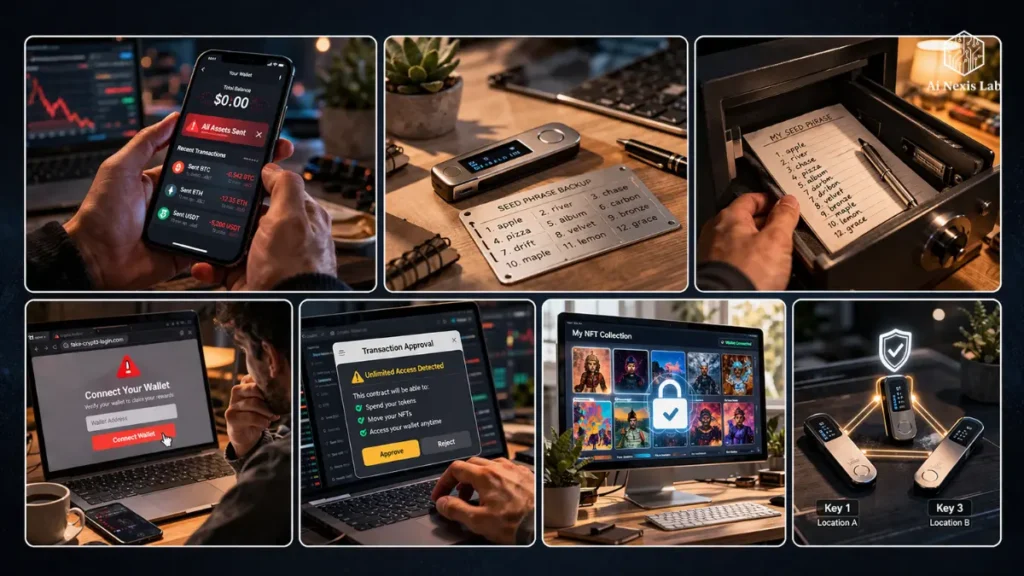
You Are Really Drained In 4 Ways
1. Social Engineering (#1 Killer)
This is where most people lose money.
Not hacking. Not code.
You agree to do something.
- Click on the link
- Connect your wallet
- Sign the transaction
- Enter your seed phrase
Once you do that, the “hack” is already over.
You have granted them access.
2. Malware + Clipboard Attacks
This one is simple and deadly.
You copy the wallet address → the malware swaps it → you paste → send the funds.
The money goes to the attacker.
No warnings.
You only notice it after it’s gone.
3. Smart Contract Exploitation
You approve the contract.
Not carefully. Not fully understood.
Now that contract can:
- Spend your tokens
- Move assets
- Delete your wallet later
Most people don’t even remember what they approved.
That’s the problem.
4. Exchange Risk (You Don’t Own It)
If your crypto is on an exchange:
You don’t control it.
You have a claim to ownership, not possession.
If something breaks:
- Hack
- Freeze
- Bankruptcy
You’re stuck waiting.
Or worse… you’re done.
Reality Check
Blockchain itself?
Almost never an issue.
You are the attack surface.
Cold Storage Mastery: The Only Real Defense
If you ignore everything else, don’t ignore this.
Cold storage Is Not Optional.
If you have meaningful money in crypto and you’re not using a hardware wallet, you’re gambling.
What a Hardware Wallet Actually Does
It keeps your private keys offline.
This is the whole game.
- No Internet Exposure
- No Malware Access
- No Remote Compromise
Even if your computer is infected:
Your keys remain secure.
How a Transaction Works (Simple Version)
- You create a transaction on your computer
- The device signs it internally
- The signed transaction goes out
Your keys never leave the device
What Most People Do Wrong
They consider hardware wallets to be a “nice upgrade”.
Wrong.
It is not optional.
It’s the minimum standard.
Practical Setup (No Overthinking)
- 1 primary hardware wallet (home)
- 1 backup hardware wallet (separate location)
That’s it.
If you only have one, you are one accident away from losing everything.
Cruel rule
Hot wallet = spending money
Cold wallet = real money
Seed Phrase Survival: Your Only Point of Failure
Your seed phrase is your wallet.
Not “access”.
Not “backup”.
It is a wallet.
If Someone Has It
it’s all theirs.
No discussion.
What You Should Never Do (Yet People Still Do It)
Let’s be clear:
If you do any of these, you’ll get tired:
- Store it in a Notes app
- Save it to Google Drive
- Email it
- Screenshot it
- Type it into websites
- Share it with “support”
All of this = ultimate damage
The Only Setup That Makes Sense
- Write it down (no pen, no pencil)
- Store it physically
- Use metal backups (fireproof)
Redundancy (Non-Negotiable)
You need multiple copies in different locations
Example:
- Home safe
- Backup location (bank / trusted place)
If you only have one copy, you’re not safe – you’re fragile.
Advanced Layer (Most People Skip)
Add passphrase (25th word)
Even if the seed is stolen:
- The attacker sees an empty wallet
But here’s the catch:
Lose the passphrase = you lock yourself out.
So don’t use it unless you can manage it properly.
Phishing Protection: Where Most People Lose Everything
This is where people get screwed.
And no – they are not stupid.
They are in a hurry.
Modern Phishing Is Clean
You won’t see any obvious red flags.
You’ll see:
- Perfect UI
- Proper branding
- Real emails
The only difference?
Slightly incorrect URL.
3 Common Traps
1. Fake Links
Search → Click → Wrong Site → Connect Wallet → Done
2. Fake Support
DM → “We will solve your problem” → Connect Wallet → Empty
3. Fake Airdrops
“Free Money” → Sign Transaction → Wallet Empty
Your Defense System
Non-Negotiable Habits:
- Bookmark Every Site
- Never Google Login Pages
- Never Click Links from DMs
- Use a Dedicated Browser for Crypto
- Check the URL Every Time
Simple Rule
If Something Seems Urgent or Exciting:
It’s Probably a Trap.
Smart Contract Risk: The Silent Wallet Killer
This is where experienced users get caught.
Problem: Unlimited Approvals
You approve the agreement once.
Now it gets permission forever.
Even after years.
What It Means
If that agreement is compromised:
Your wallet is emptied.
No interaction required.
What You Should Do
Monthly:
- Check permissions
- Remove unused permissions
- Limit permissions
Hard Truth
If you’ve been in DeFi for a while and have never checked permissions:
You’re open.
NFT Security: Different Game, Same Risk
NFTs are not just “images”.
It is a resource with access rules.
And it gets stolen in a different way.
Common NFT Attack
You sign something that seems harmless.
It actually:
- Lists your NFT
- Sells it instantly
For nothing.
Another Trap
You get a random NFT.
You interact with it.
It triggers a malicious action.
What Smart Users Do
- Separate wallet for NFTs
- No DeFi interactions on that wallet
- Never touch unknown NFTs
Clean Strategy
Vault wallet = storage
Hot wallet = interactions
Never mix.
OPSEC: The Part No One Wants To Hear
You are constantly leaking information.
And the attackers are watching.
What You Think Is Harmful
- Posting profits
- Sharing wallet screenshots
- Talking about holdings
What It Really Does
It targets you.
Real Strategy
Separate Identity:
- Public Crypto Identity
- Exchange Identity
- Cold Wallet Identity
None of these should be connected.
The Harsh Truth
The more visible you are, the more attack surface you create.
Multi-Signature: Real Security Starts Here
If you have serious money, single-key wallets are weak.
What Does Multisig Do?
Requires multiple permissions.
So:
- One key compromised ≠ funds gone
Practical Setup
System 2 out of 3:
- Device 1 (home)
- Device 2 (backup location)
- Device 3 (trusted holder)
Tradeoff
More friction.
But much more security.
Reality
If you are holding a large amount of money without multisig:
You are unprotected.
Recovery Plan: When Things Go Wrong
Let’s be honest.
If your wallet is empty:
Recovery is unlikely.
What You Can Do
Immediately:
- Move remaining assets
- Revoke permissions
- Document everything
- Secure all accounts
Important
Speed is more important than accuracy.
Every minute counts.
Advanced Move
Use a “Canary Wallet”:
A small wallet associated with a risky activity.
If it hits:
You know before it targets your main wallet.
6 Asset Armor Techniques
This is your system.
Not theory – implementation.
1. Vault Structure
- 80% Cold Storage
- 15% Secondary
- 5% Hot Wallet
2. Zero-Trust Rule
Never blindly trust any transaction.
3. Monthly Audit
Check:
- Approvals
- Devices
- Backups
4. Identity Isolation
Never mix everything together.
5. Succession Planning
If something happens to you:
Can anyone access your assets?
If not, you have created a dead vault.
6. Monitoring
Set alerts for each wallet.
Know immediately when something moves.
Frequently Asked Questions
Can crypto be recovered after being stolen?
In most cases, no.
Once a transaction is confirmed, it is final. Law enforcement can sometimes track down funds, but recoveries are rare and slow. If you are relying on recovery instead of prevention, you are already losing the game.
Are hardware wallets completely secure?
No system is “perfectly” secure.
They do fend off remote attacks, which is a big plus. But if you mishandle your seed phrase or allow malicious transactions, you can still lose funds. The device protects the key – not your decisions.
Is holding crypto on an exchange really that bad?
For small amounts, it’s fine.
For serious holding, it is dangerous. You are trusting a third party with complete control. History shows that exchanges fail, withdrawals freeze, or get hacked. If you don’t control the keys, you don’t control the outcome.
How often should I check the security of my wallet?
At least every month.
If you are active in DeFi or NFT, check back more often. Approvals, connections, and risks accumulate quietly. Ignoring this is like never checking your bank account.
Do I really need multiple wallets?
Yes.
One wallet for everything is lazy and dangerous. Separation reduces the risk. If one wallet is compromised, the rest are saved. This is the point.
Final Verdict: Stop Taking This Casually
Here’s the reality:
Most people don’t lose crypto because they’re unlucky.
They lose it because:
- They rush
- They assume
- They don’t take security seriously
You don’t have to be perfect.
You just need to be more difficult than the average user.
Because attackers don’t prey on the best-secured targets.
They go for the easiest targets.
Your Action Plan (Do This This Week)
- Get a hardware wallet
- Properly backup your seed phrase
- Audit permissions
- Enable real 2FA
- Separate wallets
- Set up alerts
Security is not a feature.
It’s a habit.
And if you don’t make it now, you’ll learn it expensively later.