Buy now, pay later sounds easy – until it is. A brutally honest analysis of BNPL apps, hidden costs and how to use them without getting yourself into trouble
“About 62% of BNPL users have made purchases that they otherwise could not afford. They regretted it about a quarter later.”
– Consumer Financial Protection Bureau (CFPB)
Table of Contents
Let’s Start With Reality – Not Marketing
You’re scrolling late at night. What does it matter – sneakers, laptops, skincare, furniture. The price is outrageous. Then you see it:
“Pay only $34.75 today.”
Suddenly, it seems cheap.
You don’t think about the total. You don’t think about next month. You just click.
That moment right there? That entire BNPL business model is working perfectly.
Let’s be clear: Buy now, pay later is not a scam. But it’s not neutral either. It’s engineered. And if you don’t understand how it really works, you’re playing a game where the rules aren’t clear.
The BNPL market has crossed $100B+ in the US and is heading towards $150B+ by 2026. This is no longer exclusive. That is mainstream financial behavior.
So the real question is not:
“Is BNPL good or bad?”
The real question is:
“Are you using it intentionally – or are you falling into it?”
What “Buy Now, Pay Later” Really Means (Not the Advertising Version)
Remove the Branding. Here’s what happens:
- You buy something today
- A third-party lender pays the store immediately
- You pay the lender over time
That’s it. It is a short-term debt.
Most Common Structure
- Pay in 4 → 4 equal payments over ~6 weeks
- Monthly financing → 3–36 months (often with interest)
The phrase “no interest” is where people get careless.
Because technically:
- Yes, pay-in-4 often has 0% interest
But practically:
- It doesn’t mean zero costs
How BNPL Companies Actually Make Money
If you think these apps exist just to “help customers”, you’re already off track.
They make money in three main ways:
1. Merchant Fees (This Is The Big Way)
Retailers pay 2%–8% per transaction.
Why would they do this?
Because BNPL:
- Speeds up conversions
- Increases order size
- Reduces checkout friction
Translation:
You spend more when BNPL is available. It has been proven.
2. Late Fees (Death By Small Penalty)
- Afterpay: ~$10 per missed payment
- Klarna: ~$7
- Sezle: Up to 25% of order value
Personally small. Collectively huge.
3. Interest on “Long Term Plans”
This is where it gets real.
- Affirm: Up to 36% APR
- Klarna Financing: Can reach ~34% APR
It’s not “friendly fintech”.
It’s the credit card sector – sometimes worse.
The Brutal Truth
Pay-in-4 is a hook.
Interest-bearing schemes are business.
Major BNPL Apps – No Marketing Spin
Here’s what really matters, as follows:
Klarna
- Strong branding, mass adoption
- Pay-in-4 is good
- Financing plans = high APR risk
- Data-heavy ecosystem (they track a lot)
Verdict: Seems friendly, can get expensive quickly
Affirm
- Transparent pricing (where credit is due)
- No late fees
- Always report to credit bureaus
- High APR cap
Verdict: Honest, but financially onerous if abused
Afterpay
- Cleanest pay-in-4 model
- No interest
- Does not report to credit bureaus (mostly)
- Low spending limits
Verdict: One of the safest options – if you stay disciplined
Sezzle
- Flexible
- Alternative credit Reporting
- High potential for fines
Verdict: Middle ground, but read the fine print
PayPal Pays Later
- Famous ecosystem
- No late fees
- Interest in some financing options
Verdict: Solid, but not risk-free
Zip (QuadPay)
- Easy pay-in-4
- Basic fee structure
Verdict: Functional, not special
Apple Pay Later (Status Changing)
- Originally Very Customer-Friendly
- Now Moving Towards Partnerships (Like Affirm)
Verdict: Changing Direction – Don’t Assume Old Terms Apply
Real Risks (People Miss Out)
Late Fees Not a Real Threat. That’s obvious.
The real risks are subtle – and more dangerous because of it.
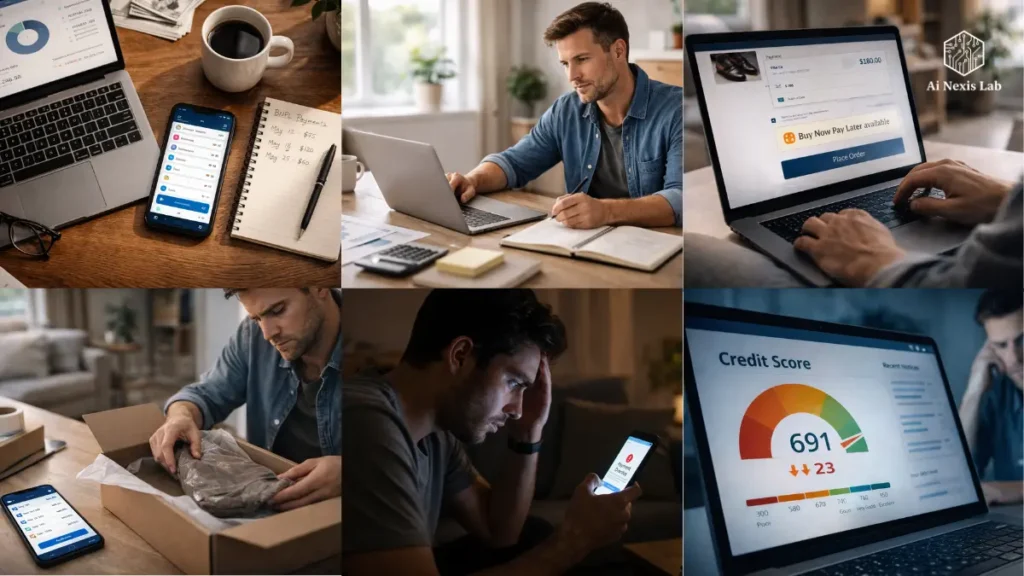
1. The Credit Score Trap
This is where people get blindsided.
- Pay-in-4 → Usually soft check (no impact)
- Monthly plans → Often hard inquiry + reporting
That means:
- Missed payments → Impact your credit
- New accounts → Lower average account age
- Balances → Impact debt ratio
And here’s the messy part:
Different BNPL companies report differently.
So:
- One lender sees everything
- Another sees nothing
This inconsistency can bother you when applying for:
- Mortgage
- Car loans
- Apartments
The “Debt Stacking” Problem
Because the apps don’t share data:
You can have:
- Klarna
- Afterpay
- Sezzle
- Affirm
All active at the same time – without any one system seeing the whole picture.
This is how people think they’re okay… until everything comes at once.
2. Psychology Is Not Neutral
This is the part that most people underestimate.
BNPL doesn’t just change payments.
It changes how your brain perceives value.
Instead of:
“This costs $200”
You think:
“This costs $50”
That’s not small change. That’s all.
Studies show:
- People spend 15-20% more on installment payments
Not because they are careless.
Because the system is designed that way.
The Brutal Reality
You are not “bad with money”.
You are reacting the way the product was designed to react.
3. Returns Become a Mess
Returning a BNPL purchase is not like returning a credit card purchase.
The flow looks like this:
- You return the item to the retailer
- The retailer sends the refund to the BNPL provider
- BNPL applies it to your balance
That delay can take 3-10 days.
Meanwhile:
- Your payment is still due
- Missed → Late Fee
Yes, even if you have already returned the item.
4. You’re Being Tracked More Than You Think
BNPL apps collect:
- Purchasing behavior
- Browsing patterns
- Spending time
- Response to promotions
These feeds:
- Targeted recommendations
- In-app shopping feeds
It’s not just a payment tool.
It’s a shopping ecosystem designed to keep you spending.
Who Does BNPL Really Work For
Let’s stop pretending it’s for everyone.
It works if:
- Your income is stable
- You have already planned your purchases
- You can afford the full price today
- You use one plan at a time
It Doesn’t Work If:
- Your income is inconsistent
- You make impulse purchases
- You deal with multiple payments
- You already have debt
There is no moral judgment. Just math.
BNPL Clarification System (Use This or Expect Problems)
These are not “tips”. These are filters.
1. Full-Price Audit
Before Confirmation:
Would I buy this at full price?
If the answer is not a clear yes – do not proceed.
2. One-Plan Rule
More than one active BNPL plan = you’re asking for trouble.
No exceptions.
3. 72-Hour Pause
Impulse buying happens quickly.
Regret takes longer.
Wait 72 hours. Then decide.
4. The Savings-First Test
If you don’t already have the money:
You’re not “splitting payments.”
You are borrowing to spend.
Big difference.
5. Credit Timeline Awareness
Planning:
- Mortgage
- Car Loan
- Apartment
Then BNPL = Out of Limit.
Regulation Is Increasing Rapidly (Slowly)
For years, BNPL lived in a grey zone.
That is changing.
In 2024, the CFPB began classifying BNPL lenders as credit card issuers.
That means:
- Dispute rights
- Refund obligations
- Clear disclosures
But implementation is still evolving.
Globally:
- UK → Stricter affordability checks
- EU → Stricter oversight
- Canada/Australia → Moving in the same direction
What Does This Mean For You
- More transparency (good)
- A few tougher approvals (also good)
- Lower “frictionless” costs (definitely good)
Why Younger Consumers Are Hit Hardest
Generation Z and Millennials:
- Distrust of credit cards
- Want control
- Prefer fixed payments
BNPL goes further and says:
“We are the safe option.”
And compared to revolving debt?
Sometimes, yes.
But here’s the problem:
It seems safer than it really is.
That gap is where mistakes happen.
Real Scenarios – No Theory
Scenario A: Smart Usage
- $600 Tool → Generates $2,400 in Revenue
- User Has Savings
- 0% Uses Plan
Result: Works Perfectly
Scenario B: Common Mistake
- Multiple Small Purchases
- Different Applications
- Overlapping Due Dates
Result: Cash Flow Shortage + Fees
Scenario C: Credit Surprise
- Applying for Mortgage
- Lender Looks at BNPL Accounts
- High Risk Profile
Result: Bad Loan Terms
Where BNPL Is Heading (2026 and Beyond)
Two Forces Shaping the Future:
1. Consolidation
- Fewer, Bigger Players
- More Polished Ecosystems
2. Regulation
- Standardized Ads
- Stronger Consumer Protection
Next Phase: Embedded Finance
BNPL will appear in:
- Retail applications
- Loyalty programs
- Even payroll systems
That’s where things get more complicated.
Because then:
You’re not choosing BNPL – it’s included in everything.
Frequently Asked Questions
Does BNPL hurt your credit score?
It depends on the provider and plan type. Basic pay-in-4 plans typically use soft credit checks and are not reported to credit bureaus, which means they usually don’t directly affect your score.
However, long-term financing options often involve and are reported as hard inquiries, which can temporarily lower your score and affect your credit profile over time.
The big issue is compatibility. Since different BNPL providers report differently, lenders may see an incomplete or confusing picture of your financial obligations.
That inconsistency can hurt you during major applications like a mortgage or auto loan. The safest assumption is that any BNPL usage may affect your credit in some way.
What happens if you miss a payment?
Missing a payment has immediate consequences. Most BNPL providers charge late fees, and repeated missed payments can add up quickly. In some cases, accounts are sent to collections, which can significantly hurt your credit score.
Additionally, the platform may freeze your ability to make future purchases until the balance is resolved. If the provider reports to the credit bureaus, missed payments will appear on your credit report and remain there for years. Even if the initial amount is small, the long-term impact can be disproportionately large.
Is BNPL better than a credit card?
It can be – but only under certain conditions. BNPL has fixed payments and often no interest for short-term plans, which makes it easier to manage compared to revolving credit card debt with compound interest.
However, both involve spending money you don’t currently have. The difference is psychological: BNPL seems lighter and less risky, which can lead to overspending. Credit cards are more transparent about having debt, while BNPL hides it as a convenience. Functionally, the required discipline is the same.
Which BNPL app is the most secure?
There is no universally “safe” option – only safe use. Apps like Afterpay and PayPal Pay Later are more customer-friendly due to limited fees and simple structure. However, security depends less on the app and more on how you use it.
Even the safest app becomes risky if you don’t read the terms, use multiple plans, or rely on BNPL for purchases you can’t fully afford. Real safety comes from limiting usage, understanding the terms, and controlling your spending.
Can you use multiple BNPL apps simultaneously?
Yes, and that’s the problem. Most apps don’t share data, so it’s easy to open multiple plans on different platforms without understanding your total liability.
This leads to “debt stacking,” where multiple small payments are aligned into a larger short-term burden. It may not seem dangerous at first, but it is one of the most common ways people lose control.
Limiting yourself to one active plan at a time is the simplest and most effective protection.
Final Verdict
BNPL Is a Tool – Not a Lifestyle
Let’s get it all straight:
- It’s not evil
- It’s not harmful
- It has benefits
Used properly:
→ It’s efficient
Used casually:
→ It builds pressure quietly
The Only Rule That Really Matters
Before you click:
“Would I still buy this at full price?”
If yes → go ahead
If hesitation → stop
That hesitation is your brain doing its thing.
Don’t override it.