$109 Billion Grudge Match: Why Musk vs OpenAI Trial Became a Battle of Silicon Valley Wills
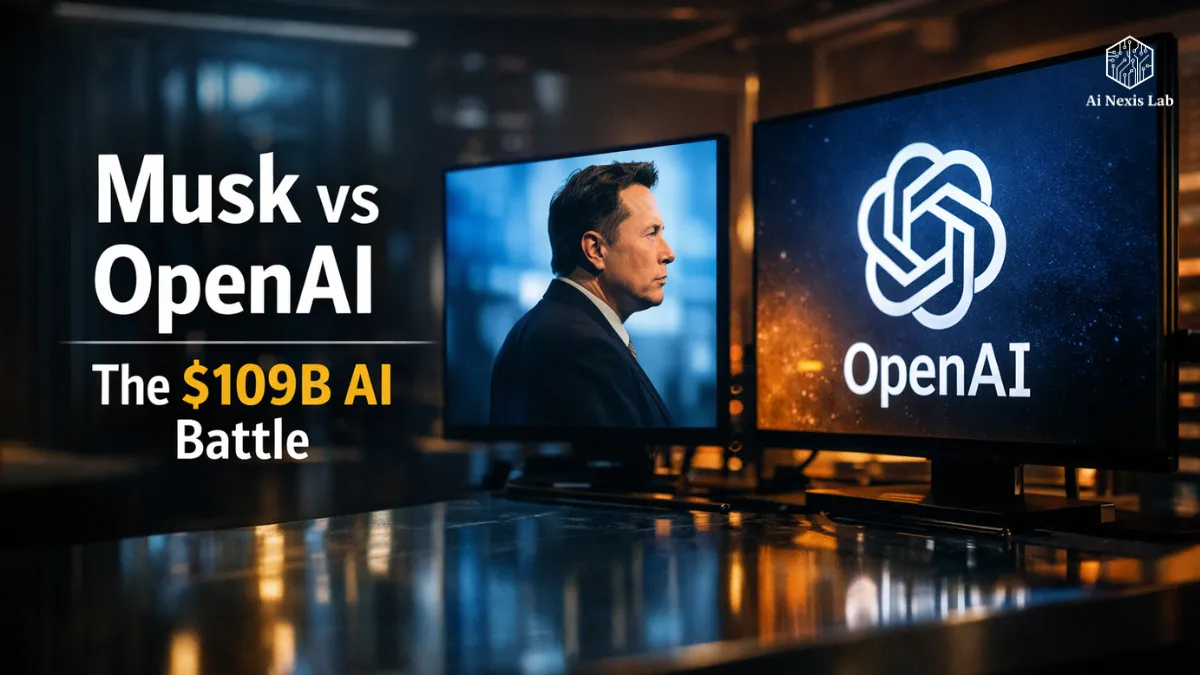
Musk vs OpenAI lawsuit explained: 8 explosive facts about the $109 billion AI war, nonprofit betrayal claims, Microsoft’s role, and what it means for the future of AI.
The atmosphere in the courtroom wasn’t just tense – it also felt expensive.
When the world’s richest man sued one of the most powerful artificial intelligence companies on the planet for $109 billion, the atmosphere stopped feeling like a regular legal process and started feeling like a high-stakes referendum on the future of technology itself.
This is where the ongoing legal battle between Elon Musk and OpenAI began in 2026.
What began nearly a decade ago as a joint mission to create safe artificial intelligence has evolved into something much dirtier: broken promises, corporate power, and a bitter dispute over ownership of humanity’s most transformative technology.
The recent courtroom twist – where a judge blocked efforts to introduce Musk’s reported ketamine use at trial – seems like a minor procedural detail. In fact, it signals something much bigger. The court is moving the case away from personality attacks and forcing both sides to confront the real issue:
Was OpenAI’s transition from nonprofit idealism to multibillion-dollar AI powerhouse a betrayal of its founding promises?
To understand why this fight is important – and why it could reshape the entire AI industry – you have to go back to the beginning.
Table of Contents
1. The Origins of a $109 Billion Friction
In 2015, OpenAI was born out of a very specific fear.
The founders believed that artificial intelligence was advancing rapidly and that a small group of corporations could control technology powerful enough to reshape culture.
Early figures involved include Sam Altman, Elon Musk, and many well-known researchers. His vision for Silicon Valley was radical: create an AI research lab, structured as a nonprofit organization, committed to developing artificial general intelligence for the benefit of humanity.
The idea was simple but ambitious.
Instead of competing for profit, OpenAI will operate like a scientific organization, openly publishing research and sharing successes with the world.
Musk’s Role in the Early Days
Musk didn’t just give his name to the project. He is also said to have committed millions of dollars to help launch the organization.
Their motivation was not subtle. Musk has warned about the dangers of artificial intelligence for years. In interviews and public statements, he has repeatedly compared uncontrolled AI development to “summoning a demon.”
Supporting OpenAI helped them shape the field.
The mission seemed noble:
- Develop safe AI
- Avoid corporate monopolies
- Share discoveries with the world
At the time, it seemed contrary to the traditional tech startup playbook.
Inflection point
But the AI landscape changed dramatically.
Training large AI models suddenly required enormous computing power and billions of dollars in infrastructure.
That financial reality brought about a turning point within OpenAI.
In 2019, the organization introduced a controversial structure: a “limited profit” subsidiary designed to attract investors while keeping the nonprofit parent in control.
Shortly after, Microsoft stepped in with major funding commitments that ultimately resulted in a multi-billion dollar partnership.
That’s where Musk claims the story changed.
According to their lawsuit, this change effectively transformed OpenAI from a nonprofit research lab into a commercial AI powerhouse serving corporate interests.
And that change is where the $109 billion claim begins.
2. The Ketamine Defense: Why the Judge Shut It Down
One of the most dramatic moments in this case had nothing to do with artificial intelligence.
Instead, it revolved around Musk’s personal life.
Lawyers representing OpenAI attempted to dismiss allegations about Musk’s ketamine use, arguing that it could affect the credibility of his testimony about early conversations about OpenAI’s founding mission.
The strategy was straightforward.
If Musk’s memory of events can be shown to be unreliable or impaired, it could undermine his claim that OpenAI has violated certain promises.
Why Did The Court Reject It?
The judge closed the argument.
The ruling declared the investigation into Musk’s personal habits irrelevant to the legal issues at hand.
That decision was more important than it might seem.
By blocking the line of questioning, the court effectively signaled that the trial should focus on documents, contracts, and corporate actions – not character attacks.
For Musk’s legal team, it was an important victory.
That means the debate will return to the main question:
Did OpenAI misrepresent its intentions when accepting Musk’s funding and public support?
Big Legal Strategy
OpenAI’s effort was not unusual. In high-stakes litigation, lawyers often try to undermine a key witness by questioning their credibility.
But courts typically draw a line when personal information is not directly relevant to the dispute.
And in this case, the judge made it clear that Silicon Valley gossip will not determine the outcome of a $109 billion lawsuit.

3. The “Non-Profit” Trap: A Warning to Founders
This lawsuit highlights a broader issue that goes far beyond OpenAI.
It highlights the legal and ethical complications that arise when mission-driven organizations collide with venture capital economics.
Original Structure
OpenAI initially operated as a 501(c)(3) non-profit, a structure that included:
- Significant tax benefits
- Public-benefit obligations
- Restrictions on profit distribution
That model works well for universities, charities, and research institutions.
But it’s not designed for companies that need billions of dollars in computing infrastructure.
Capped-Profit Model
To solve that problem, OpenAI created its unusual hybrid structure.
A non-profit parent oversees a for-profit subsidiary that can raise money from investors – but only up to a limited return.
In theory, that arrangement allows OpenAI to attract funding while preserving its mission.
In practice, critics argue that it creates a confusing governance structure with unclear incentives.
Lessons For Founders
Regardless of the outcome of the trial, there is a clear solution for startup founders.
If your company is built around a mission or public promise, those commitments need to be accurately documented.
Silicon Valley culture often runs on informal agreements, shared visions, and handshake deals.
But when billions of dollars come into the picture, handshakes rarely escape legal scrutiny.
4. Microsoft’s Shadow Over the Courtroom
Although the lawsuit focuses on OpenAI, Microsoft’s influence looms over the entire case.
Microsoft has invested billions in OpenAI and integrated its technology into the following products:
- Azure cloud services
- Enterprise software tools
- Consumer AI applications
By 2026, the partnership has become one of the most influential alliances in the technology industry.
Musk’s Argument
Musk’s legal claim suggests that OpenAI has effectively become a strategic extension of Microsoft’s cloud business.
From their perspective, this contradicts the original mission of preventing AI dominance by a handful of corporations.
Instead of distributing AI power broadly, he argues, partnerships concentrate influence in the hands of a single tech giant.
OpenAI’s Counterpoint
OpenAI’s lawyers frame the situation differently.
Their argument is clear:
Developing sophisticated AI requires enormous computational resources.
Without a partner capable of providing global cloud infrastructure, OpenAI would not have been able to build systems like ChatGPT or large-scale language models.
In other words, the Microsoft partnership wasn’t a betrayal – it was a practical necessity.
5.“Public Benefit” vs. “Fiduciary Duty”
At the heart of this case is a philosophical conflict.
This is the difference between public mission and corporate responsibility.
Musk’s Position
Musk argues that OpenAI gained credibility – and financial support – by presenting itself as a nonprofit organization dedicated to the benefit of humanity.
According to the lawsuit, the move to a profit-driven partnership violated that promise.
According to Musk, the organization basically built trust under one narrative and then shifted to another.
OpenAI’s Defense
OpenAI’s legal team emphasizes fiduciary duty.
Once investors entered the picture, the company had responsibilities not only to the mission but also to stakeholders.
His view is that AI requires massive investment to scale responsibly, and that investment demands a viable business structure.
From their perspective, the technology itself – tools used by millions of people – represents a real public benefit.
6. Behind The Scenes: Lawyers Face-Off
The courtroom talks between the two sides are said to have been intense.
Each legal team is relying on a different interpretation of Silicon Valley culture.
OpenAI’s Approach
OpenAI’s lawyers are focusing on a simple question:
Where is the agreement?
If Musk cannot clearly present a written agreement preventing OpenAI from becoming profitable, they argue, the case collapses.
Musk’s Legal Strategy
Musk’s lawyers rely on a concept called promissory estoppel.
This legal principle allows a promise to be enforced even without a formal contract if:
- A clear promise was made
- Someone relied on that promise
- The reliance caused harm
Musk claims that he funded OpenAI and publicly promoted it because he believed the organization would be committed to its nonprofit mission.
If the court accepts that argument, OpenAI could face significant consequences.
7. Calculating $109 Billion: How Do We Value “Lies”?
The number attached to Musk’s lawsuit – $109 billion – seems almost absurd.
But large civil cases often involve multiple methods for calculating damages.
Replacement Cost
One approach considers how much it would cost to rebuild OpenAI’s technology ecosystem from scratch.
These include:
- Data centers
- AI training infrastructure
- Research talent
- Ownership models
Given the scale of modern AI systems, that figure can easily reach billions of dollars.
Compensation
Another possibility involves returning profits made through the alleged misrepresentation.
If OpenAI’s commercial success depends in part on its nonprofit reputation, Musk’s lawyers could argue that those benefits should be redistributed.
Punitive Damages
In extreme cases, courts impose penalties designed to deter similar behavior.
While $109 billion is unlikely as a direct payment, the lawsuit could lead to structural changes or billions in financial settlements.
8. What This Means For The AI Industry
Regardless of who wins, the case could reshape the rules governing AI development.
Scenario 1: Musk Wins
A victory for Musk could force OpenAI to:
- Increase transparency
- Share more technology openly
- Rethink its corporate structure
That outcome could ripple across the industry.
Other AI labs may face pressure to align their public messaging with legally binding commitments.
Scenario 2: OpenAI Wins
If the court sides with OpenAI, it will reinforce a different message.
Mission statements, public promises, and marketing language may have limited legal weight compared to formal contracts.
For Silicon Valley startups, it will confirm a long-standing reality: real power lies in legal agreements and capital structures, not in vision statements.
Strategic Navigation Framework
1. Integrity Audit (“Glass House” Protocol)
Before presenting your company as ethically managed, test the sustainability of that claim.
Ask what happens when serious money enters the picture.
Will your mission survive billions of dollars of investment?
If the answer is unclear, your communication probably needs to be modified.
2. Vision-Contract Alignment (“Ironclad” Method)
Public statements should be consistent with legal documents.
If your CEO promises transparency, your operating agreement should define what transparency actually means.
Otherwise, those promises become potential legal liabilities.
3. Pivot-Proofing Logic (“North Star” Filter)
Every company eventually faces opportunities that challenge its mission.
The real test is not whether you pivot – it is whether the pivot strengthens the mission or changes it.
Organizations that fail this test often face the same kind of backlash as those faced in the Musk vs. OpenAI case.
Common Pitfalls In High-Stakes Tech Litigation
The paper Trail Problem
Many founders believe that invisible messages or encrypted chats eliminate the risk.
In reality, missing records often create suspicion rather than protection.
Courts often interpret gaps in documentation as evidence of intentional concealment.
Character vs. Content
Attacking the founder’s personal habits may generate headlines, but courts generally prioritize evidence of the contract.
If the dispute is centered on agreements and governance, character arguments rarely carry decisive weight.
Public Opinion vs. Legal Reality
Online polls and social media discussions can influence perceptions.
But in the courtroom, the governing rules are corporate law statutes and documented commitments – not public sentiment.
Frequently Asked Questions
Is Elon Musk really going to get $109 billion?
Very unlikely.
Large lawsuits often involve headline-grabbing figures that represent maximum potential damages rather than actual outcomes.
Even if Musk wins significant portions of the case, the outcome is more likely to involve structural reforms, settlements, or funding commitments rather than individual payments of that size.
The real stakes revolve around control, transparency, and corporate governance, not around a single financial transaction.
Why did OpenAI want to raise the issue of Musk’s ketamine use?
The goal was to question credibility.
If lawyers can suggest that Musk’s memory of early conversations was unreliable due to impairment, it could undermine the foundation of his claims about the promises made during the creation of OpenAI.
However, courts generally demand a clear relevance between personal conduct and the legal dispute. In this case, the judge concluded that the argument was speculative and unrelated to the contractual issues being examined.
Could this trial change the way AI technology is shared?
Potentially.
If the court determines that OpenAI has violated its openness commitments, it can impose remedies that affect the company’s research or distribution of technology.
That doesn’t mean every AI model becomes completely open-source overnight, but it could push for greater transparency or broader access.
Such paradigms will impact how future AI organizations structure their governance and partnerships.
Does this lawsuit affect everyday users of ChatGPT?
Not immediately.
Customers using AI tools may not see sudden disruptions as the case progresses.
However, the long-term implications could affect everything from pricing models to the availability of open-source AI systems.
If the court forces OpenAI toward greater openness or restructuring, developers and businesses that rely on AI tools could ultimately experience changes in access or licensing.
Could this case lead to a leadership change at OpenAI?
It is possible but far from guaranteed.
A change in leadership typically occurs when clear evidence of misconduct emerges in litigation or when board members decide that a change is necessary to stabilize the company.
Until the trial reveals concrete evidence that officials knowingly misled donors or partners, dramatic leadership changes in the short term remain unlikely.
Nevertheless, the outcome could influence board governance, oversight structures, and future strategic decisions.
Final Verdict
This legal battle is not just about a dispute between two powerful individuals.
It’s about the rules governing one of the most consequential technologies ever created.
On the one hand, Elon Musk is arguing that OpenAI’s founding mission had real responsibilities – moral commitments that shouldn’t disappear when billions of dollars appear.
On the other hand, OpenAI maintains that building advanced AI requires enormous capital, and it was necessary to adapt its infrastructure to effectively advance its mission.
The court’s decision to exclude personal attacks suggests something important.
The trial will not be based on personalities, rumors, or Silicon Valley drama.
It will depend on the law, documentation, and corporate structure.
And for a company built on a hybrid model that blends profitable ideals with profitable investments, that scrutiny could prove far more consequential than any headline about a $109 billion lawsuit.