$10,000 Panic Attack: Why Your Choice Between a Personal Loan and a Credit Card Changes Everything
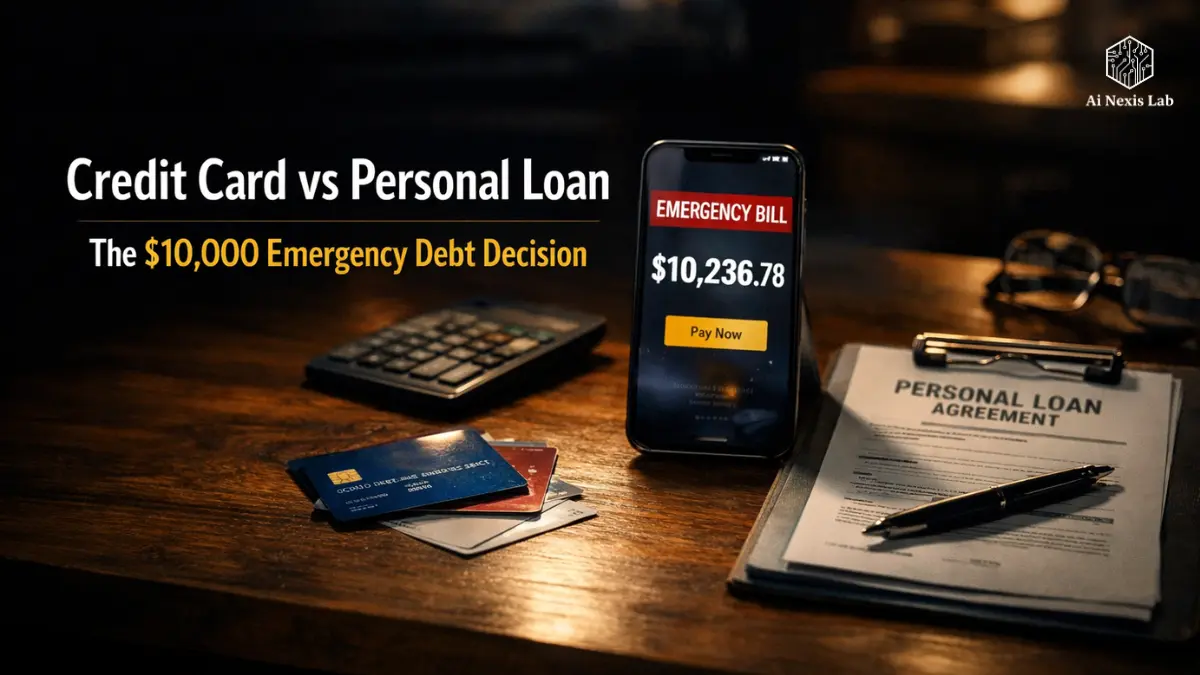
Credit Card vs Personal Loan: Discover 7 powerful truths that could save you thousands. Learn which option wins during emergencies and how to avoid costly debt traps.
Your house is quiet, except for the soft hum of the refrigerator and the dim light of your phone illuminating the room. There’s a number on the screen that you didn’t expect to see today: $8,462.
This is the estimate from the contractor who just looked at your flooded basement.
Maybe it’s a car engine.
Maybe it’ll be a medical bill.
Maybe it was a leak from the roof that suddenly became a complete replacement.
Whatever it is, it’s so expensive that your checking account can’t absorb the hit.
Your mind starts racing.
You know you have options.
You have a credit card in your wallet.
You can also apply for a personal loan online.
One of them is a quick and easy option.
The second option requires filling out a form and waiting for approval.
Most people choose the easy option.
And that decision – made late at night, when your brain is tired, stressed – could quietly cost you thousands or even hundreds of thousands of dollars over the next decade.
This is not just about interest rates.
It’s about how debt behaves over time.
Because the truth is simple and brutal:
Credit card debt is designed to keep you alive.
Personal loans are designed to kill it.
Understanding that difference can completely change how you get out of a financial crisis.
In this in-depth study, we’ll discuss:
- The psychology behind emergency spending
- Why minimum payments trap millions of Americans
- How personal loans create a structured escape plan
- The real numbers behind the $5,000–$10,000 emergency
- And how modern financial modeling tools – like those used – can predict the long-term impact of your choices.
This is not about surviving this week.
It’s about making sure one bad day doesn’t turn into ten years of financial losses.
Table of Contents
1. Crisis Structure: What Are We Really Solving?
Before choosing a financial instrument, you need to understand what kind of problem you are facing.
Most people treat every unexpected bill the same way.
That is a mistake.
Not all financial crises are created equal.
Hard Crisis
A hard crisis is a sudden, unavoidable expense that has a clear cost.
Examples include:
- Car transmission failure
- Flooded basement
- Emergency dental surgery
- Broken furnace in winter
- Necessary home repairs
These costs typically range between $3,000 and $12,000.
They are painful but limited. Once paid, the crisis is over.
Structural Crisis
A structural crisis is something completely different.
When your income and expenses no longer match.
Examples include:
- Rent increases
- Grocery prices caused by inflation
- Job instability
- Gap in health insurance
- Chronic low income
Instead of a single bill, you get less each month.
And here’s the dangerous part:
Using debt to solve a structural problem doesn’t solve the problem.
It just delays the explosion.
Why the Type of Emergency Matters
Financial instruments behave differently depending on the situation.
A credit card is a revolving instrument.
This means that the balance can continuously increase and decrease.
A personal loan is an installment instrument.
It has:
- A fixed amount
- A fixed payment
- A fixed expiration date
If you use a revolving credit facility for a one-time emergency, the debt often lasts much longer than the original problem.
People regularly pay for car repairs for years after the car is gone.
The issue is not one of irresponsibility.
The issue is how the system is designed.
2. Credit Cards: The Siren Song of Instant Liquidity
Credit cards are the most accessible form of borrowing in America.
According to Federal Reserve estimates, by 2026, Americans will carry more than $1.25 trillion in credit card debt.
Why?
Because credit cards solve one immediate problem very well:
Speed.
You are not applying.
You are not waiting.
You swipe, tap, or click.
And the problem disappears – at least temporarily.
But convenience comes at a price.
The Illusion of “Magic Money”
Psychologically, credit cards seem less painful than other forms of borrowing.
Research by behavioral economists shows that people spend 10-20% more when paying with credit compared to cash.
Why?
Because the brain does not register damage immediately.
Instead of money being taken out of your bank account, the charge becomes a future problem.
That mental isolation makes credit cards incredibly easy to use – and incredibly easy to abuse.
The Minimum Payment Trap
The real threat is not the interest rate.
It is a minimum payment system.
Let’s go through the math.
Let’s say you charge $10,000 on a credit card with a 24% APR, which is common in 2026.
Your minimum payment might be about 2.5% of the balance.
That’s approximately:
$250 per month.
Sounds manageable.
But look closer.
During the first year:
- About $200 goes to interest
- Only $50 reduces the actual balance
At that rate, the debt barely moves forward.
If you only make the minimum payment, it could take 30 years or more to eliminate a $10,000 balance.
Total payment:
About $30,000.
For a $10,000 emergency.
Credit Utilization: The Hidden Credit Score Killer
Another rarely discussed topic is credit utilization.
This measures how much of your available credit you are using.
Example:
If your card limit is $12,000 and you charge $10,000, your utilization is 83%.
That’s extremely high.
Credit scoring models prefer to use below 30%.
Above that threshold, your score can drop 40-80 points overnight.
This is important because it can prevent you from:
- Qualifying for a cheaper loan
- Refinancing debt
- Getting approved for a mortgage
- Using better financial products
So the crisis doesn’t just cost interest.
It can temporarily shut you out of financial opportunities.
When a Credit Card Really Makes Sense
Despite the risks, there are scenarios where a credit card is the best tool available.
0% APR Introductory Offers
Some cards offer 0% interest for 12 to 21 months.
If you can:
- Eligible for the card
- Pay off the balance within the promotional period
Then you’ve effectively borrowed free money.
The discipline required here, however, is real.
After the promotional period ends, the rate often increases to 25-30% APR.
Some cards also charge prepayment interest if the balance is not paid.
So this strategy only works if you treat the deadline like a strict financial contract.

3. Personal Loans: Structured Exit Strategy
Personal loans work very differently from credit cards.
Instead of revolving debt, you get:
- A lump sum
- A fixed interest rate
- A predictable payment
- A clear payment date
In 2026, the average personal loan APR in the U.S. is approximately:
9% to 15% for borrowers with decent credit.
That’s dramatically lower than typical credit card rates.
The Psychological Advantage of Fixed Debt
There is also a psychological component that many people underestimate.
Credit card balances seem permanent.
Because there is no clear end date.
You can always make the minimum payment.
Personal loans are different.
Each payment takes you closer to zero.
It is more important than you think.
Financial stress often comes from uncertainty.
Knowing exactly when the debt will disappear provides mental peace and better planning ability.
Interest Rate Differential
Let’s compare two realistic scenarios.
Credit Card
$10,000 Balance
24% APR
$300 Monthly Payment
Result:
- Payment Period: About 48 Months
- Interest Paid: About $4,400
Personal Loan
$10,000 Loan
12% APR
$333 Monthly Payment
Result:
- Payment Period: 36 Months
- Interest Paid: About $1,980
That’s a difference of over $2,400.
And the debt disappears a year earlier.
4. Comparing the Two: A Side-by-Side Reality Check
| Feature | Credit Card | Personal Loan |
|---|---|---|
| Speed | Instant if card exists | 24–72 hours |
| Interest Rate | High (20–30%) | Moderate (8–18%) |
| Repayment | Flexible but slow | Fixed schedule |
| Credit Impact | High utilization risk | Improves credit mix |
| Best Use | Small short-term expenses | Large one-time emergencies |
Key takeaway:
Credit cards prioritize convenience.
Loan resolution prioritizes.
5. Perspective: Using Data to Predict Your Recovery
One of the biggest changes in the personal finance space in the last few years has been the rise of AI-powered financial modeling.
Traditional budgeting tools show you what has already happened.
Newer systems try to predict what will happen next.
In research labs, financial models simulate how future debt choices affect months or years of your life.
For example:
AI models can analyze:
- Income volatility
- Spending behavior
- Seasonal bills
- Debt obligations
- Inflation trends
Then estimate your time to financial recovery.
Why Is Credit Card Modeling Difficult?
Credit cards create unpredictable payment patterns.
Because:
- Balances change
- Minimum payments fluctuate
- Spending behavior changes
This makes long-term projections messy.
However, personal loans are predictable.
It allows financial algorithms to simulate scenarios such as:
- Payment acceleration strategies
- Refinancing opportunities
- Debt snowball modeling
The result is a clear financial roadmap.
6. Real-World Scenario: Basement Flooding
Let’s walk through a real-world emergency.
Your basement floods after a heavy storm.
Cleaning and repair costs:
$8,500
You have two options.
Option A: Credit Card
APR: 22%
Monthly Payment: $300
Result:
Repayment Period: 48 Months
Interest Paid: $4,400
Option B: Personal Loan
Loan Amount: $8,500
APR: 12%
Monthly Payment: $280
Result:
Repayment Period: 36 Months
Interest Paid: $1,600
Difference
Choosing a loan saves approximately:
$2,800
And eliminates debt one year earlier.
Only that difference can kickstart an emergency fund.
This is exactly how financial stability begins.
7. Common Pitfalls: Where People Get Burned
Even when choosing the right tool, mistakes happen.
Here are three pitfalls to watch out for.
Prepayment Penalty
Some lenders charge a fee if you pay off your loan early.
This is rare with reputable lenders but still appears in some subprime loans.
Always check if your loan allows early repayment without any penalty.
That flexibility allows you to quickly eliminate debt when extra money comes in.
Variable Interest Rates
Some financial products use variable rates.
This means that payments may increase if interest rates rise.
For emergency borrowing, fixed rates are usually safer.
Forecasting is important when you are already under financial pressure.
Origination Fees
Many personal loans include an origination fee of between 1% and 5%.
This fee is deducted before the funds are deposited.
Example:
Borrow $5,000 with a 4% fee → you will receive $4,800.
That means you may need to borrow a little more than the repair costs.
8. Strategic Crisis Solutions: Tactical Framework
When a financial crisis occurs, decisions are often made in a hurry.
Instead of reacting emotionally, it helps to follow a simple framework.
1. Repeated Audit
Before borrowing anything, examine your recent spending.
Look at the last three months of transactions.
Ask a brutal question:
Was this really a random crisis?
Or is your lifestyle slowly draining your money?
If it’s a systemic problem – high rents, excessive spending, or declining income – borrowing only delays the problem.
Loans work best for isolated events, not for ongoing deficits.
2. Rate Arbitrage Pivot
Even if the debt is already on a credit card, it may still be possible to fix the situation.
Debt consolidation loans allow you to replace high-interest credit card debt with low-interest installment loans.
This strategy often:
- Reduces interest
- Reduces monthly payments
- Speeds up the repayment timeline
It is basically refinancing consumer debt.
3. Liquidity Buffer Method
Here’s a trick that many financial advisors recommend.
Never borrow the exact amount of the repair.
If the emergency costs $4,500, borrow $5,000.
The extra $500 becomes a small emergency buffer.
Without that cushion, the next unexpected expense often comes back to the credit card.
And the cycle begins again.
Frequently Asked Questions
Will applying for a personal loan hurt my credit score?
Yes – but usually only a few and temporarily.
When you apply for a loan, lenders conduct a hard credit inquiry, which can lower your score by about 5 to 10 points.
However, if you use that loan to pay off high credit card balances, your credit utilization drops, which can actually boost your score in a few weeks.
In many cases, borrowers see an increase in their credit scores after consolidation, especially if they maintain on-time payments.
Can you get a personal loan with a 600 credit score?
Yes, but the interest rate will probably be higher.
Borrowers in the 580-640 credit range may see APRs closer to 18%-30%, depending on the lender.
However, structured loans can still be beneficial because they create a fixed repayment timeline.
Some lenders also offer rate reductions after making on-time payments for several months, which can gradually reduce the cost of borrowing.
Is it better to take money out of a 401(k) during a crisis?
Usually not.
Withdrawing money from a retirement account often results in:
1) Income taxes
2) Early withdrawal penalties
3) Lost compounding growth
For example, withdrawing $10,000 today can result in a loss of $30,000–$40,000 in retirement value over decades.
Unless the crisis is truly catastrophic, consumer loans generally cause less long-term damage than raiding retirement savings.
What happens if you can’t repay a personal loan?
Missing a loan payment can damage your credit and possibly lead to foreclosure.
However, many lenders offer hardship programs.
This may include:
1) Temporary payment reductions
2) Forbearance periods
3) Loan modifications
The key is communication. If financial difficulty appears, contacting a lender early dramatically improves your chances of finding a solution.
Ignoring the problem usually makes the situation worse.
How fast can personal loan funds arrive?
The speed of funding has improved dramatically in recent years.
Many online lenders now approve and deposit funds within 24 to 48 hours.
Some fintech lenders even offer same-day funding.
While a credit card remains the fastest option if you already have one, personal loans are no longer the slow bureaucratic process they once were.
Final Verdict
If your emergency expenses are less than $2,000 and you can realistically pay off the balance within three months, a credit card may be perfectly fine.
Convenience is better than short-term interest.
But if the emergency goes above $3,000 – and especially if repayment takes more than six months – a personal loan usually becomes a smarter choice.
It provides:
- Low interest
- Predicted payments
- Guaranteed maturity date
And perhaps most importantly, it gives you a clear path back to financial stability.
Because financial emergencies happen to everyone.
The goal is not to avoid them forever.
The goal is to make sure that one bad week doesn’t quietly turn into a bad decade.