
The $250 Billion Bet: Why AT&T is Rebuilding the American Backbone
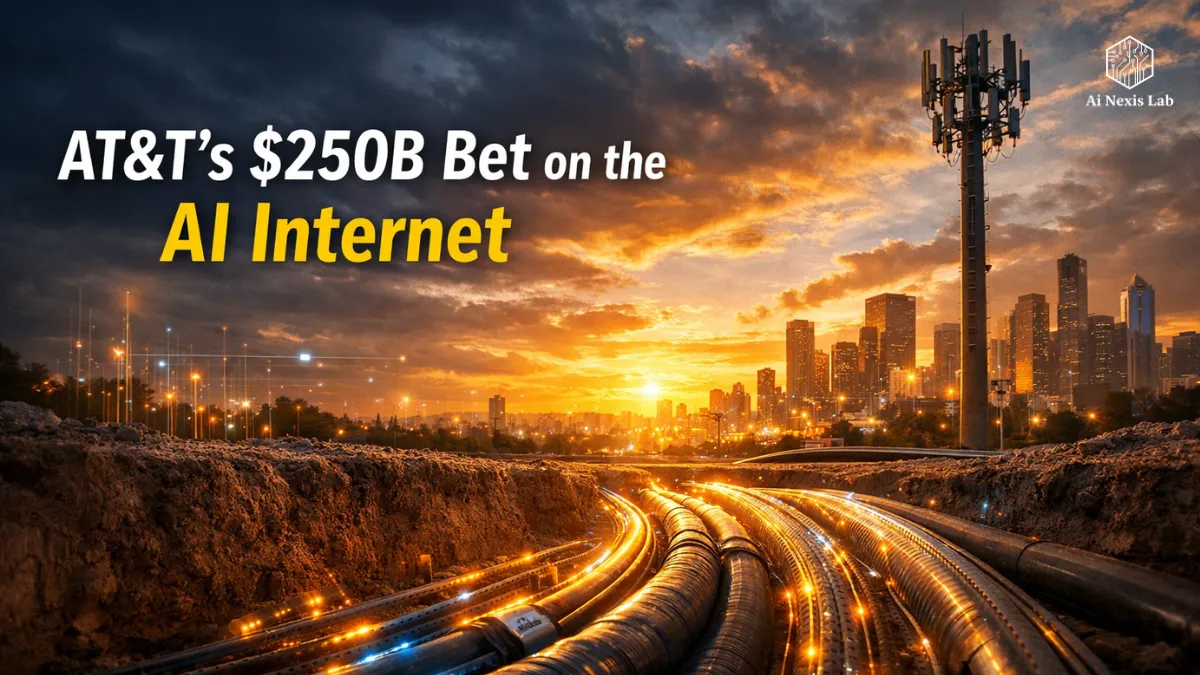
Most people look at their phone bill and think about monthly charges, data limits, or perhaps forgotten roaming fees. But those three blue letters – AT&T – represent something much bigger than a telecom bill. Currently, the company is in the midst of one of the largest infrastructure builds in modern American history.
On March 10, 2026, AT&T took a step that made most headlines look like another corporate press release. In fact, it was a signal for the entire tech and financial ecosystem. The company pledged approximately $250 billion to reorganize connectivity infrastructure in the United States over the next five years.
That number isn’t just big – it’s staggering. $250 billion is larger than the annual economic output of many developed countries. It is one of the most aggressive telecom investment cycles the U.S. has ever seen.
But here’s the part that most coverage misses: This isn’t really about fast phone service.
This is about creating a physical backbone for the artificial intelligence economy.
Every AI query, cloud workload, video stream, financial transaction, and autonomous system relies on a network of fiber cables, cell towers, and data routing systems. The United States may be ahead in the AI software race, but the infrastructure supporting that software is still being upgraded.
AT&T’s stake is simple but huge:
If AI becomes the dominant technology of the next decade, the companies that control the data highway will control the flow of value.
In other words, while tech companies build the engines, AT&T is laying the interstate highways on which those engines will run.
In the next few sections, we’ll break down exactly where that $250 billion is going, why Wall Street is paying attention, how fiber and 5G are converging into a single system, and what it means for investors, businesses, and everyday consumers.
This is not just a telecom story.
It is an infrastructure story.
Table of Contents
Convergence Strategy: Why “Wireless vs. Wired” Is a Dead Debate
For years, the telecom industry treated wireless networks and wired networks as separate products.
You had home internet – usually fiber or cable – and you had mobile internet powered by a 4G or 5G tower.
That distinction is disappearing.
AT&T’s entire $250 billion investment revolves around something industry insiders call network convergence.
Simplified Version
Every wireless tower still relies on physical fiber cables buried underground.
Your phone may connect wirelessly to a nearby tower, but that tower connects to the internet backbone via fiber.
So if the fiber network is slow or old, the wireless network gets blocked.
Why This Matters
5G networks are incredibly fast, but they require a large amount of bandwidth to function properly.
Without a dense fiber infrastructure beneath them, they simply cannot deliver their promised performance.
AT&T’s strategy is to control both layers:
- Fiber infrastructure in the ground
- 5G wireless infrastructure above ground
That combination creates a unified network where devices move seamlessly between fiber and wireless connections without significant performance changes.
The “Connectivity Blanket” Idea
Instead of selling separate services – home internet, mobile data, enterprise connectivity – AT&T wants to offer a single integrated ecosystem.
Imagine your device transitioning from fiber Wi-Fi to ultra-fast 5G without any slowdowns after leaving your home.
To the user, the connection seems continuous.
For AT&T, that means they control the entire data pipeline.
Fiber Expansion Target
By 2030, AT&T aims to reach more than 30 million locations with fiber.
These include:
- Homes
- Small businesses
- Government offices
- Industrial facilities
- Data centers
- AI infrastructure hubs
And that last category is where things get interesting.
AI Latency War: Why Microseconds Are Worth Billions of Dollars
When most people evaluate internet speed, they think about download speed.
But the real battle currently raging in telecom is not just about megabits per second.
It’s about latency.
Latency is the delay between sending data and receiving a response.
For Netflix streaming, latency is rarely important.
For AI workloads, robotics, or autonomous systems, it is very important.

Real-World Example
Imagine a self-driving car approaching an intersection.
Vehicle sensors capture data about:
- Traffic lights
- Pedestrians
- Nearby vehicles
That information is processed by AI systems.
If it takes even half a second for a round trip, the car could make the wrong decision.
That’s why companies in the tech industry are investing in edge computing.
Instead of sending data thousands of miles to central servers, the process happens closer to the user.
AT&T’s network expansion is designed to support this architecture.
Building the Edge Layer
The company is using:
- Edge Data Centers
- Dense Fiber Nodes
- Small-Cell 5G Networks
These systems dramatically reduce the distance data travels.
Shorter distances mean lower latency.
Low latency means faster AI response times.
And fast response times unlock entirely new industries.
Industries That Rely on Ultra-Low Latency
Some examples include:
- Autonomous vehicles
- Remote surgery systems
- Industrial robotics
- AR/VR collaboration
- Real-time financial trading
All of these rely on networks that respond in milliseconds or microseconds.
AT&T’s infrastructure push is basically a race to reduce that latency.
Insider Tip: The “Dark Fiber” Advantage
One of the most overlooked assets that telecom companies have is called dark fiber.
Dark fiber refers to fiber-optic cables that are already installed but are not currently transmitting data.
Think of it as an unused lane on the highway.
When demand increases, AT&T can activate those cables almost immediately without digging new trenches.
This becomes incredibly valuable for companies that need a dedicated high-capacity connection.
Major AI developers – including companies like OpenAI, Google, and Meta Platforms – move massive datasets between data centers.
Dedicated fiber lines offer:
- Security
- Predictable performance
- Large bandwidth
Because dark fiber already exists, it requires minimal additional construction costs to get it up and running.
That’s a big margin advantage.
Financial Mechanics: How Do You Spend $50 Billion a Year?
A common misconception is that this $250 billion is a single cash flow.
It’s not.
This is a multi-year capital investment cycle.
Most of the spending comes through CapEx (capital expenditure), which telecom companies use to build revenue-generating infrastructure that will last for decades.
Annual Investment Breakdown
AT&T is expected to spend approximately:
$22–$24 billion in annual direct CapEx
The remainder includes:
- Operational expansion
- Spectrum acquisition
- Network maintenance
- Scaling of enterprise services
The infrastructure itself will remain productive for 30 years or more.
Major Spending Categories
1. Spectrum Acquisition
Wireless networks operate on specific frequencies called spectrum bands.
These airwaves are licensed through government auctions.
Owning spectrum is the right to transmit data over the air.
The more spectrum a telecom company controls, the more data it can move.
2. Solving the “last mile” Problem
The final connection between the network and the user’s home or business is called the last mile.
This is also the most expensive part of fiber deployment.
This includes:
- Digging trenches
- Installing conduits
- Running cables into buildings
Those construction costs are one reason why fiber rollouts have been historically slow.
But once installed, the infrastructure can function for decades.
3. Core Network Upgrade
At the heart of the Internet is a large routing hub.
These systems direct national and global traffic between networks.
AT&T is upgrading these key systems to handle:
- AI workloads
- Large amounts of cloud traffic
- Cybersecurity threats
- Disaster resilience
Building AI Infrastructure
Ironically, artificial intelligence is helping to design the networks that will support future AI systems.
AT&T uses machine learning models to predict:
- Where data demand will increase
- Which neighborhoods need upgrades
- How to optimize construction timelines
This reduces waste and allows engineers to dig once and build right the first time.
Bridging the Rural Divide: The “BEAD” Factor
Infrastructure expansion in the United States is not happening in isolation.
Government programs are playing a major role.
The largest is the Broadband Equity, Access, and Deployment program, often called BEAD.
The program was created under the Infrastructure Investment and Jobs Act and allocates $42.5 billion to expand broadband access in rural America.
Its goal is simple:
Bring high-speed internet to areas that private companies have historically ignored.
Rural Connectivity Gap
Millions of Americans still live in areas with limited internet access.
It includes the following parts:
- Nebraska
- Montana
- Wyoming
- Rural Texas
- Appalachian communities
Without reliable connectivity, residents struggle to access:
- Remote work opportunities
- Telemedicine services
- Online education
- Digital commerce
AT&T’s Position
AT&T is competing aggressively for BEAD funding.
The company already has extensive fiber infrastructure in many regions, making it easy to expand the network to underserved areas.
But this is not just about public service.
It is also a customer acquisition strategy.
Rural “lock-in” Effect
When a telecom provider installs fiber in a previously underserved region, something predictable happens.
Residents often move multiple services to the same provider.
A household that adopts AT&T Fiber can also switch to:
- Mobile phone plans
- Home security systems
- Streaming bundles
The result is a long-term customer relationship that can last for decades.
In telecom economics, that’s extremely valuable.
Competitive Landscape: AT&T vs. Verizon vs. T-Mobile
The American telecom market is dominated by three major carriers.
- AT&T
- Verizon
- T-Mobile
Each company has adopted different strategies in the race to build next-generation networks.
T-Mobile’s Spectrum Advantage
T-Mobile got a big boost after acquiring Sprint in 2020.
That merger gave the company a large amount of mid-band spectrum, helping it roll out 5G faster than competitors.
The company built its brand around the idea of being an “un-carrier” – a customer-friendly alternative with aggressive pricing.
Verizon’s Content Mistake
Verizon has previously tried to move beyond telecom infrastructure.
It acquired media companies such as:
- AOL
- Yahoo
The goal was to combine connectivity with content.
But the strategy failed to deliver meaningful growth, and Verizon eventually sold those assets.
Since then, the company has refocused on network infrastructure.
AT&T’s Course Correction
AT&T tried a similar strategy when acquiring WarnerMedia.
The idea was to create a vertically integrated media empire.
That experiment didn’t work either.
AT&T later spun off the business into Warner Bros. Discovery and focused on telecommunications.
New Position
Today, AT&T’s strategy is clear:
Become the infrastructure backbone of the digital economy.
Instead of pursuing media content or consumer branding, the company is targeting enterprise connectivity.
Large organizations need secure, high-capacity networks to run global digital systems.
The more fiber AT&T controls, the more attractive it becomes to these customers.
Future Impact: The Rise of the “Gigabit Economy”
As networks improve, the way people use technology changes dramatically.
When dial-up internet dominated in the 1990s, downloading a single photo could take several minutes.
Broadband changed the way people used the web.
Now the next change is coming.
The widespread availability of gigabit and multi-gigabit speeds will reshape digital behavior.
Cloud-Native Computing
Instead of storing files locally, devices increasingly rely on cloud services.
With an ultra-fast connection, applications run remotely while the device acts only as a display interface.
Immersive Communication
Video calls are already dominating remote work.
But future communications may include volumetric video, where participants appear as three-dimensional holographic projections.
That level of data transmission requires enormous bandwidth.
Smart Infrastructure
Cities are deploying sensor networks that monitor:
- Traffic flow
- Energy consumption
- Air quality
- Public transportation
These systems generate vast streams of real-time data.
Fiber networks allow those signals to be moved instantly to municipal systems.
Precision Agriculture
Farmers are increasingly relying on drones, sensors, and AI analytics.
High-speed connectivity allows farms to monitor plant-by-plant.
It improves crop yields by reducing water and fertilizer use.
Potential Pitfalls: Debt Overhang
Despite the ambitious vision, there are real risks.
AT&T carries a significant debt load.
Large infrastructure investments combined with rising interest rates are creating fiscal pressure.
If economic conditions worsen or demand slows, the company could face challenges in managing that debt.
What Could Go Wrong
Many scenarios can cause problems.
First, if the AI industry experiences a downturn, demand for high-capacity networks could soften.
Second, competition from alternative technologies – such as satellite networks – could impact long-term revenue growth.
Companies like SpaceX are using satellite internet services like Starlink that bypass traditional fiber infrastructure.
While satellite connectivity still can’t match fiber speeds, improvements could make it competitive in rural areas.
Historical Trends
That said, the long-term trajectory of internet usage has been consistent.
For more than three decades, global data consumption has grown every year.
Bandwidth demand has historically never declined.
Betting against the growth of data traffic is fundamentally betting against digital transformation.
“Blueprint for Digital Sovereignty” (Problem-Solving Techniques)
Understanding this structural change is not just useful for telecom analysts.
Businesses, investors, and entrepreneurs can apply practical frameworks to adapt their strategies.
Let’s call these Nexus Navigators.
1. Proximity Audit
Location increasingly influences digital capabilities.
If your business operates in an area scheduled for fiber expansion, your bandwidth potential can increase dramatically.
High bandwidth enables services such as:
- AI training workloads
- High-resolution video production
- Cloud-based development environments
Property values can also increase in regions with strong connectivity infrastructure.
Businesses should monitor local fiber rollout plans and prepare for new capabilities before the network becomes active.
2. Capital Cycle Sync
Infrastructure companies often experience long investment cycles.
AT&T is currently in a heavy construction phase.
That means profits may increase slowly in the short term as money is being reinvested in construction.
But once the network is complete, revenue from subscriptions and enterprise contracts could generate strong cash flow.
Investors who align their expectations with a five-year build cycle rather than quarterly earnings reports can better understand a company’s trajectory.
3. Redundancy Protocols
Connectivity outages can cripple businesses.
A single damaged fiber cable can disrupt operations for hours.
Modern converged networks offer new redundancy options.
Companies can deploy fixed wireless backups that are automatically activated if the fiber connection fails.
Using both fiber and 5G together reduces downtime and ensures business continuity.
Frequently Asked Questions: What you need to know
Is AT&T increasing my phone bill to pay for this $250 billion?
Not directly – but such infrastructure projects rarely happen without some impact on cost. Telecom companies typically fund network expansion through a mix of debt financing, operational revenue, and incremental pricing adjustments. Instead of visible “construction fees,” customers may see new premium plans with higher speeds, additional features, or bundled services.
These plans may include enhanced cloud storage, advanced mobile security, or AI-enabled network features. Over time, telecom prices tend to gradually increase as networks become more capable. So while the investment may not appear as a charge, customers are likely to contribute to it indirectly through upgraded service levels.
Will this finally make 5G work inside buildings?
Yes, this is one of the main goals of investing. Many current 5G networks rely on large towers located miles away from users. While these towers provide broad coverage, they struggle to penetrate buildings, especially in dense urban environments.
AT&T’s expansion includes thousands of small-cell installations placed on light poles, rooftops and utility structures. These small transmitters operate very close to users and are directly connected to the fiber backhaul. The result is stronger indoor coverage, faster speeds, and more consistent connections in crowded areas like stadiums, airports, and office buildings.
How does this compare to Verizon’s strategy?
Verizon is also investing heavily in infrastructure, but the companies have emphasized different approaches. Verizon has leaned more aggressively toward fixed wireless access, using 5G signals to deliver home internet without running fiber directly into the building.
On the other hand, AT&T believes that the long-term benefit comes from having physical fiber connections to homes and businesses. Fiber offers greater capacity and reliability, especially for enterprise customers and high-demand environments. There is merit in both strategies, but AT&T’s approach focuses on building deep physical infrastructure rather than relying primarily on wireless distribution.
Why does AI rely so much on telecom networks?
Artificial intelligence requires enormous computing power and constant data movement. Training large AI models involves transferring huge datasets between servers, data centers, and research facilities. Even after training the models, they must process user queries in real time.
Telecom networks provide the means to move this information. Faster networks reduce latency, improve reliability, and allow AI systems to respond immediately. As AI adoption increases across industries from healthcare to logistics, the demand for high-capacity connectivity will increase dramatically.
When will customers really see the benefits?
Infrastructure rollouts happen gradually, so improvements won’t appear overnight. Major metropolitan areas will see initial upgrades over the next two years, including dense 5G coverage and expanded fiber availability.
Rural broadband expansion funded by government programs can take longer, sometimes up to five years depending on terrain and construction challenges. Over time, users should experience faster speeds, more reliable connections, and new services that weren’t possible on the old network.
Final Verdict
If you’re focused on the exciting tech headlines, it’s easy to overlook AT&T’s $250 billion infrastructure project.
New AI models and smartphone launches attract attention. Fiber cables buried underground don’t attract attention.
But infrastructure determines whether technological advances spread throughout the economy.
Without high-capacity networks, AI systems slow down. Cloud services become bottlenecks. Entire industries struggle to grow.
By committing a quarter-trillion dollars to connectivity, AT&T is making a big statement about the future of technology.
The company is betting that demand for data will continue to grow for decades.
If that assumption holds true, AT&T could transform from a traditional telecom provider into something much bigger.
Not just a service company.
But the basic utility of the digital age.
The nervous system of the modern economy may not be silicon chips or software algorithms.
It could be the fiber cables running quietly beneath our feet.