
The $150 Barrel: Why Your Wallet Is the Collateral Damage of the Iran Conflict
Tensions over the Iran oil crisis could threaten global oil supplies and gas prices. Discover 7 shocking ways $150 oil could affect your wallet, food costs, travel, and the economy in 2026.
The world changed this week.
Not in a slow, academic way where analysts discuss charts for months. It changed suddenly – the kind of change you experience before you fully understand it. Push notifications started coming in. Headlines about the Middle East escalated from diplomatic tensions to outright military confrontation.
And while it may seem like far-fetched geopolitics, the truth is far more disturbing.
This conflict is not just about Iran, Washington, or military strategy. It’s about the cost of filling your gas tank, the cost of groceries, the cost of shipping goods across oceans, and the stability of the global economy.
When energy markets shake, everything shakes.
Oil remains the single most important commodity in the world economy. Even in 2026 – with the rise of electric vehicles, renewable energy, and AI-powered infrastructure – global civilization still runs largely on petroleum.
Transportation, agriculture, plastics, shipping, aviation, heating, industrial production – it all relies on energy that ultimately turns to oil.
And when that oil supply becomes uncertain, panic spreads in the markets.
That’s exactly what’s happening right now.
As tensions rise between the United States and Iran, a geographical sticking point has become a focus of global economic concern: the Strait of Hormuz.
About 20% of the world’s oil supply passes through that narrow passage every day.
That means a military confrontation in a stretch of water just 21 miles wide has the power to reshape the global economy.
Oil traders know this.
Shipping insurance companies know this.
Governments know this.
And now customers are starting to feel it too.
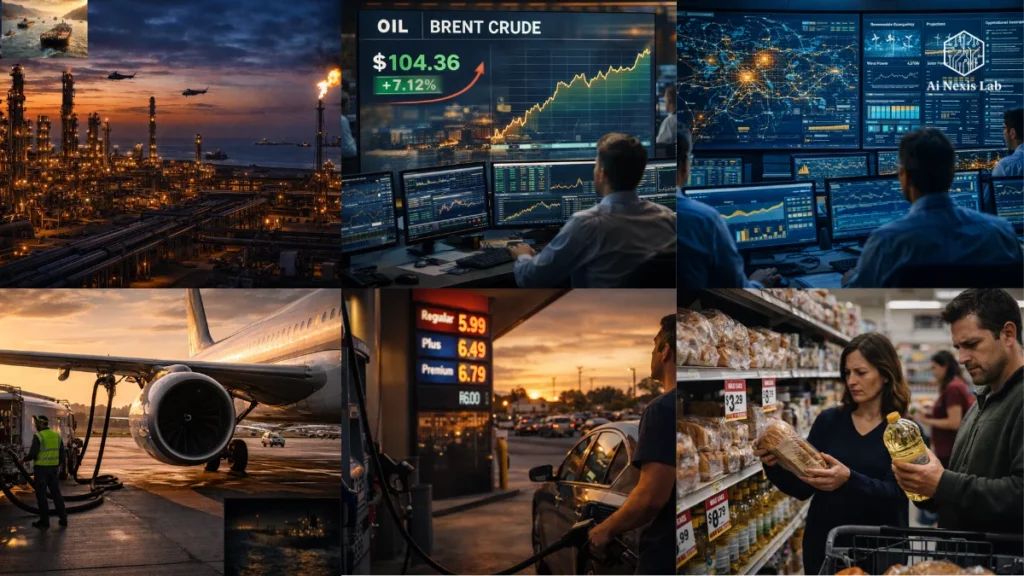
Gasoline prices are rising. Airlines are raising ticket prices. Freight companies are quietly increasing logistics fees. Grocery stores are adjusting prices on staple products like wheat, corn, and packaged goods.
The economic ripple effects are fast-moving.
But the deeper story is not just about oil prices reaching $120 or $150 a barrel.
The profound truth is that we are entering a new era of structural instability in global energy markets – the likes of which the world has never seen since the oil crisis of the 1970s.
For decades after the Cold War, the global economy enjoyed relatively stable energy supplies and increasingly efficient global trade routes.
Cheap shipping. Cheap fuel. Predictable logistics.
That era could be coming to an end.
And if that happens, the cost of living across the United States could rise permanently.
This article is not about political debates or sensational headlines.
Instead, we’re going to break down the mechanics behind what’s happening.
We will explore:
- Why the Strait of Hormuz is the world’s most dangerous energy chokepoint
- How US policy towards Iran is reshaping global oil markets
- Why energy shocks are impacting the prices of food, airlines and everyday consumer goods
- How the global “shadow oil market” is complicating sanctions
- Why Saudi Arabia may not be able to stabilize prices this time
- How AI and energy technology can reshape the grid in response
- And most importantly – how individuals can financially prepare for an unstable energy future
Because this is not just a geopolitical crisis.
It is an economic crisis.
And if oil prices rise to $150 per barrel or more, every household in America will feel the consequences.
Table of Contents
Chokehold: Why the Strait of Hormuz Is The Most Important Place In The World
To understand why oil prices are rising so violently, you need to understand geography.
More specifically, you need to understand the Strait of Hormuz.
This narrow waterway lies between Iran to the north and Oman and the United Arab Emirates to the south.
At its narrowest point, the shipping lane is only two miles wide in each direction.
Yet despite its size, this corridor handles a large share of global energy trade.
The Numbers That Matter
About 20 to 21 million barrels of oil pass through the Strait of Hormuz every day.
It represents:
- About 20% of global oil consumption
- About one-third of seaborne crude oil shipments
Major exporters relying on this route include:
Simply put, this waterway is the artery of the global energy system.
If it shuts down, the world doesn’t just experience higher prices.
It experiences a supply shock.
Why Do Markets React So Quickly?
One of the biggest misconceptions people have about oil markets is that prices only rise when actual supply is disrupted.
In fact, oil markets react to perceived risk long before a physical shortage occurs.
When tensions rise around the Strait of Hormuz, several things happen immediately:
1. Shipping insurance skyrockets
Tankers traveling through conflict zones must purchase war-risk insurance.
Premiums can increase by 300-400% overnight.
2. Some ships avoid routes altogether
Shipping companies sometimes change the route of ships to avoid risk.
Even if oil is technically available, it reduces effective supply.
3. Traders hedge against worst-case scenarios
Oil traders buy futures contracts in anticipation of a shortage.
This speculative buying drives prices up rapidly.
Why Gas Prices React Within Days
You’d be surprised how geopolitical news around the world translates into higher prices at your local gas station within 48 hours.
The reason is simple.
Gas stations set fuel prices based on replacement cost.
Even if a station bought gasoline at a low price last week, they still set the price based on how much it would cost to replace that supply tomorrow.
So when oil futures rise, retail gasoline prices rise almost immediately.
In other words:
You are paying today for the fear of tomorrow’s shortage.
The Trump Doctrine and the Return of Maximum Pressure
US policy towards Iran has always had global energy implications.
But the current strategy represents significant progress.
The administration has revived a version of the previous “Maximum Pressure” strategy, which aims to isolate Iran economically and strategically.
This approach focuses on several objectives:
- Restricting Iranian oil exports
- Cutting off financial access to global markets
- Limiting Iran’s ability to fund regional proxy forces
- Increasing military deterrence in the Persian Gulf
But while these measures target Iran, they also affect the broader oil market.
Removing Supply from an Already Tight Market
Before the current upswing, global oil markets were already experiencing tight conditions.
Several factors contributed to this:
- Post-pandemic travel demand
- Low investment in new oil projects during the 2020-2023 energy transition pressure
- Production limits from OPEC+
- Supply disruptions in many regions
Iran has historically exported 1.3-1.7 million barrels per day without sanctions in place.
If those exports disappear, global supplies become significantly tighter.
The Return of the Geopolitical Risk Premium
For much of the last decade, oil markets operated under the assumption that geopolitical tensions would ultimately be resolved diplomatically.
This creates what analysts call a “diplomatic discount.”
Traders believed that the supply disruption would be temporary.
But when military confrontation becomes possible, that discount disappears.
Instead, markets add a risk premium.
That premium could add $10-$30 per barrel to oil prices almost overnight.
The End of Cheap Energy Stability
For American consumers, the real result is that energy prices could become structurally more volatile.
That volatility contributes directly to inflation.
And inflation spreads throughout the economy.
The Domino Effect: From Crude Oil to Your Grocery Cart
Oil doesn’t just power cars.
It powers the entire industrial system.
When oil prices increase dramatically, the effects spread across many sectors.
Agriculture
Modern agriculture relies heavily on petroleum.
Fuel powers tractors, irrigation systems, and harvesting equipment.
Fertilizers are often derived from petrochemicals.
And transporting food requires diesel-powered trucks.
When oil prices rise:
- Fertilizer costs rise
- Transportation costs rise
- Storage and refrigeration costs rise
All of this ultimately shows up as higher food prices.
Aviation
Jet fuel is one of the largest operating costs for airlines.
When oil prices rise, airlines implement:
- Fuel surcharges
- Higher ticket prices
- Reduced flight routes
This means that travel becomes significantly more expensive.
Manufacturing and Consumer Goods
Oil also plays an important role in the production of plastics and synthetic materials.
Affected products include:
- Electronics
- Clothing
- Packaging
- Automotive components
- Medical equipment
When petrochemical inputs become more expensive, production costs increase.
And those costs are passed on to consumers.
Energy as a “Stealth Tax”
Economists sometimes describe rising energy costs as a stealth tax on consumers.
You don’t see it listed as a tax.
But you pay it anyway.
High fuel prices reduce disposable income.
And while households spend more on essential goods, they spend less on discretionary purchases.
It slows down economic growth.
Dark Fleets and the Shadow Economy
One of the most interesting – and worrying – developments in global energy markets is the rise of the “Dark Fleet.”.
These vessels operate outside the traditional regulatory system.
What is the Dark Fleet?
The Dark Fleet refers to oil tankers that:
- Disable their location transponders
- Change ship ownership frequently
- Transfer ship-to-ship at sea
- Operate under unclear insurance arrangements
Many of these ships are older ships near the end of their operational lives.
How Sanctioned Oil Still Reaches Buyers
Despite sanctions, Iranian oil continues to reach buyers through this shadow network.
Countries that benefit from discounted oil can quietly participate in these transactions.
This creates a two-tier energy market:
- Official oil trading at global market prices
- Approved oil sold through informal channels at discounted rates
Why This System Is Dangerous
The Dark Fleet presents several risks:
- Environmental accidents from aging ships
- Increase in maritime collisions
- Difficulty tracking oil flows
And if one of these ships is damaged during a military escalation, the consequences could include major oil spills or shipping disruptions.
Regional Fire: Why Saudi Arabia and the UAE Can’t Save Us
In past oil shocks, the world relied on Saudi Arabia to boost production and stabilize markets.
But this time, that strategy may not work.
Vulnerability of Gulf Infrastructure
Iran has demonstrated the ability to attack regional energy infrastructure.
The 2019 Abqaiq attack temporarily knocked out half of Saudi Arabia’s oil production capacity.
That attack involved drones and cruise missiles.
If a major conflict breaks out, energy facilities across the region could become targets.
Excess Capacity Under Threat
Saudi Arabia is often described as the world’s “swing producer”.
But additional capacity is only important if the facilities remain operational.
If major refineries or export terminals are damaged, supply disruptions could increase dramatically.
$200 Oil Scenario
In a worst-case regional war scenario:
- Multiple Gulf producers could experience output cuts
- Shipping routes could close
- Insurance costs could skyrocket
In those scenarios, oil prices could surpass $200 per barrel.
At that level, global economic growth is likely to stall.
Tech and AI Pivot: Can Nexus-Level Tech Save the Grid?
Ironically, crises often spur innovation.
And the current energy crisis could accelerate the adoption of advanced energy technologies.
AI-Powered Grid Optimization
Artificial intelligence systems are increasingly being used to manage electricity grids.
These systems can:
- Predict energy demand
- Optimize distribution
- Integrate renewable sources more efficiently
This technology helps stabilize grids that rely on variable energy sources like wind and solar.
Long Transition Away From Oil
However, the energy transition takes decades.
The global vehicle fleet alone includes more than 1.4 billion combustion engine vehicles.
Replacing them takes time.
That means the world could experience a “transition gap” – a period where oil remains essential but supplies become unstable.
This gap could last five to ten years.
During that time, energy technology and infrastructure will become one of the most important sectors of the global economy.
The Architect’s Playbook: 3 Strategies for Indefinite Times
Volatility Rewards Preparation Periods.
Instead of reacting emotionally to headlines, it helps to think strategically.
1. Resource Allocation
Assess how dependent your lifestyle or business is on volatile energy markets.
If you travel long distances or rely on shipping goods across continents, rising energy costs will affect you more.
Reducing that dependency increases resilience.
2. Inflation-Proof Investments
Energy shocks often trigger inflation.
Assets linked to infrastructure, commodities, and energy systems perform better during periods of inflation.
Diversification is more important than ever.
3. Personal Energy Independence
Technologies such as:
- Home solar
- Battery storage
- High-efficiency heating systems
- Better insulation
Can reduce exposure to rising energy costs.
These are not just environmental decisions.
They are financial risk management.
Shipping Crisis: Why Your Amazon Package Was Late
Energy markets are only part of the story.
Shipping routes are also under pressure.
The Middle East connects Asia and Europe through the Suez Canal corridor.
If the conflict spreads to the Red Sea, shipping companies could move around the Cape of Good Hope.
He adds:
- 10 to 14 days in transit time
- Millions of dollars in fuel costs
- Additional crew costs
These costs will be spread across global supply chains.
Electronics, automotive parts, pharmaceuticals, and consumer goods all rely on reliable shipping.
When that route slows down, prices go up.
Psychological Impact: The “Perma-Crisis” Consumer
Economic behavior is not just driven by numbers.
It is driven by psychology.
When consumers feel uncertain about the future, they behave differently.
They delay major purchases.
They increase savings.
They reduce discretionary spending.
This phenomenon – sometimes called demand destruction – can slow economic growth even when supplies remain available.
In extreme cases, it can cause depression.
Insider Note: Currency Trap
Globally, oil prices are determined in US dollars.
It creates an interesting dynamic.
When oil prices rise, countries need more dollars to buy the same amount of oil.
This increases the global demand for dollars.
It could strengthen the US currency.
However, a strong dollar can also:
- Harm American exports
- Put pressure on emerging market economies
- Increase global financial tensions
So a rising dollar during an energy crisis is often a warning sign, not a sign of strength.
Frequently Asked Questions: What Americans are asking right now
Will gas prices in the United States reach $7 per gallon?
It’s not guaranteed, but it’s entirely possible in certain regions. Baseline fuel prices are already high in West Coast states like California due to environmental regulations and refinery limitations. If global oil prices rise toward $150 per barrel or if shipping disruptions in the Strait of Hormuz intensify, the national average could surpass $6 per gallon. Local factors such as refinery outages or pipeline disruptions can temporarily push certain markets above $7.
Why can’t U.S. rely on its own oil production?
The United States is actually one of the world’s largest oil producers, largely due to shale production in Texas and North Dakota. However, the global oil system is interconnected. Many U.S. refineries were designed decades ago to process heavy crude oil imported from abroad. Local shale oil is lighter and requires different refining processes. While the U.S. exports significant oil, the refining system still relies on a mix of global supplies.
What happens to the stock market during an energy shock?
Energy shocks produce uneven effects on the market. Energy producers, defense contractors, and some commodity companies often benefit from rising prices and increased government spending. However, industries with high fuel costs – such as airlines, transportation and manufacturing – typically struggle. Broad markets often experience volatility as investors reassess inflation expectations and economic growth.
Is this conflict likely to start a global war?
Most analysts currently see the situation as a regional conflict rather than the start of a world war. However, the presence of multiple proxy groups and the risk of war escalating accidentally creates uncertainty. Military incidents involving shipping lanes, energy infrastructure, or allied forces can quickly escalate tensions beyond the immediate region.
Should consumers consider electric vehicles as a hedge against oil volatility?
Electric vehicles can reduce direct exposure to gasoline prices, but they are not a perfect hedge. The cost of electricity varies by region and often depends on natural gas production, which can also increase during energy crises. However, EV owners generally experience less price volatility than drivers who rely entirely on gasoline.
Final Verdict: Preparing for the New Normal
The conflict between the United States and Iran may finally be calmed by diplomacy.
History shows that many geopolitical crises eventually subside.
But even if this conflict settles, a big lesson remains.
The global energy system is fragile.
It relies on narrow shipping routes, complex supply chains, and fragile political relationships.
When any of those components breaks down, the consequences spread throughout the economy.
Consumers, investors, and businesses all need to accept that the era of permanently cheap and stable energy is coming to an end.
The world is becoming more unstable.
And in unstable systems, adaptability matters more than size or tradition.
The people and companies that thrive will be those that reduce risk exposure, diversify resources, and stay informed.
Because the next energy shock could come faster than anyone expects.