The Silent Tax: How I Cut My Credit Card APR in a 15-Minute Call (and How You Can Too)

You’re sitting at the kitchen table with your credit card statement open. The coffee is getting cold. The numbers don’t make sense.
You are paying aggressively. No minimums – real payments. Yet the balance barely moves.
Then your eyes fall on:
Interest charge.
$217.
Last month it was $204.
The month before that? $198.
You suddenly feel something uncomfortable: “Despite doing the right thing,” your debt isn’t decreasing the way it should.
This is the moment when most people finally realize that there is a silent financial leak in their bank account every month.
Your credit card APR.
It’s an invisible tax that most Americans never question.
And the uncomfortable truth?
Most people never try to change it.
The banks know this. They believe it.
But when I finally learned how the system works, I was shocked:
That interest rate is not fixed. It’s not sacred. And that is definitely negotiable.
When I made a single 15-minute phone call to my credit card issuer, my APR dropped from 24.99% to 16.49%.
Nothing else changed.
Same card. Same balance. Same bank.
That one call saved me thousands of dollars in future interest.
And here’s the part that banks want you to never understand:
They actually expect some customers to negotiate.
In this guide, I’ll look at exactly how it works – how banks agree to a rate cut, how to prepare for the call, what to say, and what to do if they push back.
If you carry credit card debt – even a few thousand dollars – this could be the most rewarding 15 minutes of your financial life.
Let’s see how it works.
Table of Contents
1. Lender Psychology: Why They Really Want to Say “Yes”
Before you call your bank, there’s one important thing you need to understand:
You’re not negotiating with a soulless corporation.
You are negotiating with risk models, customer retention metrics, and profit calculations.
And those calculations often favor giving you a lower rate.
Credit Card Profits Are Not What People Think
Most people assume that banks want the highest interest rates possible.
But that’s not entirely accurate.
Banks don’t want the highest rates, they want predictable borrowers.
From a bank’s perspective, the ideal credit card customer is someone who:
- Keeps a balance
- Makes consistent payments every month
- Rarely misses a payment
- Doesn’t default
These customers are called “revolvers.”
According to the Federal Reserve’s 2026 consumer credit data:
- More than 46% of U.S. credit card holders carry a balance
- The average APR on all cards is now over 24%
- The average revolving balance is about $6,400
For banks, revolvers are a steady stream of interest income.
But here’s the catch:
If rates get too high, borrowers start doing one of three things.
They:
- Transfer balance to another card
- Consolidate with loan
- Default on debt
All three outcomes are bad for the bank.
So if lowering your APR a little bit allows you to make payments reliably, it’s often a smart financial decision for them.
Customer Acquisition Cost Problem
Banks spend a huge amount of money to acquire credit card customers.
Between marketing campaigns, welcome bonuses, referral incentives, and advertising, estimates suggest that banks spend $250 to $500 per new customer.
That means if you leave, the bank loses:
- Future interest
- Annual fees
- Transaction fees
- Interchange revenue
And they still have to replace you.
So when a customer with a good payment history calls and says:
“I’m thinking of moving this balance to another bank.”
That statement internally triggers a retention alert.
And retention teams have one job:
Keep profitable customers from leaving.
The “Good Risk” Paradox
Ironically, the ones most likely to receive low APRs are the customers who don’t really need them.
If you have:
- On-time payments
- Stable income
- Many years of account history
You are exactly the type of borrower banks want to have.
Even lowering your rate slightly can keep the account profitable.
Leaving you doesn’t make this happen.
That’s leverage.
2. The “Battle Folder” Phase: Data is Your Greatest Weapon
People lose when they go into negotiations unprepared.
Call the bank and say:
“Can I get a lower rate?”
… rarely works.
You need leverage.
And that leverage comes from the data.
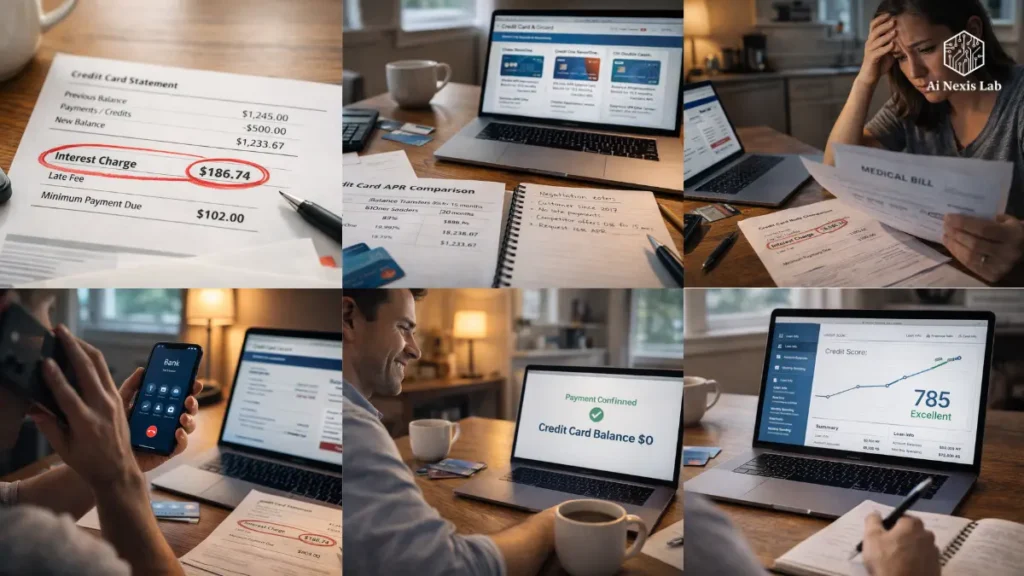
Before making the call, create a simple document called your Battle Folder.
This takes about 10 minutes but improves your chances dramatically.
Your Internal Statistics
Pull your last six credit card statements.
Write down three key numbers:
1. Current APR
Most credit cards now fall between 20% and 29%.
Knowing your specific number shows the representation you are paying attention to.
2. Current Balance
Your balance determines how valuable you are as a customer.
A $50 balance doesn’t motivate banks.
The $6,000 balance definitely does.
3. Customer History
Length of account history is powerful.
If you have a card for:
- 3+ years
- 5+ years
- 10+ years
Mention it.
Banks love long-term customers.
“Better Offer” Ghost
Competition is your strongest negotiating tool.
Take five minutes to search for competitors’ offers.
Sites like NerdWallet, Bankrate, and WalletHub regularly list promotional rates.
Examples commonly seen in 2026:
- 0% APR for 12-18 months on balance transfers
- Standard APR around 17-21%
Write three offers.
Not because you’re planning to apply – but because mentioning them changes the conversation.
Example statement:
“I’m seeing a lot of cards offering 0% intro APR and sub-20% long-term rates.”
Now the bank knows:
You are making a purchase.
And savvy customers are at risk of losing them.
Your Target Number
Never ask for a “low rate”.
It is unclear.
Ask for a specific number.
Example goals:
| Current APR | Reasonable Target |
|---|---|
| 28% | 19% |
| 24% | 16% |
| 20% | 14% |
Having numbers signals confidence.
Confidence changes how negotiations proceed.
3. The “Leverage Escalation” Script: Exactly What to Say
Most people freeze when the call begins.
They panic.
They mumble.
They apologize.
It immediately weakens your position.
Instead, use a simple structure.
Defending the Beginning
Start calmly and directly.
Example script:
“Hello, I have been a customer for several years and have noticed that my APR is significantly higher than offers from other banks. I would like to request a reduction to approximately 16% so that I can maintain my balance on this card.”
Notice what this does:
- Shows loyalty
- Mentions competitors
- Provides a target rate
All in one sentence.
A Soft “No”
The first representative will often respond something like this:
“There are currently no promotional offers on your account.”
This is a scripted response.
That doesn’t mean the conversation is over.
Your response should be calm and consistent.
Example:
“I understand that there may not be an automatic offer. Can you check with the retention department or supervisor?”
The call now goes to someone with real authority.
Enter the Retention Department
Retention teams exist to keep customers from leaving.
These representatives have tools that first-tier agents don’t have.
Possible outcomes include:
- APR reductions
- Temporary promotional rates
- Fee waivers
- Statement credits
This is where mentioning competitor offers becomes powerful.
Example:
“Capital One is offering a balance transfer at 0% for 15 months. I would love to keep this account, but the rate difference makes it difficult.”
You’ve now created a credible exit threat.
4. “Temporary Difficulty” The Key Issue (When You’re Struggling)
Sometimes the issue isn’t about power negotiations.
It’s financial stress.
If your situation changes – job loss, income reduction, medical bills – then the strategy changes.
Instead of using a loyalty script, you use a difficulty script.
What Are Hardship Programs?
Most major banks run formal hardship programs.
These programs temporarily reduce or eliminate interest.
General Terms:
- APR is reduced to 0-9%
- Program length 6-12 months
- Card usage is frozen
This last part is important.
You typically can’t make new purchases during hardship plans.
But that restriction is intentional.
It keeps the balance from growing again.
Why Do Banks Offer These Programs?
Distress programs reduce default risk.
If the borrower stops making payments altogether, the bank loses money.
If reducing interest keeps payments flowing, everyone wins.
These programs quietly help thousands of borrowers every year.
But they are rarely advertised.
You have to ask.
Insider Tip: “Annual Fee Pivot”
If APR reduction fails, ask for something else.
Example:
“If the rate can’t change, can you waive the annual fee this year?”
Annual fees on premium cards range from $95 to $695.
An offset immediately forgives the interest expense.
It’s not the same as a rate cut, but it’s still a win.
5. Identifying “Rate Traps” and Fine Print Failures
Sometimes banks offer rate reductions with hidden strings attached.
You need to understand the fine print.
Variable Rate Trap
Most credit cards use a variable APR tied to the prime rate.
If the Federal Reserve raises rates, your APR also increases.
When negotiating, ask:
“Is this a temporary promotional rate or a permanent change to my margin above prime?”
This question tells the representative that you understand the system.
Penalty APR
Missing a payment – even by one day – can trigger a penalty APR.
The penalty rate often reaches 29.99%.
This effectively erases your negotiated savings.
To protect yourself:
- Set up autopay
- Use calendar reminders
- Pay several days early
Negotiating a lower rate is only important if you keep it.
6. Case Study: The $4,200 Difference
Let’s look at a real example.
Meet Sarah.
She has:
- $10,000 credit card balance
- 26% APR
- $400 monthly payment
Scenario 1: No negotiation
At 26% APR:
- Repayment period: 38 months
- Interest paid: $4,732
Almost half of the original balance disappears in interest.
Situation 2: After Negotiation
Sarah negotiates by lowering her APR to 16%.
Same payment.
Same balance.
New result:
- Repayment period: 30 months
- Interest paid: $2,185
Difference
Sarah saves $2,547.
For a phone call that lasted about 15 minutes.
That’s effectively $10,000 per hour.
Very few financial tasks offer this much reward.
7. What To Do If They Say “No” (The Nuclear Option)
Sometimes negotiations fail.
That doesn’t mean you’re stuck.
You still have options.
Option 1: HUCA (Hang Up, Call Back)
Different representatives have different flexibility.
Calling again often yields different results.
Time is also important.
Best call windows:
- Tuesday morning
- Midweek afternoon
Avoid Monday and Friday.
Option 2: Balance Transfer
If your credit score is above about 680, balance transfer cards become practical.
Common offers include:
- 0% APR for 12-18 months
- Transfer fees around 3-5%
Used properly, this strategy eliminates interest for more than a year.
But you have to aggressively pay off the balance before the promo period ends.
Option 3: Debt Consolidation Loan
Personal loans often offer low fixed rates.
Typical ranges in 2026:
- 9-15% for good credit
Benefits include:
- Fixed repayment timeline
- One monthly payment
- No variable APR spikes
For large balances, consolidation can dramatically simplify debt repayment.
8. Tactical Friction-Reduction (Problem Solving Techniques)
Most people never negotiate their interest rates.
Not because they can’t.
Because they procrastinate.
This section removes the friction that prevents people from calling.
Script-Decoupling Method
Emotion kills negotiations.
People start explaining their life stories.
Banks don’t need it.
Write your script and read it silently.
Treat the call like a support ticket.
Professional.
Direct.
Neutral.
This dramatically reduces anxiety.
Leverage-Staking Protocol
Never disclose all leverage at once.
Use it gradually.
Sequence is important.
- Loyalty argument
- Competitor offer
- Balance transfer threat
Every step increases the pressure.
Calendar-Trigger Loop
Negotiations are not a one-time action.
Set a recurring reminder every six months.
Your credit profile changes over time.
Your bank’s risk model is also updated.
The answer today might be “no.”
Six months from now it might be “yes.”
9. Future Impact: Credit Scores and Beyond
Many people worry that negotiating a lower APR could hurt their credit score.
It doesn’t.
In fact, it often improves it.
Here’s why.
Lower Interest Speeds Up Principal Payments
When interest is reduced:
More of each payment goes toward the balance.
Low balances improve credit utilization, which makes up about 30% of your FICO score.
Reduced Utilization Improves Credit Score
Example:
$10,000 limit with $8,000 balance = 80% utilization
After paying down $3,000:
Utilization drops to 30%
That alone can significantly increase your credit score.
Better Credit Opens Up Better Opportunities
A higher credit score unlocks:
- Lower loan rates
- Better mortgage terms
- Higher credit limits
- Premium credit card rewards
It all starts with reducing interest costs.
Frequently Asked Questions
Will asking for a lower APR trigger a hard credit inquiry?
Usually not. In most cases, requesting an APR reduction involves an internal account review rather than a new credit application. That means the bank only evaluates your existing relationship, payment history, and internal risk profile. However, policies vary slightly between issuers. Always confirm with the representative before proceeding by asking whether the review includes gentle questioning or hard pulling. If a hard inquiry is necessary, consider whether the potential savings outweigh the temporary drop in your credit score.
Can someone with a 600 credit score successfully negotiate for a lower rate?
It is more challenging but far from impossible. Borrowers with low credit scores often have less leverage when negotiating a standard APR reduction. However, hardship programs and retention options may still apply. If you have maintained consistent payments despite financial stress, banks may choose to adjust the terms rather than risk default. In these cases, positioning the request around financial stability rather than competing offers can significantly improve the chances of approval.
How often should I request a credit card APR reduction?
A reasonable strategy is to revisit the conversation every six to twelve months. Credit profiles change over time as balances decrease, income changes, and payment history strengthens. Banks also periodically update their internal risk models, which may change eligibility for promotional offers. Setting a recurring calendar reminder ensures that you revisit the opportunity regularly rather than assuming the first response you receive is permanent.
Are premium credit card APRs negotiated differently?
Premium cards often operate under slightly different pricing structures. Products with large annual fees or extensive rewards programs sometimes maintain a fixed margin above the prime rate, making it difficult to get APR reductions. However, premium issuers are highly sensitive to customer retention. If APR changes aren’t available, they may offer alternative retention incentives like statement credits, bonus reward points, or annual fee waivers.
Does the threat of closing the card really work?
It’s possible – but only if the threat is real. Banks understand that customers with large balances generally cannot close their cards immediately. A more credible statement explains that you are actively considering transferring the balance to another lender offering a lower rate. This signals the real possibility of losing the account, a situation that retention sections are designed to prevent.
Final Verdict: Your Step
Negotiating your credit card interest rate is one of the simplest, most impactful financial steps available.
He doesn’t need:
- High salary
- New side hustle
- Complex investment strategies
He needs a conversation.
Banks quietly collect billions in interest every year from customers who never ask for better terms.
That silence is profitable.
Breaking that silence is powerful.
Open your statement.
Create your battle folder.
Pick up the phone.
Fifteen minutes from now, you might have cut thousands of dollars off your debt payment journey.
And if you’re taking the balance today, there’s really only one question left:
Why haven’t you called yet?