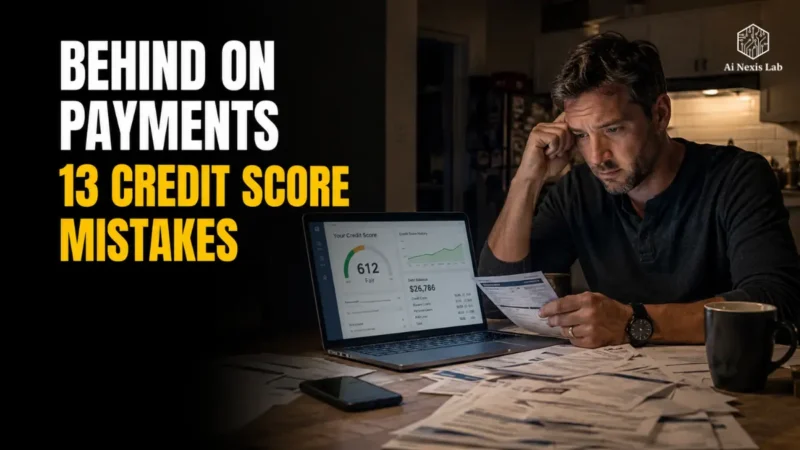
600 to 750 Credit Rebuild Playbook

A Practical, No-BS Guide to Real Credit Returns in 2026
I still remember sitting in the dealership office with a plastic cup of burnt coffee, staring at a loan offer that felt like a punishment. I walked away confident. My income was steady. No bankruptcies. No dramatic financial disasters. Just a credit score sitting around 610.
The finance manager didn’t insult me. They didn’t have to. The numbers did it for him. The interest rate was bad. The monthly payment was worse. I wasn’t being denied credit – I was being taxed for having an average score.
a risk-scoring algorithm built on behavioral data.
That was the moment I stopped treating credit as a mysterious decision and started treating it for what it really is:
Once you look at it that way, everything changes. A credit score is not a reflection of your worth. It is a probability model that answers the question:
“How likely is it that this person will pay as agreed?”
If your score is around 600, the system sees uncertainty. If it’s around 750, the system sees reliability. That’s it. No ethics. No drama. Just math.
This guide teaches you how to move from the “unreliable” bucket to the “reliable” bucket – realistically, legally, and sustainably – without falling for tricks or shady repair services.
No fancy hacks. No miracle timelines. Just tricks that really move the needle.
Table of Contents
First: What a 600 Score Really Means
A 600 FICO score in 2026 typically means:
- You’ve had at least one late payment in the last two years
- Or your credit card balances are consistently running high
- Or your credit history is thin
- Or all three
It doesn’t mean:
- You’re financially irresponsible
- You’re permanently locked out of good credit
- You need a credit repair company
It simply means there are risk indicators in your profile. The game is about identifying signals and replacing them with stability signals.
How the score is actually made
Modern FICO and VantageScore models still weigh the same key categories:
Payment history – ~35%
Did you pay on time?
Credit Utilization – ~30%
How much of your available revolving credit are you utilizing?
Length of history – ~15%
How long have your accounts been in existence?
Credit Mix – ~10%
Do you handle both revolving (card) and installment (loan)?
New Credit – ~10%
How often do you apply for accounts?
Here is the main truth:
You can’t speed up time.
So the length of history improves gradually.
But:
Payment history and usage are completely under your control – and they account for about two-thirds of your score.
That’s where rebuilding really happens.
Part 1: Fix the Fastest Lever – Credit Utilization
Credit utilization is simply:
Total Card Balance ÷ Total Card Limit
If you have $4,000 in limit and $2,000 in balance, that’s 50% utilization. Scoring models interpret high utilization as a reliance on credit – even if you pay in full every month.
In 2026, the best ranges still look like this:
- Under 30% → Acceptable
- Under 10% → Strong
- 1% to 5% → Best
- 0% on all cards → Slightly less ideal than carrying a small balance
Yes, the models still want to see some active usage.
Practical Implementation
If you are carrying a balance:
- Strategically pay off cards starting with the highest usage
- Don’t close cards after paying them off
If you are making full monthly payments:
- Shift when you pay, not just how much you pay
Statement date is more important than due date
The bureaus look at the balance that exists on the statement closing date, not the day you pay.
If your card closes on the 18th and you pay on the 25th, the report still shows the 18th.
The Fix:
Pay off most of your balances before the statement closes.
Just leave a small balance ($10–$30) on one card.
This alone can create significant score movement in 1-2 reporting cycles.
No tricks. Just understand the timing.

Part 2: Payment History – The Non-Negotiable Rule
Nothing hurts a credit score more than late payments. Nothing helps more consistently than never paying one again.
If you have late payments:
- Their impact diminishes over time
- New on-time history gradually outweighs them
If you keep adding new late payments:
- You’ll get stuck
The easiest permanent solution
Set up AutoPay for the minimum payment on each account.
Then pay the remaining amount manually in any way you like.
AutoPay prevents:
- Forgetting due dates
- Travel disruptions
- App notification failures
- “I’ll pay tomorrow” disasters
This one behavior change prevents the single most common cause of scores below 650.
Part 3: Managing Collections and Charge-Offs
This is where people get screwed by bad advice.
Reality in 2026:
- Most scoring models still consider unpaid collections negative
- Paid collections hurt less, but they still hurt
- Dismissal helps most people – but not always possible
What actually works
Step 1: Check for accuracy
Dispute anything:
- Wrong amount
- Wrong dates
- Accounts not yours
Step 2: If valid and unpaid
Contact the collector:
- Ask if they will dismiss upon payment
- Get it in writing
- Then pay
Not every agency agrees. Some will. Some won’t. There’s no guarantee.
Step 3: If deletion is not offered
payment still helps, especially in new scoring models that weight unpaid collections more strictly than paid ones.
No miracles. Just slow improvement.
Part 4: Authorized User – Useful, but Not Magical
Adding an authorized user to a well-organized, old, low-balance card:
- Can increase the average age of accounts
- Can reduce overall utilization
- Can add positive payment history
But:
- Not all scoring models treat AU accounts equally
- If the primary user mismanages the card, you get hit too
- Some lenders discount piggybacking entirely
So yes – it can help.
No – it’s not a cheat code.
Part 5: Thin files and alternative data
Tools like eligibility and rental reporting still exist in 2026. They:
- Add additional positive payment entries
- Help thin files more than thick files
- Generally add modest points, not big jumps
Think about this:
Supplementary evidence, not main score drivers.
If you already have active credit cards, these tools are icing – not cake.
Part 6: Credit Builder Loans – When They Make Sense
Credit Builder Loans:
But:
- Not necessary if you already have an auto loan, student loan, or mortgage
- Potentially useful if you only have credit cards
They are great tools. Not necessary for everyone.
Part 7: Hard Inquiry – Not the Monster People Think
Inquiry typically:
- Reduce score by a few points
- Recover within months
- Stop being important after about a year
The real danger isn’t the inquiry – it’s opening too many new accounts at once.
Spacing applications several months apart keeps risk signals low.
Part 8: The Time Factor – What Timelines Really Look Like
Let’s kill the imaginary timelines.
If you:
- Lower usage
- Stop new late payments
- Add consistent on-time history
You can often see:
- Significant improvement in 1-3 months
- Strong gains in 6-12 months
- Prime-tier scores in 12-24 months
Faster if your negatives are low.
Slower if you have a heavy abusive history.
No instant rebuild. No overnight 150-point miracle. Just compounding behavior.
Part 9: Behavioral Credit Engineering
Most people whose scores are stagnant are not failing because of math. They fail because of habits.
Common pitfalls:
- Paying off cards only once a month
- Forgetting statement dates
- Closing old accounts
- Opening store cards impulsively
- Making minimum payments as balances grow
- Avoiding credit altogether after mistakes
Good credit is boring consistency.
If your system:
- Automates minimum payments
- Keeps balances low
- Keeps old accounts open
- Limits new applications
Your score will naturally increase.
No drama required.
Part 10: What a 750 Score Really Unlocks
A score in the mid-700s typically qualifies you for:
- Prime-tier loan pricing
- Top-tier credit card approvals
- Lower insurance risk pricing in some states
- Easier apartment approvals
- Lower security deposits
Beyond ~760, the benefits become marginal. The real goal isn’t perfection. It’s avoiding high-risk rates.
Frequently Asked Questions
Q: How long does it really take to get from 600 to 750?
A: For mild credit damage: 6–12 months.
For more damage: 12–24 months.
Anyone who promises quickly is selling something.
Q: Does checking my own credit hurt my score?
A: No. Personal checks are soft inquiries and have no impact on scoring.
Q: Do I need a credit repair company?
A: No. They can’t do anything that you can’t legally do yourself. Most people send automated disputes and charge a monthly fee for it.
Q: Should I close paid-off credit cards?
A: No. Closing reduces available credit and may shorten the average history.
Q: Will paying off all my debts immediately increase my score?
A: Reducing use helps quickly. It takes time to clear up old negative history.
Q: Can I rebuild a house after bankruptcy?
A: Yes. But expect a multi-year process. New positive history gradually outweighs old losses.
Q: Is 750 better than 700?
A: Yes. Many lenders reserve their best price levels for the 740–760+ range. This difference can be significant on larger loans.
The Ultimate Reality Check
There is no secret hack.
There is no instant reset button.
There are only:
- Low usage
- Perfect payment history
- Time
- Consistency
That’s the whole algorithm.
Once you understand that, credit stops being scary. It becomes predictable.
A score of 600 is not a life sentence.
A score of 750 is not a mystery.
It’s simply disciplined behavior that is applied long enough to account for the math.
If you build a system, the score follows.
There is no magic.
There are no shortcuts.
Just engineering.