
The Ultimate Guide to 2026 IRS Mileage Rates: How the New Figures Work, Why They Changed, and Smart Ways to Maximize Your Tax Savings

Taxes permeate every part of life – even the miles you put on your car.
And if you’ve ever tried to understand tax rules while juggling work, family, and everything else, you know it can feel like deciphering an ancient puzzle.
The mileage deduction is one of the most misunderstood parts of the tax code. It’s simple on the surface – drive for business, get a deduction – yet underneath are layers of rules, exceptions and strategy choices that can either save you thousands… or leave money on the table.
On December 29, 2025, the IRS released standard mileage rates for 2026 – benchmark values used to calculate deductible miles for business use, medical travel, charitable driving, and certain relocation situations.
At first glance, the changes may appear small. A penny here. Two pennies there.
But in tax planning, those little numbers don’t stay small. They multiply with every mile you drive, every month of the year, and every trip you take for work or essential purposes.
And in 2026, that money tells a big story.
They show how the IRS sees the real cost of owning a car.
They highlight economic trends – insurance increases, repair costs, fuel patterns, medical costs, EV adoption – and how policymakers interpret it all.
They also create opportunities, especially if you’re intentional about tracking and planning.
Let’s find out what changed, why it changed, and how to use these rules to your advantage without getting into the audit realm.
What exactly are the 2026 IRS mileage rates?
Every year, the IRS calculates how much the average person actually spends on driving a vehicle. They look at a mix of factors – fuel, wear and tear, depreciation, repairs, tires, insurance and other ownership costs. From that research, they determine standardized mileage rates.
These rates allow taxpayers to deduct a fixed amount per mile, rather than trying to manually calculate every small expense.
For 2026, here are the figures:
- Business travel: 72.5 cents per mile (up from 2025)
- Medical and moving purposes: 20.5 cents per mile (down from 2025)
- Charitable service: 14 cents per mile (unchanged – and legally frozen until Congress acts)
At first glance, it seems random: why increase one category and decrease another?
But it’s not random at all – it depends on how each rate is calculated.

Why did the business rate go up while medical/moving went down?
The different directions of the 2026 adjustments come from one thing: What expenses does the IRS choose to count.
Business miles include both fixed and variable vehicle costs:
- Depreciation (the loss of value of your car)
- Insurance
- Maintenance and repairs
- Tires and parts
- Fuel and fluids
These are the big picture ownership costs, and many of them have remained stubbornly high – especially insurance, parts, and new vehicle technology repairs.
Medical and moving miles only include variable costs:
- Fuel
- Oil
- Small out-of-pocket travel expenses
Those variable costs have declined compared to peak inflation years. So even though owning a vehicle is expensive overall, out-of-pocket driving costs have decreased – and that’s why medical/moving rates have decreased.
Charitable mileage remains steady at 14 cents
Not because the IRS wants it that way – but because Congress set it years ago and has never updated it. Unless lawmakers change the law, it’s where it is, regardless of reality at the pump.
That’s the logic. But what does it really mean for you?
Business Mileage Boost: A Win for Entrepreneurs, Drivers, and Freelancers
If you earn income and drive as part of that work, the 2026 increase is good news.
Think about delivery drivers, real estate agents, consultants, small business owners, sales representatives, home health workers, and countless others. For many of them, a car is practically a business tool.
At 72.5 cents per mile, the deduction adds up quickly.
Driving 10,000 business miles in 2026?
That’s a $7,250 deduction.
If you’re in about the 22% tax bracket, that translates to about $1,595 in tax savings – just for keeping good records.
And for people who drive more than 10,000 miles a year – rideshare drivers, traveling sales professionals, regional service technicians – the numbers increase dramatically.
Mileage deductions are not “spare change.”
It is one of the most powerful legal tax tools available to independent workers and small businesses.
What’s really driving the business mileage rate up?
The IRS isn’t just reacting to gas prices. In fact, gas alone doesn’t explain the trend.
Here are the things that shape the 72.5-cent rate:
Depreciation is brutal
Cars lose value quickly — even faster when driven heavily for work. Modern vehicles are technology-packed and expensive, making depreciation a significant expense.
Insurance premiums are rising
Accidents cost more to repair. Repair shops are understaffed. Vehicles require specialized parts. All of this translates into premiums.
Mechanics and parts aren’t getting cheaper
Labor shortages, high wages, complex car systems, and imported parts are driving up costs. Replacing a bumper or sensor is no longer the same as before.
Put together, owning and operating a car in 2026 is not “cheap” – even if gas prices are low. The IRS recognizes this reality in the business rate.
The Downside of the Lower Medical & Moving Rate
The 20.5 cents per mile reduction affects two specific groups.
Medical Travel
People with chronic illnesses, frequent hospital visits, or specialized care often rely on this deduction. But that only applies if your medical expenses exceed 7.5% of your adjusted gross income (AGI) — and with a low mileage value, it becomes difficult to reach that threshold.
It’s not disastrous – but it’s certainly less generous.
Military Relocation Only
Most taxpayers lost the relocation deduction in 2017. Today, only active-duty military members under official orders can deduct relocation expenses.
For service members moving between states or across the country, the reduction means slightly lower deductions.
It’s subtle — but subtle adds up.
Charitable Mileage: Stuck at 14 Cents
If you volunteer your time and your car – perhaps delivering meals, delivering supplies, or supporting community work – you still get 14 cents per mile.
And yes… that’s barely enough gas for many vehicles.
The frustration is understandable. But until Congress updates the law — which nonprofits have been lobbying for years — it remains frozen.
Still, even at 14 cents, it’s worth tracking if you volunteer regularly.
The Big Question: Standard Mileage vs. Actual Expense Method
This is where strategy enters the picture.
The IRS gives you two options when deducting business use:
Option 1: Standard Mileage (72.5¢ per mile)
Simple. Clean. Predictable.
- You track the miles.
- Multiply by the IRS rate.
- You’re done.
There is no shoe box full of mechanic receipts. No spreadsheet nightmares.
It works especially well if:
- Your car is old and paid off
- Insurance and repair costs are low
- You put a lot of miles on the car
- You appreciate convenience
Sometimes, the standard mileage is even more than you actually spend – effectively maximizing your deduction.
Option 2: Actual Cost Method
Here, you track everything:
- Gas
- Oil
- Repairs
- Insurance
- Depreciation
- Lease Payment (if applicable)
- Maintenance
- Registration Fee
- Tires
Then you deduct the business-use percentage.
This method can generate large deductions for:
- New vehicles with heavy depreciation
- Luxury cars with expensive maintenance
- Heavy-duty trucks
- SUVs used primarily for work
- High-priced electric vehicles
The catch you need to know
If you own a car and want the option to use the standard mileage method later, you should start with it in the first year the vehicle is used for business. After that, you can switch back and forth (with some limitations).
But if you start with real costs, you are usually locked in permanently.
Strategy is key here. Making the right choices in the first year can save you thousands over the life of the car.
How to Keep Your Mileage “Audit-Proof”
Mileage deductions are one of the most challenging items on a tax return. Not because they’re illegal – but because many people assume they are.
“I think I drove about 12,000 miles for work last year” won’t cut it.
The IRS wants contemporaneous logs – meaning records created at or near the time of the trip.
Your entries should show:
- Date
- Odometer reading started
- Odometer reading ended
- Total miles
- Where you were going
- Business purpose (brief but specific)
Example:
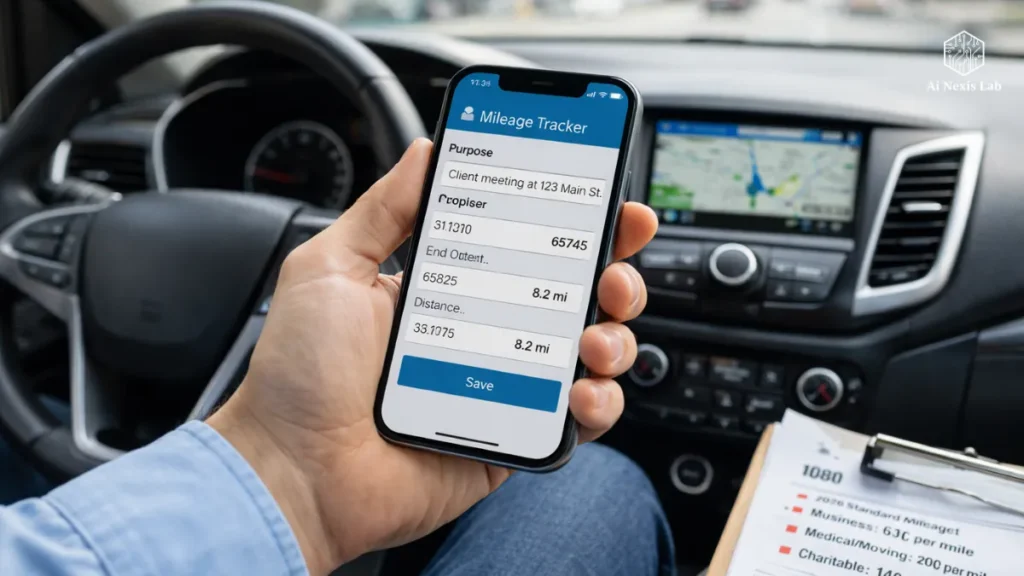
“02/12/2026 — Driven to 123 Main Street — Client meeting for contract renewal.”
That’s enough detail to document your intentions without being a novelist.
Apps make it easy
Paper logs still work, but today’s mileage-tracking apps make everything easier:
- MileIQ
- QuickBooks Self-Employed
- Everlance
- Hurdlr
They automatically track your drives using GPS. You simply classify trips as business or personal. At tax time, print the report — and you’re covered.
It takes seconds instead of guessing.
Common Mileage Mistakes People Don’t Realize They’re Making
Mileage deductions are powerful – but they’re easy to abuse. Here are the pitfalls that catch people every year:
Mistake 1: Counting travel as business mileage
Driving from home to your regular workplace is travel, not business use. Completely non-deductible.
Exception:
If you qualify for a home office, your first trip of the day from your home to client sites can be considered business.
Mistake 2: Double-dipping
You can’t claim mileage and also deduct gas receipts or repair bills separately.
The 72.5 cents already includes all those expenses.
Mistake 3: Claiming 100% business use
Unless the car is a clearly dedicated work vehicle – think fleet van with company branding – claiming full business use is a concern.
Most people run errands. Pick up groceries. Drop off the kids. Go out to dinner. The IRS expects personal use unless you can prove otherwise.
Be honest. Be conservative. Be documented.
EVs and Mileage Rules: A Quiet Advantage
Electric vehicles bring an interesting twist.
EV charging is often dramatically cheaper than gasoline on a per-mile basis. In some regions, charging can cost as little as 3-4 cents per mile. Compare that to 15 cents per mile or more for a gas-burning vehicle.
Yet the standard mileage rate for EVs doesn’t decrease. It’s calculated based on an overall vehicle cost average — which includes things like depreciation — that is broadly applicable.
The result?
EV owners using standard mileage sometimes receive deductions that are much higher than their actual out-of-pocket fuel costs. It’s not illegal or secretive—it’s just how the formula works.
For commercial drivers frequently considering EVs, this becomes a less appreciated benefit.
Putting it all together: Your 2026 mileage strategy
The 2026 mileage rules are nothing to be afraid of. They’re tools. The main thing is to use it intentionally, not reactively.
Here’s a simple roadmap:
Step 1: Evaluate your vehicle
Is it expensive to run? Depreciating quickly? Or cheap and efficient?
That answer helps in deciding between standard or actual costing methods.
Step 2: Start tracking on January 1
Whether you use a notebook or an app, consistency is more important than perfection.
Step 3: Cleanly separate business and personal
Never mix. Never guess. Just document.
Step 4: Talk to a tax professional if you are a high-mileage driver
If you drive thousands of miles each year, these choices become complicated. CPAs can model both methods and show which one wins – often saving much more than their fees.
Preparation beats panic. Mileage isn’t just paperwork – it’s money you’ve already earned.
Frequently Asked Questions: About 2026 IRS Mileage Rates
Q1: Can I switch between standard mileage and actual costs?
Yes — but only if you used standard mileage the first year the car was in business service. If you start with the actual cost of the vehicle you own, you will typically be locked in for its lifetime.
Q2: Do I need receipts if I am using the standard mileage rate?
You don’t need gas or repair receipts.
But you need a mileage log documenting dates, locations, and business purposes. Without it, the deduction may be denied.
Q3: Are travel miles ever deductible?
Regular travel from home to your permanent workplace is never deductible.
However, trips may occur between multiple workplaces – or from qualifying home offices to clients – on the same day.
Q4: What if I sometimes forget to record my trips?
It is possible to recreate small distances using calendar, email or GPS history. But making a habitual guess is dangerous. Aim to record trips while traveling – apps make this easy.
Q5: Are rideshare drivers (Uber, Lyft, DoorDash, etc.) eligible?
Sure. Mileage is one of the biggest deductions available to gig economy drivers – often the difference between paying taxes and breaking even.
Q6: Do EV owners get special mileage rates?
No. EVs use the same rate as gasoline vehicles. But because charging is cheap, EV owners sometimes have a significant advantage when using the standard mileage method.
Q7: Can I deduct miles if my employer reimburses me?
No — not if the reimbursement is equal to or greater than the IRS rate. If your employer reimburses less than the IRS standard, in some cases you can deduct the difference based on your tax situation.
Q8: Do I also need to track personal miles?
Yes, if you use the actual expense method. The IRS needs your total miles to calculate the business percentage. With standard mileage, it’s fine to just track business miles – but recording the annual odometer total still helps solidify your record.
Q9: Does charitable driving require documentation?
Yes. The rate may be lower, but records are still important. Keep a simple log showing dates, miles, and the organization you served in.
Q10: Is it risky to take mileage from an audit perspective?
Not if it’s documented correctly. The IRS audits sloppy records — not legitimate deductions supported by solid logs.
Final Word: Knowledge Makes Mileage Work for You
Mileage deductions may seem like tax trivia, but they are anything but.
They quietly shape business profitability. That’s important for gig workers. They ease the medical burden. They reflect broader economic trends, from insurance markets to EV adoption.
In 2026, the theme is clear:
- Professional driving is encouraged.
- Medical and military moving miles get a little tighter.
- Charitable driving stays put — for now.
The smartest move is not fear – it’s preparation.
- Track every mile with discipline.
- Choose the deduction method that fits your car and your life.
- If your driving plays a large role in your income, seek professional guidance.
And remember: these rules are not designed to punish you. It exists so money you actually spend in the normal course of life and business is not taxed.
Use it well, drive confidently, and let the miles you record work in your favor – not against you.
Disclaimer: This article provides a general overview of the 2026 IRS mileage rates and should not be considered legal or tax advice. Always consult a qualified tax professional regarding your specific situation.