
$100 Wealth Playbook for 2026: A No-Bull Guide to Owning a Piece of the U.S. Market Today
You are looking at a hundred dollars. Maybe it’s burning a hole in your pocket. Maybe it’s sitting in savings (where inflation is eating away at it). Anyway, you’re wondering if this little green thing can actually do anything meaningful in the stock market.
Let’s be clear:
Yes – $100 can start your investing journey. It won’t make you a millionaire overnight. But it can set you on a path where your behavior is more important than the initial amount.
This guide gives you:
- A realistic framework for how to invest $100 in 2026
- Updated mechanics (no outdated assumptions)
- A clear roadmap with logic and numbers
Table of Contents
1. Why $100 is enough – but not because of the number
People overestimate the amount you need and underestimate habit and consistency.
Investing is not about the zero in the account today – it’s about the zero years from now, amplified by time and returns.
Here’s what Forbes, Vanguard, and historical market data all agree on:
- The U.S. stock market has returned roughly 7%–10% annually after inflation over long periods (decades).
- Starting early leads to big earnings later.
If you put $100 into today’s broad market and never touch it:
- At a 7% return per year, that $100 grows to ~$761 in 30 years
- That’s normal – but it proves a point: time is worth more than the initial amount
Where the real gain comes from is the continued contributions.
Example:
- $100 today
- $25 compounded weekly (that’s $100/month)
- At a 7% annual return
- In 30 years you’ll have ~$171,000
That’s math – not hype.
2. The Psychology of Starting Small
Most people never invest because they are waiting for the “right amount”. They think:
“I need $5,000”
“I’ll start when I have a bonus”
“I need to learn everything first”
Newsflash: You never seem completely ready. Waiting gives you the biggest advantage – time.
Learning by doing matters:
- You learn what it feels like when the market crashes
- You learn how to choose broad exposure
- You build discipline and habits
It all depends on whether you started with $100 or $1,000.
So: Stop waiting. Start now.
3. Where Will You Actually Put That $100 in 2026 (Updated and Practical)
In 2026, you have easy access to:
- Zero commissions
- Fraction shares
- No minimum accounts
- Automatic recurring purchases
Here are the best platforms to consider today:
Fidelity
- No account minimum
- Fraction shares on thousands of stocks and ETFs
- Best for long-term investors with growth plans
Charles Schwab
- Strong all-around broker
- Fraction shares (stock slices) are nifty
- Good research tools
Robinhood
- Mobile-first
- Fraction shares
- Great if you want easy, fast trading
Public
- Social perspective (see what long-term investors are doing)
- Fraction shares
No perfect option – Pick one and get started.
I don’t care if it’s the “sexiest” or the “cheapest” – pick one and move.
Hidden Fee Warning: Many “free” brokers make money through Payment for Order Flow (PFOF). That may result in a few bad execution prices – but at $100 it’s money. Don’t overthink it; just know it exists.
4. Fractional Shares: Your Superpower in 2026
When a single share is worth $1,000+, fractional shares allow you to buy by the dollar.
If Apple is $180 per share and you buy for $20:
- You own ~0.111 shares of Apple
- You get 0.111 × dividends and price movement
This is huge because it:
- Removes the “price per share” barrier
- Allows you to diversify with very little money
Instead of:
- One stock + high risk
You could have:
- A basket of stocks + low risk
5. Core and Exploration Strategy – A Simple Blueprint
Core (80%)
Invest most of your money in a broad market ETF.
Why?
- Diversification reduces risk
- You own hundreds of companies at once
Good ETFs:
- Vanguard S&P 500 ETF (VOO) – Large U.S. companies
- Vanguard Total Stock Market ETF (VTI) – The entire U.S. stock market
Put $80 here and sleep at night.
Explore (20%)
It’s your fun money – but smart fun.
Examples:
- You own $10 of Apple (AAPL) because you use the products
- You own $10 of Nvidia (NVDA) if you believe in AI infrastructure
You care more about these situations – so you can read and learn more.
Combine discipline with curiosity.
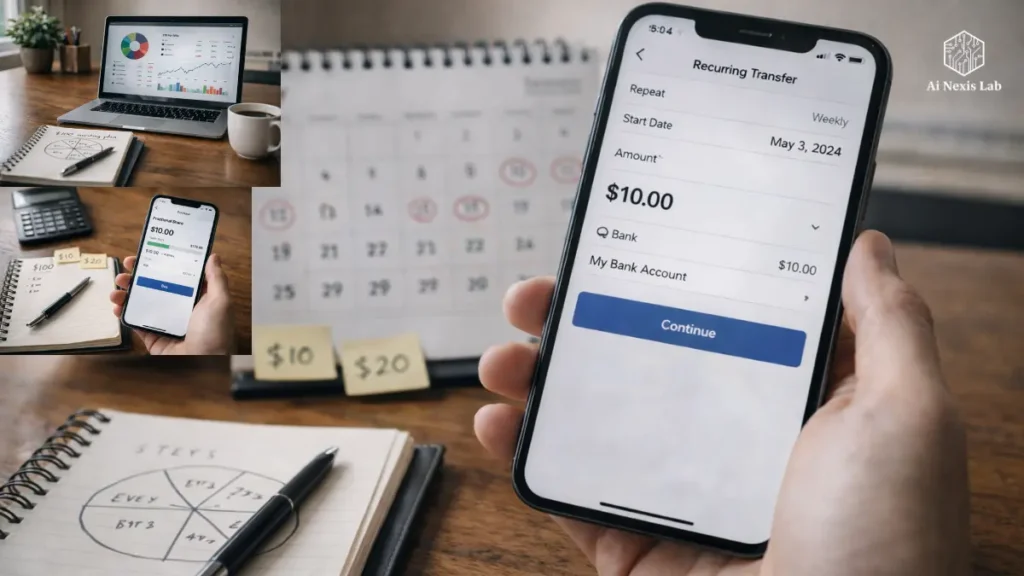
6. Dollar-Cost Averaging (DCA) – Your Best Friend
DCA = Automated Regular Investing
Instead:
- Try to “time the market”
This is what you do:
- $10 every paycheck
- $20 every week
The market goes up and down.
Automated buying means:
- You buy more when prices are low
- You buy less when prices are high
- Your average cost becomes smoother over time
If you are not automated – you are inconsistent.
7. Tax-advantaged accounts are really important (yes, even with $100)
You might be thinking:
“Why bother with a Roth or 401(k) with just $100?”
Because the accounts combine taxes differently.
Roth IRA
- You pay taxes now
- Money grows tax-free
- Withdrawals tax-free in retirement
For young investors: This is huge. You are basically locking in tax-free growth over decades of compounding.
401(k) with Employer Match
If your employer matches:
- It’s an immediate benefit
- The company is giving you free money – don’t leave it on the table
Just remember:
- Early withdrawals before age 59½ are usually subject to penalties and taxes
8. Common pitfalls (because most people make this mistake)
Penny Stock Dreams
If something is trading for $0.05 and someone on TikTok says it will go for $5 – that’s gambling.
Most penny stocks:
- Have low returns
- Low liquidity
- High risk of losing everything
Stay away.
Obsessive Price Checking
If you check your account multiple times a day:
- You will panic
- You will panic-sell
- You will sell low and buy high
Investing is not day trading – it’s compounding.
Check once a month. That’s it.
Chasing propaganda
When you see something on CNBC or TikTok:
- The smart money has priced it in
- Most of the profit opportunities are gone
Stick to disciplined, broad investing.
9. 2026 Market Reality Check
Here’s what’s really happening in the markets in early 2026:
- Artificial intelligence isn’t a fad – it’s embedded in business operations
But investors aren’t buying companies for the “AI label” anymore – they’re buying profitability - Interest rates are no longer in turbo volatility mode
They’ve stabilized compared to 2022-2025 - The recovery isn’t the same everywhere
Tech still leads – but energy, healthcare, and industrials are showing real cash flow
What it means:
- Leadership is expanding
- Diversification is more important than sector betting
With $100 you want exposure – not concentrated betting.
10. Realistic Expectations (So You Don’t Get Disappointed)
If you’re thinking:
- “$100 will make me rich quickly”
You’re misunderstanding the markets.
If you think:
- “$100 can put me on a growth path for decades”
Then you got it.
Here is a real compensation table:
| Scenario | 10 Years | 20 Years | 30 Years |
|---|---|---|---|
| 7% annual return, no added funds | ~$196 | ~$387 | ~$761 |
| 7% + $100/month | ~$18,300 | ~$61,000 | ~$162,000 |
| 10% + $100/month | ~$24,600 | ~$92,000 | ~$280,000 |
Notice something?
Monthly contributions are more important than the initial $100.
Frequently Asked Questions
Q: Is $100 really enough to get started?
A: Yes, as a psychological and practical beginning. The real goal is consistency, not dollar size first.
Q: Can I lose all my money?
A: If you invest in a diversified ETF, losing everything means the U.S. market will sink – impossible. If you pour $100 into a risky penny stock, then yes – you can. That’s why diversification is important.
Q: Should I pay off debt first?
A: If your debt is high interest (20%+), pay it off first – it’s a guaranteed return. If it’s a 4-7% student loan or mortgage, you can do it both ways: pay off debt + invest.
Q: How often should I add money?
A: Ideally, every salary. Even $5 or $10 over the years makes a difference.
Q: Should I hold crypto or stocks?
A: Crypto can be fun money. Stocks (broad market) are investment money. If you treat crypto as a bet with money, you won’t lose, sure – but it’s not a core investment.
Q: What is the best app to use?
A: Fidelity or Schwab for serious long term. If you want simple mobile then Robinhood or Public. Pick one and stick with it.
Q: When should I sell?
A: When your investment thesis changes, or you need money for life reasons. Not because the price has fallen.
Q: Does the fee matter with $100?
A: Yes – avoid hefty fees. With modern brokers, commissions are low or zero – good.
The Ultimate Reality Check
This is not a magic formula.
This is not a pump piece.
This is not a get-rich-quick strategy.
This is a habit.
$100 is just the beginning. Real wealth comes from:
- Time
- Consistent action
- Diversification
- Tax-efficient accounts
- Stubborn patience
If you treat your first $100 like practice and your next dollar like discipline, you will be on the path that 90% of people fail to take.
You don’t need a war chest to get into the game – you just need consistency, clarity, and courage to get started.
So choose a platform, fund an account, and buy your first piece of the market.
Then automate.
Then rinse and repeat.
This is not hype.
This is what works.
Disclaimer
This content is for educational and informational purposes only and does not constitute financial, investment, tax, or legal advice. Investing involves risk, including possible loss of principal. Always do your own research and consult a qualified financial advisor before making investment decisions.