
The Great Decoupling: Why the Japanese Yen is Falling Hard in 2026 – and What It Really Means

Discover why the Japanese yen is weak in 2026, what’s driving USD/JPY to multi-year highs, and the key impacts on markets and policy – backed by up-to-date global data.
There is nothing calm or regular about what is currently happening in the Japanese yen.
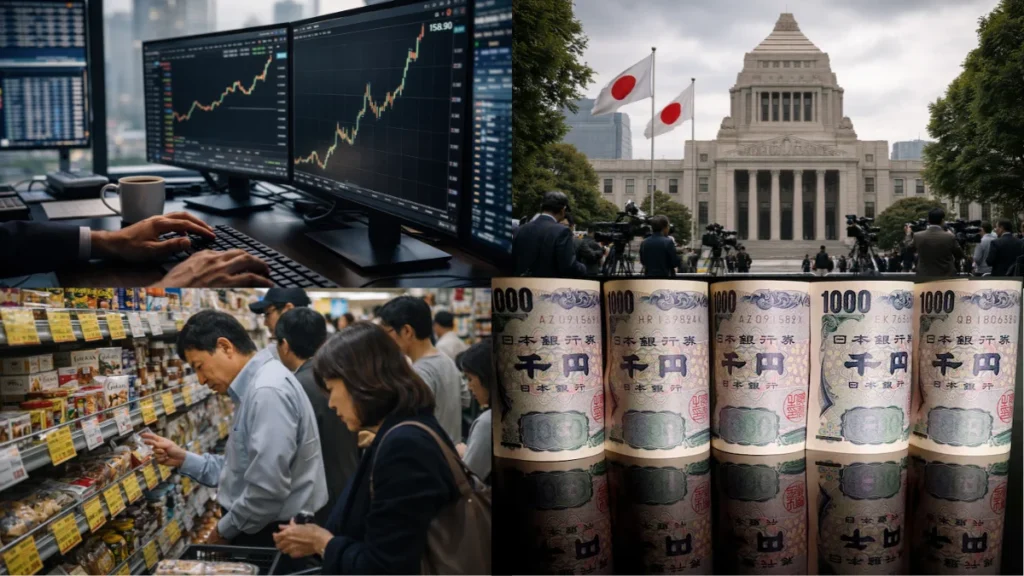
The yen – which was once the poster child of “safe-haven” currencies in financial turmoil – is falling rapidly against the US dollar. On January 13, 2026, it reached its weakest level since mid-2024 at ¥158.9 per dollar. The euro, pound and Swiss franc are also strong against the yen.
This is not a setback. It is a collision of politics, investor psychology, central-bank policy inertia, and international financial tensions.
A full breakdown of what’s actually going on – not a ready summary – is here.
Part I – Politico-Market Shock: Election Speculation and the Takaichi Factor
1.1 Snap Elections Are Not Just Politics – They’re a Market Phenomenon
Japanese Prime Minister Sanae Takaichi is expected to call a snap general election in early February 2026 to strengthen his governing mandate. This alone has created a stir in the markets.
Why?
A surprise election = rising uncertainty.
Investors hate uncertainty because it makes risk calculations unpredictable. When you don’t know whether fiscal policy will tighten or loosen, you don’t hold the currency.
The market currently believes that a Takaichi victory will legitimize further fiscal stimulus and loose monetary policy, which is a cause of weakness for the yen. Because stimulus usually increases the money supply and devalues the currency.
Simply put:
- Politicians talk about expansionary spending –> Investors sell yen
- More selling + fewer buyers = yen down
1.2 Bonds, stocks and risk appetite move together
Data shows that Japanese government bonds are selling off as the yen weakens. This is happening because expectations of more government spending mean more debt issuance and higher yields – which lowers bond prices.
At the same time, Japanese stocks are rallying, as a weaker currency helps exporters and investors are piling into equities to profit from the Takaichi ho stimulus narrative.
That puts the BOJ in a difficult position:
- Stocks rise –> good for sentiment
- Bonds fall and yen weaken –> bad for inflation and cost of living
It’s a classic unbalanced risk environment.
Part II – Policy Disconnect: BoJ vs. Fed
The yen’s weakness is not just political. It is structural.
2.1 Bank of Japan’s tightening is not tight enough
In late 2025, the Bank of Japan broke with decades of ultra-loose policy with its first rate hike in years – raising the short-term policy rate to 0.75% – the highest since the 1990s.
But here’s the key: nominal rate increases don’t automatically strengthen a currency.
Because real interest rates in Japan remain very negative – inflation is outpacing policy rates – holding the yen still loses purchasing power. It discourages foreign investors from holding yen assets.
In technical terms:
- BoJ rate = 0.75%
- Inflation = ~2+%
- Real yield = negative
Negative real yields make the yen unattractive compared to countries with positive real yields.
2.2 The US Federal Reserve is not coming down from its tight stance easily
In contrast, markets are reducing expectations for an early Fed rate cut as recent US economic data shows continued resilience.
A resilient U.S. economy + sticky rates = strong dollar. It widens the interest rate differential between the US and Japan – the primary driver of the USD/JPY exchange rate.
Simple math for carry traders:
- Borrow in yen at low cost -> invest in high-yielding dollar assets
- Rate differential + profit from currency movement
This is how you get a carry trade flow that drives the selling of the yen. It has been a major contributor to the yen’s weakness for months.
So even when the BoJ hikes, if the Fed stays high for a long time, the yen does not strengthen.
2.3 Central Bank Policy Divergence = Structural Drag
Here’s the brutally honest truth: Japan is trying to normalize policy after decades of hyper-easiness, but it’s too little, too late compared to the rest of the developed world.
Other central banks – the ECB, the Bank of England, etc. – fought inflation aggressively. Japan’s inflation has recently surpassed 2%, and its policy pivot has been comparatively shallow.
That structural divergence makes the yen consistently weaker against the dollar.
Part III – The Changing Story: From West to East
3.1 Besant and Tokyo: Integration or Co-ordination?
The Japanese and U.S. finance ministers publicly acknowledged shared concerns about the yen’s decline. Japanese Finance Minister Satsuki Katayama said he and U.S. Treasury Secretary Scott Besant shared concerns about the unilateral depreciation of the yen.
This is huge – and real.
It signals a rare alignment between two policy areas that often distrust each other.
Why would the U.S. worry about the yen?
Because:
- A weak yen hurts U.S. exports to Japan.
- It could create a competitive devaluation cycle in Asia.
- Excessive volatility could disrupt global markets.
And here’s the kicker: Japan is signaling a willingness to intervene in forex markets to stop the yen’s decline — with possible U.S. consent.
It’s not a guarantee they will intervene – but it’s a clear change from the usual “hands off” rhetoric.
3.2 Interventions are strategic – not tactical
Japan has intervened in forex markets before – but always selectively and usually when moves become erratic.
Currently, the feared level for intervention is not just 158-159 – markets believe the real activation point is closer to ¥160 per dollar.
If markets break that level:
- Intervention probability increases
- Yen volatility may increase
- Carry positions may suddenly open
This nuance is important because intervention risk is not binary – it is structural and contingent.
Part IV – What does this mean in practical terms
Let’s break it down into practical, real-world implications.
4.1 For everyday consumers and travelers
If you are planning a trip to Japan soon, here is some good news:
- Buy more yen with your dollars, euros, pounds, etc.
- Hotels and consumer goods seem cheaper in local terms.
“A weak currency makes tourism cheaper” is the classic effect.
However, for Japanese citizens:
- Imported fuel and food are more expensive
- Inflationary pressures persist
This is a major reason why domestic political pressure is increasing – the cost of living is not coming down despite the currency weakening.
4.2 For investors – opportunity or trap?
There are two narratives circulating in the market:
Story A: Yen weakness = trading opportunity
- Buy dollars, sell yen
- Borrow yen cheaply, U.S. Invest in assets
- Profit from carrying
If the current divergence continues, this trade may continue.
Story B: Structural Weakness = Systemic Risk
- Japan’s Negative Real Yields Disappoint Yen Assets
- Political Instability Makes Policy Unpredictable
- If Intervention Triggers Carry Unwinds, Markets Could Rise
The Brutal Truth? Both narratives are valid. But there is a risk in Narrative B – sudden upheaval could hit equities and bonds hard.
The carry trade works until it doesn’t.
Investors are right to be cautious.
4.3 For central banks and policymakers
Japan’s options are limited:
- Raise rates more aggressively? Could growth slow and hurt domestic debt markets?
- Stand pat? Allows the yen to weaken further.
- Intervene? The risk of diplomatic blowback and draining reserves.
Nothing is easy.
And for the Fed:
- U.S. political pressure on Fed independence (highlighted by recent subpoenas and political rhetoric) adds another layer of complexity.
Part V – What happens next? A Practical Roadmap
Here’s an honest, no-nonsense look at potential scenarios:
| Scenario | Probability | Impact |
|---|---|---|
| Continued Yen Weakness (158–160+) | High | Moderate |
| BOJ Rate Normalization Lags | High | Moderate |
| Intervention Around ~160 | Moderate | High |
| Quick Global FX Shock | Low-Moderate | Very High |
Two factors matter most right now:
- Japan’s political trajectory (timing for snap elections, strength of LDP)
- U.S. monetary policy and Fed independence narrative
If Takaichi strengthens his mandate and pushes for monetary easing, yen weakness will accelerate unless the BoJ hikes aggressively.
If the Fed cuts faster than markets expect – or sees political intervention – the dollar could weaken, causing USD/JPY to fall.
This dynamic collision makes 2026 a turning point for currency markets.
Frequently Asked Questions (FAQ)
Q: Why is the yen weak even though Japan raised interest rates?
A: Japan’s recent hike to ~0.75% is historic compared to its own past, but it still yields negative real rates even after accounting for inflation. Global investors compare yields – and if they are getting much higher real returns in the U.S. or Europe, they won’t buy yen assets.
Q: Could the BoJ hike more aggressively to protect the yen?
A: Technically yes – and further increases could be on the table. But the BoJ is holding back from tightening further because:
1) It is concerned about the stock market and debt service costs.
2) There are still fragile sectors in Japan’s economy.
Watch the policy statements from the upcoming meeting (January 22-23) for clues.
Q: What is the “carry trade” and how does it affect the yen?
A: Trade = borrow in low-yielding yen, invest in high-yielding dollar or euro assets. When the rate differential remains wide, this trade increases, which increases the demand for dollars and the supply of yen – pushing the yen down.
Q: Is there a possibility of intervention?
A: If the yen crosses ¥160 per dollar, the possibility of market intervention is high. But the intervention is strategic – not a long-term solution.
Q: Should investors bet on a yen rebound?
A: Not blindly. Short-term corrections occur on sentiment or policy surprises. But structural factors – rate differentials, politics, capital flow inertia – continue to support weakness until a clear pivot signal emerges.
Q: How does this affect global markets?
A: JPY weakness affects:
1) Asian currencies (competitive depreciation pressure)
2) Export competitiveness worldwide
3) Risk assets if carry trades suddenly close
It’s no different – FX is systemic.