Vibe Coding 101: How I Built a Production-Ready App in 30 Minutes – Without Writing Code
Build powerful apps in 30 minutes with Vibe Coding. Follow this step-by-step guide, tools, and tips to launch production-ready software fast.
There’s a quiet shift happening in technology right now – and if you’re building software the “old school” way, it can feel both unreliable and unsettling.
A few years ago, someone on tech Twitter jokingly used the phrase “vibe coding”. At the time, it seemed like a meme – something you laugh at and scroll through.
But here we are in 2025, and that sentence accidentally became the most honest description of how real software is increasingly being created.
I don’t mean rapid prototypes.
I don’t mean toy apps.
I’m talking about fully functional products – applications with authentication, real databases, payments, dashboards, and clean architecture – built faster than most teams can finish their stand-up meeting.
And I know this because I recently made one.
A full SaaS product.
With authentication.
With Stripe integrated.
With a real database.
Built in:
28 minutes start to finish.
And the worst part?
I didn’t write any code.
I barely touched the terminal.
I simply explained what I wanted – guided, refined, nudged and shaped – while the AI took over the implementation.
That’s Vibe Coding.
And whether you love it, hate it, fear it, or celebrate it – it’s here now.
In this guide, I want to explain what it means, what it looks like in practice, and why it completely changes the idea of who “builds software”.
Let’s dive in.
Table of Contents
Part 1: What “Vibe Coding” Really Means
Before we talk about tools or workflows, we need to properly understand the definition – because vibe coding is not “no-code”, and it is not traditional development either.
1. Traditional Coding: The Craft
For decades, software development meant mastering syntax and systems. You had to:
- Remember frameworks and libraries
- Manage state, dependencies, and edge cases
- Manually optimize for performance
- Keep up with infinite versions and breaking changes
It was slow.
It was demanding.
And honestly – it was easy to break things.
That model made heroes out of people who were willing to go through deep technical complexity. And there’s still value in that knowledge – a lot of it.
But something new has entered the room.
2. Vibe Coding: The Director’s Seat
Vibe coding is not about writing line-by-line instructions.
It’s about clearly describing the results and letting AI agents do the implementation.
You become:
- Stable
- Decision-maker
- Editor
- Taste-maker
Think about the role of a film director.
They are not:
- Holding a boom mic
- Arranging a camera lens
- Sewing a costume
They shape the vision, the flow, the experience – while the experts execute.
Vibe Coding works the same way for software.
You say:
“I want a dashboard with dark mode, clean sidebars, real-time stats, and a glassy Apple-like feel”.
And instead of opening five documentation tabs and sweating through CSS, you collaborate with an AI assistant that:
- Designs layouts
- Wires up state
- Connects databases
- Writes clean TypeScript
- Fixes bugs faster than any junior developer ever could
You’re not a spectator.
You’re still creating.
You’ve just stopped wrestling with syntax and started dictating results.
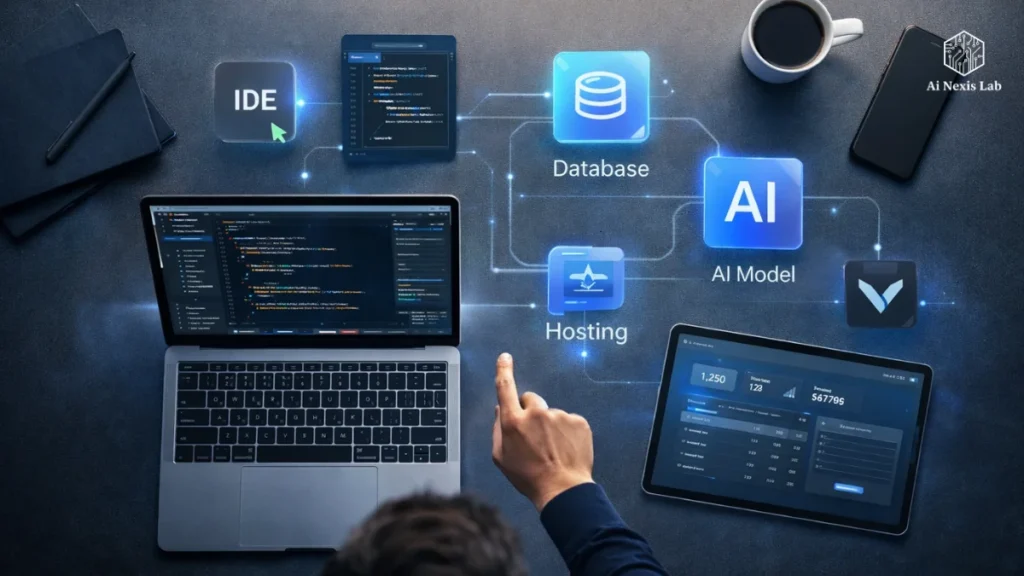
Part 2: The Modern “Vibe Stack”
If you want to build like this, you’ll need tools designed to work with AI, not tools that bolt on AI as a gimmick.
Here’s the combo that powered my 30-minute build.
1. The Brain – Cloud 3.5 Sonnet
Not all AI models think alike. Some are great at creative writing. Some are good at math.
Cloud 3.5 Sonnet has a particular strength:
It understands structure, patterns, and logical flow incredibly well.
He writes code the way a thoughtful engineer writes – modular, readable, and intentional.
2. Workplace – Cursor
Cursor is not just “VS Code” but also with AI.
It understands your entire project context, file relationships, and goals.
You could literally say:
“Add authentication with Supabase and update existing routes to secure the dashboard”.
And it rewires everything. Seamlessly.
3. Backend – Supabase
Database, authentication layer, and storage – without the setup nightmares.
It gives you:
- Instant Postgres
- Built-in Auth
- API out of the box
Perfect for fast builds.
4. Hosting – Versailles
There was an ordeal before deployment.
Environment variables, server setups, error logs, build systems – hours passed.
Now?
Vercell Deploy
Wait a minute
Boom – global, fast, production-grade hosting.
Everything integrates cleanly into this stack. Each tool “speaks AI“, so your instructions travel smoothly from idea to implementation.
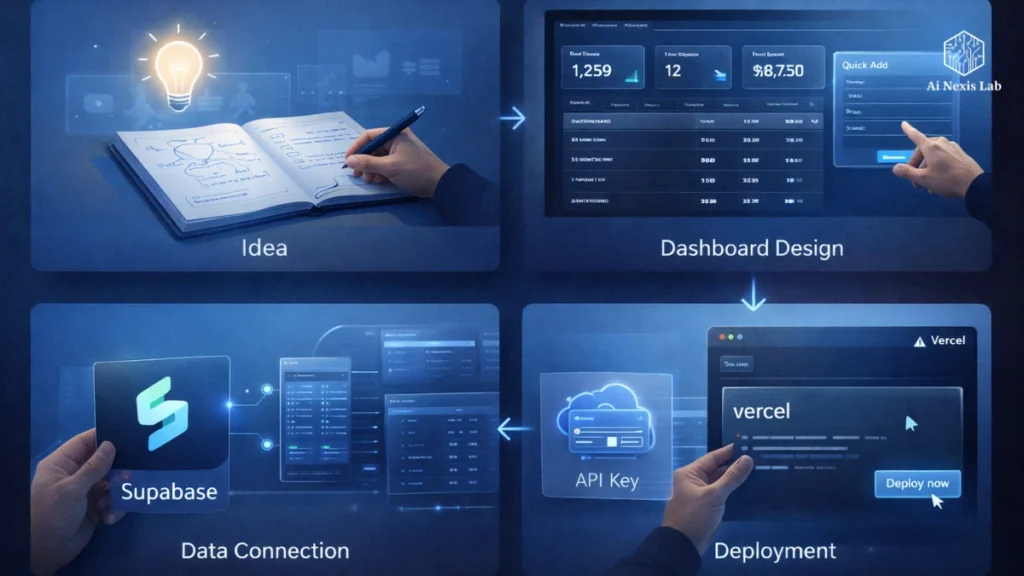
Part 3: 30-Minute Build – Step by Step
Let’s see how this actually unfolded.
1. Minutes 0-5: Defining the Objective
Most people make a fatal mistake with AI tools:
They request code instead of describing the goals.
Bad prompt:
“Generate React component for inventory items”.
Good prompt:
“Create a polished inventory management dashboard. Dark mode. Sidebar with dashboard, inventory, and settings. Real-time stats at the top. Use Next.js, Tailwind, Supabase, and Lucide icons”.
I wrote a master brief.
Cursor generated:
- Pages
- Components
- API routes
- Layout structure
I didn’t do a line-by-line review. I just looked at the preview.
It worked – but it felt generic. That’s where the next phase began.
2. Minutes 5–15: Vibe Feedback
Instead of manually editing the code, I shaped the feel.
I said:
- “Make the cards glassy and soft, like the Apple UI”.
- “Add subtle motion to the sidebar transitions”.
- “Move the quick-add button to the top bar”.
- “Tone down the shadows. Make them quiet”.
The code was automatically updated with each change, but I kept focusing on the experience.
And by the 15-minute mark, the UI looked like something a professional had designed.
3. Minutes 15–25: Real Efficiency
Beautiful apps without data are toys.
So I connected it to Supabase and told the AI:
- Generate schema
- Create CRUD operations
- Wire up “Quick Add” form
- Validate fields
- And show alerts for low stock
Wrote SQL to it.
I pasted once.
Everything worked.
No fetch calls.
No reducers.
No state bugs.
4. Minutes 25–30: Shipping
I opened the terminal, typed:
vercelEnvironment variables set when prompted.
Less than two minutes later:
Live. On the internet. Useful.
And then I realized:
This wasn’t a hacking trick.
This was production-enabled engineering – simply done through conversation instead of keystrokes.
Part 4: Is this really “production-ready”?
Let’s be honest: too many “no-code” builders produce brittle, fragile prototypes.
But here’s the difference.
Those tools hide everything.
AI-assisted coding still generates real software.
- Real TypeScript
- Real API
- Real database schema
- Real infrastructure
And because I asked for error conditions, retries, and guards, the system handles failures gracefully.
This is not replacing developers.
It is replacing tedious developer tasks.
The architecture remains understandable.
Humans still need to reason about logic.
But now the AI teammate does most of the typing.
Part 5: Why this makes people uncomfortable
Technological culture has always rewarded suffering.
We pride ourselves on:
- Avoiding C pointers
- Debugging ghosted cast situations
- Remembering obscure framework quirks
And taking pride in craftsmanship – worthy of pride.
But the markets don’t care how hard you worked.
They care whether:
The app loads quickly
The UI is intuitive
The product solves real problems
Truth?
A tool that saves months of time is not a “cheat”.
It’s inevitable progress.
1. The Vanishing Junior Role
Historically, junior developers did:
- Boilerplate wiring
- Basic components
- Minor bug fixes
AI is now incredibly good at those tasks.
It doesn’t destroy opportunity – it changes it.
2. Enter the Product-Minded Engineer
Winners Now:
- Understand Users Deeply
- Shape Big Trends
- Communicate Clearly
- Express Ideas Visually
- Ask Smart Questions
AI Becomes Their Power Multiplier.
Not competition – leverage.
Part 6: How to Get Better at Vibe Coding
Here are practical ways to adopt this mindset.
1. Think like a designer, not a typist
Stop saying:
“Fix the padding here”.
Start by saying:
“The layout feels crowded – create more breathing space”.
You are directing the experience, not micromanaging the line.
2. Make something fast, then polish
Speed first. Perfection later.
Get:
- Navigation
- Efficiency
- Data Wiring
Then repeat.
3. Learn Logic Basics
You don’t have to memorize syntax.
But you should understand:
- APIs
- Database relationships
- Authentication flows
- Error handling basics
AI can’t fix ambiguity. Clear thinking is still important.
4. Test everything
Always ask the AI:
“Explain what this code does, including potential risks”.
Just because AI helps doesn’t mean ownership is gone.
Part 7: Why this moment matters
Five years ago, a system like the one I built would have required:
- A full development team
- Three months
- Thousands of dollars in expenses
- Endless planning calls
Today, it’s an afternoon project – including a coffee break.
It’s not a trick.
It’s a fundamental reimagining of how ideas become reality.
The question before us is not:
“Can you code?”
The new question is:
“Can you imagine something worth creating – and bring it into existence?”
Those are the real skills of the next decade.
Frequently Asked Questions: Common questions about Vibe Coding
Q1: Is vibe coding the same as no-code?
No – and the difference is important.
No-code tools generate black-box systems that are difficult to modify deeply.
Vibe Coding still creates real source code, which means:
1) You can customize
2) You can refactor
3) You can scale
It’s assisted development, not restricted development.
Q2: Does this mean that developers will no longer be needed?
Developers will still be essential – but their responsibilities will change.
Instead of manually typing each component, they will:
1) Architect systems
2) Choose trade-offs
3) Enforce standards
4) Integrate complex services
5) Solve fuzzy logic challenges
AI will handle iteration. Humans will handle the decision-making.
Q3: Can non-technical founders actually use Vibe Coding?
Absolutely – but with a caveat.
You still need to understand these concepts:
1) What is a database
2) How authentication works
3) Why performance matters
If you are willing to learn at a conceptual level, AI can do the rest.
Q4: Is AI-generated code reliable?
It is surprisingly robust – when well guided.
But like any engineering output, it requires:
1) Review
2) Test
3) Inspection
Trust, but verify.
Q5: What happens when something breaks?
Good news:
AI is also amazing at debugging.
You can paste the error, describe what happened, and ask:
“Find the root cause and fix it safely”.
And it will often diagnose faster than a human.
Q6: Should beginners still learn traditional coding?
Learning the basics is still powerful.
Understanding:
Loops
Conditions
State
Architecture Patterns
Makes you a sharper collaborator with AI.
You don’t have to spend years studying syntax – but logic literacy is invaluable.
Q7: Which industries benefit the most from Vibe Coding?
Almost all – but especially:
1) SaaS
2) Maker tools
3) Dashboards
4) E-commerce
5) Analytics
6) Workflow automation
Anywhere ideas need to move quickly.
Q8: What’s the biggest mistake people make when trying this?
They micromanage the AI like a junior developer.
Instead, treat it like a senior colleague.
Provide direction, context, desired outcomes – then repeat.
Final Thoughts: Vision is the New Superpower
We are entering a phase of technology where friction is evaporating.
The gap between “I have an idea”
and
“Here’s a live product”
is closing.
That doesn’t cheapen craftsmanship.
It enhances creativity.
That means more founders, more experimentation, more opportunities – and a world where the task of building software is not reserved for an elite few.
The real competitive advantage going forward will not be to memorize the framework.
It will be clarity. Taste. Insight. Imagination.
Because if you can describe it – clearly, thoughtfully, and intentionally – chances are you can create it.
And often, it becomes possible faster than you ever believed possible.