
The Geopolitics of Crude Oil: Inside Trump’s Venezuela Oil Strategy and What It Means for Global Markets
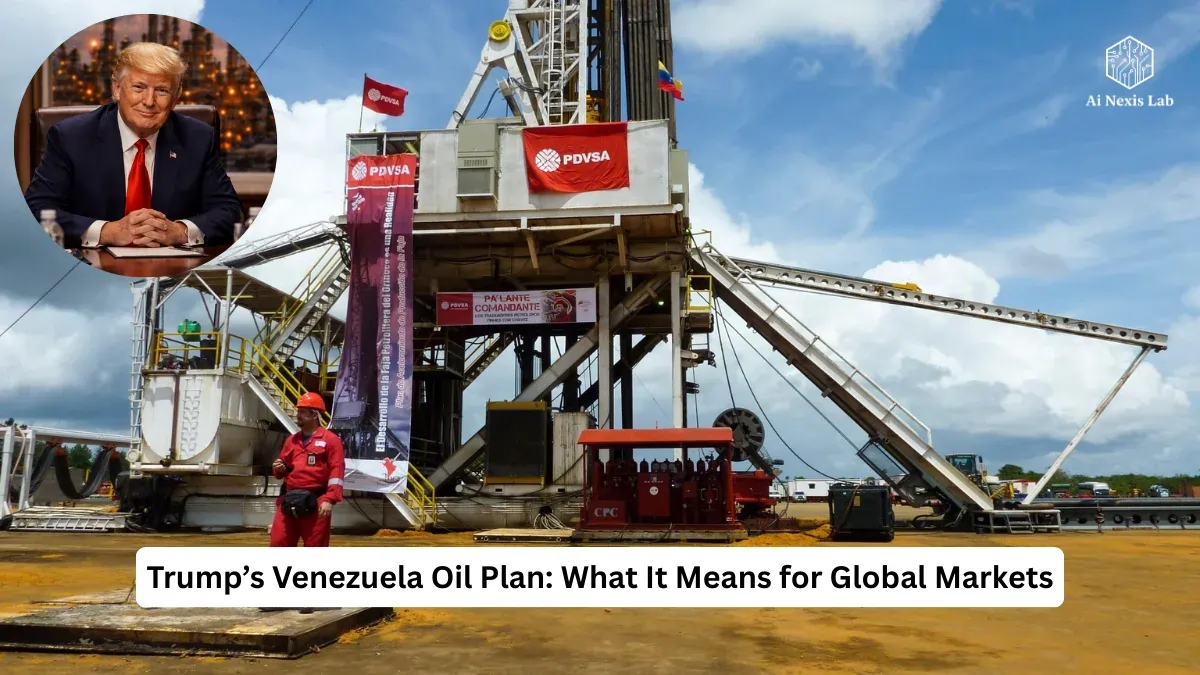
2026’s top Trump Venezuela Oil shifts – from stock surges and sanctions to production bottlenecks and geopolitical impact on global energy markets.
It is rare for a single foreign policy move to simultaneously shock Washington, Caracas, Wall Street, and global commodity markets. But that’s exactly what happened in early 2026.
In the past week, the United States has dramatically escalated its involvement in Venezuela – including a military operation that resulted in the arrest of President Nicolas Maduro and a series of policy statements by U.S. leadership regarding the reconstruction of Venezuela’s oil infrastructure. President Donald Trump has openly presented an 18-month timetable for reviving Venezuela’s oil industry with the help of US companies, including suggesting that American companies could be compensated for their investment by the US government or future Venezuelan revenues.
This development has sparked joy in some boardrooms and concern in environmental and diplomatic circles. But beneath the headlines lies a mix of surprising opportunity, surprising risk, and fundamental questions about whether this bold plan is a reality.
Let’s break it all down.
1. 18-Month Timeline: Ambitious or Achievable?
When Trump talks about “getting” U.S. oil companies “on” in Venezuela within 18 months, that’s a rapid pace by oil-industry standards — almost record-breaking if true. But to understand why that is such a big claim, we have to look at the starting point.
The State of Venezuela’s Oil Industry Today
Venezuela sits on the world’s largest proven oil reserves – approximately 303 billion barrels – mostly heavy or ultra-heavy crude that requires specialized infrastructure and blending to extract and refine efficiently.
Yet manufacturing today is a shadow of what it once was.
- In the late 1990s, Venezuela regularly produced more than 3.5 million barrels per day (bpd).
- Today, after decades of mismanagement, sanctions, and brain drain, production has fallen to around 900,000-1.1 million bpd.
That sharp decline isn’t just idle trivia – it reflects decades of deteriorating drilling rigs, refineries, pipelines and storage tanks. Poor maintenance, corruption, theft, and lack of investment have undermined PDVSA’s ability to reliably produce and export crude oil.
Investopedia
Why 18 months seems overly optimistic
Consider what is realistically needed for a major production increase:
- Equipment overhaul and new investment – Many rigs, pumps, and refinery units are rusty or outdated. Skilled workers have left the country.
- Expanding Diluent and Blending Capacity – Heavy Venezuelan crude must be blended with lighter hydrocarbons to flow. That infrastructure isn’t just “back on.”
- Security and Logistics in Unstable Conditions – Venezuela’s civil and economic instability means that contractors will demand strong guarantees – and potentially insurance – before deploying personnel.
Energy analysts highlighted in recent reports suggest that with significant investment and clear governance, it may be possible to double production to 2 million barrels per day within two years. But it would take about a decade and more than $100 billion in capital spending to get back to the kind of production that Trump’s timeline calls for – close to 3 million barrels per day.
Bottom line: If companies have clear incentives and support, but full capacity is restored, it could take 18 months to achieve “operational” status? Probably not.
2. The Compensation Model: A New Financial Game
One of the most controversial ideas to emerge from recent statements is the suggestion that the U.S. government could compensate private energy companies for rebuilding Venezuela’s oil industry – either directly or through a revenue arrangement tied to future production.
International oil development doesn’t usually work this way.
A rare blend of public risk and private reward
Traditionally, private energy companies take on market and political risk in exchange for future profits – not taxpayer-backed guarantees. Using public funds to de-risk private investments creates what economists call moral hazard: companies may embark on risky projects expecting the government to cover the losses.
There are a few ways to structure this concept:
- Direct government compensation: The U.S. pays oil companies for specific reconstruction milestones.
- Revenue-backed payments: Companies invest now and receive payments from future Venezuelan oil revenues.
- Debt-for-oil swap: Venezuela offers future production rights in exchange for infrastructure investment.
Either option would be politically explosive in Washington. Congress has not passed any legislation authorizing this type of foreign reconstruction funding for oil companies, and that is likely to fuel an intense debate about the government’s role in private sector risk.
Market Reaction: Cautious Euphoria
Investors initially reacted positively. The prospect of big new oil consumption combined with government support sent U.S. energy stocks soaring, cheering traders. But analysts warn that markets are probably moving ahead, as the compensation plan is still just a policy proposal that does not yet have any legal basis.
3. Geopolitics on a knife’s edge
Oil politics is rarely just about energy – it’s about global power.
The Shifting Balance in the Western Hemisphere
For decades, Venezuela has been a geopolitical battleground:
- Russia, China, and Iran have strategic and financial stakes in its oil fields.
- The U.S. has used sanctions and diplomatic pressure to isolate Maduro’s government.
- The recent military action and high-profile capture of Maduro signal a dramatic shift in US strategy.
It increases geopolitical tensions. Countries that previously enjoyed imports of Venezuelan oil – especially China – see their energy interests at risk. Recent tracking data suggests that some banned tankers may have secretly left Venezuelan waters, highlighting the deep geopolitical trade games that are still unfolding.
Who controls the fields?
Formally, Petróleos de Venezuela S.A. (PDVSA) still owns the assets. But operational control has been challenged:
- Chevron is the only major US company to have a special US Treasury license to operate joint ventures.
- PDVSA itself has cut production due to storage problems following the US naval blockade.
With Maduro out and a caretaker government in place, there is nothing stable about control – which is why foreign investors are hesitant to rush in.
4. What the data says vs. what the rhetoric claims
Let’s separate the headlines from the deeper trends:
Claim: U.S. companies can be fully operational in 18 months
Reality: It is possible to start operations and achieve modest production gains – just not enough to reach historic output in that timeframe. Restoring production at scale will take years, not months.
Claim: Will compensate U.S. companies
Reality: This is a proposal, not a law. Implementation will require congressional action and a new policy framework.
Claim: U.S. action will cause global oil prices to fall rapidly
Reality: For the foreseeable future, global oil markets are driven by broad supply-demand fundamentals. Even a successful transition in Venezuela is years away and an immediate sharp price drop is unlikely. Analysts have noted that fluctuations in domestic gas prices in the U.S. are more closely tied to regional supply cycles than simply Venezuelan policy.
5. How this could affect the average consumer
Whether you’re filling up at a station in Dallas, New York, or Ahmedabad, the fundamentals of oil eventually trickle down to the outside.
Short-Term Market Psychology
The possibility of millions of barrels of Venezuelan crude oil re-entering global markets has boosted energy stocks and pushed up futures prices. But traders also recognize logistical, political and environmental obstacles.
Long-term supply considerations
If production can expand meaningfully over the next decade:
- U.S. Gulf Coast refiners – many designed to process heavy crudes like Venezuela’s – would benefit.
- Global supply diversification could reduce some dependence on Middle Eastern crude oil.
- Venezuela’s heavy oil could provide a buffer against geopolitical upheaval – although heavy crude economics are complicated, as the oil commands a discount compared to lighter grades.
For consumers, any real downward pressure on retail gasoline prices will be gradual and variable, not immediate.
6. Environmental and Social Issues
No conversation about increasing fossil fuel production is complete without acknowledging the climate dimension.
Climate Trade-Off
Venezuelan oil has carbon-intensive extraction and refining. Rapidly expanding production could conflict with global climate goals and lock in decades of emissions. Environmental experts have described this strategy as highly problematic for efforts to halt warming – potentially releasing millions of tons of additional CO₂ annually.
At the same time, rehabilitating damaged infrastructure – reducing leaks, flare-ups and spills – can improve local environmental outcomes, even as overall production increases. That creates a paradox: good practices but more fossil fuels burned.
Local social impacts
Venezuela’s humanitarian crisis is linked to the collapse of its oil industry. Strong economic activity, if well managed, can improve employment and public services. But mismanagement can also exacerbate inequality and environmental degradation.
7. The Road Ahead: What to Watch
Here are the real trigger points that will signal whether this strategy becomes a reality or remains a pipe dream:
OFAC Licensing Moves
The U.S. Treasury license currently allows Chevron limited operations. Expanding the license to allow other companies – such as ExxonMobil or ConocoPhillips – to invest would be a big step.
Congressional Action
Legislation around a Venezuela reconstruction fund or a foreign investment reimbursement plan would demonstrate a serious commitment.
Foreign Policy and Diplomacy
Negotiations with global partners – including China and Russia – could determine how smoothly Venezuela’s oil reunification happens. Any diplomatic success that stabilizes Caracas and attracts private capital will be key.
Frequently Asked Questions
Q: Why is Chevron the only U.S. company operating in Venezuela today?
A: Chevron has a special U.S. Treasury license that allows it to operate certain joint ventures with PDVSA despite sanctions, making it the only U.S. major with legal access to Venezuelan production.
Q: Can production in Venezuela really return to pre-2000 levels?
A: Experts suggest that moderate gains are possible over several years with clear governance and investment, but a return to historical peaks (>3 million barrels per day) will take a decade or more and will require significant capital.
Q: Will this move bring down gas prices soon?
A: Not for the short term. Any production increases meaningful enough to affect global oil prices will take years to occur, and retail gas prices are influenced by many factors, including regional refining and distribution dynamics.
Q: Is the U.S. reimbursing companies right now?
A: No. Compensation is a proposal that would require legal action. No legislation has been enacted yet.
Q: What will happen if the restrictions continue?
A: Sanctions and blockades – including US naval action on tankers – are already hampering Venezuelan exports and slowing production. Large-scale investment flows will require the removal or relaxation of restrictions.
Conclusion: A High-Risk, High-Reward Gambling
Trump’s Venezuelan oil strategy is bold – perhaps unprecedented in its scale and ambition. It combines geopolitics, economics, and energy security into one huge bet.
For investors, the market’s initial reaction reflects cautious optimism. For policymakers, it raises tough questions about the government’s role in underwriting private sector risk. For environmental advocates, it represents a potential setback in the fight against climate change.
And for the Venezuelan people, the promise of a revived industry holds both hope and uncertainty.
The real answer to whether this plan succeeds won’t be clear in weeks – but in many ways, we’re only at the beginning of the story.