Death of the developer? Why 2026 is the year to build your own empire?
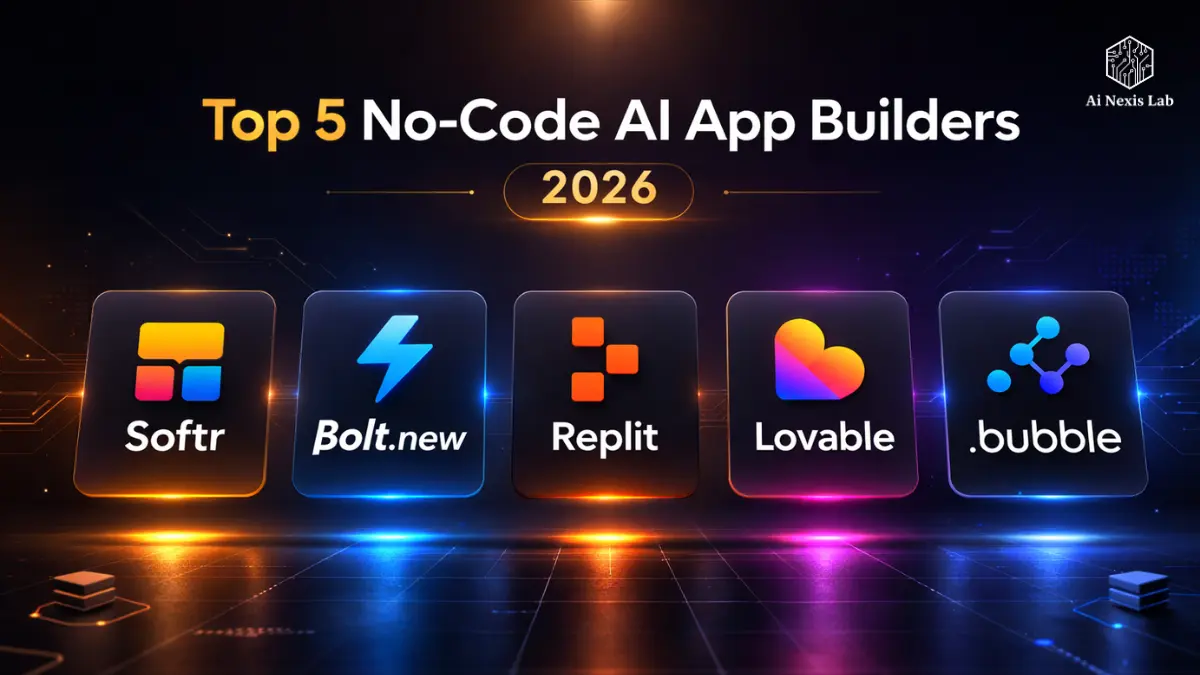
Explore the top 5 no-code AI app builders of 2026, including Lovable, Bolt, Bubble, Replit, and Softr – compare features, pricing, and scalability.
In 2022, if you had a serious software idea, you had two options: learn coding or raise money. There was no third option.
You either spent the night wrestling with React Components and Stack Overflow threads, or you wrote a check for $50,000 to the dev shop and hoped it would disappear during sprint two.
That Gatekept era is over.
It’s February 2026. The barrier to building software is no longer technical skill. It’s clarity of idea. If you can clearly explain what you want to create, you can create it. The only real barrier now is how well you articulate the vision.
We’re not talking about clunky drag-and-drop “toy apps” with outdated UIs. We’re talking about production-grade, scalable software that uses modern frameworks like React, Next.js, Supabase, Stripe, and serverless backends – built by describing the product in plain English.
Welcome to the era of Vibe Coding.
And no, that doesn’t mean “lazy coding”. That means using AI as a co-founder – not as an innovation tool.
Let’s analyze five major platforms that will reshape how products are created in 2026 – and more importantly, how to use them intelligently.
Table of Contents
1. Lovable: A Designer’s Dream And a Founder’s Best Friend
Loveable (formerly GPT Engineer) has evolved from an innovative code generator into a legitimate product development platform.
If you care about design quality and ownership of your codebase, this is one of the strongest options in 2026.
Why It’s a Game Changer
Loveable doesn’t just generate random stacks and hope for the best. It plans before it builds.
When you ask:
“Build a premium real estate marketplace with interactive map views, saved listings, agent chat, and user authentication.”
It breaks it down into:
- Frontend structure (typically React or Next.js)
- Database schema (typically Supabase)
- Auth logic
- API connections
- Styling (typically Tailwind CSS)
- Deployment configuration
This planning layer is important. Most AI builders fail because they abandon architecture. Loveable doesn’t do that.
Visual Editor Advantage
The killer feature in 2026 is the Visual Editor.
You can:
- Click on elements to adjust padding, color, layout
- Modify component structure without editing code
- Fix visual alignment without breaking logic
This hybrid model – code ownership + visual refinement – is why serious developers are drawn to it.
Real Ownership: Why GitHub Sync Matters
Lovable syncs directly with GitHub.
That means:
- You have the full repo.
- You can deploy anywhere.
- You can hire engineers later without the migration headache.
This is important if you are building a real company, not just a side project.
“How To” For Your First MVP
If you use Lovable incorrectly, you will get messy output. If you use it strategically, you will move 10 times faster.
Step 1: Prompt With Precision
Weak prompt:
“Build a fitness app.”
Strong Prompt:
“Build a workout tracker with user authentication, a Supabase backend, chart-based progress visualization, and Stripe subscription tiers.”
Specificity reduces illusion.
Step 2: Connect to GitHub Immediately
Don’t wait. Sync on day one. You want version control and rollback options.
Step 3: Iterate In layers
Don’t rebuild the entire application at each prompt. Refine:
- Layout
- Then Authentication
- Then Core Features
- Then Payments
Where It Breaks Down
Dear shines on design-heavy SaaS and consumer apps. But when the backend logic becomes extremely complex – think multi-tenant enterprise SaaS – you need to be clear about:
- Database relationships
- Row-level security
- Permission models
AI will not automatically create complete data governance.
If you skip this step, that’s on you.
2. Bolt.new: The Speed Demon of Full-Stack Prototypes
Bolt.new feels like controlled chaos – in a good way.
Built by the team behind StackBlitz, it runs a complete development environment inside your browser using WebContainers.
That means:
- Real npm install
- Real Next.js servers
- Real backend endpoints
- No local setup
Why Speed Changes Everything
In 2026, speed is leverage.
Bolt can:
- Scaffold a Next.js full-stack app in minutes
- Install packages
- Connect APIs
- Deploy to preview URLs almost instantly
If you’re quickly validating ideas, this tool is dangerous – because it removes friction.
Live Validation Scenario
You are at a networking event.
Someone says:
“I wish there was a receipt scanner that calculated carbon impact.”
You open Bolt.
You prompt.
You connect the API.
You deploy.
Within 20 minutes, you have a functional prototype.
In 2022, it would have taken weeks.
Where Bolt Wins
- Rapid Experimentation
- Building Hackathons
- Early Stage MVP Validation
- Solo Founder Iteration
Where It Can Bite You
Because it’s so fast, you can create a messy architecture if you don’t carefully organize your signals.
Speed enhances discipline – or lack thereof.
Bolt is not a strategy tool. It’s a power tool.

3. Replit Agent: The “Do-Everything” Architect
Replit has always been developer-friendly. But in 2026 Replit Agent acts more like a technical co-founder.
This is not just frontend generation. These are:
- Backend Services
- Python Scripts
- Web Scraping
- API Orchestration
- Background Jobs
- Environment Variable Management
Why You’ll Choose It
If your product requires heavy backend logic – consider:
- AI Data Pipelines
- Automation Tools
- Scrapers
- Multi-Step Workflows
Replit handles the infrastructure automatically.
It sets up:
- Cloud hosting
- Database
- Server configuration
Without you touching AWS.
Cost Reality
Replit is calculation-based.
If your app:
- Runs heavy scripts
- Receives traffic spikes
- Processes AI requests
Your bill scales.
This is powerful – but not free at scale.
It is ideal for:
- Internal business tools
- Complex backend SaaS
- AI automation systems
Overkill for a static landing page.
4. Softr: The King of Internal Tools and Portals
Not everything requires custom code.
Sometimes you just need:
- CRM
- Client Portal
- Membership Dashboard
- Inventory Management
Software connects directly to:
- Spreadsheets
- Google Sheets
- Databases
and turns them into apps.
Why It Works
It completely eliminates architecture decisions.
You:
- Connect to the data source.
- Choose layout blocks.
- Apply logic.
- Publish.
Done.
Who Should Use It
- Agencies Building Client Dashboards
- Coaches Launching Membership Portals
- Small Businesses Need a Lightweight System
Who Shouldn’t
If you’re building the next billion-dollar startup with custom logic, Softer will feel restrictive.
This is Lego, not engineering steel.
5. Bubble: A Legacy Giant with New AI Teeth
Bubble has been working to gain respect for a long time.
In 2026, his AI assistant dramatically reduces his historical learning curve.
Why Bubble Still Dominates
Bubble’s workflow engine can handle:
- Conditional logic
- Payment triggers
- Webhooks
- Role-based permissions
- Multi-user systems
You could describe it as:
“When a user clicks Buy, check balance, process Stripe payment, send webhook to shipping partner.”
And that creates workflow blocks.
Platform Lock-In Reality
Unlike Loveable or Bolt, you are not able to easily fully extract the raw code.
You are building in a bubble ecosystem.
That’s not necessarily bad – but it’s a strategic decision.
If your startup relies on portability, consider this carefully.
Problem-Solving Techniques: Taking Your App to the Finish Line
Building is now easy.
Finishing is still rare.
Here are the techniques that separate a real launch from a half-built dashboard.
1. The “Prompt-Chaining” Method
Never say:
“Build my entire SaaS.”
You will be confused.
Instead:
Step A: Landing Page
Step B: Authentication
Step C: Main Feature
Step D: Database Connection
Step E: Payments
Sequential logic reduces AI drift.
2. The “Figma-to-Reality” Bridge
Design in Figma first.
AI is strong in logic.
It is inconsistent in aesthetics.
Provide visual direction.
Otherwise you will get:
- Random spacing
- Questionable font choices
- Design inconsistency
3. The “Rubber Duck” Prompting Strategy
When stuck:
Don’t regenerate.
Instead ask:
“Explain this error as if I were a junior-level person and suggest three architectural alternatives.”
This forces deep reasoning.
You will learn quickly.
The AI will reset the context.
Frequently Asked Questions
If an AI wrote the code, do I really own it?
With Lovable, Bolt and Replit – yes. The code lives in a GitHub repository under your control. You can deploy to your own hosting provider and run from there.
With Softr and Bubble, you are connected to their platform infrastructure. You own your business logic, but not the portable codebase.
Ownership is not emotional. It is architectural.
Is no-code safe for healthcare or finance apps?
Security depends on configuration.
Platforms like Bubble and Supabase offer encryption and compliance pathways. But AI won’t perfectly configure row-level security or permission levels for you every time.
If you are building in regulated industries, you must manually review access controls.
AI makes it faster. It does not exempt from liability.
How much does this actually cost?
Expect:
1) $20–$50/month for Pro tiers
2) $50–$150/month for scaling features
3) Additional hosting or API usage fees
Still dramatically cheaper than hiring a developer for a week.
But don’t think it’s free.
Can these apps handle 10,000 users?
Yes – technically.
React/Next.js powers companies like Netflix and TikTok.
The real bottleneck isn’t the frontend code.
It is database structure, caching, and backend optimization.
If your schema is weak, scaling will hurt.
Do I need to learn any code?
Yes – at least the basics.
Understand:
1) JSON structure
2) API requests
3) Authentication flow
4) Database relationships
You don’t need to write complex functions.
But if you can’t read what’s happening, you’ll end up hitting walls.
Final Verdict: Which one should you choose?
If you want beautiful design + full ownership → Lovable.
If you want insane speed + browser-based builds → Bolt.New.
If you want heavy backend logic + automation power → Replit Agent.
If you want fast internal tools → Softr.
If you want deep no-code scalability → Bubble.
The role of “developer” is not dead.
It is evolving.
The advantage is no longer just for those who can write syntax from memory. It belongs to people who can think clearly, structure systems, and communicate in a precise manner.
The barrier is no longer coding skills.
It is about implementation discipline.
So the real question is not:
“Can you make it?”
It’s:
“Will you actually get it done?”