
Orbit of Uncertainty: What’s Really Happening on the ISS – The Thin Line Between NASA, Medicine and Research, and Human Fragility
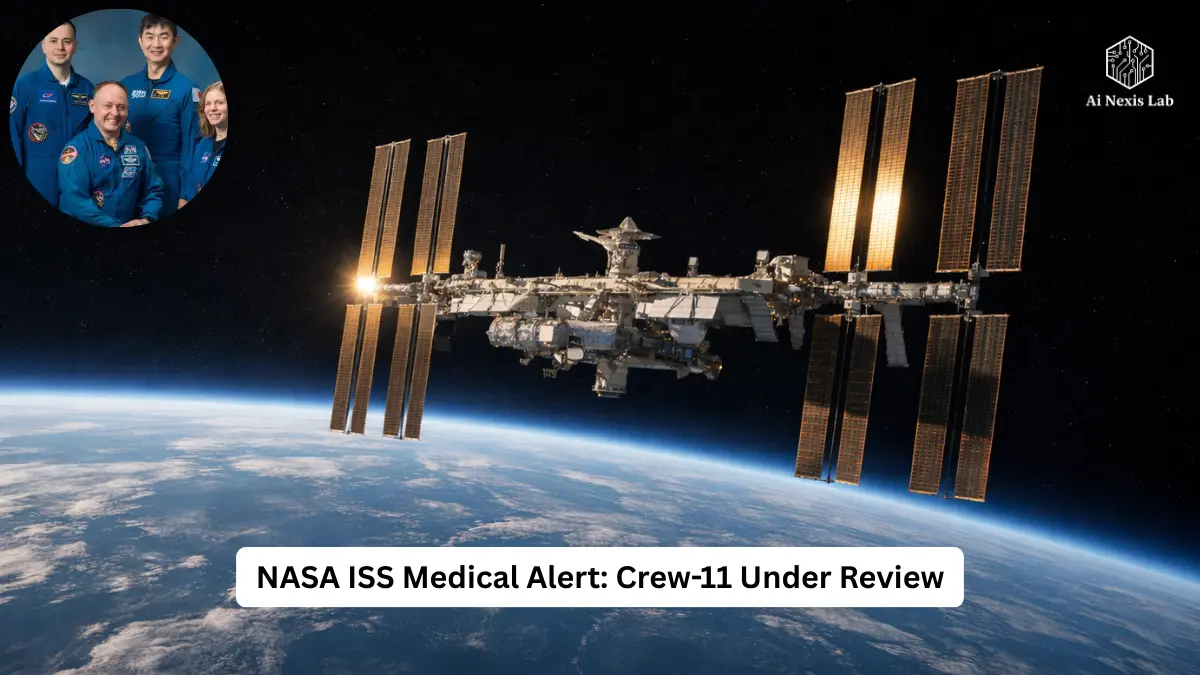
NASA ISS medical alert raises concern as critical signals point to Crew-11 return risk. What NASA is evaluating and why the decision matters.
For months, space exploration has been moving at the pace of inevitability: rockets flying reliably, astronauts training hard, Mars rovers sending back amazing science. But this week, this veil of routine was split by a very earthly issue – a medical concern aboard the International Space Station (ISS) that has NASA publicly evaluating the possibility of an early return for the entire crew.
Let’s cut through the speculation, cut through the dramatic headlines, and talk clearly about what we know, what we don’t know, and what this event really reveals about the unforgivable reality of humans in space.
1. What’s happening right now – a real snapshot
Here’s the situation in raw terms:
- NASA has postponed a planned spacewalk (extravehicular activity, EVA) with one of the ISS crew members due to a medical concern.
- Details of the affected astronaut’s identity, nationality and condition are being kept secret – NASA citing privacy and medical confidentiality.
- NASA says the astronaut is stable, not in critical condition, and can share as much publicly as possible.
- The agency is evaluating all options, and one of them is to end the current mission early – bringing the crew back to Earth ahead of time.
- This mission is SpaceX’s Crew-11 flight to the ISS, which launched in August 2025 and was originally scheduled to launch in early 2026.
That’s it. No fake disasters, no leaks from anonymous sources – these bullet points reflect the public record verified by NASA and reliable news agencies this week.
The rest – rumors, speculation about diagnoses, internet theories – is noise unless supported by actual statements from NASA.
2. Why NASA is acting this way
This is where you need to put aside the Hollywood narratives and think like a flight surgeon and mission operations leader.
Decision-making in such situations is governed by two principles:
A. Astronauts have privacy rights
Astronauts are federal employees and individual human beings with medical privacy – even if they live in a tin can 250 miles above Earth. NASA cannot publicly release specific medical details without consent. That’s not confidentiality; that’s the law.
This means that what you’re seeing – “medical concern,” “stable,” “evaluation of options” – is actual language that NASA is authorized to use publicly.
B. Safety comes before schedule
Space missions are planned down to the minute – but that’s not sacrosanct. Canceling a spacewalk or considering an early return is not dramatic; it’s responsible. When there are health problems and uncertainty, you don’t move forward for pride.
That’s why NASA is evaluating options, including reentry, rather than denying or hiding anything.


3. What are the real risks?
We don’t know the exact diagnosis – so let’s treat all medical speculation with a skeptical lens and focus instead on the spaceflight context. What are the real risks of getting sick in orbit?
Microgravity is known, with measurable effects
Spaceflight is not just “Earth with a beautiful view”. The human body is designed for one gravity level – and its absence has predictable physical consequences:
- Fluid shifts: Fluid moves from the feet to the head, increasing pressure inside the skull and eyes. This can affect vision and intracranial pressure over time.
- Decreased bone density: Astronauts lose bone mass at a rate of approximately 1-2% per month in microgravity.
- Muscle atrophy and cardiovascular deconditioning: Without regular exertion against gravity, the muscles and cardiovascular system weaken.
- Immune system changes: Space alters immune responses and makes astronauts more susceptible to infections.
Is this deadly every day? Rarely. But they accumulate and reduce the body’s ability to handle surprising situations – such as acute illness or injury.
So if someone in orbit gets sick with a problem that would be manageable on Earth – kidney stones, appendicitis, dehydration – it can escalate quickly because the body is already under stress.
Onboard medication is limited
Medical supplies on the ISS are robust for basic issues – pain management, minor injuries, flu-like symptoms, routine scans, and telemedicine guidance from Earth-based doctors. It’s not a hospital. There are no surgeons, no full imaging suite, no trauma center.
If someone needs complex intervention – surgery, advanced imaging, intensive care – the only real option is to bring them back to Earth.
4. Why returning early is a big deal
If there was a medical emergency, you might think NASA would just “send them home.” But it’s not that easy.
A. Transport Limitations
The ISS relies on docked spacecraft as lifeboats. Currently, the Crew-11 astronauts are on the SpaceX Crew Dragon capsule which serves as their return vehicle. If one person returns early, they all return. There is no separate seat for just one astronaut.
This is not inefficiency – this is how crew rotation has worked for two decades. There is no dedicated medical evacuation shuttle waiting for launch on standby.
B. Time is of the essence
If NASA chooses to return early:
- Crew-11 will return home earlier than planned, which will impact ISS manpower and operations.
- The Crew-12 launch schedule may change to ensure there is never a moment without a full team.
Valuable research and station maintenance tasks are postponed.
However, this is not an abandonment of the ISS. It’s a logistical transformation that NASA and its international partners are training for.
C. Reentry is not gentle
Returning from orbit is not like landing a jetliner. The capsule slows from ~17,000 mph and reaches speeds in excess of 4-5Gs – stresses that can exacerbate heart, brain, or vascular problems. So NASA has to strike a balance:
- Be risk-averse: Illness is worse in microgravity with limited equipment.
- Return Risk: The physical stress of readmission on a vulnerable patient.
That’s why NASA is evaluating all options instead of making specific statements.
5. Is this unprecedented?
Not really.
Medical problems have occurred in space that required decisions about mission changes. There was no public announcement at this level because NASA keeps medical issues private.
But in the early era of space stations:
- Soviet cosmonaut Vladimir Vasyutin suffered a serious illness on Salyut 7 in 1985 that forced the mission to be ended early. (Confirmed historical example – not a NASA flight.)
- NASA has previously canceled planned spacewalks due to astronaut health or suit issues – for example, in 2024 due to spacesuit discomfort.
So while rare, this is not a strange anomaly; It’s part of operating the real human body in extreme environments.
6. Psychological Reality on the ISS
A part that often gets hidden in the headlines:
A living, breathing human falling ill in a closed station is psychologically significant for the entire crew.
You are in a metal house 250 miles up, with no real escape except the craft you flew in. A medical problem doesn’t just strain medical systems; He adds:
- Stress and anxiety for a teammate.
- Concerns about mission objectives slipping.
- There has been increased focus on safety protocols that could prevent operations.
Astronauts are selected and trained to be resilient – but humans don’t compartmentalize stress perfectly.
NASA also has psychologists and behavioral health specialists who monitor crew well-being, as mental state is part of mission success.
7. What this means for Artemis, Mars and deep space missions
This event is important – but not for the clickbait reasons you see on social media.
Reality Check:
- ISS is an environment where a medical problem can be treated in a hospital within hours.
- On the Moon or Mars, that’s not the case – an emergency return could take days or months.
This means that:
- NASA already knows that deep space missions require autonomous medical systems.
- Real innovation needs to focus on onboard diagnostics, telemedicine bandwidth, and medical autonomy.
But this incident, at least to date, does not indicate that NASA’s entire Moon or Mars strategy is collapsing. It’s a reminder – not an emergency.
8. Want vs. Reality in Space Medicine
Popular coverage sometimes portrays space medicine as one of two things:
- Miraculous (“They can fix anything up there!”)
- Doomed (“They’re trapped and dying!”)
Neither of which is true.
The ISS is equipped for routine maintenance. NASA has flight surgeons, psychologists, and emergency protocols – and they train for these specific situations.
But really any major medical incident? It still requires Earth-based resources or compensation.
End of story.
Frequently Asked Questions
Q: Who is the astronaut with the medical problem?
A: NASA has not disclosed that. Medical privacy laws apply – even to astronauts.
Q: Is the astronaut’s condition serious?
A: No. NASA says the affected person is stable. “Stable” in medical terms means that they are not deteriorating rapidly at the moment.
Q: Is NASA definitely bringing the crew home early?
A: No. NASA is also considering it as an option along with monitoring and support. No official decision has been made yet.
Q: If the ISS returns now, will it be abandoned?
A: Not at all. Other astronauts are also in it for different missions. NASA operates by overlapping crew rotations.
Q: Has this happened before?
A: Rarely. Medical issues have historically caused mission changes, but NASA keeps medical incidents private. Historical examples exist, but none have been widely publicized in recent ISS history.
Q: Could this be Covid or something contagious?
A: There is no evidence to the public that it is contagious. ISS crews undergo quarantine before launch.
Q: What happens if they return early – will Crew-12 still launch?
A: Yes – crew rotation continues. Early returns could change the timeline, but NASA plans for overlapping missions to avoid gaps.
Q: Is this a sign that space travel is too dangerous?
A: No. Space travel is inherently dangerous – that’s why protocols and medical support exist. Such incidents are serious, but expected even during decades of missions.
The Ultimate Reality Check
Let’s be honest:
You don’t go to space because it’s safe. You go because it is essential for science, research, and the expansion of human potential.
This medical concern on the ISS is a reminder that space has been a difficult environment for biology – not a sign that the entire human spaceflight venture is collapsing.
NASA is handling it professionally, transparently, within the bounds of the law, and with safety as a priority. That’s not panic. That’s competence.
If you want drama, watch a sci-fi movie.
If you want reality, read the facts.