The Invisible Cord: Why You Buy Things You Don’t Need (and How to Cut It)

Impulse buying psychology explained. Learn 10 powerful strategies to stop impulsive spending, break dopamine shopping habits, and take control of your money.
You’re on the couch, half-watching something on Netflix while scrolling through your phone. The algorithm knows you better than your closest friends. It knows the brands you click on, what colors you live by, the products you almost bought last month.
Then it happens.
An ad slides into your feed: a matte-black espresso machine with brushed steel knobs. Or maybe a pair of colorful sneakers that you didn’t even know existed 30 seconds ago.
Your brain lights up.
You start to rationalize.
“It’s on sale.”
“I will use it every day.”
“I deserve it.”
FaceID confirms the payment. The order goes through.
And for a moment, it feels good.
Then the confirmation email arrives in your inbox and reality sets in. That little lump appears in your stomach.
Congratulations. You’ve just experienced a shopper’s hangover.
If this sounds familiar, you’re not weak. You are working in a system built by some of the smartest behavioral psychologists and data scientists in the world.
Their job is simple:
Move you to spend money you weren’t planning to spend.
And they are very good at it.
According to the National Retail Federation’s 2026 consumer research, Americans make more than 40% of their purchases impulsively, with the average adult spending $3,400 per year on unplanned purchases. Younger consumers are spending more due to mobile-first shopping and algorithmic marketing.
The problem is not just advertising.
The problem is that the modern shopping environment is optimized to completely bypass your rational brain.
Retailers aren’t just selling products anymore.
They sell versions of yourself.
A fitter you.
A cooler you.
A more successful you.
And they use predictive human psychology to do it.
But here’s an uncomfortable truth that most budget advice ignores:
You can’t use your willpower to get out of a trillion-dollar marketing machine.
Willpower is a finite resource. It wears out throughout the day, like a phone battery. The more decisions you make, the weaker it gets.
By evening, your brain gets tired – and at the same time, impulse spending increases.
If your only defense is discipline, you will eventually lose.
The real solution is something else.
You need systems.
You need to understand the psychological triggers behind spending – and then create small methods that disrupt them.
This guide breaks down the invisible strings behind modern spending behavior and shows you how to cut them.
No generic “skip your latte” nonsense.
No unrealistic budget rules.
Just practical psychology that you can actually use.
Table of Contents
1. The “Post-Purchase Simulation” Strategy
Impulse buying happens because your mind is focused on acquisition, not ownership.
When you see a product you want, your mind immediately starts playing an imaginary highlight reel.
You imagine:
- Getting the most out of the item
- Feeling proud to own it
- Improving your lifestyle
- Becoming a better version of yourself
But your brain easily skips the boring part.
Ownership.
How-To
Before buying anything non-essential, pause and run a post-purchase simulation.
Close your eyes and imagine that it has been three months since today.
Ask yourself:
- Where is this thing right now?
- Is it lying around unused somewhere?
- Are you still excited about it?
- Does it actually improve your daily life?
If that thing already seems normal in that simulation, you probably don’t need it.
Why
This works because it disrupts the dopamine anticipation loop.
Dopamine is not a happiness chemical.
It is the alchemy of expectation.
Your brain releases dopamine when you anticipate a reward – not when you actually get it.
That’s why buying something feels amazing until the moment you own it.
The post-purchase simulation forces your brain to skip the anticipation stage and jump straight to the boring reality of ownership.
Once this happens, the excitement quickly subsides.
Future Impact
Continuous practice of this creates something powerful:
Delayed emotional response.
Instead of reacting like a kid in a candy store to every new product, your brain starts to default to practical questions.
“Where do I put this?”
“How often will I actually use it?”
This change alone can save thousands of dollars each year.
2. The “Friction Architecture” Method
Modern shopping is designed to eliminate friction.
Think about how easy it has become to buy something.
Now you can buy products with:
- One click
- Fingerprint verification
- FaceID
- Stored payment methods
Retailers didn’t just build this feature to help you.
They built it because every extra step in the checkout process reduces sales.
In fact, according to 2026 eCommerce analytics data, adding just one extra step to checkout reduces conversion rates by 7-12%.
So companies have removed every possible barrier.
Which means you need to hold back a little.
How to do it
Intentionally create friction in your buying process.
Start with these changes:
- Delete saved credit cards from browsers
- Remove stored payment methods from Amazon
- Log out of shopping apps after each purchase
- Turn off one-click ordering
If you shop in physical stores, add a simple rule:
Keep the item around for 20 minutes before checking out.
Just that pause dramatically reduces impulse buying.
Reason
Friction gives your prefrontal cortex time to engage.
The prefrontal cortex is the part of your brain responsible for:
- Long-term thinking
- Financial decision-making
- Impulse control
But it only activates when there is a pause between desire and action.
One-click purchasing eliminates that pause entirely.
Re-introducing friction gives logic time to wake up.
Insider Tip: “Hourly Wage” Conversion
This is brutally effective.
Stop evaluating prices in dollars.
Start evaluating them in hours of your life.
Example:
If you earn $30 per hour and an item is worth $150, that item represents five hours of your time.
Ask yourself honestly:
“Is this jacket suitable for my five hours of work?”
That reframing changes everything.
Because time seems more valuable than money.
And that’s the point.
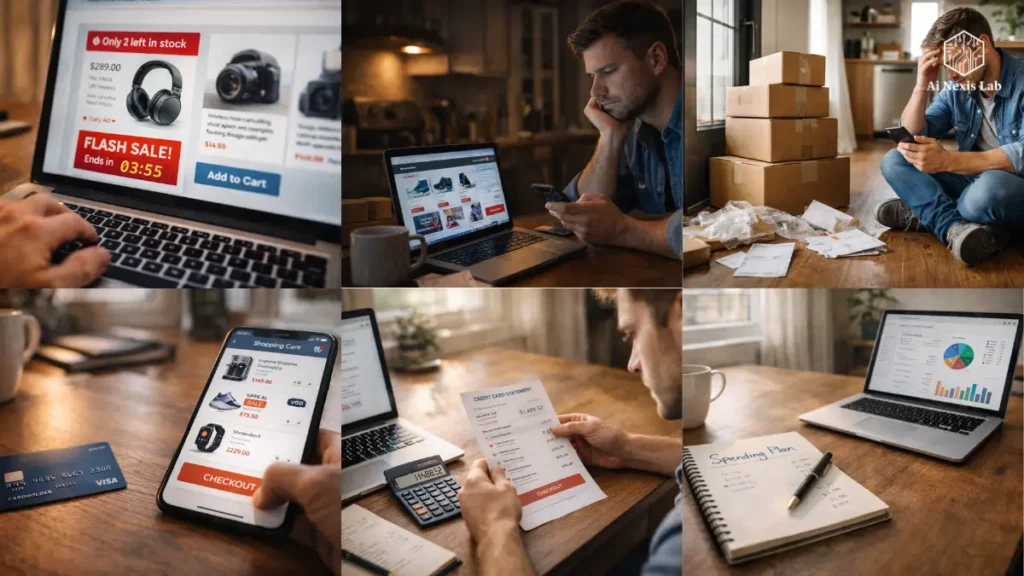
3. Neutralizing the “Scarcity Heuristic”
“Only 3 left in stock.”
“Sale ends in 4 hours.”
“Limited time offer.”
These messages trigger something ancient in the human brain.
Thousands of years ago, scarcity was about survival.
If food was scarce, you would grab it immediately.
Retailers exploit that instinct.
This is called the Scarcity Heuristic.
It’s one of the most powerful psychological triggers in marketing.
How-To
The moment you see scarcity messages, tell yourself this:
“This is a sales ploy, not reality.”
In 2026, very few products are truly scarce.
If one store runs out of something, another store will have it.
Or a better version will appear next month.
Why
Labels to a trick break its emotional power.
Psychologists call this pattern interrupting.
Instead of reacting emotionally, you step outside the situation and analyze it.
Once you see the tactic, it stops working.
4. Deconstructing the “Halo Effect”
The halo effect is one of the most dangerous biases in consumer psychology.
It happens when we assume that if something looks impressive, then everything about it must be impressive.
Companies use this all the time.
Beautiful ads.
Stylish influencers.
Minimalist branding.
Suddenly the product seems magical.
But the magic rarely comes from the product.
It comes from the story built around it.
How to
Mentally take the product down.
Ask yourself:
“If this product had no branding, would I still want it?”
Imagine a product without a logo.
Without influencers.
Without aesthetic marketing.
If your interest disappears, you weren’t buying the product.
You were buying a vibe.
Hypothetical Scenario
A common example is photography equipment.
Someone buys a $3,000 camera and thinks it will make them a photographer.
But cameras don’t make photographers.
Taking thousands of photos does.
Buying equipment often creates the illusion of progress without the actual work.
5. The “72-Hour Cooling-Off” Rule
This is one of the simplest and most powerful anti-impulse rules ever created.
How to
For any non-essential purchase over $50:
Wait 72 hours.
Add the item to your cart.
Close the tab.
Come back in three days.
If you still want it with the same intensity – and it fits your budget – then buy it.
Reason
Impulse buying follows a predictable emotional pattern.
Excitement peaks quickly.
Then subsides.
Behavioral research shows that most buying urges fade within 48 hours.
Retailers know this – that’s why flash sales often last less than a day.
The 72-hour rule ensures that you are making decisions after the emotional wave has passed.
6. Fighting “Retail Therapy” (Emotional Regulation)
Purchases often have nothing to do with the products.
It is connected to emotions.
When people shop, they shop for:
- Boredom
- Stress
- Loneliness
- Disappointment
Buying something provides a temporary sense of control.
It creates a short-lived dopamine boost.
But that boost wears off quickly.
And the credit card bill remains.
How-To
Use the HALT check.
Before you shop, ask yourself if you are:
Hungry
Angry
Lonely
Tired
If you are, don’t shop.
Instead, switch to a zero-dollar pivot:
- Go for a walk
- Exercise
- Call a friend
- Cook something
- Listen to music
These activities regulate emotions without emptying your bank account.
Future Impact
Separating emotions from spending prevents Spending Spirals.
A stressful evening shouldn’t turn into a $500 credit card balance.
7. The “Anti-Budget” (Pay Yourself First)
Traditional budgets fail because they feel restrictive.
They track every dollar and create guilt for spending.
Eventually people rebel against them.
The alternative is simple.
How to
Automate savings before the money shows up.
When your paycheck arrives:
- Automatically move savings to another account
- Invest interest immediately
- Leave the rest available for spending
Because
This creates guilt-free spending.
You don’t need to track every purchase because your financial priorities are already taken care of.
The system automatically protects you.
8. Avoiding lifestyle Waste and Social Proof
Avoiding lifestyle waste gradually.
You get a raise.
Then increase your spending to match your new income.
Nice restaurants.
New clothes.
Upgraded gadgets.
Soon, you’re earning more but saving the same.
Social media dramatically amplifies this effect.
You constantly see a curated lifestyle that makes your own life seem small.
How to
Curate your digital environment.
Unfollow accounts that encourage comparison or unnecessary spending.
Follow creators who focus on:
- Experiences
- Financial Freedom
- Minimalism
- Entrepreneurship
Why
People use social cues to determine what “normal” looks like.
If everyone around you seems to be buying luxury items, it can feel normal to overspend.
Change the environment and your spending habits will follow.
9. “Cost Per Use” Calculator
Not every expensive purchase is a waste.
Some items become extremely valuable over time.
The key metric is cost per use.
How to do it
Estimate how often you will actually use the item.
Then divide the price by the use.
Example:
$120 boots worn 300 times = $0.40 per use
That’s a good buy.
But a $40 shirt worn once costs $40 per use.
Not so good.
Common Pitfall: Sales Traps
People often buy unnecessary items just because they are on sale.
But a 50% discount doesn’t mean you saved money.
It just means you spent money.
If you didn’t need the item to begin with, the discount is irrelevant.
10. “Aspiration Audit”
One of the biggest causes of unnecessary purchases is the fantasy self.
For those of you who:
- Cook elaborate meals
- Exercise every day
- Wake up at 5am
- Learn new languages
- Become a professional photographer
It seems productive to buy equipment for the future version.
But if you never follow through, things get messy.
How to do it
Look at your last three “aspirational purchases.”
Ask yourself honestly:
Did you actually use it?
If not, stop shopping for your fantasy self.
Start shopping for your actual habits.
Targeted Problem-Solving Techniques
This framework makes it easier to think rationally about spending decisions.
“Shadow-Value” Assessment
Instead of asking what something costs, ask what you’re giving up to buy it.
A $1,000 phone can be worth:
- A weekend trip
- A month’s worth of groceries
- A cumulative investment over the years
Looking at the trade-offs changes the shopping experience.
“Zero-Trace” Protocol
Try to go 48 hours without interacting with any store.
No browsing.
No window shopping.
No online carts.
You’d be surprised how often spending is driven by exposure.
“Utility-First” Filter
Before buying anything, ask one simple question:
What problem does this solve?
If the answer is vague or emotional, you probably don’t need the item.
Frequently Asked Questions
I know I shouldn’t stop buying things, but why can’t I stop buying things?
Impulsive buying is often driven by a combination of dopamine anticipation, emotional regulation, and decision-making fatigue. By the end of the day, your brain has made hundreds of choices, which weakens your ability to resist temptation. Retailers design their apps and stores to target this precise moment when self-control is at its lowest. That’s why people often buy things late at night or during stressful periods.
How can I tell the difference between a need and a want?
A need is something that is necessary for health, safety, or income. Housing, food, transportation, and basic tools for work fall into this category. A necessity is anything that improves lifestyle but is not essential for survival or stability. A simple test is time: if you can delay buying something for 30 days without real consequences, then it is a necessity.
Is retail therapy really real?
Yes, and it’s backed by behavioral research. Buying something releases dopamine associated with the anticipation of reward. This can lead to a temporary improvement in mood, especially in stressful situations. The problem is that the emotional boost is short-lived, while the financial consequences remain. Over time this can create a cycle where negative emotions lead to more spending.
Does the “one-in, one-out” rule really work?
Yes, because it introduces physical and mental friction. If you have to get rid of something every time you buy something new, it forces you to think about the true value of the purchase. This rule also prevents the accumulation of dirt and encourages more deliberate consumption. Many minimalist homes use it as a main system.
How can I cope with social pressure to spend money?
Honesty works better than excuses. Saying something like “That’s not in my budget right now” signals financial discipline rather than a limit. Most people secretly admire someone who has control over their spending. It also sets boundaries that discourage friends from pressuring you into expensive activities.
Final Verdict
Impulse buying is not about weakness.
It’s about systems versus psychology.
Retailers spend billions every year learning how your brain works so they can influence your decisions.
The only real defense is to understand those mechanisms and build systems that combat them.
When you remove the noise of impulsive spending, something interesting happens.
You get clarity.
You start spending money on things that actually improve your life instead of on things that excite you for a while.
And the financial difference over time is huge.
Every impulse purchase steals resources from your future.
Every deliberate purchase builds it.
The version of you five years from now will either thank you for your discipline – or pay for your impulsiveness.
Choose wisely.