
Hybrid AI Portfolio (2026 Edition): How to Invest When the Index is Lying to You
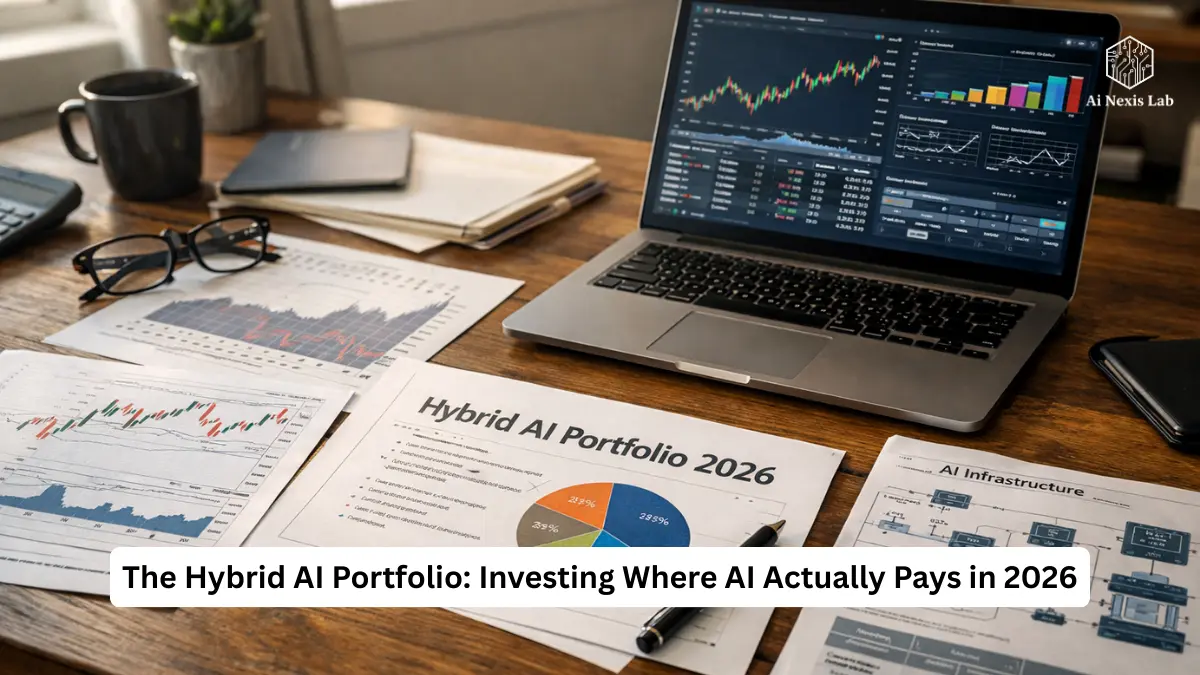
Discover the Hybrid AI Portfolio with 7 smart investments for 2026. Learn how to balance AI growth, infrastructure, and stability in a top-heavy market.
For the past decade, investors were rewarded for laziness.
Buy the S&P 500. Reinvest the dividends. Ignore everything else.
That strategy worked because capital concentration didn’t matter when rates were near zero, margins were expanding everywhere, and growth was cheap. That world is gone.
By 2026, the S&P 500 is no longer a proxy for the broader market. It’s a narrow bet on a handful of mega-cap AI winners, with the rest of the index quietly dragging its feet. If you don’t understand that difference, you’re already behind.
This isn’t an argument against index investing. It’s an argument against blind index investing.
Today the market is divided into three groups:
- Companies monetizing AI at scale
- Companies using AI to reduce costs and increase productivity
- Companies talking about AI when margins are shrinking
A hybrid AI portfolio is designed to take advantage of that divide – without blowing itself up when the inevitable improvements come.
1. Market Reality 2026: Why the Index is Misleading
Let’s first kill this comforting myth.
The S&P 500 looks diversified. That’s not the case.
As of early 2026, a small group of technology and AI-related companies account for a disproportionate share of index returns. This is not new – but what is new is that earnings growth is no longer broad-based.
The AI rally of 2023-2024 was driven by expectations.
2025 separated the leaders from the pretenders.
2026 is about cash flow, margins, and ROI on AI spend.
That’s where most investors are still confused.
Valuations aren’t the problem – misallocated capital is
High valuations alone don’t kill bull markets. Poor returns on capital do.
In 2026, the market is punishing companies that:
- Spent billions on AI infrastructure
- Failed to turn that spending into revenue
- Cannot articulate a reliable payback timeline
Meanwhile, companies that either sell infrastructure or use AI internally to reduce costs are quietly outperforming.
This is why the old “just buy the index” logic is breaking down. The index is now mixed:
And it weighs them badly.
2. The AI Economy Is K-Shaped—And It’s Not a Buzzword
The phrase “K-shaped recovery” is overused, but in AI it’s painfully accurate.
Three AI Classes in 2026
1. AI Infrastructure Owners
These companies sit at the base of the stack. They don’t care which model wins. They get paid anyway.
These include:
- Semiconductors
- Networking
- Power Delivery
- Cooling
- Data Center Optimization
The margins are real here. Demand is contractual. Switching costs are high.
2. Productivity Winners
These aren’t AI companies by branding. They are companies that use AI to do the same work with fewer people, fewer errors, and in less time.
They don’t sell AI.
They use it ruthlessly.
This group is not proprietary and is misunderstood.
3. The Laggards
These companies:
- Advertise pilots
- Run proofs of concept
- Hire “AI strategy” consultants
- See no margin expansion
They’re already losing – and the market isn’t done pricing it.

3. Hybrid AI Portfolio: Structure before stock selection
If your portfolio structure is wrong, stock selection won’t save you.
Hybrid AI portfolios exist for one reason:
Asymmetrical upside with controlled downside.
That means:
- You embrace volatility where the upside is strong
- You demand stability where capital preservation is important
The 60/30/10 Model (and why it still works)
| Allocation | Role | What It Actually Does |
|---|---|---|
| 60% | Core Stability | Keeps you solvent during drawdowns |
| 30% | AI Growth | Captures structural AI winners |
| 10% | Speculative Satellite | Optionality, not necessity |
If this sounds boring, fine. Boring portfolios survive.
4. Core Stability (60%): This is not optional
This is where most people make mistakes.
They consider core to be “dead money.” That’s not the case. It is volatility insurance.
Broad ETFs like VOO or dividend-focused vehicles like SCHD are still important – but equal-weight strategies deserve more attention in 2026 because they reduce concentration risk.
The core point is not to beat the market.
The rest of the strategy is to keep you invested for the long term for it to work.
If you panic-sell during a drawdown, the rest of this article is irrelevant.
5. Pillar One: AI Infrastructure – Real Money Level
Forget the headlines. Follow capital expenditure.
AI in 2026 is limited by three things:
- Power
- Heat
- Data movement
GPUs are important – but they are no longer the only choke point.
Power and Cooling: Unsexy Winners
Modern AI data centers are limited less by compute and more by electricity availability and thermal management.
This is why companies like Vertiv and Modine have become structural beneficiaries.
They do not rely on customer demand.
They rely on signed buildouts.
If AI spending slows, these are the last budgets to be cut.
Networking: Where Latency Becomes a Barrier
As models move towards multi-agent architectures, internal data movement becomes mission-critical.
That puts companies like Arista Networks and Marvell in a powerful position.
The shift to open standards (such as Ultra Ethernet) is breaking down early vendor lock-ins. That’s good for innovation – and dangerous for investors who believe that old monopolies are permanent.
6. Pillar Two: Agentic AI Software – Where the Margins Expand
Most people still misunderstand software risk in 2026.
The threat is not disruption.
The danger is commoditization.
Chat interfaces are cheap.
There is no autonomous workflow.
What really matters in software now
Look for companies that:
- Replace, not assist, human labor
- Deeply integrate into workflows
- Measurably reduce headcount or error rates
That’s why platforms like ServiceNow and Salesforce are outperforming peers that have simply added “AI features.”
Cybersecurity: A Silent Arms Race
AI-powered attacks are increasing exponentially. Human-powered defenses don’t do this.
Companies like CrowdStrike and Palo Alto Networks are winning because they focus on preemptive detection, not reactive cleaning.
If a cybersecurity firm is still marketing “alerts,” they are already obsolete.
7. Pillar Three: Productivity Adopters – The Most Ignored Alpha
This is where lazy investors miss the real opportunity.
The biggest AI winners of the next decade won’t all be tech companies.
They will be:
- Insurance companies processing claims faster
- Hospitals reducing diagnostic error rates
- Logistics companies operating near autonomous warehouses
Healthcare companies like Eli Lilly aren’t winning because of hype – they’re winning because AI shortens R&D cycles and improves trial efficiency.
These companies don’t talk like AI companies.
They report like winners.
8. 10% Moonshot Sleeve: Treat this like a venture bet
This is where discipline is important.
10% of satellites exist for:
- Early agentic platforms
- Sovereign AI infrastructure
- Quantum-adjacent tooling
Most of these will fail.
That’s to be expected.
It is not acceptable to allow this sleeve to grow uncontrollably. If it works, you rebalance. If it fails, you survive.
If you need this sleeve to be emotionally successful, you’re in the wrong size.
9. Execution Reality Check: Where Theory Meets Behavior
Here’s the uncomfortable truth that most investment articles avoid:
The strategy is simple. Execution is where portfolios die.
On paper, the hybrid AI portfolio looks elegant. Balanced. Rational. Professionally diversified. But markets don’t reward good intentions. They reward discipline under pressure. And 2026 is not a quiet environment.
AI stocks now move like biotech stocks did in the 2010s – violent surges, brutal declines, and narratives flipping overnight. If you’re not emotionally ready for it, your allocation percentage doesn’t matter. You will sell the wrong thing at the wrong time.
So before you think about compensation, you need to think about behavioral survival.
Volatility is the price of entry
AI infrastructure names can fall 25% in a month on a single earnings call. Not because the business has collapsed, but because expectations have exceeded reality. That’s normal. That’s the cost of asymmetric volatility.
If a 20-30% reduction in your AI sleeve makes you question the entire thesis, your size is wrong. Not the stocks.
The hybrid model works precisely because the core index allocation stabilizes your nervous system. It makes you invest long enough to make the combination important.
No core = no staying power.
Timing the AI Cycle Is a Losing Game
Another harsh truth: you can’t time AI rotations perfectly.
There will be quarters where:
- Infrastructure underperforms
- Software outperforms
- Productivity adopters lag
- Indexes turn sideways
Trying to outpace these short cycles leads to overtrading, tax drag, and decision fatigue.
The advantage comes from structural exposure, not clever timing. You are holding out because the long-term capital spending cycle in AI is still in its early innings. Data centers, grid upgrades, and enterprise automation are multi-year projects. This is your time horizon – not the sound of next quarter’s earnings.
Ignore the AI headlines. Follow the cash flow statements.
By 2026, every CEO will say “AI-first.”
Only a minority will show AI-driven margin expansion.
This is why cash flow statements are now more important than product demos. If a company claims AI transformation but:
- Operating margins are not expanding
- Free cash flow is not scaling
- Capex keeps rising faster than revenue
…then AI is a story, not a business.
Serious investors are quietly shifting from narrative-based investing to a return-on-invested-capital (ROIC) discipline in 2026. That’s the real edge. Not choosing the hottest model. Choosing companies that turn silicon into profit.
Hidden Risk: Political and Energy Constraints
Most retail investors still ignore one risk: electricity availability.
AI growth is now gated by the electricity infrastructure. Local permitting, grid expansion, and political regulation are becoming real obstacles. This means that AI growth will be geographically uneven, not globally uniform.
Investors who understand this are gaining ground in:
- Power management suppliers
- Cooling system manufacturers
- Grid modernization contractors
These are not catchy names. But they sit at the heart of every serious AI expansion plan. That’s where sustainable cash flow resides.
Patience becomes a competitive advantage
The ultimate truth is simple:
The greatest advantage in 2026 is the ability to do something when nothing needs to be done.
Most investors overreact to noise. The Hybrid AI Portfolio is designed so that you don’t have to do that.
You become balanced again.
You monitor the margins.
You ignore the headlines.
You remain solvent.
This is how real wealth accumulates.
10. Risk Management: The Part Everyone Skips (and Regrets)
The biggest risk in 2026 is not a crash.
It is a capital misallocation masked by speed.
Non-negotiable rules
- Aggressively rebalance when AI exposure exceeds your target
- Track capex-to-revenue conversion, not hype metrics
- Accept that regulation will slow some AI deployments – especially in healthcare and finance
If a company can’t explain how it will improve margins in 12-18 months, you should question why you own it.
Final Verdict: This is not a “set and forget” market
2026 is not forgiving.
The index will not save you.
Narratives will not save you.
Hope will not save you.
Hybrid AI Portfolios work because they are honest:
- Honest about risk
- Honest about concentration
- Honest about human behavior
You don’t have to predict the future.
You need to create conditions for it without betting everything on one outcome.
This is the difference between investing and gambling.
Frequently Asked Questions: Hybrid AI Portfolio (2026)
Q: Is the S&P 500 still relevant?
A: Yes – but not as a standalone strategy. It’s a base layer, not a solution.
Q: Is AI already in a bubble?
A: There are some parts to it. Infrastructure and productivity plays are not acting like bubbles.
Q: How often should I rebalance?
A: At least annually – or sooner if price action causes an explosion in AI allocations.
Q: What is the biggest mistake investors make in AI?
A: The adoption process and monetization complication.
Q: Can this strategy work for a small portfolio?
A: Yes. Allocation discipline is more important than capital size.